Showing posts with label 17th century. Show all posts

March 6, 2026

Guarino Guarini - architect

Baroque master who shaped the identity of Turin

Guarini's daring geometrics brought a new dimension to the architecture of Turin
Guarini's daring geometrics brought a
new dimension to the architecture of Turin
Guarino Guarini, an architect regarded as one of the most transformative figures in the architectural history of Turin, died on this day in 1683 at the age of 59.

Guarini enjoyed the patronage of the House of Savoy from 1666 until his death, during which time he is said to have built or submitted designs for as many as six churches and chapels and five palaces in the city. He reportedly designed a gate to replace the existing Porta di Pio, although it was never actually built.

Of those projects that progressed beyond the drawing board, his Church of San Lorenzo, with its structurally daring dome, the Chapel of the Holy Shroud and the Palazzo Carignano, notable for the rhythmic curves of its facade, are regarded as his most notable achievements.

The circumstances of Guarini’s death are not documented beyond his being in Milan at the time. His presence there may have been connected with his Architettura Civile, the treatise which became a reference point for many of his architectural successors, upon which he was still working at the time of his death. 

He also remained active in the Theatine Order - he was ordained a priest in 1648 at the age of 24 - and may have been in Milan to teach or to pursue other Theatine business, the order having a tradition of architectural patronage.

Guarini was born in Modena in 1624. Coming from a religious family, Guarino and his four brothers all became novices in the Theatine Order, Guarino being despatched to serve his novitiate at the monastery of San Silvestro al Quirinale in Rome.


In the event, he stayed in Rome for nine years, learning from the most innovative Baroque architects of the period. Francesco Borromini, whose spatial complexity and elastic geometry left a lasting imprint on Guarini’s imagination, was a major influence, as to a lesser degree was Gian Lorenzo Bernini

He returned to Modena in 1648. He combined his duties as a priest and  a lecturer in philosophy at the Theatine College with architectural projects for the Order, beginning with the reconstruction of the Church of San Vincenzo in Modena.

The undulating facade of Guarini's Palazzo Carignano, a Baroque masterpiece in Savoyard Turin
The undulating facade of Guarini's Palazzo Carignano,
a Baroque masterpiece in Savoyard Turin

Guarini also worked in Messina in Sicily, where he built the façade of the Church of Santa Maria Annunziata for his Order, providing early evidence of his willingness to experiment with design. He constructed the façade diagonally to the nave, so that it could conform with the line of the street. The church was destroyed in an earthquake but drawings show plans for complex vaulting and spatial layering. 

From Messina, Guarini moved to Paris, where a number of projects showed the influence of Borromini on his construction methods. Appointed a lecturer in theology at the Theatine School in Paris, he might have stayed much longer but for disagreements over the management of funding for the Church of Sainte-Anne-la-Royale, which he had been invited to design. Instead, he left for Turin.

It was in the capital of the Duchy of Savoy that Guarini produced his greatest work, his buildings there being defined by intricate geometries, interlaced ribs, and dramatic manipulation of light.

Among the most striking examples is the Real Chiesa di San Lorenzo, a Baroque-style church adjacent to the Royal Palace of Turin, which bears influences of Borromini and Bernini. In accordance with Guarini’s ambition ‘to erect buildings that were very strong, but looked so weak as to need a miracle to keep them standing,’ the dome of San Lorenzo was a masterpiece of spatial illusion, its structure appearing to be held up by slender columns, whereas the load-bearing was really down to massive brick arches hidden from view.  Its star-like pattern of interlocking arches dissolves the boundary between structure and ornament.

Guarini's beautiful cupola in Turin's Church of San Lorenzo seemed to defy the laws of physics
Guarini's beautiful cupola in Turin's Church of
San Lorenzo seemed to defy the laws of physics
The light that floods the interior creates a luminous quality, something also characteristic of the Chapel of the Holy Shroud, a building attached to the Royal Palace, a project started after Charles Emmanuel II, Duke of Savoy, impressed with his work on the Church of San Lorenzo, named him Royal Engineer and Mathematician in May 1668.

The chapel uses stacked, progressively narrowing arches to create a soaring vertical ascent, culminating in a lantern that floods the space with symbolic light. It remains one of the most technically daring domes of the Baroque.

Yet some regard the Palazzo Carignano in Turin, which showcased Guarini’s command of undulating façades and dynamic massing, anticipating styles that would become characteristic of later Baroque and Rococo. 

Built for Emmanuel Philibert, Prince of Carignano, heir to Victor Amadeus II, Duke of Savoy, it is regarded as one of the finest urban palaces of the second half of the 17th century in Italy.  In addition to its distinctive terracotta façade, the palace stands out for its atrium with double staircases and a double dome in the main salon. 

Guarini wrote prolifically throughout his career, producing treatises on  mathematics and astronomy as well as architecture.  He published books at the rate of one every other year and his major work, Architettura Civile, was published posthumously in 1737, bringing together previously unpublished manuscripts on architecture, surveying and drawing. 

Filippo Juvarra built on Guarini's legacy
Filippo Juvarra built
on Guarini's legacy
This text circulated widely in 18th‑century Europe and became a key reference for architects seeking alternatives to classical orthodoxy. Guarini’s influence can be seen particularly in the Central European Baroque styles that became prevalent in Bohemia, Austria and southern Germany. 

Nearer to home, Piedmontese architects such as Filippo Juvarra, responsible for the monumental Basilica of Superga and the Palazzo Madama among other great works, and later Bernardo Vittone, who built some of the finest churches not only in Turin but across the whole region,  absorbed and expanded Guarino’s geometric daring.

Guarini sits in a remarkably elevated position among the architects who shaped Turin. The buildings he created can be said to have fundamentally altered the city’s architectural language.

Where Amedeo di Castellamonte planned many of the Savoy projects, giving Turin its ordered urban structure, Guarini reimagined them, introducing spatial complexity and daring geometry.  Juvarra admired Guarini’s work and built on his legacy, while taking fewer risks, yet Vittone’s domes and lanterns would have been unthinkable without Guarini’s precedent.

The Palazzo Madama, designed by Filippo Juvara, can be found on Turin's Piazza Castello
The Palazzo Madama, designed by Filippo Juvara,
can be found on Turin's Piazza Castello
Travel tip:

Turin became the capital of the House of Savoy in 1562, when Duke Emmanuel‑Philibert transferred his ducal seat from Chambéry to Turin. This move marks the beginning of Turin’s transformation from a provincial stronghold into a consciously designed capital city.  Much of the architecture of Turin illustrates its rich history as the home of the Savoy Kings. In the centre of the city, Piazza Castello, with the royal palace, royal library, and Filippo Juvarra’s Palazzo Madama, which used to be where the Italian senate met, showcases some of the finest buildings in ‘royal’ Turin, including the Palazzo Reale, to which Juvarra and Amedeo di Castellamonte both contributed, and the Teatro Regio, built to Juvarra’s plans after his death. Some members of the House of Savoy are buried in Turin’s Duomo in Piazza San Giovanni, built by Amedeo de Francisco di Settignano. Guarini’s adjoining chapel, of course, is famous for being the home of the Turin shroud, which many people believe was the actual burial shroud of Jesus Christ.  At the centre of the historic city, Piazza Castello is a hub that connects Via Po, Via Roma and Via Garibaldi.

Stay in Turin with Expedia

Luigi Bartolomeo Avanzini's huge Ducal Palace, built as a home for the Este Dukes of Modena
Luigi Bartolomeo Avanzini's huge Ducal Palace,
built as a home for the Este Dukes of Modena
Travel tip:

Modena, where Guarino Guarini was born, is a city on the south side of the Po Valley in the Emilia-Romagna region.  It is known for its car industry, because Ferrari, De Tomaso, Lamborghini, Pagani and Maserati have all been located there.. One of the main sights in Modena is the huge, Baroque Ducal Palace, begun by Francesco I on the site of a former castle in 1635. His architect, Luigi Bartolomeo Avanzini, created a home for him that few European princes could match at the time. In the Galleria Estense, on the upper floor of the Palazzo dei Musei in Modena, is a one-metre high bust of Francesco I d’Este, Duke of Modena, by Gian Lorenzo Bernini.  The Cathedral of Modena and its bell tower, Torre della Ghirlandina, are both UNESCO World heritage sites. The tower stands more than 89 metres (292ft) tall and can be seen outside the city from all directions. Inside, there is the Sala della Secchia room, which has 15th century frescoes, and the tower also houses a copy of the oaken bucket, from the War of the Bucket referred to by Tassoni in his poem, which was fought between Modena and Bologna in 1325. The statue of Alessandro Tassoni, which stands at the foot of the tower, was sculpted by Antonio Cavazza and erected in 1860. Modena is also well known for its balsamic vinegar, while operatic tenor Luciano Pavarotti and soprano Mirella Freni were both born in the city.

Search Hotels.com for accommodation in Modena

More reading:

Filippo Juvarra, the architect behind the magnificent Basilica of Superga

Carlo Mollino, Turin’s 20th century ‘Renaissance man’

Alessandro Antonelli, the creator of Turin’s striking Mole Antonelliana, the tallest unreinforced brick building in the world

Also on this day:

1483: The birth of writer and diplomat Francesco Guicciardini

1779: The birth of Papal executioner Giovanni Battista Bugatti 

1853: The premiere of Giuseppe Verdi’s opera La traviata

1933: The birth of Augusto Odone, who invented ‘Lorenzo’s Oil’ for sick son


Home


August 11, 2022

Lavinia Fontana – artist

Mother of 11 was Italy’s first female professional painter

A detail from Fontana's Self-Portrait at the Clavichord with a Servant, painted in 1577
A detail from Fontana's Self-Portrait at the
Clavichord with a Servant,
painted in 1577
Bolognese Mannerist artist Lavinia Fontana, who became famous for her portraits, died on this day in 1614 in Rome. She has come to be regarded as the first female professional painter in both Italy and throughout western Europe because her family lived on her income from commissioned works. Her husband worked as her assistant and agent and helped her bring up their 11 children.

Lavinia was born in Bologna in 1552 and baptised at the Basilica di San Petronio in the city. Her father, Prospero, was a prominent artist of the Bolognese school and trained Lavinia to follow in his footsteps. This allowed her to become an artist at a time when women were not widely accepted in the profession.

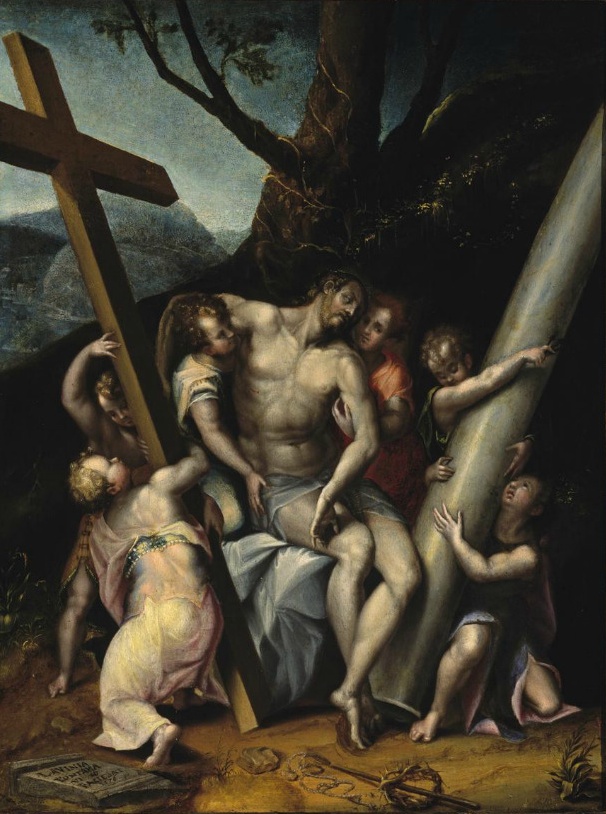
Her earliest known work, Child of the Monkey, was painted in 1575 when she was 23, but is now lost. Another early painting, Christ with the Symbols of the Passion, which was painted in 1576, is now in the El Paso Museum of Art in Texas.

Bologna society was largely supportive of Lavinia’s career, providing opportunities that were not given to women artists in other areas of Italy. She is thought to be the first woman artist working within the same sphere as her male counterparts to live outside a court or a convent.

Lavinia began working professionally by painting small devotional pictures on copper, which had popular appeal as papal and diplomatic gifts. By the 1580s she was in demand as a portrait painter of Bolognese noblewomen, who competed for her services and paid large sums of money for her work because of her close attention to detail. 

Mancini's Christ with the Symbols of Passion, at the El Paso Museum of Art
Mancini's Christ with the Symbols of
Passion,
at the El Paso Museum of Art
She displayed the wealth of the sitter by not neglecting any fashionable detail and by using bright colours for their clothes and jewellery. She also painted portraits of important people connected with the University of Bologna. As her career developed, she began creating large-scale paintings with religious or mythological themes. Among her most famous works are her large altarpieces for churches in Bologna.

Lavinia married another painter, Gian Paolo Zappi, in 1577, at the age of 26, and continued to paint professionally, adding the name Zappi to her signature.

Her husband helped her take care of the household and worked as her painting assistant and agent. He would paint minor elements of her canvases, such as draperies. Lavinia attended Bologna University and was listed as one of the city’s ‘donne addotrinate’, women with doctorates, in 1580.

In 1589, Lavinia painted the altarpiece Holy Family with the Sleeping Christ Child for El Escorial in Madrid.

At the invitation of Pope Clement VIII, Lavinia and her family moved to Rome in 1604 and she was appointed Portraitist in Ordinary at the Vatican. Pope Paul V was later among her sitters.

In 1604, Lavinia painted her largest work, The Martyrdom of St Stephen, an altarpiece for San Paolo Fuori le Mura - Saint Paul Outside-the-Walls - in Rome.

Among the honours she received was a bronze portrait medallion of herself cast by sculptor and architect Felice Antonio Casoni in 1611. She was also elected into the Accademia di San Luca of Rome, which was rare for a woman.

Minerva Dressing (1613), thought to be
the first female nude painted by a woman 
Lavinia died in Rome on 11 August 1614 and was later buried in Santa Maria sopra Minerva, one of the major Dominican churches in the capital.

One of Lavinia’s masterpieces is considered to be the Self-Portrait at the Clavichord with a Servant, which she painted as a gift to the Zappi family before her wedding, describing herself as a virgin in the signature. She also stated that she painted it while looking at herself in a mirror as a testament to it being an accurate depiction of her.

Over 100 of her works have been documented, but only 32 signed and dated are still known today. Another 25 have been attributed to her, giving her the largest collection of works by any female artist before 1700.

Lavinia’s religious and mythological paintings sometimes featured nude figures. Her painting, Minerva Dressing, for Cardinal Scipione Borghese, nephew to Pope Paul V, is believed to be the first female nude executed by a woman in Italy.  This can be seen in the Galleria Borghese in Rome. It has also been claimed Lavinia was the first female artist to paint mythological subjects.

Lavinia was immortalised by being the subject of Portrait of a Woman by Paolo Veronese, painted in 1595, when she was 43. She was the only woman to be featured in the 17th century book Considerazioni sulla pittura - Considerations on Painting - written by the physician and art collector Giulio Mancini, where the beauty of her paintings was likened to her own physical attractions by the writer.

It was rare for a woman painter to achieve such success and to profit from her talent during the Renaissance period. Some experts would argue that, to this day, Lavinia Fontana remains insufficiently appreciated as an artist.

The Basilica of San Petronio in Bologna is the sixth largest church in Europe
The Basilica of San Petronio in Bologna
is the sixth largest church in Europe
Travel tip:

The Basilica di San Petronio, where Lavinia Fontana was baptised, dominates Bologna’s Piazza Maggiore. Standing 47m (154ft) tall, 132m (144yds) long and 60m (66yds) wide, it is the sixth largest church in Europe and is seen as a symbol of the city. Strangely,  it was not consecrated as a church until 1954 - 574 years after it was built. It was constructed as a civic temple and not transferred from the city to the diocese until 1929.  It is notable for its unfinished facade, the red and brick marble of Domenico da Varignana’s design abandoned when it had barely reached one third of the building’s height, following the intervention of Pope Pius IV, who considered the project too expensive and ambitious.

The Basilica of St Paul Outside-the-Walls is one of Rome's four major Papal Basilicas
The Basilica of St Paul Outside-the-Walls is
one of Rome's four major Papal Basilicas
Travel tip:

St Paul Outside-the-Walls is one of the four major Papal Basilicas in Rome, along with St John in the Lateran (San Giovanni in Laterano), St Peter’s (San Pietro in Vaticano) and St Mary Major (Santa Maria Maggiore). Originally built in the fourth century, it was founded by the Roman emperor Constantine I over the burial place of St Paul. It was damaged and rebuilt after Saracen raids in the ninth century and an earthquake in the 14th century and almost completely destroyed by a fire in 1823, after which Pope Leo XII ordered it to be reconstructed to exactly resemble the original, consecrated in 324, although this turned out to be an unrealistic ambition. The new basilica bears only a general resemblance to the original. The tomb of St Paul is below a marble tombstone in the basilica’s crypt.

Also on this day:

1492: The election of Rodrigo Borgia as Pope Alexander VI

1902: The birth of cycling champion Alfredo Binda

1967: The birth of football coach Massimiliano Allegri 


Home

June 3, 2019

Pietro Paolini – artist

Follower of Caravaggio passed on his techniques to the next generation


Paolini's Achilles among the Daughters of  Lycomedes,  which is in the J. Paul Getty Museum in Los Angeles
Paolini's Achilles among the Daughters of  Lycomedes,
 which is in the J. Paul Getty Museum in Los Angeles
Pietro Paolini, a painter in the Baroque period in Italy, was born on this day in 1603 in Lucca in Tuscany.

Sometimes referred to as Il Lucchese, Paolini was a follower of the controversial Italian artist Caravaggio.

He also founded an academy in his native city and taught the next generation of painters in Lucca.

Paolini’s father, Tommaso, sent him to Rome when he was 16 to train in the workshop of Angelo Caroselli, who was a follower of Caravaggio.

Paolini had the opportunity to study various schools and techniques, which is reflected in the flexible style of his work.

Paolini's Bacchic Concert, which is in the collection of the Dallas Museum of Art
Paolini's Bacchic Concert, which is in the collection of
the Dallas Museum of Art
He was exposed to the second generation of painters in the Caravaggio tradition such as Bartolomeo Manfredi, Cecco del Caravaggio and Bartolomeo Cavarozzi.

The principal themes of Paolini’s work were the subjects popularised by Caravaggio around the turn of the 17th century involving lower class people such as hawkers, prostitutes and musicians. Some of his paintings have allegorical meanings, such as The Allegory of the Five Senses, which depicts a darkened inn with people engaged in playing music and drinking, each representing one of the five senses. The picture shows the realism and the strong chiaroscuro typical of Caravaggio.

Paolini spent two years living and working in Venice where he had the opportunity to study the works of Paolo Veronese and Tintoretto and he then returned to Lucca where he spent the rest of his life. His parents had died and he needed to support his siblings.

Paolini's The Allegory of the Five Senses, which is on display at the Walters Art Museum in Baltimore
Paolini's The Allegory of the Five Senses, which is
on display at the Walters Art Museum in Baltimore
After establishing a successful studio in Lucca he specialised in cabinet pictures and introduced the still life genre to the city. He received many commissions from religious institutions in Lucca as well as prominent local citizens.

In about 1652 he founded the Academy of Painting and Drawing of Lucca, where he helped train many young painters. Artists such as Girolamo Scaglia, Simone del Tintore, Antonio Franchi, Giovanni Coli and Filippo Gherardi were all trained there. At this stage he almost entirely gave up painting himself in order to devote himself to teaching.

Paolini died in Lucca in 1681.  He had two sons, Andrea, who became custodian of the Public Archives in Lucca, and Giovanni Tommaso.

Many of Paolini’s most famous works are on display in galleries around the world, including The Mystic Marriage of St Catherine of Alexandria, which can be seen in the Galleria Nazionale d'Arte Antica in Rome, Achilles among the Daughters of Lycomedes (J. Paul Getty Museum) and Bacchic Concert (Dallas Museum of Art).  The Allegory of the Five Senses is in the Walters Art Museum in Baltimore, Maryland.

Others, such as The Card Sharps, Portrait of a Man and A Young Lady Holding a Compass are in private collections.

A view over the rooftops of Paolini's home city of  Lucca in western Tuscany, not far from Pisa
A view over the rooftops of Paolini's home city of
Lucca in western Tuscany, not far from Pisa
Travel tip:

Lucca, Paolini’s home city, is situated 30km (19 miles) inland from Viareggio on the coast and 20km (12 miles) from Pisa, with its international airport, yet is often overlooked by travellers to the area. It has much to recommend within its majestic walls, where visitors can stroll along narrow cobbled streets into a number of beautiful squares, with lots of cafes and restaurants for those content to soak up the ambiance, but also a wealth of churches, museums and galleries for those seeking a fix of history and culture.   The Renaissance walls, still intact, are an attraction in their own right, providing a complete 4.2km (2.6 miles) circuit of the city popular with walkers and cyclists.

The facade of the Palazzo Barberini in Rome,  designed by the architect Carlo Maderno
The facade of the Palazzo Barberini in Rome,
designed by the architect Carlo Maderno
Travel tip:

The Galleria Nazionale d'Arte Antica (National Gallery of Ancient Art) is an art gallery in Rome. It has two sites: the Palazzo Barberini and the Palazzo Corsini.  The Palazzo Barberini was designed for Pope Urban VIII, a member of the Barberini family, by 16th century Italian architect Carlo Maderno on the old location of Villa Sforza, facing the Piazza Barberini in central Rome. Its central salon ceiling was decorated by Pietro da Cortona with the visual panegyric of the Allegory of Divine Providence and Barberini Power to glorify the papal Barberini family.  The Palazzo Corsini, formerly known as Palazzo Riario, is a 15th-century palace in the Trastevere district that was rebuilt in the 18th century by architect Ferdinando Fuga for Cardinal Neri Maria Corsini.

More reading:

Caravaggio sentenced to death after a murder in Rome

How did Caravaggio die?

Luca Giordano, the artist known as The Thunderbolt

Also on this day:

1678: The birth of architect Domenico Antonio Vaccaro

1751: The birth of the Blessed Vincent Romano

1977: The death of film maker Robert Rossellini


Home


February 17, 2016

Arcangelo Corelli – musician

Baroque composer had a major influence on the development of music


The composer Arcangelo Corelli was famous for his concerti grossi
The composer Arcangelo Corelli
Violinist and composer Arcangelo Corelli was born on this day in 1653 at Fusignano, a small town near Ravenna.

He is remembered for his influence on the development of violin style and for his use of the genres of sonata and concerto. Corelli’s 12 Concerti Grossi established the concerto grosso as a popular medium of composition.

Named Arcangelo after his father, who died a few weeks before his birth, he studied music with the curate of a neighbouring village before going to the nearby towns of Faenza and Lugo to learn musical theory.

Corelli later studied with Giovanni Benvenuti, who was a violinist at the Basilica of San Petronio in Bologna and in 1670 he started at the Philharmonic Academy in Bologna.

He moved on to Rome where to begin with he played the violin at a theatre. It is known that by 1677 he had written his first composition, a Sonata for Violin and Lute.

By 1675 Corelli was third violinist in the orchestra of the chapel of San Luigi dei Francesi and by the following year he had become second violinist.In 1681 his 12 Trio Sonatas for two violins and a cello were published and the following year he became first violinist in the San Luigi dei Francesi orchestra.

In 1687 Corelli became musical director at the Palazzo Pamphili, where he performed, conducted and organised important musical occasions.

On one occasion he conducted a large orchestra of stringed instruments to entertain the British ambassador, who had been sent to Rome by King James II of England to attend the coronation of Pope Innocent XII.

Corelli was also a brilliant teacher and among his many students was the young Antonio Vivaldi.

Considered to be the best violinist of his time, Corelli was invited to Naples in 1702 to perform a composition by Alessandro Scarlatti in the presence of the King.

Corelli died in Rome in 1713 and his 12 Concerti Grossi were published the following year in Amsterdam. Both Bach and Handel are said to have studied his work and been influenced by him.

The Basilica of San Vitale is famous for its Byzantine mosaics
The Basilica of San Vitale in Ravenna
Photo: 0mente0 (CC BY-SA 4.0)
Travel tip:

Fusignano, where Corelli was born, is a comune (municipality) in the province of Ravenna in the Emilia-Romagna region. Ravenna was the capital city of the Western Roman Empire from 402 until its collapse in 406. The city’s Basilica of San Vitale is famous for its wealth of Byzantine mosaics, the largest and best preserved outside Turkey, and the church is on the Unesco World Heritage list. Arguably, Fusignano's most famous citizen is football manager Arrigo Sacchi, who won two European Cups as manager of AC Milan.


Corelli is buried in the Pantheon in Piazza della Rotonda in Rome . Considered to be Rome’s best preserved ancient building, the Pantheon was built in AD 118 on the site of a previous building dating back to 27 BC. It was consecrated as a church in the seventh century and many important people, including Victor Emanuel II, Umberto I and his wife, Queen Margherita, are buried there, along with the painters Raphael and Annibale Carracci, the architect Baldassare Peruzzi and the writers Voltaire, Rousseau, Victor Hugo and Émile Zola.


More reading:


Also on this day:


(Picture credits: Basilica of San Vitale by 0mente0; Pantheon by Roberta Dragan; via Wikimedia commons)