Showing posts with label Fiat. Show all posts

November 8, 2026

Luigi Segre - motor engineer and entrepreneur

Neapolitan who turned Ghia name into symbol of automotive style

Luigi Segre at his desk at the workshop of Carrozzeria Ghia, which he turned into a global brand
Luigi Segre at his desk at the workshop of Carrozzeria
Ghia, which he turned into a global brand
The automobile entrepreneur Luigi “Gigi” Segre, whose short life managed to combine wartime heroics with creating an iconic postwar coupé whose name would come to symbolise luxury styling in mass production cars, was born on this day in 1919 in Naples.

Segre was only 43 when he died but left a lasting legacy as the driving force behind the Volkswagen Karmann Ghia sports car, which proved that beauty and style in automobile design could also be affordable.

It was so successful that when car giants Ford acquired Segre’s former company in 1970 they gave the Ghia name to top-of-the-range versions of their most popular models.

Segre had been working in his father’s construction business in Naples when Italy became embroiled in World War Two. He was a soldier in the Italian army but after the 1943 armistice took up arms against the Nazi occupiers of his home city, taking part in the uprising known as the Quattro giornate di Napoli - the Four Days of Naples - which cost 300 Italian lives but successfully drove out the German forces ahead of the arrival of Allied troops.


He volunteered to fight with the Allies, who gave him some training and sent him to northern Italy on behalf of American intelligence as a liaison officer, parachuted in behind enemy lines to work with partisan groups in Piedmont.

He learned English quickly, earning the respect of  his commanders, and his bravery impressed the Allies, who helped him secure a university place at the end of the conflict. He graduated in engineering and took a job with Siata, a small car manufacturer based in Turin which also made mopeds, a mode of transport that was hugely in demand as Italy struggled with war-damaged roads.

The VW Karmann Ghia, the stylish sports coupé built on the chassis of the VW Beetle family car
The VW Karmann Ghia, the stylish sports coupé
built on the chassis of the VW Beetle family car
From there he joined Carrozzeria Ghia, a coachbuilding and car design company launched by Giacinto Ghia in 1916 and then owned by the designer Mario Boano. As commercial director, Segre was so successful he was able to buy part-ownership of the business.

Carrozzeria Ghia’s market was largely domestic, making custom bodies for Italian manufacturers such as Fiat and Alfa Romeo, but Segre wanted to expand into global markets. He travelled to the United States, where his fluent English and his familiarity with Americans, due to his wartime activities, enabled him to forge a relationship with Chrysler and its chief designer, Virgil Exner, which would ultimately lead to 18 Chrysler Ghia cars.

The Volkswagen Karmann Ghia, the project that ultimately defined Segre’s legacy, came about through his connection with Wilhelm Karmann, the owner of a German coachbuilding company based in Osnabrück, in the northwest of the country. They would often meet at international motor shows.

Karmann had worked with Volkswagen before and was aware that the company, whose success had been built on the utilitarian Beetle family car, wanted to enhance its range with something more sporty. It was a contract he was keen to land and in 1952 he and Segre hatched a plan to build a sports coupé that could be mounted on a Beetle chassis.

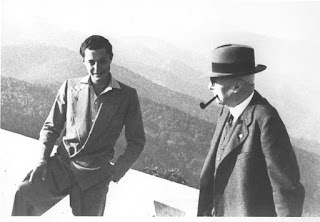
Luigi Segre with Wilhelm Karmann, with whom he worked on the Karmann Ghia
Luigi Segre with Wilhelm Karmann, with
whom he worked on the Karmann Ghia 
Such was the waiting list for Beetles that it would have taken Ghia months to source one in Italy but Gian Paolo - Mario Boano’s son - managed to buy one in Paris and drove it back to Turin. Over the next months, with Segre, Mario Boano plus in-house Ghia designers Sergio Coggiola and Giovanni Savonuzzi all having input, the concept became a reality.

The result was a car that had the look of an expensive marque, with sweeping, sculpted lines and elegant, low-slung proportions, but was as simple to drive and as economical to run as its parent Beetle. 

Production ran from 1955 to 1974, with almost half a million of the cars sold. It cemented the "Ghia" name into the vocabulary of mainstream car buyers worldwide.

Sadly, Segre did not live to enjoy many years of Ghia success. After Mario Boano left the business in 1953, Segre became sole owner in 1954 and hired well-respected designers such as Pietro Frua to ensure Ghia continued to be at the forefront of the market.

However, in February, 1963, following successful surgery to remove kidney stones, his health suddenly and unexpectedly deteriorated and he died in a Turin clinic.

Doctors blamed a viral infection, possibly one he had picked up on a business trip to Brazil, but this was not confirmed. He was survived by his wife, Luisa, whom he had married in 1955, and their two sons, Edmondo and Silvio.

Luisa subsequently sold most of the Carrozzeria Ghia business. It was acquired by Ford in 1970 and remains in that company’s ownership, helping craft designs for the European market from its headquarters in Corso Guglielmo Marconi in Turin.

The Basilica of Santa Chiara in Naples was badly damaged during a World War Two bombing raid
The Basilica of Santa Chiara in Naples was badly
damaged during a World War Two bombing raid
Travel tip:

Naples was the most heavily bombed Italian city during World War Two, enduring roughly 200 Allied air raids and extensive damage from retreating German forces. Following the war, a massive effort was undertaken to resurrect its historic centre.  Among the buildings worst affected were the Basilica di Santa Chiara, the 18th-century Baroque interior of which was ruined along with historic frescoes when a bombing raid triggered a fire that burned for two days, causing the roof to collapse. Restorers stripped away the damaged plaster to reveal and rebuild the church’s original 14th-century Gothic architecture.  The Royal Palace of Naples was damaged several times, including by the catastrophic March 1943 explosion of the ammunition ship Caterina Costa in the nearby port. Bombing raids damaged the palace's facades, collapsed the roof of the Court Theatre, and destroyed the palace chapel.  The Teatro di San Carlo, Europe's oldest continuously active opera house, sustained direct bomb damage in 1943. The auditorium only narrowly escaped complete demolition, and the foyer and adjacent structural sections were also badly hit. Amazingly, in view of its huge cultural importance, it was one of the first buildings to receive emergency aid. Under the direction of Allied authorities and local craftsmen, it was rapidly patched up and fully restored by 1948.

Stay in Naples with Hotels.com

Fiat's vast Lingotto Factory was renowned for its rooftop test track, which was 1,500m in length
Fiat's vast Lingotto Factory was renowned for its
rooftop test track, which was 1,500m in length
Travel tip:

Turin’s identity is closely connected with the Italian automotive industry, earning it the nickname the "Detroit of Italy." The association began in 1899 with the founding of FIAT (Fabbrica Italiana Automobili Torino) by Giovanni Agnelli. By 1906, Turin was home to more than 20 car manufacturers. The city benefited from strategic advantages, including cheap hydroelectric power from nearby Alpine lakes and a direct rail link to France through the Frejus tunnel, which accelerated early technical exchange. The crowning symbol of this era was Fiat’s Lingotto Factory, an architectural marvel completed in 1923, featuring a test track on its roof where newly-assembled vehicles were put through their paces. As well as large-scale manufacturing, Turin became a global centre for elite automotive design and specialised coachbuilding, becoming the home of great design houses such as Pininfarina and Bertone.  Today, its engineering prowess lives on through cultural institutions such as MAUTO - The National Automobile Museum - which exhibits more than 200 cars from 80 global manufacturers.

Hotels in Turin by Expedia

Read also:

Filippo Illuminato, the 13-year-old partisan who gave his life for the city of Naples

Battista 'Pinin' Farina, the little brother who became a giant of car design

Why Giorgetto Giugiaro has been described as the most influential auto designer of the 20th century

Also on this day:

1817: The death of painter Andrea Appiani

1830: The death of Francis I of the Two Sicilies

1931: The birth of film director Paolo Taviani

1936: The birth of actress Virna Lisi

1942: The birth of footballer Sandro Mazzola

1979: The birth of actor Salvatore Cascio

1982: The birth of golfer Francesco Molinari


Home

February 15, 2026

Vincenzo Lancia - racing driver and engineer

Founder of ground-breaking car maker

Vincenzo Lancia in 1908, at the wheel of a Fiat car at the Targa Florio race
Vincenzo Lancia in 1908, at the wheel
of a Fiat car at the Targa Florio race
Vincenzo Lancia, the founder of one of the most important car manufacturers in the history of Italy’s automobile industry, died on this day in 1937 in Turin.

He was only 55 years old and had suffered a heart attack, his unexpected death coming just as the aerodynamic Lancia Aprilia, second only to the 1922 Lambda among Lancia cars to have a profound impact on auto design across the world, was about to go into full production.

Vincenzo, who worked with the brilliant designer Battista 'Pinin' Farina in the later part of his career, is regarded as one of the three foundational figures of Italian car making, alongside Fiat founder Giovanni Agnelli, who was the first to manufacture cars on an industrial scale, and Enzo Ferrari, who led the way in Italy’s sports car culture.

Italy has a long tradition of stylish high-performance cars, with Ferrari, Lamborghini, Maserati, Alfa Romeo and Lancia recognised as the standard bearers.

The Lancia company was founded in 1906, Vincenzo having gained experience working for Fiat, for whom he was a test driver and often drove their cars in races.

Vincenzo Lancia - often called Censin - was born in August 1881 in Fobello, a small village in a mountain valley in northern Piedmont, about 18km (11 miles) from the border with Switzerland and 26km (16 miles) west of Lago Maggiore. 

Thanks to his father, Giuseppe, who had been successful in the food canning industry, the family was comfortably off. His father had ambitions for his son to build a steady career in accountancy or the law. He studied bookkeeping at the Turin Technical School. 

Yet, as industrialisation began to expand rapidly in Italy, Vincenzo was increasingly interested in machines and the engineers who built them.


By chance, an opportunity arose for him when his father agreed to rent some property he owned in Turin to Giovanni Ceirano, a pioneering bicycle and early automobile builder, who needed premises to open a workshop. 

Vincenzo eventually persuaded his father to let him work with Ceirano, ostensibly to further his experience in accountancy. He was listed in the company's brochure in 1898 as bookkeeper.

The 1922 Lancia Lambda was the first production car to be built with a rigid single shell body
The 1922 Lancia Lambda was the first production
car to be built with a rigid single shell body 
His real purpose was to learn about building cars, volunteering to help out as a mechanic when not needed in the office.

If he had set out somehow to put himself in the right place at the right time in the development of the Italian car industry, it could not have gone better if he had planned it.

The prototype car Ceirano produced, given the curious, English-sounding name of Welleyes, made such an impression when it was exhibited for the first time that a group of entrepreneurs looking for an opportunity to enter the fledgling automobile market proposed not only to buy the patent for the Welleyes car, but to take control of the Ceirano factory too, along with all its employees. 

The company they formed in order to do this was named Fabbrica Italiana Automobili Torino - FIAT.

Thus, at the age of 18, Vincenzo Lancia found himself employed by Fiat. As the Welleyes became the Fiat 4 HP, the company’s first production model, Lancia’s role was as a test driver. Soon, he began competing for the company in local races, achieving his and Fiat's first victory in the 1902 Turin Sassi- Superga race. 

His record as a competitive driver was mixed. He often set records for the fastest lap but his driving style was impetuous and he often failed to finish because of technical problems or minor accidents. 

The Fiat 4HP, the first car to bear the Fiat name after Vincenzo Lancia joined the new company
The Fiat 4HP, the first car to bear the Fiat name
after Vincenzo Lancia joined the new company
There were some successes, although Fiat valued him mainly for his mechanical sensitivity and his ability to diagnose faults as he drove at speed. His feedback helped refine early Fiat models.

In the meantime, in partnership with Claudio Fogolin, a friend and fellow Fiat driver, Vincenzo had in 1906 founded his own car manufacturing, under the Lancia name, in Turin, operating from a small workshop on Via Ormea, at the corner of Via Donizetti, in the south eastern part of the city.

Their first car was called the Tipo 51 or 12 HP, which Vincenzo later renamed as Alfa, beginning a tradition of naming vehicles he produced after letters in the Greek alphabet.  As the business grew, the factory moved to larger premises in the Borgo San Paolo district.

Right from the start, Lancia was different from other Italian marques: it prioritised engineering innovation over mass production, emphasising precision, and mechanical elegance. Vincenzo insisted on rigorous testing and would delay production rather than release a car that did not meet his standards.

The Lambda, which first appeared in 1922, was almost certainly his most important contribution to automotive history. Its monocoque construction, combining the body shell and chassis in one rigid unit, was a world first in production cars, as was its independent front suspension. 

Lancia’s conceptual leap in the way the Lambda was made brought major improvements in handling and safety and influenced car design across Europe, setting the template for modern vehicle construction. The monocoque body became the global standard for passenger cars.

The innovative, aerodynamic Lancia Aprilia was about to go into production when Vincenzo died
The innovative, aerodynamic Lancia Aprilia was
about to go into production when Vincenzo died 
Vincenzo’s personal prestige grew with the reputation of his cars. He was instrumental, as a high-profile supporter, in the construction of the Monza race track, at which he laid the foundation stone in 1922. In 1930, he joined forces with a group of other industrialists to form the coachbuilding company called Carrozzeria Pinin Farina, headed by the car designer Battista ‘Pinin’ Farina, which was to become synonymous with Italian sports cars and influenced the design of countless luxury and family cars across the world.

Lancia teamed up with Pinin Farina to work on his second ground-breaking car, the Aprilia, which was just weeks away from going into production when Vincenzo died. The Aprilia was one of the first cars designed using a wind tunnel, its streamlined body achieving record low drag. The Aprilia also featured four pillarless doors, a narrow-angle V4 engine and independent suspension.

Vincenzo Lancia was a contradictory character, according to those who knew him. A jovial bon viveur away from work, a music lover who was good company, he was a perfectionist in his professional role, intensely driven and willing to work long hours to achieve his goals. Some say these traits may have contributed to his premature demise.

After his death, a funeral was held in Turin, after which he body was taken back to Fobello and laid to rest in the family tomb at the village’s small cemetery.

The running of the Lancia business was taken over by his son, Gianni, and Gianni’s mother, Adele, who had been Vincenzo’s secretary. They hired Vittorio Jano, the Hungarian-born engineer who had made a name for himself with Alfa Romeo. 

Like his father, Gianni was energetic, ambitious and imaginative and Lancia continued to produce technically brilliant cars, the Aprilia being followed by the Ardea, Aurelia and later the Flaminia. 

But the company’s engineering‑first philosophy became increasingly expensive to sustain and ultimately contributed to Lancia becoming part of Fiat in 1969.

The Villa Lancia in the village of Fobello, in the High Mastallone Valley, was the Lancia family home
The Villa Lancia in the village of Fobello, in the High
Mastallone Valley, was the Lancia family home
Travel tip:

Fobello, where Vincenzo Lancia was born, is a small mountain village in Valsesia, in the province of Vercelli, Piedmont. It sits at about 880 metres in the High Mastallone Valley, surrounded by dense beech woods and gentle alpine slopes. The area is often called the “Emerald Basin” because of its unusually lush, sunlit green amphitheatre of forests and meadows. Fobello is part of the High Valsesia Nature Park, one of the most pristine alpine environments in Piedmont. It is a popular area for hiking and excursions through beech forests and high pastures, for wildlife observation and exploring traditional alpine hamlets, of which there are many in the vicinity. The name Fobello is traditionally linked to the Valsesian word fo, meaning beech, although some local lore suggests it may be a contraction of fondo bello, which could be taken to mean beautiful valley floor. Fobello’s parish church, the Chiesa San Giacomo dates back to 1545 but has twice been destroyed by flooding from the nearby Mastallone torrent, being rebuilt in 1931. The Palazzo Giuseppe Lancia, which Vincenzo Lancia himself built as a school building, now houses a museum dedicated to Vincenzo’s life and career. Visitors to Fobello often stay in nearby Varallo.

Find a hotel in Varallo with Hotels.com

Only an aerial photograph can capture the sheer size of the former Fiat factory at Lingotto
Only an aerial photograph can capture the sheer
size of the former Fiat factory at Lingotto
Travel tip:

The automobile industry in Turin is mainly defined by Fiat, whose former headquarters in Via Nizza in the Lingotto district, where Vincenzo Lancia worked before setting up in business himself, was once the largest car factory in the world, built to a linear design by the Futurist architect Giacomo Matte Trucco. It featured a spectacular rooftop test track made famous in the Michael Caine movie, The Italian Job. The track is still in place and though Fiat’s main production centre is elsewhere, is still used to test the company’s range of electric cars. Redesigned in the 1980s by the award-winning contemporary architect Renzo Piano, it now houses concert halls, a theatre, a convention centre, shopping arcades and a hotel, as well as the Pinacoteca Agnelli art gallery and the Automotive Engineering faculty of the Polytechnic University of Turin.  The Oval Lingotto, an indoor arena built for the 2006 Winter Olympics, is now used for exhibitions.

Book at the NH Lingotto Congress or other Turin hotels with Expedia

More reading:

How Battista ‘Pinin’ Farina became a giant of the car industry

What made Vittorio Jano one of the greatest engine designers in motor racing history

The ‘tractor maker’ insult that inspired Ferruccio Lamborghini

Also on this day:

1564: The birth of Renaissance scientist Galileo Galilei

1898: The birth of comic actor Totò

1910: The birth of circus clown Charlie Cairoli

1927: The birth of cardinal Carlo Maria Martini

1944: The destruction of Monte Cassino Abbey


Home


July 11, 2025

The founding of Fiat

The investors and aristocrats who created giant of car industry

Lorenzo Delleani's painting of the founding of Fiat shows 
Bricherasio in the cream jacket, with Agnelli third from the right.
A group of nine Italian investors and aristocrats met at the Palazzo Cacherano di Bricherasio in Turin on this day in 1899 to found the automobile company Fabbrica Italiana Automobili Torino - Fiat, as it would become known.

The group were brought together by Emanuele Cacherano di Bricherasio, a wealthy nobleman and entrepreneur, and his fellow entrepreneur Cesare Goria Gatti, who were founder members of the Automobile Club of Italy. The two had already enjoyed some success in the fledgling world of car manufacture as part of the Ceirano GB & C partnership the previous year and saw the potential of producing vehicles on a much bigger scale.

In addition to Bricherasio and Gatti, the nine consisted of two other nobleman, Count Roberto Biscaretti di Ruffia and the Marquis Alfonso Ferrero de Gubernatis Ventimiglia, the banker and silk industrialist Michele Ceriana Mayneri, the lawyer Carlo Racca, the landowner Lodovico Scarfiotti, the stockbroker Luigi Damevino and the wax industrialist Michele Lanza.

Giovanni Agnelli, who became known as the founder of Fiat and whose descendants ensured kept the family at the heart of the business for 115 years, was not part of the original group but after Lanza dropped out was approached by Scarfiotti, his fellow landowner, to come on board.


After a number of meetings at the Caffè Burello on Corso Vittorio Emanuele in Turin, the group secured the financial support of the Banco di Sconto e Sete of Turin and met in Palazzo Bricherasio to sign the deeds drawn up by Dr Ernesto Torretta, patrimonial notary of the Royal House of Savoy.

The first Fiat off the production line at the Corso Dante factory was the two-seater 3½ HP
The first Fiat off the production line at the Corso
Dante factory was the two-seater 3½ HP
The members paid a capital of 800,000 lire in return for 4,000 shares and entrusted the presidency to Ludovico Scarfiotti. 

The new company’s first outlay was to pay 30,000 lire for the Ceirano business, including all its expertise and workforce. Ceirano had already produced a small car known as the Welleyes - so called because English names had commercial appeal at the time - designed by the engineer Aristide Faccioli and handcrafted by Giovanni Battista Ceirano.

The first car built by Fiat  - the 3½ HP, a modest two-seater with a top speed of just 22mph (35kph) - was a copy of the Welleyes. Eight were built in total in 1899. The first factory was located on Corso Dante, in the southeast of the city, a short distance from the sweep of the Po river that gives the city a natural border. It opened in 1900, producing 24 cars, and remained the company’s production headquarters until the famous Lingotto plant went online in 1923.

Although Giovanni Agnelli quickly became the central figure of Fiat’s expansion and development, he was considered a junior member of the business at first, serving as secretary to the board.

But it soon became clear through his ideas that he had the strategic mindset required to build a profitable enterprise and his status was quickly elevated. By 1902, he was made managing director.

Fiat’s early years were not straightforward. There were various recapitalisations and changes in the composition of the share capital, but Agnelli steered the business through this period and by 1920, having become effectively the owner, he had risen to chairman.

By that time, Fiat had become the dominant player in Italy’s car industry with global expansion under way. Having become profitable by 1903, when it produced 135 cars, by 1906, that number had jumped to 1,149. It produced its first truck in 1903 and its first aircraft engine in 1908.  By 1910, as Italy’s largest car manufacturer, it entered the US market with a plant in New York. 

A rare picture of a young Gianni Agnelli (left) in conversation with his grandfather, Giovanni
A rare picture of a young Gianni Agnelli (left) in
conversation with his grandfather, Giovanni
Giovanni Agnelli remained involved with the company until his death in 1945 at the age of 79, although for many years the man at the helm had been Vittorio Valletta, his trusted lieutenant, who had assumed control when Giovanni’s future was compromised by his close ties with the Fascist regime. 

Control would probably have passed to Giovanni’s only son, Edoardo, but he was killed in a plane crash in 1935. In the event, Valletta became president with Giovanni’s death and remained in that role until 1966, when at the age of 83 he finally handed over to Gianni Agnelli, the founder’s grandson.

The Agnelli family's direct operational control of Fiat ended in 2004, a year after the death of Gianni. The last Agnelli to lead Fiat as CEO was Umberto Agnelli, who passed away in May 2004, although the family remains involved, through John Elkann, Gianni Agnelli’s grandson.

Elkann took on a key leadership role and stayed in a prominent management position after the 2014 merger with Chrysler created Fiat Chrysler Automobiles and Fiat as an independent family business ceased to be.

Fiat Chrysler evolved in 2021 into Stellantis, of which Elkann is chairman. Elkann is also CEO of Exor, the Agnelli family’s investment company, which owns major stakes in Stellantis as well as Ferrari, Juventus FC, and The Economist.

The company name still sits proudly above the original factory in Corso Dante, which opened in 1900
The company name still sits proudly above the
original factory in Corso Dante, which opened in 1900
Travel tip:

The original Fiat factory on Corso Dante in Turin still exists today and is open to the public as a museum, the Centro Storico Fiat, which has a large number of exhibits, including cars and aeroplanes, outlining the company’s history up to about 1970. The Fiat exhibits are part of the Museo Nazionale dell’Automobile. Tickets cost €10 for adults, with opening times from 10am until 6pm. The factory opened in 1900 and was active for 22 years before the massive Lingotto plant came into use, and became associated with the Fiat Brevetti car.  The museum can be found at the junction of Corso Dante and Via Gabriele Chiabrera about 5km (3 miles) from the centre of Turin, near the southern end of the Parco del Valentino and a few streets from where the Ponte Isabella crosses the Po river.

The Palazzo Cacherano di Bicherasio, which dates back to 1636, now houses a bank
The Palazzo Cacherano di Bicherasio, which
dates back to 1636, now houses a bank
Travel tip:

The Palazzo Cacherano di Bricherasio, located on Via Lagrange in central Turin, between Via Giovanni Giolitti and Via Cavour, was built in 1636 as a noble residence in the Contrada dei Conciai. It became the home of the now-extinct Cacherano di Bricherasio family in 1855, known for their military honours and cultural patronage. Count Emanuele Cacherano di Bricherasio, a key figure in Italy’s early automotive industry, hosted the founding meeting of Fiat in his study, making the palace a cradle of industrial history. His sister Sofia, a painter and patron, transformed the residence into a vibrant cultural salon, welcoming artists such as Lorenzo Delleani and Arturo Toscanini. After World War Two, the palace housed a school and then an exhibition venue for the Palazzo Bricherasio Foundation, following its restoration in 1994. Since 2010, it has housed Banca Patrimoni Sella & C, preserving its architectural elegance and historical significance while remaining partially open to the public for guided visits.

Also in this day:

138: Antoninus Pius becomes Roman Emperor following the death of Hadrian

1576: The murder of noblewoman Eleonora di Garzia di Toledo, wife of Don Pietro de’ Medici

1593: The death of painter Giuseppe Arcimboldo

1934: The birth of fashion designer Giorgio Armani


Home


.


August 31, 2021

Luca Cordero di Montezemolo – aristocrat and businessman

Luca di Montezemolo led Ferrari to F1 success
Luca di Montezemolo led
Ferrari to F1 success
Former driver who led Ferrari to Formula One success

Luca Cordero di Montezemolo, a former racing driver,  former chairman of Ferrari and Fiat and president of employers’ federation Confindustria, was born on this day in 1947 in Bologna.

He is one of the founders of NTV, an Italian company that is Europe’s first private, open access operator of 300km/h (186 mph) high-speed trains. He retains an interest in motor sport as a director of McLaren Group Holdings Ltd.

Montezemolo is a descendant of an aristocratic family from Piedmont, who served the Royal House of Savoy for generations. He is the youngest son of Massimo Cordero dei Marchesi di Montezemolo and Clotilde Neri, niece of the surgeon, Vincenzo Neri. His uncle was a commander in the Italian Navy in World War II and his grandfather and great grandfather were both Generals in the Italian Army.

After graduating with a degree in Law from Rome Sapienza University in 1971, Montezemolo studied for a master’s degree in international commercial law at Columbia University.

His sporting career began at the wheel of a Giannini Fiat 500. He then drove briefly for the Lancia rally team, before joining the auto manufacturing conglomerate Fiat. In 1973 he moved to Ferrari, where he became Enzo Ferrari’s assistant, and he became manager of the Scuderia - the racing division of the company - in 1974.

Montezemolo pictured in 1985 with Fiat chairman Gianni Agnelli, who made him a trusted lieutenant
Montezemolo pictured in 1985 with Fiat chairman
Gianni Agnelli, who made him a trusted lieutenant 
While Montezemolo was involved with the team, Ferrari won the Formula One world championship with Nikki Lauda in 1975 and 1977. He became head of all Fiat racing activities in 1976 and became a senior manager of Fiat in 1977.

During the 1980s he held a number of positions in the Fiat empire, including managing director of the drinks company, Cinzano. He also managed Team Azzurra, the first Italian yacht club to enter the America’s Cup and in 1985 he became manager of the organising committee for the 1990 World Cup in Italy.

Fiat chairman Gianni Agnelli appointed Montezemolo president of the then struggling Ferrari company in 1991, after the death of Enzo Ferrari. Montezemolo was awarded the Lorenzo Bandini trophy for his achievements in Formula One motor racing in 1997 and, under his leadership, the Ferrari team won the world drivers’ championship in 2000.

Montezemolo became president of Confindustria in 2004 and on the death of Agnelli was elected chairman of Fiat. He stepped down from Fiat in 2010 and resigned as president and chairman of Ferrari in 2014. 

He launched NTV - Nuovo Trasporto Viaggiatori - in 2006 along with three other businessmen with the aim of competing for business on the Italian high speed rail network following the liberalisation of the railway sector in the European Union.  Trading under the brand name Italo, today it operates more than 90 daily services across 11 routes, serving serving 54 cities.

He is also non-executive chairman of the board of the airline Alitalia and was committee president of the Rome bid for the Summer 2024 Olympics.

He has been awarded five honorary degrees in Mechanical Engineering by Italian universities. Married twice, Montezemolo has five children. 

This article was updated in August, 2025.

The Villa Ada is surrounded by one of the biggest urban parks in Rome
The Villa Ada is surrounded by one of the
biggest urban parks in Rome
Travel tip:

While working on the Rome bid for the 2024 summer Olympics, Montezemolo has had an office at the Foro Italico, the site for the 1960 Olympics, and an apartment in the exclusive Parioli district in the north of Rome. This became an upper class area early in the 20th century after the construction of Viale Parioli. Now considered to be Rome’s most elegant residential area, notable for its tree-lined streets and some of Rome's finest restaurants, it is also home to some foreign embassies.  The Villa Ada, once the Rome residence of the Italian royal family and surrounded by the second largest park in the city, can also be found within the Parioli district.

Hotels in Rome by Expedia

The elegant Piazza Galimberti is the central square in Cuneo
The elegant Piazza Galimberti is
the central square in Cuneo
Travel tip:

The Montezemolo family name comes from a small village in the province of Cuneo in the Piedmont region, about 80 kilometres (50 miles) southeast of Turin. Cordero Montezemolo Barolo wine is made in the wine producing area of La Morra by a branch of the Montezemolo family. The city of Cuneo is characterised by its 19th-century Savoy layout and architecture, with eight kilometres of arcaded streets, at the heart of which in the elegant Piazza Galimberti.

Find a hotel in Cuneo with Hotels.com


Also on this day:

1542: The birth of noblewoman Isabella de’ Medici

1834: The birth of opera composer Amilcare Ponchielli

1900: The birth of Gino Lucetti, Mussolini’s would-be assassin

1907: The birth of Altiero Spinelli, political visionary


Home


August 7, 2019

Giorgetto Giugiaro - automobile designer

The Volkswagen Golf Mk I was one of  Giugiaro's most successful designs, the car selling 6.8 million units
The Volkswagen Golf Mk I was one of  Giugiaro's most
successful designs, the car selling 6.8 million units

Creative genius behind many of the world’s most popular cars


Giorgetto Giugiaro, who has been described as the most influential automotive designer of the 20th century, was born on this day in 1938 in Garessio, a village in Piedmont about 100km (62 miles) south of Turin.

In a career spanning more than half a century, Giugiaro and his companies have designed around 200 different cars, from the high-end luxury of Aston Martin, Ferrari, Maserati and DeLorean to the mass production models of Fiat, Volkswagen, Hyundai, Daewoo and SEAT.

The Volkswagen Golf and the Fiat Panda, two of the most successful popular cars of all time, were Giugiaro’s concepts.

In 1999, a jury of more than 120 journalists from around the world named Giugiaro “Designer of the Century.”

Giugiaro formed his own company. Italdesign, just outside Turin in 1968
Giugiaro formed his own company.
Italdesign, just outside Turin in 1968
Giugiaro’s father and grandfather both painted in oils and Giugiaro became passionately interested in art. He enrolled at the University of Turin to study art and technical design.

He took an interest in styling automobiles only after one of his professors suggested that the motor industry would pay big money for someone of his artistic vision who could come up with elegant and practical designs.

Not surprisingly, after he had presented some sketches of cars at a student exhibition in Turin in 1955, it was Fiat - based in Turin - who became aware of his talent. The company’s technical director, Dante Giacosa, approached Giugiaro and three months later he joined Fiat’s Special Vehicle Design Study Department. He would stay with Fiat for four years, although he struggled to win approval for his designs.

From Fiat, he moved up the ladder of automotive design very quickly, lured away by Nuccio Bertone to join Gruppo Bertone, where Giugiaro delivered an amazing run of successful designs.

The stylish Alfa Romeo Brera is based on another of Giugiaro's designs for Italdesign Appointed chief designer at the age of just 22, his work included the Aston Martin DB4 GT, the Ferrari 250 GT Concept, Chevrolet Corvair Testudo Concept, Alfa Romeo Sprint, and the Fiat 850 Spider.    Giugiaro moved to Ghia in 1965, shortly before it was taken over by Alejandro de Tomaso, head of De Tomaso. He stayed there only two years, but it was long enough for him to make his mark with the De Tomaso Mangusta and the Maserati Ghibli, both unveiled in 1966.    Only a year later, Giugiaro moved on again, this time to form a partnership with Aldo
The stylish Alfa Romeo Brera is based on another of
Giugiaro's designs for Italdesign
Appointed chief designer at the age of just 22, his work included the Aston Martin DB4 GT, the Ferrari 250 GT Concept, Chevrolet Corvair Testudo Concept, Alfa Romeo Sprint, and the Fiat 850 Spider.

Giugiaro moved to Ghia in 1965, shortly before it was taken over by Alejandro de Tomaso, head of De Tomaso. He stayed there only two years, but it was long enough for him to make his mark with the De Tomaso Mangusta and the Maserati Ghibli, both unveiled in 1966.

Only a year later, Giugiaro moved on again, this time to form a partnership with Aldo Mantovani and a new company, based in Moncalieri, just outside Turin, which would be called Italdesign (later Italdesign Giugiaro.)

Since its founding, Giugiaro’s company has styled an estimated 200 vehicles for clients all over the world.

The Fiat Panda is another massive seller worldwide that began life as a Giorgetto Giugiaro design
The Fiat Panda is another massive seller worldwide
that began life as a Giorgetto Giugiaro design
Among the best known have been the Alfa Romeo Alfasud, Lotus Esprit, Volkswagen Golf and Scirocco, Bugatti EB112, Saab 9000, Subaru SVX, and the DeLorean DMC 12. There are few major motor manufacturers around the world for whom Giugiaro or his company have not worked.

Probably the most successful of all has been the Volkswagen Golf Mark I, which was unveiled for the first time in 1974 and went on to sell 6.8 million units.

Giugiaro’s favoured styles in the early days of Italdesign tended to accentuate curves, as characterised by the DeTomaso Mangusta and the Maserati Ghibli. Later he became more concerned with straight lines, as characterised by the VW designs for the Passat and Scirocco as well as the Golf. Other designers often followed suit. A high-sided taxi he conceived for the Museum of Modern Art in New York in 1978 did not enter production but became the influence for a generation of MPVs.

Like the Golf, Giugiaro’s Fiat Panda sold in huge numbers. Conceived to be minimalist, aesthetic and functional, the model continued in production for 32 years with barely an upgrade in that period.

His design talents have not stopped at cars. Giugiaro has also designed cameras for Nikon, firearms for Beretta, and motorcycles for Ducati, and Suzuki.

The castle at Moncalieri, once a royal residence for the Savoys, now houses a Carabinieri training college
The castle at Moncalieri, once a royal residence for the
Savoys, now houses a Carabinieri training college
Travel tip:

Moncalieri, where Giugiaro established the Italdesign company with his partner Aldo Mantovani, has a population of almost 58,000 people. About 8km (5 miles) south of Turin within the city’s metropolitan area, it is notable for its castle, built in the 12th century and enlarged in the 15th century, which became a favourite residence of King Victor Emmanuel II and subsequently his daughter, Maria Clotilde. The castle now houses a prestigious training college for the Carabinieri, Italy’s quasi-military police force.

The village of Garessio sits in a valley in the Ligurian Alps, close to the Langhe wine region
The village of Garessio sits in a valley in the Ligurian Alps,
close to the Langhe wine region
Travel tip:

Garessio, where Giugiaro was born, is located in the Ligurian Alps, on the border between Liguria and Piemonte provinces. In medieval times it was an important staging post for the salt trade and eventually salt brought over the Ligurian Alps from the Mediterrean Sea was re-packed and sold in Garessio for distribution to Northern Europe.  It is close to the Langhe wine region, which produces famous wines such as Barolo and Dolcetto, and is famous for the Aqua San Bernardo mineral water, which is renowned to have healing properties. At the turn of the century, Garessio built its fame as a spa town. It has a well preserved historical town centre.

More reading:

Why Giuseppe 'Nuccio' Bertone is known as the 'godfather of Italian car design'

Dante Giacosa, the engineer behind the iconic Fiat Cinquecento

How 'Pinin' Farina became a giant of the car industry

Also on this day:

1616: The death of architect Vincenzo Scamozzi 

1893: The death of opera composer Alfredo Catalani

1956: The birth of TV presenter Gerry Scotti


Home


March 31, 2019

Dante Giacosa - auto engineer

Dante Giacosa worked for Fiat automobiles for almost half a century
Dante Giacosa worked for Fiat automobiles
for almost half a century

Designer known as ‘the father of the Cinquecento'


The automobile engineer Dante Giacosa, who worked for the Italian car maker Fiat for almost half a century and designed the iconic Fiat 500 - the Cinquecento - in all its incarnations as well as numerous other classic models, died on this day in 1996 at the age of 91.

Giacosa was the lead design engineer for Fiat from 1946 to 1970. As such, he was head of all Fiat car projects during that time and the direction of the company’s output was effectively entirely down to him.

In addition to his success with the Cinquecento, Giacosa’s Fiat 128, launched in 1969, became the template adopted by virtually every other manufacturer in the world for front-wheel drive cars.

His Fiat 124, meanwhile, was exported to the Soviet Union and repackaged as the Zhiguli, known in the West as the Lada, which introduced Soviet society of the 1970s to the then-bourgeois concept of private car ownership.

Born in Rome, where his father was undertaking military service, Giacosa's family roots were in Neive in southern Piedmont. He studied engineering at the Polytechnic University of Turin.

Dante Giacosa, standing between the familiar shape of the Nuovo Cinquecento and the original 'Topolino'
Dante Giacosa, standing between the familiar shape of the
Nuovo Cinquecento and the original 'Topolino'
After completing his compulsory military service he joined Fiat in 1928, at first working on military vehicles and then in the aero engine division. The director of the aero engine division was Tranquillo Zerbi, designer of Grand Prix cars for Fiat, from whom Giacosa learned the basics of car design.

In 1929, Senator Giovanni Agnelli, co-founder of the Fiat company (and grandfather of Gianni), asked his engineers to design an economy car that would sell for 5,000 lire.

There was an emphasis on producing economical small cars in all the industrialised European countries. Giacosa's new 500cc vehicle, originally called the Zero A, appeared for the first time in 1934 and was immediately hailed as a triumph of engineering subtlety.

The vehicle was only just over three metres (10 feet) in length, yet Giacosa had managed to squeeze in a four-cylinder engine and space for two adults and two children. The radiator was squeezed in behind the engine for compactness, which allowed a sharply sloping nose.

Giacosa's Fiat 600 was a bigger version of the Fiat 500 but with space for four adults and some luggage
Giacosa's Fiat 600 was a bigger version of the Fiat 500 but
with space for four adults and some luggage
The whole looked not unlike a clockwork mouse and enthusiastic buyers nicknamed it il Topolino after Mickey Mouse. Nonetheless, with independent suspension, the car out-handled many larger contemporaries.

During the Second World War, Giacosa returned to working on aero engines but also began planning a post-war range of economy cars.

However, in the financial chaos that followed, the Topolino was priced at 720,000 lire when Fiat resumed its production in 1945, a long way from Agnelli’s dream. The best that ordinary Italians could aspire to at the time was a bicycle or, later, perhaps a Vespa or Lambretta scooter.

But the needs of Italians changed with the baby boom of the early 1950s, by which time they had more disposable income. What they wanted was a family car, bigger and more comfortable than the Topolino, and Giacosa met that need by designing the Fiat 600.

Giacosa's Cisitalia D46 racing car, which he designed for the entrepreneur and racing driver Piero Dusio
Giacosa's Cisitalia D46 racing car, which he designed for
the entrepreneur and racing driver Piero Dusio
Although it cost 580,000 lire when it went on sale in 1955, it became more affordable through the new concept of credit payments. Though still compact, the rear-engined car had space for four passengers, while a stretch version went into regular use as a taxi.

However, as the narrow streets of Italian cities became busier, smaller cars such as the old Topolino that could whisk through traffic and park in a small spot, came back into vogue. Giacosa met that need by designing a new Cinquecento - the familiar Nuovo 500 - based on the rear-engined pattern of the 600, with seats for four adults, an open roof and a top speed of 100kph (60mph). It was an immediate hit, selling 3.7 million models before production stopped in 1973.

In addition to his mass production cars for Fiat, Giacosa also worked on behalf of the entrepreneur Piero Dusio and his Consorzio Industriale Sportivo Italia company to design a single-seater racing car cheap known as the Cisitalia D46. The car scored multiple successes in competition, particularly in the hands of drivers as talented as the brilliant Tazio Nuvolari, winner of 24 Grands Prix in the pre-Formula One era.

Fiat's extraordinary motor production plant at Lingotto, a  few kilometres from the centre of Turin
Fiat's extraordinary motor production plant at Lingotto, a
few kilometres from the centre of Turin
Travel tip:

The former Fiat plant in the Lingotto district of Turin was once the largest car factory in the world, built to a linear design by the Futurist architect Giacomo Matte Trucco and featuring a rooftop test track made famous in the Michael Caine movie, The Italian Job. Redesigned by the award-winning contemporary architect Renzo Piano, it now houses concert halls, a theatre, a convention centre, shopping arcades and a hotel, as well as the Automotive Engineering faculty of the Polytechnic University of Turin. The former Mirafiori plant, situated about 3km (2 miles) from the Lingotto facility, is now the Mirafiori Motor Village, where new models from the Fiat, Alfa Romeo, Lancia and Jeep ranges can be test driven on the plant's former test track.

The village of Neive in Piedmont is at the heart of an important wine production area
The village of Neive in Piedmont is at the heart of an
important wine production area
Travel tip:

Neive, from which Giacosa’s family originated, is a large village in the Cuneo province of Piedmont region, about 12km (7 miles) north of the larger town of Alba and 70km (44 miles) southeast of Turin. It is best known as the centre of a wine producing region but more recently has enjoyed a boom in agritourism among visitors wishing to experience a rural Italian village. The centre of the village is the charming narrow Piazza Italia and the most important landmark the 13th century Torre Comunale dell’Orologio, the tallest building in the village. The village is beautifully presented and listed as one of the Borghi Più Belli d’Italia - the most beautiful small towns of Italy. The Baroque Chiesa Di San Pietro is one of the most important churches, with several beautiful art works by artists of the region. The notable wines produced in the area include Barbaresco, Barbera, Dolcetto d’Alba and the sweet dessert white wine Moscato d’Asti.

More reading:

How Fiat boss Gianni Agnelli became more powerful than politicians

Giovanni Agnelli and the 'horseless carriage' that launched Italy's biggest automobile company

How little 'Pinin' Farina became the biggest name in Italian car design

Also on this day:

1425: The birth of Bianca Maria Visconti - Duchess of Milan

1675: The birth of intellectual leader Pope Benedict XIV

1941: The birth of comic book artist Franco Bonvicini

Home

December 6, 2018

Andrea Agnelli - Juventus chairman

Fourth member of famous dynasty to run Turin club


Andrea Agnelli has been chairman of Juventus since succeeding John Elkann in 2010
Andrea Agnelli has been chairman of Juventus
since succeeding John Elkann in 2010
The businessman Andrea Agnelli, who since 2010 has been chairman of Italy’s leading football club, Juventus, was born on this day in 1975 in Turin.

He is the fourth Agnelli to take the helm of the famous club since 1923, when his grandfather, Edoardo, took over as president and presided over the club’s run of five consecutive Serie A titles in the 1930s.

Andrea’s father, Umberto, and his uncle, the flamboyant entrepreneur Gianni Agnelli, also had spells running the club, which has been controlled by the Agnelli family for 88 years, with the exception of a four-year period between 1943 and 1947. The family still owns 64% of the club.

As well as being chief operating officer of Fiat, which was founded by Andrea’s great-grandfather, Giovanni, Umberto was a Senator of the Italian Republic.  On his mother’s side, Andrea has noble blood.

Donna Allegra Caracciolo di Castagneto is the first cousin of Marella Agnelli - Gianni’s widow - who was born Donna Marella Caracciolo di Castagneto and is the daughter of Filippo Caracciolo, 8th Prince di Castagneto, 3rd Duke di Melito, and a hereditary Patrician of Naples.

A young Andrea Agnelli pictured at the 1996 Champions League final - the last Juventus won - with his uncle, Gianni
A young Andrea Agnelli pictured at the 1996 Champions
League final - the last Juventus won - with his uncle, Gianni
Andrea had a private education St Clare's, an independent college in Oxford, England, and at Bocconi University in Milan.  After university, Agnelli entered the business world, working for companies in England and France that included Iveco and Auchan Hypermarché. He also spent several years in Switzerland.

He was appointed chairman of the board of directors of Juventus by his first cousin, John Elkann, in 2010, after Elkann had come under criticism from Juventus fans for the club's poor results during the 2009–10 season.

Many Juventus fans welcomed Andrea’s arrival because of the family's historic association with the club. He is credited with turning round the club’s fortunes at a time when the financial recession and the aftermath of the infamous Calciopoli scandal were making progress difficult.

Emma Winter, the English artist Agnelli married in 2005
Emma Winter, the English artist
Agnelli married in 2005
He stabilised the club’s finances and, after initially appointing Sampdoria duo Giuseppe Marotta as director of sport and Luigi Delneri as coach, pulled off a masterstroke in May 20100 by hiring former captain and fan favourite Antonio Conte as new manager.

Conte, who had coached Bari to the Serie B title in 2008-09, steered Juve in his first season to their first scudetto since they were stripped of two titles in the mid-2000s as a result of the Calciopoli rulings.

Since then, with Agnelli appointing the former AC Milan coach Massimiliano Allegri to replace Chelsea-bound Conte in 2014 in a seamless change at the top, Juventus have won a record seven Serie A titles in a row, as well as four Coppa Italia titles in a row since 2014–15.

Juventus are well on course for an eighth consecutive title, having already built a lead of eight points over Napoli in the Serie A table, but Agnelli and the club more than anything crave success in the Champions League, which they have not won since 1996, when they defeated Ajax on penalties in the final in Rome.

In the 22 seasons subsequent to that one, they have been runners-up five times, twice since Andrea became chairman, in 2015 and 2017, when they were beaten respectively by the Spanish giants Barcelona and Real Madrid.

Andrea Agnelli would like to see the Champions League established as the main competition for Europe's biggest clubs
Andrea Agnelli would like to see the Champions League
established as the main competition for Europe's biggest clubs
Despite falling revenues - the club recorded an operating loss of €19 million (£17 million) in 2017-18 - Andrea authorised the signing of Real’s Cristiano Ronaldo in July this year for a fee of €100 million (£88.5 million), beating the previous record fee paid by an Italian club that was set by Juventus in 2016 when they signed Gonzalo Higuaín from Napoli for €90 million (£75.3 million).

The Ronaldo signing will eventually cost Juventus €340 million (£301 million) with the player’s salary taken into account, yet Agnelli insisted that the outlay “made sense on and off the pitch”, in a reference to the commercial revenue the Portugal star was likely to generate for the club through merchandising, and to his potential for helping Juventus achieve Agnelli’s target of winning the Champions League.

As chairman of the powerful European Club Association, a position he has held since 2017, Andrea is keen to see the Champions League overtake domestic competition as the principal focus for Europe’s top clubs, proposing an increase in the size of the Champions League and a corresponding reduction in the number of domestic fixtures.

Edoardo Agnelli, grandfather of Andrea, ran Juventus in the 1930s
Edoardo Agnelli, grandfather of
Andrea, ran Juventus in the 1930s
This has been driven in part by the inequality that now exists between the domestic leagues in European countries, mainly because of the huge variations in television revenue, particular compared with the Premier League in England. Juventus, despite their dominant position in Italian football, are only the 10th wealthiest club in Europe in terms of revenue.

Andrea Agnelli is married to Emma Winter, a English-born artist, designer and art director, whose clients have included United Visual Artists, Universal, Sony, Polydor, Ted Baker, Adidas, Dove, Peugeot and Panasonic.

They were married in 2005 at the church of San Pietro in Vincoli in Villar Perosa in Piedmont, with the reception taking place at the nearby Villa Agnelli, the family estate which is now the home of Marella Agnelli. The couple have two children, 13-year-old Baya Agnelli and six-year-old Giacomo Dai Agnelli.

UPDATE: Agnelli resigned as chairman and president of Juventus in November 2022 following investigations into financial irregularities at the club. He received a two-year ban from football over alleged false accounting and was suspended for a further 16 months from July 2023 when he was found guilty of fraud relating to player salary cuts during the Covid-19 pandemic.


The Villa Agnelli, country home of the Agnelli family at Villar Perosa in Piedmont in 1811
The Villa Agnelli, country home of the Agnelli family
at Villar Perosa in Piedmont in 1811
Travel tip:

Villar Perosa, where Giovanni Agnelli was born, is a small town about 40 km (25 miles) southwest of Turin.  The Villa Agnelli, the family's country house and estate there, consisting of a 45-room stuccoed rococo villa with grounds and a commanding views of the Alps, has been in the the Agnelli family since 1811. As well as Russell Page, the English landscape gardener, the Agnellis hired renowned architect Gae Aulenti to create the timbered pool house. The estate also contains a family chapel, where members of the Agnelli clan are buried.

Search TripAdvisor for Villar Perosa hotels

Juventus play their home matches at the Juventus Stadium, which holds 41,000 people, in the Vallette district of Turin
Juventus play their home matches at the Juventus Stadium,
which holds 41,000 people, in the Vallette district of Turin
Travel tip:

Juventus is one of the two major football clubs in Turin, the other being Torino.  Although Juventus now play at a stadium on the northern perimeter of the city in the Vallette district, the club's roots are in the city centre.  Their original ground was in what is now known as the Parco Cavalieri di Vittorio Veneto, a large green space between Corso IV Novembre and Corso Galileo Ferraris just south of the city centre, which in the late 19th century was Piazza d'Armi, an army parade ground.  Nearby is the Stadio Olimpico, now the home of Torino, which was formerly called Stadio Comunale, where the two clubs cohabited until 1990. Juventus now play at the Juventus Stadium, an ultra-modern ground with a 41,000 capacity that has been their home since 2011, and which also houses the Juventus museum.


More reading:

How Gianni Agnelli became more powerful than politicians

Marella Agnelli, the noblewoman who married into a business dynasty

Massimiliano Allegri, the coach who keeps the trophies coming at Juventus

Also on this day:

1478: The birth of Baldassare Castiglione, the author of the Italian classic, The Book of the Courtier

1586: The birth of astronomer Niccolò Zucchi

1794: The birth of 19th century opera star Luigi Lablache


Home