8 June 2022

8 June

Giuseppe Fiorelli - archaeologist

The man whose painstaking work saved Pompeii

Giuseppe Fiorelli, the archaeologist largely responsible for preserving the ruins of Pompeii, was born on this day in 1823, in Naples.  It was due to Fiorelli’s painstaking excavation techniques that much of the lost Roman city on the Neapolitan coast was preserved as it had looked when, in 79 AD, it was totally submerged under volcanic ash following the eruption of Vesuvius.  He also hit upon the idea of filling the cavities in the hardened lava and solidified ash left behind by long-rotted bodies and vegetation with plaster to create a model of the person or plant that had been engulfed.  This became known as the Fiorelli process.  Little is known of Fiorelli’s early life apart from some details of his academic career, which clearly show him to be precociously clever.  He studied law from the age of 11 and obtained a degree in legal studies at the age of 18. He was also a student of italic languages, numismatics – the study of coins, paper money and medals -- and epigraphy – the study and interpretation of ancient inscriptions.  Having chosen to pursue his interest in archaeology and the study of ancient civilisations, he wrote an article on numismatics that won him membership of a number of academies at the age of 20.  Read more…

____________________________________

Luigi Comencini – film director

Movies helped create an international audience for Italian cinema

Award winning director and screenwriter Luigi Comencini was born on this day in 1916 in Salò, a town on the banks of Lake Garda in Lombardy.  He is considered to have been one of the masters of the commedia all’italiana genre, a type of film produced between the 1950s and the 1970s that dealt with social issues such as divorce, contraception and the influence of the Catholic Church in a sardonically humorous way.  After Comencini studied architecture in Milan he went to work as a newspaper film critic. He began his career as a filmmaker in 1946 with a short documentary, Bambini in città, about the hard life of children in post-war Milan.  His first successful movie was L’imperatore di Capri in 1949, featuring the comedian Totò.  Comencini’s 1953 film, Pane, amore e fantasia, starring Vittorio De Sica and Gina Lollobrigida, is considered a prime example of neorealismo rosa -  pink neorealism. It was followed by Pane, amore e gelosia in 1954.  His masterpiece is considered to be Tutti a casa, starring Alberto Sordi, which was a bitter comedy about Italy after the armistice of 1943, when Italy surrendered to the Allies.  Read more…

_________________________________

Tomaso Albinoni - Venetian composer

Prolific writer of operas and instrumental music

The composer Tomaso Albinoni, perhaps best known for the haunting and powerful Adagio in G Minor, was born on this day in 1671 in Venice.  Albinoni was a contemporary of two other great Venetian composers, Arcangelo Corelli and Antonio Vivaldi, and was favourably compared with both.  It is his instrumental music for which he is popular today, although during his own lifetime he was famous for his operas, the first of which was performed in Venice in 1694.  He is thought to have composed some 81 operas in total, although they were not published at the time and the majority were lost.  His first major instrumental work also appeared in 1694. With the support of sponsorship from noble patrons, he published nine collections - in Italy, Amsterdam and London - beginning with Opus 1, the 12 Sonate a Tre, which he dedicated to his fellow Venetian, Cardinal Pietro Ottoboni, the grand-nephew of Pope Alexander VIII.  It was this work that established his fame.  He followed it with another collection of instrumental pieces, dedicated to Charles IV, Duke of Mantua, who may have employed him as a violinist.  Read more…

____________________________________

Benedetto Alfieri – architect

Talented designer behind the Teatro Regio in Turin

Baroque architect Benedetto Innocenzo Alfieri was born on this day in 1699 in Rome.  He was a member of the Alfieri family who originated in Piedmont and he became the uncle of the dramatist, Vittorio Alfieri. Benedetto was also the godson of Pope Innocent XII.  Alfieri was sent to be educated in mathematics and design by the Jesuits. He later moved to Piedmont and lived in both Turin and Asti, where he practised as a lawyer and an architect.  Charles Emmanuel III, King of Sardinia, one of his patrons, commissioned him to design the Royal Theatre in Turin, originally assigned to Filippo Juvarra, but who died before work began. The building was acknowledged as his masterpiece, but it burned down in 1936 and the theatre did not reopen until 1973.  Benedetto also helped with the decoration of the interior of the Basilica of Corpus Domini in Turin and the interior of Palazzo Chiablese next to the Royal Palace in Turin. In recognition, Charles Emmanuel III made him Count of Sostegno.  Alfieri also completed the bell tower of the Church of Sant’Anna in Asti and the façade of Vercelli Cathedral.  Read more…

____________________________________

Guido Banti – physician

Doctor was the first to define leukaemia

The innovative physician and pathologist Guido Banti was born on this day in 1852 in Montebicchieri in Tuscany.  His work on the spleen led him to discover that a chronic congestive enlargement of the spleen resulted in the premature destruction of red blood cells. Closely related to leukaemia, this was later named 'Banti’s disease' in his honour.  Banti’s father was a physician and sent him to study medicine at the University of Pisa and the Medical School in Florence.  He graduated in 1877 and was appointed an assistant at the Hospital of Santa Maria Nuova and also as an assistant in the laboratory of Pathological Anatomy.  The ability to observe patients in bed and then carry out post mortem examinations was to prove fundamental to his work.  Within five years he had become chief of medical services. In 1895, after a five year spell in a temporary post he was appointed Ordinary Professor of Pathological Anatomy in the medical school in Florence. He remained in this post for 25 years.  Banti published the first textbook in Italy on the techniques of bacteriology in 1885.  He studied and also wrote about heart enlargement.  Read more…


Home


7 June 2022

7 June

Federico da Montefeltro – condottiero

Patron of the arts made money through war

Federico da Montefeltro, one of the most successful of the Italian condottieri, was born on this day in 1422 in Gubbio.  He has been immortalised by the famous portrait painted of him by Piero della Francesca, where he was dressed in red and showing his formidable profile.  Federico ruled Urbino from 1444 until his death, commissioning the building of a large library where he employed his own team of scribes to copy texts.  He was the illegitimate son of Guidantonio da Montefeltro but he was legitimised by the Pope with the consent of Guidantonio’s wife.  Federico began his career as a condottiero - a kind of mercenary military leader - at the age of 16. When his half-brother, who had recently become Duke of Urbino, was assassinated in 1444, Federico seized the city of Urbino.  To bring in money he continued to wage war as a condottiero. He lost his right eye in an accident during a tournament and later commissioned a surgeon to remove the bridge of his nose to improve his field of vision and make him less vulnerable to assassination attempts.  Subsequently, he refused to have his portrait painted in full face, hence he is depicted in profile by Piero della Francesca.  Read more…

___________________________________

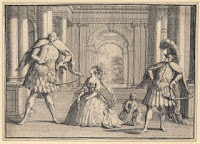
Gaetano Berenstadt – operatic castrato

Italian-born performer who specialised in roles created by Handel

Gaetano Berenstadt, an alto castrato who sang many roles in George Frideric Handel’s operas, was born on this day in 1687 in Florence.  His parents were German and his father played the timpani - kettle drums - for the Grand Duke of Tuscany.  Berenstadt was sent to be a pupil of Francesco Pistocchi, a singer, composer and librettist who founded a singing school in Bologna.  After performing in Bologna and Naples, Berenstadt visited London where he performed the role of Argante in a revival of Handel’s Rinaldo. The composer created three new arias especially for Berenstadt’s voice.  On a later visit to London, Berenstadt sang for the composers of the Royal Academy of Music. On this visit he created the roles of Tolomeo in Handel’s Giulio Cesare, the title role in Flavio, and the role of Adalberto in Ottone.  Back in Italy, he sang music by Italian composers and in two new compositions by Johann Adolph Hasse. He usually took on the role of a villainous tyrant and, despite the quality of his voice, he never portrayed a female character.  His final appearances on stage were in his native Florence.   Read more…

_____________________________________

Pippo Baudo - TV presenter

Record-breaking host of Sanremo festival

The television presenter Pippo Baudo, who became one of the most recognisable personalities on Italian television in a broadcasting career spanning six decades, was born on this day in 1936 in Militello in Val di Catania, in Sicily.  Baudo has presented numerous shows for the national broadcaster Rai and for private networks but is probably best known as the host of the annual Sanremo Music Festival and the presenter of the immensely popular Sunday afternoon magazine show Domenica In.  He was the face of Sanremo a record 13 times between 1968 and 2008, eclipsing another much-loved TV host, Mike Bongiorno, who presented the prestigious song contest on 11 occasions.  Baudo has anchored or co-hosted Domenica In for 11 seasons.  His appearance in the 2016-17 edition of the show came 37 years after he presented the programme for the first time in 1979.  His other major shows include Settevoci, Canzonissima, Fantastico, Serata d'onore and Novecento.  Pippo - short for Giuseppe - is the son of a lawyer, whose father had ambitions for his son to follow a similar career path.  Read more…

Booking.com


Home


6 June 2022

6 June

NEW
- Giotto Bizzarrini - auto engineer

Took part in 1961 rebellion that left Ferrari on brink

The automobile engineer Giotto Bizzarrini, a key figure in the development of Ferrari’s 1960s sports car, the 250 GTO, was born on this day in 1926 in Quercianella, a seaside village on the coast of Tuscany.  Bizzarrini famously joined with two other key engineers and several more employees in quitting Ferrari in October 1961 after a colleague had been sacked by founder Enzo Ferrari following a row over Ferrari’s wife, Laura, interfering in how the company was run.  Their walk-out left Ferrari effectively with no engineers to further develop on-going projects. The marque was already at a low point following the deaths of five of their main drivers in crashes between 1957 and 1961, one of which, at Monza in 1961, saw 15 spectators also lose their lives.  Enzo Ferrari, who was accused of running his company like a dictator, is said to have considered winding it up after Bizzarrini and the others left. The episode is remembered in Ferrari’s history as ‘the Great Walkout’.  Bizzarrini was born into a wealthy family from Livorno. His father was a landowner.  Read more…

_____________________________________

Italo Balbo - Fascist commander

Blackshirt thug turned air commander was Mussolini’s ‘heir apparent’

Italo Balbo, who rose to such a position of seniority in the hierarchy of the Italian Fascists that he was considered the man most likely to succeed Benito Mussolini as leader, was born on this day in 1896 in Quartesana, a village on the outskirts of Ferrara in Emilia-Romagna.  After active service in the First World War, Balbo became the leading Fascist organizer in his home region of Ferrara, leading a gang of Blackshirt thugs who became notorious for their attacks on rival political groups and for carrying out vicious reprisals against striking rural workers on behalf of wealthy landlords.  Later, he was one of the leaders of the March on Rome that brought Mussolini and the Fascists to power in 1922.  As Maresciallo dell'Aria - Marshal of the Air Force - he rebuilt Italy’s aerial warfare capability. At the height of his influence, however, he was sent by Mussolini to be Governor of Italian Libya.  Many believed that Mussolini saw Balbo as a threat and when Balbo was killed when the plane in which he was travelling was shot down - seemingly accidentally - by Italian anti-aircraft guns over Tobruk, there were those among Balbo’s supporters who believed it was not an accident.  Read more…

_____________________________________

Camillo Benso, Count of Cavour

Prime Minister died after creating a united Italy

The first Prime Minister of Italy, Camillo Benso, Count of Cavour, died on this day in 1861 in Turin.  A leading figure in the struggle for Italian unification, Cavour died at the age of 50, only three months after taking office as Prime Minister of the new Kingdom of Italy. He did not live to see Venice and Rome become part of the Italian nation.  Cavour was born in 1810 in Turin, the second son of the fourth Marquess of Cavour. He was chosen to be a page to Charles Albert, King of Piedmont, when he was 14. After attending a military academy he served in the Piedmont-Sardinian army but eventually resigned his commission and went to run his family’s estate at Grinzane in the province of Cuneo instead.  He then travelled extensively in Switzerland, France and England before returning to Turin where he became involved in politics.  Originally he was interested in enlarging and developing Piedmont-Sardinia economically rather than creating a unified Italy.  As Prime Minister he took the kingdom of Piedmont-Sardinia into the Crimean war hoping it would gain him the support of the allies for his plans for expansion.  Read more…

____________________________________

Maria Theresa - the last Holy Roman Empress

Italian noblewoman was first Empress of Austria

Maria Theresa of Naples and Sicily, the last Holy Roman Empress and the first Empress of Austria, was born at the Royal Palace of Portici in Naples on this day in 1772.  She was the eldest daughter of Ferdinand IV & III of Naples and Sicily (later Ferdinand I of the Two Sicilies) and his wife, Marie Caroline of Austria, through whom she was a niece of the last Queen of France, Marie Antoinette.  Named after her maternal grandmother, Maria Theresa of Austria, she was the eldest of 17 children. Her father was a son of Charles III of Spain and through her father she was a niece of Maria Luisa of Spain and Charles IV of Spain.  Although she had a reputation for pursuing a somewhat frivolous lifestyle, which revolved around balls, carnivals, parties and masquerades, she did have some political influence, advising her husband about the make-up of his government and encouraging him to go to war with Napoleon, whom she detested.  She assumed her titles after she married her double first cousin Archduke Francis of Austria on September 15, 1790.  Francis became Holy Roman Emperor at age 24 in 1792.  Read more…

____________________________________

Battle of Novara 1513

Many lives lost in battle between French and Swiss on Italian soil

Swiss troops defeated a French occupying army on this day in 1513 in a bloody battle near Novara in the Piedmont region of northern Italy.  The French loss forced Louis XII to withdraw from Milan and Italy and after his army were pursued all the way to Dijon by Swiss mercenaries, he had to pay them off to make them leave France.  The battle was part of the War of the League of Cambrai, fought between France, the Papal States and the Republic of Venice in northern Italy, but often involving other powers in Europe.  Louis XII had expelled the Sforza family from Milan and added its territory to France in 1508.  Swiss mercenaries fighting for the Holy League drove the French out of Milan and installed Maximilian Sforza as Duke of Milan in December 1512.  More than 20,000 French troops led by Prince Louis de la Tremoille besieged the city of Novara, which was being held by the Swiss, in June 1513.  However, a much smaller Swiss relief army arrived and surprised the French just after dawn on June 6.  German Landsknecht mercenaries, armed with pikes like the Swiss troops, put up some resistance to the attack.  Read more…

EN - 728x90


Home


Giotto Bizzarrini - auto engineer

Took part in 1961 rebellion that left Ferrari on brink

Giotto Bizzarrini was a key Ferrari engineer
Giotto Bizzarrini was a
key Ferrari engineer
The automobile engineer Giotto Bizzarrini, a key figure in the development of Ferrari’s 1960s sports car, the 250 GTO, was born on this day in 1926 in Quercianella, a seaside village on the coast of Tuscany.

Bizzarrini famously joined with two other key engineers and several more employees in quitting Ferrari in October 1961 after a colleague had been sacked by founder Enzo Ferrari following a row over Ferrari’s wife, Laura, interfering in how the company was run.

Their walk-out left Ferrari effectively with no engineers to further develop on-going projects. The marque was already at a low point following the deaths of five of their main drivers in crashes between 1957 and 1961, one of which, at Monza in 1961, saw 15 spectators also lose their lives.

Enzo Ferrari, who was accused of running his company like a dictator, is said to have considered winding it up after Bizzarrini and the others left. The episode is remembered in Ferrari’s history as ‘the Great Walkout’.

Bizzarrini was born into a wealthy family from Livorno. His father was a landowner and his grandfather, also called Giotto, had worked with Guglielmo Marconi on his development of the wireless telegraph.

After obtaining a degree in engineering from the University of Pisa, in 1954 Bizzarrini began his career in the automobile industry with Alfa Romeo, where he trained to be a test driver. He felt it important to his work as an engineer that he understood from a driver’s point of view the problems he was asked to solve.

The Ferrari 250 GTO, developed by Bizzarrini, is still seen as one of Ferrari's best cars
The Ferrari 250 GTO, developed by Bizzarrini,
is still seen as one of Ferrari's best cars
It was as a test driver that he joined Ferrari in 1957. Promotion came quickly and it was not long before he was the company’s chief engineer. 

Bizzarrini’s most notable achievement at Ferrari was the development of the 250 GTO sports car, which even 60 years after it went into production is still regarded as one of the greatest Ferraris. In response to Enzo Ferrari’s concerns over competition from the Shelby Cobra and Jaguar E-Type Lightweight, Bizzarrini developed a shorter wheelbase than the standard 250 GT to improve its handling, as well as more aerodynamic bodywork.

The 250 GTO was capable of reaching 174 mph, which was unheard of at the time. The car won the GT world championship in its class in 1962, 1963 and 1964.

Despite the governing body of motorsport requiring that a minimum 100 examples of a car to be built in order to compete in GT events, only 39 examples of the 250 GTO were built. Enzo Ferrari created the impression that more cars existed by giving them non-consecutive chassis numbers.

Bizzarrini (right) speaks to the driver after a test run of the prototype 250 GTO in 1961
Bizzarrini (right) speaks to the driver after
a test run of the prototype 250 GTO in 1961
Its scarcity value now is such that in 2018, a 1963 Ferrari 250 GTO sold for $70 million dollars at auction, which at the time was a record for any car changing hands at a public auction.

It was Bizzarrini’s success in turning the 250 into a serial winner that made his departure such a serious blow, although in the event the project was completed successfully in his absence. 

The Great Walkout came against a background of rising tensions at Ferrari in which sales manager Girolamo Gardini frequently argued with Enzo Ferrari’s wife, Laura. Matters came to a head when Gardini was joined by Bizzarrini and two other senior staff in demanding that Laura’s involvement with the running of the company. Enzo Ferrari rejected their demands and the four left, along with several other personnel.  It has never been entirely clear whether they resigned, or were sacked.

After Ferrari, Bizzarrini worked for Scuderia Serenissima, the Venice-based racing team run by Count Giovanni Volpi, whose father, Count Giuseppe Volpi, was the founder of the Venice Film Festival, and had a spell with Lamborghini, developing the first of the marque’s successful V12 engines.

His company, Società Autostar, then won a contract with Iso Autoveicoli, building the Iso Rivolta IR 300 and the Iso Grifo. He left Iso after another dispute and began building cars under his own name, starting with the Bizzarrini Grifo Stradale in 1965.

The car evolved into the Bizzarrini 5300 GT Strada, which was produced between 1965 and 1968. Bizzarrini ran into financial difficulties and Bizzarrini Spa was declared bankrupt in 1969, after which his career as an automobile manufacturer was over.

As a consultant and university lecturer, however, he remained an influential figure in the industry, working well into his 80s.

A beach on the rocky waterfront at the seaside village of Quercianella
A beach on the rocky waterfront at
the seaside village of Quercianella.

Travel tip:

Quercianella, where Bizzarrini was born, is a small hamlet situated some 15km (nine miles) south of the port of Livorno on the Tuscan coast, from which it is separated by a stretch of rocky coastline known as Il Romito. Surrounded by tall cliffs lined with pine forests. The village is largely residential but has a small public beach and a salt-water swimming pool. The sea off Quercianella has been praised for its cleanliness and is popular with water sports enthusiasts and has abundant fish stocks. The Quercianella coastline was chosen by a former prime minister, Sidney Sonnino, who led two governments in the 1900s, to build the Castello Sonnino, a neo-medieval style castle residence built on the site of a 16th-century fort built by the Medici. 

Livorno's duomo, the Cathedral of St Francis of Assissi, originally built in the 17th century
Livorno's duomo, the Cathedral of St Francis
of Assissi, originally built in the 17th century
Travel tip:

The port of Livorno is the second largest city in Tuscany after Florence, with a population of almost 160,000. Although it is a large, industrialised  commercial port, it has many attractions, including the elegant Terrazza Mascagni, a waterside promenade with checkerboard paving, and its historic centre – the Venetian quarter – which has a network of canals and a tradition of serving excellent seafood. Situated next to Terrazza Mascagni is the Livorno Aquarium, which has 33 exhibition tanks containing around 300 different species. The city’s cathedral, commonly called Duomo di Livorno and dedicated to Francis of Assisi, can be found on the south side of Piazza Grande.

Also on this day:

1513: The Battle of Novara

1772: The birth of Maria Theresa, the last Holy Roman Empress

1861: The death of Camillo Benso, Count of Cavour, Italy’s first prime minister


Home