19 December 2022

19 December

Italo Svevo - writer

Author who became the main character in somebody else’s novel

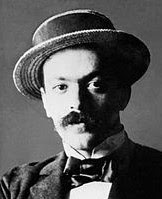
The novelist Italo Svevo was born Aron Ettore Schmitz on this day in 1861 in Trieste, which was then part of the Austrian Empire.  Schmitz took on the pseudonym, Italo Svevo, after writing his novel La Coscienza di Zeno - Zeno’s Conscience.  The novelist himself then became the inspiration for a fictional protagonist in a book by someone else. James Joyce, who was working in Trieste at the time, modelled the main character in Ulysses, Leopold Bloom, on his friend Svevo.  Svevo’s own novel, which revealed his deep interest in the theories of Sigmund Freud, received little interest at the time and might have sunk without trace if it had not been for the encouragement of Joyce, who regarded him as a neglected writer. Joyce helped Svevo get the novel translated into French and, after the translated version was highly praised, the Italian critics discovered it.  Svevo always spoke Italian as a second language because he usually spoke the dialect of Trieste where his novel is set and the story never looks outside the narrow confines of Trieste.  In the novel the main character seeks psychoanalysis to discover why he is addicted to nicotine.  Read more…

______________________________________

Giulio Ricordi - music publisher

Entrepreneur who ‘discovered’ the great Giacomo Puccini 

Giulio Ricordi, who ran the Casa Ricordi publishing house during its peak years in the late 19th and early 20th centuries and launched the career of the brilliant opera composer Giacomo Puccini, was born on this day in 1840 in Milan.  Casa Ricordi was founded by Giulio’s grandfather Giovanni in 1808 and remained in the family when Giovanni died in 1853 and his son, Tito - Giulio's father - took the helm.  Giulio became involved in 1863 after a distinguished military career in the special infantry corps known as the Bersaglieri. He had enrolled as a volunteer with the outbreak of the Second Italian War of Independence in 1859. He took part in the Siege of Gaeta and, after receiving a medal for military valour, was promoted to lieutenant.  During breaks in military activity, Giulio, a keen composer from an early age under the pseudonym of Jules Burgmein, wrote pieces of music, one of which was intended as a national anthem dedicated to Victor Emmanuel II of Savoy, but which was instead adopted as the anthem of the Bersaglieri.  He left military service after his father, who had nurtured the career of the composer Giuseppe Verdi.  Read more…

_____________________________________

Alberto Tomba – Italy’s greatest skier

Playboy showman who won three Olympic golds

Italy’s greatest alpine ski racer, Alberto Tomba, was born on this day in 1966 in San Lazzaro di Savena, a town in Emilia-Romagna that now forms part of the metropolitan city of Bologna.  Tomba – popularly known as ‘Tomba la Bomba’ – won three Olympic gold medals, two World Championships and won no fewer than nine titles in thirteen World Cup seasons, between 1986 and 1998.  The only other Italian Alpine skiers with comparable records are Gustav Thoni, who won two Olympic golds and four World Championships in the 1970s, and Deborah Compagnoni, who won three golds at both the Olympics and the World Championships between 1992 and 1998.  Thoni would later be a member of Tomba’s coaching team.  Tomba had showmanship to match his talent on the slopes. Always eager to seek out the most chic nightclubs wherever he was competing, he would drive around the centre of Bologna in an open-topped Ferrari, flaunting both his wealth and his fame.  At his peak, he would arrive with his entourage in the exclusive ski resort at Aspen, Colorado to hold open house at his rented chalet on Buttermilk Mountain.  Read more…

_____________________________________

Gianni Brera - football journalist

Outspoken writer who embellished Italian language

Italy's football world lost one of its most influential personalities on this day in 1992 when a car crash near the town of Codogno in Lombardy claimed the life of the journalist Gianni Brera.  Brera, who was 73, had enjoyed a long and often controversial career in which his writing was famous not only for its literary quality but for his outspoken views.  He could be savage in his criticisms of players and allowed reputations to count for nothing.  His long-running feud with Gianni Rivera, the AC Milan midfielder regarded by many as one of Italian football's all-time greats, in some ways defined his career.  Yet the positions he occupied in Italian football journalism gained him enormous respect.  He rose to be editor-in-chief of La Gazzetta dello Sport, Italy's biggest sports newspaper, before he was 30 and went on to write for Il Giorno, Il Giornale and La Repubblica among the country's heavyweight news dailies.  The intellectual La Repubblica for many years considered sport to be too trivial to be worthy of coverage, an attitude that persisted even through the 1970s. But the style and innovative brilliance of Brera's writing was a major factor in persuading them to drop their stance.  Read more…


Home


18 December 2022

18 December

Antonio Stradivari – violin maker

Craftsman from Cremona produced the world’s best stringed instruments

The man who produced violins worth millions, Antonio Stradivari, died at the age of 93 on this day in Cremona in 1737.  Stradivari was an ordinary man who worked as a luthier, a maker of stringed instruments, but experts now consider him to be the greatest ever in his field.  He is believed to have produced more than 1,100 instruments, often referred to as 'Stradivarius' violins.  About 650 of them are still in existence today and in the last few years some of his violins and violas have achieved millions of dollars at auction.  The Stradivari family date back to the 12th century in Cremona and it is believed Antonio was born there in 1644.  It is thought he was apprenticed to the violin maker Nicolò Amati. The label on the oldest violin still in existence, known to have been made by Stradivari, bears the date 1666.  He had enough money to buy a house for himself and his family in Cremona by 1680. He used the attic as a workshop and kept producing better and better instruments until his reputation spread beyond Cremona.  In 1688 a Venetian banker ordered a set of instruments to present to King James II of England.  Read more…

____________________________________

Mara Carfagna - politician

Former glamour model now important voice in Italian parliament

The politician Mara Carfagna, a one-time glamour model and TV hostess who became vice-president of the Chamber of Deputies in the Italian parliament, was born on this day in 1975 in Salerno.  Originally named Maria Rosaria Carfagna, she left high school to study dance at the school of the Teatro San Carlo in Naples, obtaining a diploma before going on to study acting and the piano.  In 1997 she won a beauty contest as Miss 1997 and participated in the finals of Miss Italia. She had her first experience in television as one of the co-presenters during the 1997-98 season of the Rai variety show, Domenica In, with Fabrizio Frizzi.  Carfagna found herself in demand as a model and posed for some magazine and calendar shoots, but at the same time was studying law at the University of Salerno, graduating with honours in 2001.  More television work came her ways as a glamourous co-presenter of the Mediaset show La domenica del villaggio alongside Davide Mengacci, moving on to present another entertainment show Piazza grande together with Giancarlo Magalli.  Read more…

____________________________________

Camillo Castiglioni - business entrepreneur

Young man from Trieste who reached for the skies

Camillo Castiglioni, a financier and aviation pioneer once reputed to be the wealthiest man in Central Europe, died on this day in 1957 in Rome.  Castiglioni was an Italian-Austrian banker who played a big part in the early days of aviation and also invested his wealth in the arts.  He was born in Trieste in 1879, when the port on the Adriatic, now firmly established as part of Italy, fell within the boundaries of Austria-Hungary.  His father, Vittorio, was a prominent figure in the large Jewish community in Trieste, where he was vice-rabbi, and there were hopes that Camillo might also become a rabbi. But after being educated in the law and working as an attorney and legal officer in a bank in Padua, where he quickly learnt about international finance and how to manage capital, it was clear his focus would be business.  Vittorio had been a rubber manufacturer and his son soon enjoyed financial success working as an agent in Vienna for a tyre maker in Constantinople.  He made good contacts both in business circles and the imperial court in Vienna, becoming a personal friend of the young Archduke Charles.  Read more…

________________________________________

Gianluca Pagliuca – record-breaking goalkeeper

No one has saved more penalties in Serie A matches

The footballer Gianluca Pagliuca, once the most expensive goalkeeper in the world, record-holder for the most appearances by a goalkeeper in the Italian soccer championship and still the stopper with the most penalty saves in Serie A, was born on this day in 1966 in Ceretolo, a small town about 10km (6 miles) from the centre of Bologna.  Pagliuca made 592 appearances in Serie A, taking the record previously held by Italy’s World Cup-winning captain Dino Zoff for the most by a goalkeeper in the top division of the Italian League. He held the record for 10 years from September 2006 until it was overtaken by another of Italy’s greatest goalkeepers, Gianluigi Buffon, in 2016.  He played for four major clubs in his career, starting with Sampdoria, with whom he won the Serie A title – the Scudetto – in 1990-91, playing in the team that included Gianluca Vialli, Roberto Mancini, Beppe Dossena, Attilio Lombardo and Ivano Bonetti.  After Sampdoria, he represented Internazionale in Milan, his home-town club Bologna and the small club Ascoli, from Ascoli Piceno in Marche.  He also made 39 appearances for the Italian national team.  Read more…


Home


17 December 2022

17 December

NEW
- Remains of exiled monarch returned to Italy

Repatriation of Vittorio Emanuele III sparked anger

The remains of Italy’s wartime king, Vittorio Emanuele III, were returned to Italian soil on this day in 2017, 70 years after his death in exile in Egypt.  His body had been buried in St. Catherine’s Catholic Cathedral in Alexandria since 1947, when he died at the age of 78, a year and a half after abdicating in favour of his son, Umberto II.  His remains were flown to Italy by military aircraft for reburial at his family’s mausoleum at the Sanctuary of Vicoforte, a church in the province of Cuneo, Piedmont. At the same time, the body of his wife, Queen Elena, who had died in France in 1952, was flown to Italy from Montpelier, so that they could be buried side by side.  Vittorio Emanuele’s coffin, draped in a flag bearing the coat of arms of the Savoy family, was taken from the plane at Cuneo’s small Levaldigi airport and escorted to the Sanctuary solely by local officials, including the prefect vicar, the local village mayor and the president of Cuneo’s Chamber of Commerce. Only a handful of people were allowed in the church for the interment ceremony.  Read more…

__________________________________________

NATO boss seized by Red Brigades

Brigadier-General James L Dozier held for 42 days

Three years after the kidnap and murder of the former Italian prime minister Aldo Moro shocked Italy and the wider world, terrorists representing the ultra-left group Brigate rosse - the Red Brigades - returned to the headlines on this day in 1981 with the abduction of the high-ranking United States Army officer James L Dozier.  Brigadier-General Dozier, who was serving in Italy as deputy Chief of Staff of NATO's Southern European land forces, was seized and taken from his apartment in Verona and held for 42 days before being rescued by Italian special forces. The kidnap took place at between 5.30 and 6pm when four men turned up at the door of the apartment posing as plumbers.  The general was overpowered and then struck over the head before his wife, Judith, who was initially held at gunpoint, was tied up with chains and plastic tape.  According to his wife, 50-year-old General Dozier was then bundled into what she described as a "steamship trunk", which the men carried out to a waiting van.  Mrs Dozier was left in the apartment, alerting neighbours later by banging on the walls.  It was the first time the Red Brigades had held a member of the American military, or any foreign national.  Read more…

________________________________________

Domenico Cimarosa – opera composer

Musician who developed the model for ‘comic opera’

A prolific composer of operas, Domenico Cimarosa was born on this day in 1749 in Aversa, between Naples and Caserta in Campania.  Cimarosa wrote more than 80 operas during his lifetime, including Il matrimonio segreto (The Secret Marriage), which is considered to be his finest work.  Other composers judge it to be among the greatest examples of opera buffa, the Italian term for comic opera and Verdi considered it to be the model for the genre.  Cimarosa attended a free school connected to a monastery in Naples where the organist taught him music and as a result obtained a scholarship to attend a musical institute in the city for 11 years. He wrote his first opera at the age of 23 and, after several successes in theatres in Naples, he was invited to Rome where he produced another comic opera, L’Italiano in Londra.  He travelled throughout Italy, writing operas for theatres in Naples, Rome and Florence until he was invited to St Petersburg by Empress Catherine II. He remained at her court for four years composing music for important occasions.  He then went to Vienna at the invitation of Leopold II where he produced his masterpiece, Il matrimonio segreto.  Read more…

_______________________________________

Ettore Tito - painter

Artist who captured life in Venice

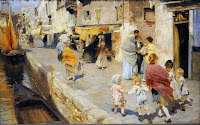
The painter Ettore Tito, whose landscapes and scenes from contemporary life in Venice earned him a substantial following in the late 19th and early 20th centuries, was born on this day in 1859 in Castellammare di Stabia, near Naples.  Despite his southern roots, Tito spent most of his life in Venice. His Campanian father captained merchant ships but his mother was Venetian and they moved to Venice when Ettore was still a child.  His prodigious talent for art emerged at an early age. He was taken under the wing of the Dutch artist Cecil van Haanen and was accepted by the Accademia di Belle Arti at the age of 12, graduating at 17 after studying under Pompeo Marino Molmenti, a distinguished professor.  Tito appreciated the beauty of Venice but wanted his paintings to capture the character of the city and its people. He earned the first important recognition of the quality of his work when his 1887 painting Pescheria vecchia a Venezia, a busy scene of traders and customers at the fish market by the Rialto bridge, won great praise at the Esposizione Nazionale Artistica in Venice and was subsequently bought by the Galleria Nazionale d'Arte Moderna in Rome.  Read more…

________________________________________

Pope Paul III excommunicates Henry VIII

The day a pontiff finally lost patience with the Tudor king

Pope Paul III announced the excommunication of King Henry VIII of England from the Catholic Church on this day in 1538 in Rome.  Henry had been threatened with excommunication by the previous pope, Clement VII, in 1533 after he married Anne Boleyn. However, Clement did not act on his threat straight away, hoping Henry might come to his senses.  Henry had been awarded the title of Defender of the Faith by a previous pope because he had written a defence of the seven sacraments of the Catholic church against the protestant leader Martin Luther.  But Clement died the following year and a new pope had to be elected.  Pope Paul III, who was born Alessandro Farnese, became pontiff in 1534 and took on the job of organising the Counter Reformation as well as using nepotism to advance the power and fortunes of the Farnese family.  When it became clear Henry was intent on demolishing the Catholic Church in England, Paul III issued the original papal bull - edict - drawn up by Clement VII.  He lost patience with Henry after he declared himself head of the Church of England and started ordering the execution of anyone who stood in his way.  Read more…

________________________________________

Leopoldo Eleuteri - flying ace

World War I pilot claimed eight aerial victories

First World War pilot Leopoldo Eleuteri, who was credited with seven of the eight combat victories he claimed, was born in Castel Ritaldi, a small town in Umbria about 60km (37 miles) by road southeast of Perugia, on this day in 1894.  Eleuteri did not begin flying active combat sorties as a fighter pilot until February 1918 but progressed rapidly with the 70th Squadron of the Corpo Aeronautico Militare, the airborne arm of the Royal Italian Army.  He went on to fly more than 150 sorties and between April 1918 and October 1918 claimed eight enemy planes shot down, being eventually credited with seven successes in his own right.  Passionate about all forms of mechanised flight since he was a boy, Eleuteri volunteered for aeronautical service as soon as he was old enough.  He was a student in a technical school until he was conscripted in 1915. At first, he was assigned to duty in ordnance factories before being sent to join the 3rd Infantry Regiment of the Royal Italian Army.  There, he was allowed to begin aviation training. In October 1916, he qualified as a pilot at Gabardini's flying school at Cameri in Piedmont.  Read more…

_____________________________________

Rome falls to the Ostrogoths

Sacking in 546 left city a shadow of its former self

The Ostrogoths, the Germanic tribe that took over large parts of the Italian peninsula with the collapse of the Western Roman Empire, achieved a symbolic victory on this day in 546 when an army under the leadership of King Totila captured and sacked Rome following a year-long siege of the Eternal City.  The event was part of the Gothic War between the Ostrogoths, who had originated on the Black Sea in the area now known as Crimea, and the Byzantine (Eastern) Empire, between 535 and 554.  Totila led a fightback by the Ostrogoths after the fall of the Gothic capital at Ravenna in 540 signalled the apparent reconquest of Italy by the Byzantines.  He had swept south with his forces and was based at Tivoli, east of Rome, as he plotted how he would recapture the region of Latium. In 545, he laid siege to the city.  Bessas, the commander of the imperial garrison charged with protecting the city, was stubborn but cruel to the Roman citizens.  Although he had a stock of grain, he would not let it be used to feed the population unless they paid for it, while at the same time refusing requests from citizens to leave the city.  Read more…

Booking.com


Home


Remains of exiled monarch returned to Italy

Repatriation of Vittorio Emanuele III sparked anger

Vittorio Emanuele III's original funeral, which took place in Alexandria, Egypt in 1947
Vittorio Emanuele III's original funeral, which
took place in Alexandria, Egypt in 1947
The remains of Italy’s wartime king, Vittorio Emanuele III, were returned to Italian soil on this day in 2017, 70 years after his death in exile in Egypt.

His body had been buried in St. Catherine’s Catholic Cathedral in Alexandria since 1947, when he died at the age of 78, a year and a half after abdicating in favour of his son, Umberto II.

His remains were flown to Italy by military aircraft for reburial at his family’s mausoleum at the Sanctuary of Vicoforte, a church in the province of Cuneo, Piedmont. At the same time, the body of his wife, Queen Elena, who had died in France in 1952, was flown to Italy from Montpelier, so that they could be buried side by side.

Vittorio Emanuele’s coffin, draped in a flag bearing the coat of arms of the Savoy family, was taken from the plane at Cuneo’s small Levaldigi airport and escorted to the Sanctuary solely by local officials, including the prefect vicar, the local village mayor and the president of Cuneo’s Chamber of Commerce. Only a handful of people were allowed in the church for the interment ceremony. 

Vittorio Emanuele III, pictured with Mussolini (left) and Hitler in Rome in 1938, was a flawed figure to many Italians
Vittorio Emanuele III, pictured with Mussolini (left) and Hitler
in Rome in 1938, was a flawed figure to many Italians 
For all that it was a low-key affair, the repatriation made headlines, and much of the reaction in Italy was critical.

Vittorio Emanuele enjoyed popularity at times during his 46-year reign, enjoying the nickname Re soldato - the soldier king - after Italy’s victory in World War One, and Sciaboletta - little sabre - because his diminutive size - he was only five feet tall - required the sword of his military uniform to be shortened.

But his reputation was fatally damaged by the decisions he took during the time of Benito Mussolini’s Fascists.

When Mussolini's Blackshirts marched on Rome in 1922, he not only refused the government request to declare martial law, he then handed power to Mussolini, inviting him to be prime minister.

Many refused to forgive him for signing Mussolini’s 1938 racial laws that harshly discriminated against Jews.

He did order Mussolini’s arrest in 1943 when it became obvious that Italy’s war was going to end in defeat. But he attracted more criticism for taking 40 days to agree an armistice with the Allies, which gave the Germans time to entrench themselves in northern Italy and even to free Mussolini from his house arrest in the mountains of Abruzzo.

Vittorio Emanuele as a baby with his mother, Queen Margherita
Vittorio Emanuele as a baby with
his mother, Queen Margherita
Vittorio Emanuele then fled Rome, which was seen as an act of cowardice. His decision to hand power to his son in 1946, shortly before the referendum in which Italians would vote to become a republic, was a desperate attempt to save the monarchy.

It was not enough to persuade Italian voters, however. Following the referendum result, all male members of the monarchy and their descendants were ordered to leave the country in a ban that remained in place until 2002.

The decision to bury the late monarch in relative obscurity attracted criticism from members of his family. Italy’s first two Savoy kings, Vittorio Emanuele II and Umberto I, and its first queen, Margherita, were all buried at the Pantheon in Rome. 

Emanuele Filberto, Vittorio Emanuele III and Elena’s great-grandson, was quoted as saying that while he was pleased with the return of his ancestors to Italy, he believed that all members of the House of Savoy deserved to be in the Pantheon.  

But this was strongly opposed by historians, on the grounds that the circular former Roman temple was traditionally a place where Italians of high esteem were laid to rest.

It also provoked an angry response from Rome’s Jewish community. Like other Italians of Jewish heritage, they could never forgive the king’s co-operation with Mussolini. But they were also sensitive to the proximity of the Pantheon to the city’s former ghetto, which saw more than 1,000 residents rounded up and sent to their death in concentration camps in 1943.

The ex-monarch's tomb at the Sanctuary of Vicoforte
The ex-monarch's tomb at
the Sanctuary of Vicoforte
Travel tip:

The city of Cuneo, which developed at the confluence of the Stura and Gesso rivers, is set out in a grid system with a large, elegant central square, Piazza Galimberti, one of the largest squares in Italy, after Piazza del Plebiscito in Naples. Surrounded by neo-classical buildings, it has a large statue of Giuseppe Barbaroux, the author of the Albertine Statute that formed the constitution of the Kingdom of Sardinia-Piedmont in 1848. The square is named after Duccio Galimberti, one of the heroes of the Italian resistance in the Second World War.   Cuneo had been acquired by the Duchy of Savoy in 1382 and remained an important stronghold of the Savoy state for many centuries.

The Pantheon in Rome, built in AD 118, contains the remains of many notable Italians
The Pantheon in Rome, built in AD 118, contains
the remains of many notable Italians

Travel tip

The Pantheon in Piazza della Rotonda in Rome is considered to be Rome’s best preserved ancient building. It was built in AD 118 on the site of a previous building dating back to 27 BC. It was consecrated as a church in the seventh century. In addition to Vittorio Emanuele II, his son, Umberto I, and his wife, Queen Margherita, the Pantheon contains the tombs of the painters Raphael and Annibale Carracci, the architect Baldassare Peruzzi and the composer Arcangelo Corelli.

Also on this day:

546: Rome falls to the Ostrogoths

1538: Pope Paul III excommunicates Henry VIII of England

1749: The birth of composer Domenico Cimarosa

1859: The birth of painter Ettore Tito

1894: The birth of WW1 pilot Leopoldo Eleuteri

1981: Red Brigades seize NATO boss Dozier


Home