4 January 2023

4 January

Gaetano Merola – conductor and impresario

Neapolitan who founded the San Francisco Opera

Gaetano Merola, a musician from Naples who emigrated to the United States and ultimately founded the San Francisco Opera, was born on this day in 1881.  Merola directed the company and conducted many performances for 30 years from its opening night in September 1923 until his death in August 1953.  He literally died doing what he loved, collapsing in the orchestra pit while conducting the San Francisco Symphony Orchestra during a concert at an outdoor amphitheatre in the city.  The son of a violinist at the Royal Court in Naples, Merola studied piano and conducting at the Conservatorio di San Pietro a Majella in Naples, graduating with honours at the age of 16.  Three years later he was invited to New York to work as assistant to Luigi Mancinelli, another Italian emigrant, born in Orvieto, who was a noted composer and cellist who was lead conductor of the New York Metropolitan Opera.  Demand for his services grew and he made regular guest appearances with companies across America and beyond, including a stint at Oscar Hammerstein’s London Opera House on the site of what is now the Peacock Theatre in Holborn.   Read more…

_______________________________________

Carlo Levi – writer and painter

Author and doctor who highlighted poverty in southern Italy

The anti-Fascist writer, painter and doctor, Carlo Levi, died on this day in Rome in 1975.  He is best remembered for his book Christ Stopped at Eboli - Cristo si è fermato a Eboli - an account of the time he spent in political exile in a remote, impoverished part of Italy.  Levi was born in Turin in 1902. His father was a wealthy Jewish physician and Levi went to the University of Turin to study medicine after finishing school.  While at University he became active in politics and after graduating he turned his attention to painting.  But he never completely abandoned medicine and moved to Paris to continue his medical research while painting.  After returning to Italy, Levi founded an anti-Fascist movement in 1929. As a result he was arrested and sent into exile to a remote area of Italy called Lucania (now renamed Basilicata).  He encountered extreme poverty, which had been unknown in the north where he grew up. As well as writing and painting while he was in exile, he served as a doctor to help the poor villagers he lived among.  When he was released from his political exile he moved back to France but on his return to Italy he was arrested again.  Read more…

________________________________________

Pino Daniele - singer and songwriter

Naples mourned star with flags at half-mast

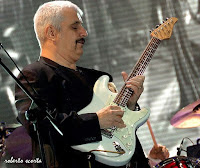
The Neapolitan singer-songwriter Pino Daniele died on this day in 2015 in hospital in Rome.  Daniele, whose gift was to fuse his city’s traditional music with blues and jazz, suffered a heart attack after being admitted with breathing difficulties. Daniele, who had a history of heart problems, had been taken to Rome after falling ill at his holiday home in Tuscany.  On learning of his death, the Naples mayor Luigi de Magistris ordered that flags on municipal buildings in the city be flown at half-mast.  Born in 1955, Daniele grew up in a working class family in the Sanità neighborhood of Naples, once a notorious hotbed of crime. His father worked at the docks.  As a musician, he was self-taught, mastering the guitar with no formal lessons and developing a unique voice, alternately soaring and soft, and gravelly to the point of sounding almost hoarse.  He named the great American jazz musicians Louis Armstrong and George Benson as his major influences but also drew deeply on the life, culture and traditions of his home city, which he loved.  His songs sometimes combined Italian, English and Naples dialect.  Read more…

______________________________________

Giuseppe ‘Pino’ Greco - Mafia executioner

Notorious hitman thought to have committed at least 80 murders

The notorious Mafia hitman Giuseppe Greco, who was convicted posthumously on 58 counts of murder but whose victims possibly ran into hundreds, was born on this day in 1952 in Ciaculli, a town on the outskirts of Palermo in Sicily.  More often known as ‘Pino’, or by his nickname Scarpuzzedda - meaning ‘little shoe’ - Greco is considered one of the most prolific killers in the history of organised crime.  The nephew of Michele Greco, who lived on an estate just outside Ciaculli and rose to be head of the Sicilian Mafia Commission - a body set up to settle disputes between rival clans - Pino Greco is generally accepted to have been responsible for 80 deaths, although some students of Cosa Nostra history believe he could have committed more than 300 killings.  Most of Greco’s victims were fellow criminals, the majority of them killed during the Second Mafia War, which began in 1978 and intensified between 1981 and 1983 with more than 1,000 homicides, as rival clans fought each other and against the state, with judges, prosecutors and politicians prominent in the fight against organised crime themselves becoming targets.  Read more…

______________________________________

Giovanni Battista Pergolesi – composer

Brief career of 'opera buffa' genius

Opera composer Giovanni Battista Pergolesi was born on this day in 1710 as Giovanni Battista Draghi, in Jesi, in what is now the province of Ancona.  He later acquired the name Pergolesi, the Italian word for the residents of Pergola in Marche, which had been the birthplace of his ancestors.  Pergolesi was the most important early composer of opera buffa - comic opera. He wrote a two-act buffa intermezzo for one of his serious operas, which later became a popular work in its own right.  He also wrote sacred music and his Stabat Mater, composed in 1736, has been used in the soundtracks of many contemporary films.  Pergolesi received a musical education at the Conservatorio dei Poveri in Naples where he gained a good reputation as a violinist.  In 1732 he was appointed maestro di cappella to the Prince of Stigliano in Naples and produced for him an opera buffa, Lo frate ‘nnammorato, and a sacred work, believed to be his Mass in D, which were both well received.  The following year his serious opera, Il prigionier superbo, was produced but it was the comic intermezzo, La serva padrona, inserted between the acts, that was most popular, revealing his gift for comic characterisation.  Read more…


Home


3 January 2023

3 January

NEW - Giovanni Treccani - businessman and patron of culture

Industrialist used his profits to encourage learning and preserve patrimony

Textile entrepreneur and publisher Giovanni Treccani, who founded an Italian encyclopaedia now known as Enciclopedia Treccani, was born on this day in 1877 in Montichiari near Brescia in Lombardy.  Born Giovanni Treccani degli Alfieri, he was the son of a pharmacist and a noblewoman from Brescia. At the age of 17 he emigrated to Germany to work in the textile industry. He returned a few years later with a small amount of capital and the technical knowledge necessary to set up his own textile business in Italy. He began in a small way but went on to become a captain of industry.  In the years after World War I, Treccani was the owner of several cotton mills. In 1919, he was able to give a generous sum of money to help the Accademia dei Lincei in Rome, the oldest scientific institute in Europe, which was in grave difficulties.  In 1923, he donated La Bibbia di Borso d’Este, a rare illustrated manuscript, to the Kingdom of Italy, after paying five million lire to buy it in Paris. This was to prevent a major work of Renaissance art from going overseas. The volume is currently housed in the Biblioteca Estense of Modena.  Read more…

_____________________________________

Pietro Metastasio – poet and librettist

From street entertainer to leading libretto writer

Pietro Metastasio, who became Europe’s most celebrated opera librettist in the 18th century, was born on this day in 1698 in Rome.  He was christened Pietro Antonio Domenico Trapassi, one of four children born to Felice Trapassi, from Assisi and Francesca Galasti from Bologna. His father served in the papal forces before becoming a grocer in Via dei Cappellari.  While still a child, Pietro could attract crowds by reciting impromptu verses. On one occasion, in 1709, Giovanni Vincenzo Gravina, director of the Arcadian Academy, stopped to listen. He was so impressed that he made the young boy his protégé and later adopted him, changing his surname to Metastasio.  He provided the young Metastasio with a good education and encouraged him to develop his talent.  When Gravina was on his way to Calabria on a business trip, he exhibited Metastasio in the literary circles of Naples, but after the young boy became ill, he placed him in the care of a relative to help him recuperate.  Gravina decided Metastasio should never improvise again but should concentrate on his education and reserve his talent for nobler efforts.  Read more...

____________________________________

Sergio Leone – film director

Distinctive style of  ‘Spaghetti Western’ creator

Italian film director, producer and screenwriter Sergio Leone was born on this day in 1929 in Rome.  Leone is most associated with the ‘spaghetti western’ genre of films, such as the Dollars trilogy of westerns featuring Clint Eastwood.  He had a distinctive film-making style that involved juxtaposing extreme close-up shots with lengthy long shots.  Leone’s father was a film director and his mother was a silent film actress. He went to watch his father at work on film sets from an early age.  He dropped out of university to begin his own career in the industry at the age of 18 as an assistant to the director Vittorio De Sica.  He began writing screen plays and worked as an assistant director on Quo Vadis and Ben Hur at Cinecittà in Rome.  When the director of The Last Days of Pompeii fell ill, Leone was asked to step in and complete the film.  He made his solo debut as a director with The Colossus of Rhodes in 1961.   Leone turned his attention to making spaghetti westerns in the 1960s and his films, A Fistful of Dollars, For a Few Dollars More and The Good, the Bad and the Ugly were big financial successes.  Read more…

_______________________________________

Renato Carosone – singer-songwriter

Composer revived popularity of the traditional Neapolitan song

Renato Carosone, who became famous for writing and performing Neapolitan songs in modern times, was born Renato Carusone on this day in 1920 in Naples.  His 1956 song Tu vuo’ fa’ l’Americano - 'You want to be American' - has been used in films and performed by many famous singers right up to the present day.  Torero, a song released by him in 1957, was translated into 12 languages and was at the top of the US pop charts for 14 weeks.  Carosone studied the piano at the Naples Conservatory of San Pietro a Majella and obtained his diploma in 1937, when he was just 17. He went to work as a pianist in Addis Ababa and then served in the army on the Italian Somali front. He did not return to Italy until 1946, after the end of the Second World War.  Back home, he had to start his career afresh and moved to Rome, where he played the piano for small bands.  He was asked to put together a group for the opening of a new club and signed Dutch guitarist, Peter van Houten and Neapolitan drummer, Gegè di Giacomo, with whom he launched the Trio Carosone.  When Van Houten left to pursue a solo career, Di Giacomo remained with Carosone and they recruited more musicians to form a new band.  Read more…

_____________________________________

Baldassare Galuppi – opera composer

Musician from Burano had a talent for comic opera

The prolific Venetian composer Baldassare Galuppi, who worked alongside the playwright Carlo Goldoni, died on this day in 1785 in Venice.  At the height of his career, Galuppi achieved international success, working at different times in Vienna, London and Saint Petersburg, but his main base was Venice, where he held a succession of prestigious posts during his life. Galuppi was born on the island of Burano in the Venetian lagoon and was sometimes referred to as Il Buranello, a signature he used on his music manuscripts. His father was a barber who also played the violin in an orchestra, and is believed to have been his first music teacher.  At the age of 15, Galuppi wrote his first opera, which was performed at Chioggia and Vicenza. He then became harpsichordist at the Teatro della Pergola in Florence.  In the early part of his career, Galuppi was successful in the opera seria genre, but after 1749 many of his operas were comic collaborations with the Venetian dramatist Carlo Goldoni. The most popular of his comic operas was his 1754 composition Il filosofo di campagna – The Country Philosopher.  Read more…

______________________________________

Cicero - politician and philosopher

Roman writer and orator revered by Renaissance scholars

Marcus Tullius Cicero, the Roman lawyer, politician, philosopher and great orator whose rediscovered works were an important driver of the Renaissance in the 14th century, was born on this day in 106BC in Arpinum, a hill town about 100km (62 miles) southeast of Rome known today as Arpino.  A loyal supporter of the Roman Republic, Cicero’s brilliance as a student of Roman law and his effectiveness as a speaker led to his rapid rise in Roman politics, which saw him become the youngest citizen to attain the rank of consul, the highest political office of the republic, without hailing from a political family.  Although his political career foundered after his opposition to the secret alliance between Caesar, Pompey and Crassus known as the First Triumvirate, forced him into exile, Cicero turned to writing, producing many works relating to philosophy, as well as hundreds of letters and speeches.  Much of his work disappeared after his death, but was rediscovered by 14th century scholars, most notably Francesco Petrarca - Petrarch - as academics sought to enhance their knowledge by seeking out ancient Greek and Roman texts. Read more…

_____________________________________

Gianfranco Fini – politician

Party leader who moved away from fascism

Gianfranco Fini, former leader of the Alleanza Nazionale (National Alliance), the post-fascist political party in Italy, was born on this day in 1952 in Bologna.  Fini has been President of the Italian Chamber of Deputies and was Deputy Prime Minister and Minister of Foreign Affairs in Silvio Berlusconi’s Government from 2001 to 2006.  His father, Argenio ‘Sergio’ Fini, was a volunteer with the Italian Social Republic, a fascist state in Northern Italy allied with Germany between 1943 and 1945.  His maternal grandfather, Antonio Marani, took part in the march on Rome, which signalled the beginning of Italian Fascism in 1922.  Fini’s first name, Gianfranco, was chosen in memory of his cousin, who was killed at the age of 20 by partisans after the liberation of northern Italy on 25 April, 1945.  Fini became interested in politics at the age of 16, after he was involved in a clash with communist activists and he went on to join the Italian Social Movement (MSI), a neo-fascist political party.  After graduating from La Sapienza University in Rome he became involved with the party’s newspaper, Il Secolo d’Italia.   Read more…


Home


Home


Giovanni Treccani – businessman and patron of culture

Industrialist used his profits to encourage learning and preserve patrimony

Giovanni Treccani made his fortune in textiles
Giovanni Treccani made
his fortune in textiles
Textile entrepreneur and publisher Giovanni Treccani, who founded an Italian encyclopaedia now known as Enciclopedia Treccani, was born on this day in 1877 in Montichiari near Brescia in Lombardy.

Born Giovanni Treccani degli Alfieri, he was the son of a pharmacist and a noblewoman from Brescia. At the age of 17 he emigrated to Germany to work in the textile industry. He returned a few years later with a small amount of capital and the technical knowledge necessary to set up his own textile business in Italy. He began in a small way but went on to become a captain of industry.

In the years after World War I, Treccani was the owner of several cotton mills. In 1919, he was able to give a generous sum of money to help the Accademia dei Lincei in Rome, the oldest scientific institute in Europe, which was in grave difficulties.

In 1923, he donated La Bibbia di Borso d’Este, a rare illustrated manuscript, to the Kingdom of Italy, after paying five million lire to buy it in Paris. This was to prevent a major work of Renaissance art from going overseas. The volume is currently housed in the Biblioteca Estense of Modena.

The following year, Treccani became a Senator of the Kingdom of Italy and in 1931 he set up the society Treves-Treccani-Tumminelli, which later became Istituto della Enciclopedia Italiana. The institute published the Enciclopedia Italiana and the Dizionario Biografica degli Italiani. Treccani had seen young Germans using encyclopaedias and dictionaries and realised that Italy lacked a national encyclopaedia of its own.

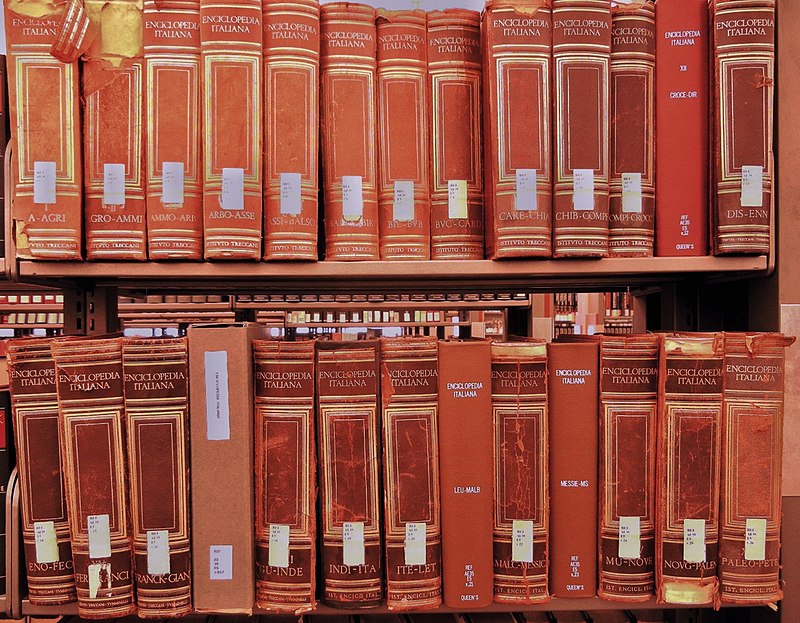
The Enciclopedia Italiana originally consisted of 35 volumes, published serially between 1929 and 1936
The Enciclopedia Italiana originally consisted of 35
volumes, published serially between 1929 and 1936
From 1925 to 1937, Treccani oversaw the industry section of the encyclopaedia. From 1933 to 1938 he was vice president, and from 1954 honorary president of the institute.

Treccani was given the title of Count in 1937 and two years later received an honorary degree in literature and philosophy from the University of Milan in recognition of his contribution to history and culture. He had founded the Lombardy committee of the History and Risorgimento Society, of which he was president from 1929 to 1938, and set up the Association of Italo-German Culture in 1932. He also served as president of the Theatre Museum at La Scala in Milan.

In 1942 he set up the Treccani degli Alfieri Foundation which published The History of Milan.  In 1949 he founded As.Li.Co. (Associazione Lirica e Concertistica) to give young singers opportunities to sing in prestigious theatres. The year before he died, Treccani set up a foundation for the History of Brescia.

Today, there are online editions of the Treccani Enciclopedia and Treccani Dictionary.

Treccani, who was the father of the painter Ernesto Treccani, died in Milan in 1961.

The Piazza della Loggia is an elegant square in the centre of the Lombardy city of Brescia
The Piazza della Loggia is an elegant square
in the centre of the Lombardy city of Brescia
Travel tip:

Treccani was born in Brescia, Lombardy’s second city after Milan. Although a place of great artistic and architectural importance, Brescia is not well-known to tourists. It had become a Roman colony before the birth of Christ and there are remains from the forum, theatre, and a temple. The town was fought over by different rulers in the middle ages but came under the protection of Venice in the 15th century. There is a distinct Venetian influence in the architecture of the Piazza della Loggia, an elegant square in the centre of the town, which has a clock tower like the one in Piazza San Marco in Venice. Next to the 17th century Duomo is a much older cathedral, the unusually shaped Duomo Vecchio, also known as la Rotonda, which is still open to the public. The Santa Giulia Museo della Citta covers more than 3000 years of Brescia’s history, housed within the Benedictine Nunnery of San Salvatore and Santa Giulia in Via Musei. The nunnery was built over a Roman residential quarter, but some of the houses, with their original mosaics and frescoes, have now been excavated and can be seen from above by visitors to the museum.

The Biblioteca Estense in Modena began life as the library of the dukes of Este in the 14th century
The Biblioteca Estense in Modena began life as
the library of the dukes of Este in the 14th century
Travel tip:

The Biblioteca Estense in Modena was the family library of the dukes of Este and is known to have existed as far back as the 14th century. Situated below the Palazzo dei Musei in Modena, It is considered one of the most important libraries in Italy and now has more than 500,000 printed works. The Biblioteca’s most famous manuscript is the 1,200-page Bible of Borso d’Este, which is extensively bordered with miniatures. It was bought at auction by Giovanni Treccani after World War I and presented to the Kingdom of Italy. It is kept out of view of the public for conservation reasons but a 1963 replica of the manuscript has been put on display in its place.

Also on this day:

106BC: The birth of Roman politician and philosopher Cicero

1698: The birth of poet and librettist Pietro Metastasio

1785: The death of opera composer Baldassare Galuppi

1920: The birth of singer-songwriter Renato Carosone

1929: The birth of film director Sergio Leone

1952: The birth of politician Gianfranco Fini


Home


2 January 2023

2 January

Piero di Cosimo – painter

Florentine artist achieved world wide recognition

A Renaissance artist famous for his elaborate landscapes, Piero di Cosimo was born on this day in Florence in 1462.  His paintings are now in galleries all over the world and experts credit him with bringing the Renaissance spirit into the 16th century, while adding vivacity and lyricism.  The painter was born Piero di Lorenzo di Chimenti, but he became known as Piero di Cosimo after being apprenticed to the painter Cosimo Rosselli, with whom he frescoed the walls of the Sistine Chapel.  Early in his career he was influenced by the Flemish artist, Hugo van der Goes, and from him acquired a love for painting the countryside with all the plants and animals in great detail.  Piero di Cosimo eventually moved to Rome where he began painting scenes from classical mythology and he also developed a reputation for eccentric behaviour among his fellow artists.  But he was regarded as an excellent portrait painter and regularly received commissions. His most famous portrait, of a Florentine noblewoman, Simonetta Vespucci, who was the mistress of Giuliano dè Medici, is now in a gallery in France.  Read more…

________________________________________

Riccardo Cassin – mountaineer

Long life of partisan who was fascinated by mountains

The climber and war hero Riccardo Cassin was born on this day in 1909 at San Vito al Tagliamento in Friuli.  Despite his daring mountain ascents and his brave conduct against the Germans during the Second World War, he was to live past the age of 100.  By the age of four, Cassin had lost his father, who was killed in a mining accident in Canada. He left school when he was 12 to work for a blacksmith but moved to Lecco when he was 17 to work at a steel plant.  Cassin was to become fascinated by the mountains that tower over the lakes of Lecco, Como and Garda and he started climbing with a group known as the Ragni di Lecco - the Spiders of Lecco.  In 1934 he made his first ascent of the smallest of the Tre Cime di Lavaredo in the Dolomites. The following year, after repeating another climber’s route on the north west face of the Civetta, he climbed the south eastern ridge of the Trieste Tower and established a new route on the north face of Cima Ovest di Lavaredo.  In 1937 Cassin made his first climb on the granite of the Western Alps. Over the course of three days he made the first ascent of the north east face of Piz Badile in the Val Bregaglia in Switzerland.  Read more…

______________________________________

Pope John II

First Pope to choose a regnal name

John II became Pope on this day in 533 in Rome, the first pontiff to take a new name after being elevated to the Papacy.  John had considered his birth name of Mercurius to be inappropriate as it honoured the pagan god, Mercury.  He chose John as his regnal name - or reign name - in memory of Pope John I, who was venerated as a martyr.  Mercurius was born in Rome and became a priest at the Basilica di San Clemente, a church with ancient origins near the Colosseum.  At that time in history, simony - the buying and selling of church offices - was rife among the clergy.  After the death of Pope John II’s predecessor, there was an unfilled vacancy for more than two months, during which some sacred vessels were sold off.  The matter was brought to the attention of the Roman Senate, which passed its last-known decree, forbidding simony in papal elections.  This decree was confirmed by the Gothic King, Athalaric, who ordered it to be engraved in marble and placed in St Peter’s Basilica.  He added a stipulation that if a disputed election took place in the future, a sum of money was to be paid by the Roman clergy, which would be distributed among the poor.  Read more…

________________________________________

Giulio Einaudi - publisher

Son of future president who defied Fascists

Giulio Einaudi, who founded the pioneering publishing house that carries the family name, was born on this day in 1912 in Dogliani, a town in Piedmont.  The son of Luigi Einaudi, an anti-Fascist intellectual who would become the second President of the Italian Republic, Giulio was also the father of the musician and composer Ludovico Einaudi.  Giulio Einaudi’s own political leanings were influenced by his education at the Liceo Classico Massimo d'Azeglio, where his teacher was Augusto Monti, a staunch opponent of Fascism who was imprisoned by Mussolini’s regime in the 1920s.  After enrolling at the University of Turin to study medicine, Einaudi decided to abandon his studies to work alongside his father Luigi in publishing an anti-Fascist magazine Riforma Sociale - Social Reform.  His own contribution was to establish a cultural supplement, edited by the writer and translator Cesare Pavese, which so offended Mussolini that in 1935 the magazine was closed down and the staff arrested.  Einaudi spent 45 days in jail along with Pavese and several writers who would later become celebrated names, including Vittorio Foa, Massimo Mila, Carlo Levi and Norberto Bobbio.  Read more…

Booking.com


Home