17 January 2023

17 January

Pope Gregory XI returns the papacy to Rome

Important date in Roman and papal history

The French Pope, Gregory XI, returned the papacy to Rome, against the wishes of France and several of his cardinals, on this day in 1377.  The move back to Rome was a highly significant act in history as the papacy, from that date onwards, was to remain in the city.  Gregory was born Pierre-Roger De Beaufort in Limoges. He was the last French pope, and he was also the last pope to reign from Avignon, where he had been unanimously elected in 1370.  He immediately gave consideration to returning the papacy to Rome in order to conduct negotiations for reuniting the Eastern and Western Churches and to maintain papal territories against a Florentine revolt being led by the powerful Visconti family.  But Gregory had to shelve his Roman plan temporarily in order to strive for peace between England and France after another phase in the Hundred Years’ War started.  However, in 1375, he defeated Florence in its war against the Papal States and the following year, he listened to the pleas of the mystic Catherine of Siena, later to become a patron saint of Italy, to move the papacy back to Rome.  Read more…

____________________________________

Antonio Moscheni - Jesuit painter

Unique legacy of chapel frescoes in India

The painter Antonio Moscheni, best known for the extraordinary frescoes he created in the chapel of St Aloysius College in Mangalore, India, was born on this day in 1854 in the town of Stezzano, near Bergamo in Lombardy.  St Aloysius, situated in the state of Karnataka in south-west India, was built by Italian Jesuit Missionaries in 1880 and the chapel added four years later.  A beautiful building, it would not look out of place in Rome and the Baroque extravagance of Moscheni's work, which adorns almost every available wall space and ceiling, makes it unique in India.  The chapel welcomes thousands of visitors each year simply to marvel at Moscheni's art for the vibrancy of the colours and the intricacy of the detail. Scenes depicted include the life of St. Aloysius, who as the Italian aristocrat Aloysius Gonzaga became a Jesuit and was studying in Rome when he died at the age of just 23, having devoted himself to caring for the victims of an outbreak of plague.  Also painted are the Apostles, the lives of the Saints and the life of Jesus.  Read more…

_______________________________________

Guidobaldo I – Duke of Urbino

Military leader headed a cultured court

Guidobaldo da Montefeltro, who was to become Duke of Urbino, was born on this day in Gubbio in 1472.  He succeeded his father, Federico da Montefeltro, as Duke of Urbino in 1482.  Guidobaldo married Elisabetta Gonzaga, the sister of Francesco II Gonzaga, Marquis of Mantua, but they never had any children.  His court at Urbino was one of the most refined and elegant in Italy where literary men were known to congregate.  The writer Baldassare Castiglione painted an idyllic picture of it in his Book of the Courtier.  Castiglione was related on his mother’s side to the Gonzaga family of Mantua and represented them diplomatically.  As a result he met Guidobaldo, Duke of Urbino, and later took up residence in his court among the many distinguished guests.  During this time Castiglione also became a friend of the painter, Raphael, who painted a portrait of him that is now in The Louvre in Paris.  Castiglione’s book, Il Libro del Cortegiano, was written in the form of an imaginary dialogue between Elisabetta Gonzaga and her guests and provides a unique picture of court life at the time. It was published in 1528, the year before he died.  Read more…

______________________________________

Antonio del Pollaiuolo – artist

Paintings of muscular men show knowledge of anatomy

Renaissance painter, sculptor, engraver and goldsmith Antonio del Pollaiuolo was born on this day in 1433 in Florence.  He was also known as Antonio di Jacopo Pollaiuolo and sometimes as Antonio del Pollaiolo. The last name came from the trade of his father who sold poultry.  Antonio’s brother, Piero, was also an artist and they frequently worked together. Their work showed classical influences and an interest in human anatomy. It was reported that the brothers carried out dissections to improve their knowledge of the subject.  Antonio worked for a time in the Florence workshop of Bartoluccio di Michele where Lorenzo Ghiberti - creator of the bronze doors of the Florence Baptistery - also received his training.  Some of Antonio’s paintings show brutality, such as his depiction of Saint Sebastian, which he painted for the Church of Santissima Annunziata in Florence and presents muscular men in action. His paintings of women show more calmness and display his meticulous attention to fashion details.   Antonio was also successful as a sculptor and a metal worker and although he produced only one engraving, The Battle of the Nude Men, it became one of the most famous prints of the Renaissance.  Read more…

EN - 728x90


Home


16 January 2023

16 January

Renzo Mongiardino - interior and set designer

Favourite of wealthy clients known as the ‘architect of illusion’

Lorenzo ‘Renzo’ Mongiardino, who became Italy’s leading classic interior designer and a creator of magnificent theatre and film sets, died in Milan on this day in 1998.  He was 81 years old and had never fully recovered from an operation the previous November to install a pacemaker.  Mongiardino, who was nominated for two Academy Awards for Best Art Direction during his career, worked on interior design for an international clientele that included the industrialist and art collector Baron Hans Heinrich Thyssen-Bornemisza, the business tycoons Aristotle Onassis and Gianni Agnelli, the former Russian prince Stanisław Albrecht Radziwiłł and his socialite wife Lee Radziwill, the fashion designer Gianni Versace, the Lebanese banker Edmond Safra, the Rothschild family and the Hearst family.  Nonetheless, he habitually rejected his reputation as the eminence grise of interior design. ''I'm a creator of ambiance, a scenic designer, an architect but not a decorator,'' he once said.  The only son of Giuseppe Mongiardino, a theatre impresario who introduced colour television to Italy, Mongiardino grew up in an 18th-century palazzo in Genoa.  Read more…

_____________________________________

Niccolò Piccinni – opera composer

Writer drawn into 18th century Paris rivalry

The composer Niccolò Piccinni, one of the most popular writers of opera in 18th century Europe, was born on this day in 1728 in Bari.  Piccinni, who lived mainly in Naples while he was in Italy, had the misfortune to be placed under house arrest for four years in his 60s, when he was accused of being a republican revolutionary.  He is primarily remembered, though, for having been invited to Paris at the height of his popularity to be drawn unwittingly into a battle between supporters of traditional opera, with its emphasis on catchy melodies and show-stopping arias, and those of the German composer Christoph Willibald Gluck, who favoured solemnly serious storytelling more akin to Greek tragedy.  Piccinni’s father was a musician but tried to discourage his son from following the same career. However, the Bishop of Bari, recognising Niccolò’s talent, arranged for him to attend the Conservatorio di Sant’Onofrio in Capuana in Naples.  He was a prolific writer. His first opera, a comedy entitled Le donne dispettose (The mischievous women) was staged at the Teatro dei Fiorentini in Naples in 1755.  Read more…

_____________________________________

Mario Tobino – poet, novelist and psychiatrist

Doctor was torn between literature and his patients

The author and poet who was also a practising psychiatrist, Mario Tobino, was born on this day in 1910 in Viareggio in Tuscany.  Tobino was a prolific writer whose works dealt with social and psychological themes. His novel, Il clandestino, inspired by his experiences fighting as a partisan to liberate Italy in 1944, won him the Premio Strega, the most prestigious Italian literary award.  After completing his degree in medicine in 1936, Tobino embarked on a career working in a mental hospital, treating people with mental disabilities.  He went to work as a doctor in Libya in 1940 but had to flee when war broke out in the country. His experiences were recorded in his book, Il deserto della Libia, which was published in 1952.  In 1953, his novel, Libere donne di Magliano, established him as an important Italian writer. In 1972, another novel, Per le antiche scale won the Premio Campiello, an annual Italian literary award. Both novels were inspired by his experiences as a director of a psychiatric hospital at Maggiano, a suburb of Lucca.  His novel Il manicomio di Pechino, published in 1990, also drew on his medical experiences. Read more…

_______________________________________

Arturo Toscanini - conductor

Talented musician had unexpected career change

World famous orchestra conductor Arturo Toscanini died on this day in 1957.  He served as musical director of La Scala in Milan, the Metropolitan Opera in New York and the New York Philharmonic Orchestra.  Toscanini was a well-known musician in the late 19th and early 20th centuries, respected for his amazing musical ear and his photographic memory.  Towards the end of his career he became a household name as director of the NBC Symphony Orchestra because of the radio and television broadcasts and recordings he made.  Toscanini was born in Parma in 1867 and won a scholarship to his local music conservatory where he studied the cello.  He joined the orchestra of an opera company and while they were presenting Aida on tour in Rio de Janeiro the singers went on strike.  They were protesting against their conductor and demanded a substitute. They suggested Toscanini, who they were aware knew the whole opera from memory.  Although he had no previous conducting experience, he was eventually persuaded to take up the baton late in the evening. He led a performance of the long Verdi opera, entirely relying on his memory.  Read more…

_____________________________________

Count Vittorio Alfieri – playwright and poet

Romantic nobleman inspired the oppressed with his writing

Dramatist and poet Count Vittorio Alfieri was born on this day in 1749 in Asti in Piedmont.  He earned himself the title of ‘the precursor of the Risorgimento’ because the predominant theme of his poetry was the overthrow of tyranny and with his dramas he tried to encourage a national spirit in Italy. He has also been called ‘the founder of Italian tragedy.’  Alfieri was educated at the Military Academy of Turin but disliked military life and obtained leave to travel throughout Europe.  In France he was profoundly influenced by studying the writing of Voltaire, Rousseau and Montesquieu and in England he embarked on a doomed affair with an unsuitable woman.  When he returned to Italy in 1772 he settled in Turin and resigned his military commission.  Soon afterwards, he wrote a tragedy, Cleopatra, which was performed to great acclaim in 1775.  He decided to devote himself to literature and began a methodical study of the classics and of Italian poetry.  Since he expressed himself mainly in French, which was the language of the ruling classes in Turin, he went to Tuscany to familiarise himself with pure Italian.  Read more…

_____________________________________

Carlo Maria Viganò - controversial archbishop

Former papal ambassador who shocked Catholic Church

Carlo Maria Viganò, the controversial former Apostolic Nuncio to the United States who was twice at the centre of serious corruption allegations against the Vatican, was born on this day in 1941 in Varese, northern Italy.  Viganò, who had occupied one of the most powerful positions in the Vatican before Pope Benedict XVI set him to be his ambassador in Washington in 2011, was a key figure in the so-called Vatileaks scandal in 2012 when the Italian journalist Gianluigi Nuzzi published leaked documents that included letters from Viganò to Pope Benedict and to the Vatican secretary of state Cardinal Tarcisio Bertone complaining of corruption in the awarding of contracts.  The subsequent scandal resulted in the conviction of Benedict’s former butler, Paolo Gabriele, who was found guilty of theft by a Vatican court and handed an 18-month prison sentence.  Viganò’s 2011 allegations pale, however, alongside the extraordinary 11-page document he published seven years later, in which he claimed that high-ranking church officials were implicated in a cover-up surrounding sexual abuse allegations against former Cardinal Theodore McCarrick.  Read more…


Home


15 January 2023

15 January

NEW - Giorgia Meloni - politician

Italy’s first female prime minister 

Politician Giorgia Meloni, who was elected as Italy’s first female prime minister in October 2022, was born on this day in 1977 in Rome.  Meloni, head of the Fratelli d’Italia party of which she is a co-founder, is a controversial figure in that her political roots are in the Italian Social Movement (MSI), the party formed by supporters of Fascist dictator Benito Mussolini after World War Two. In the past, she has described Mussolini as a “good politician” but one who “made mistakes”.  Yet she rejects accusations that Fratelli d’Italia - Brothers of Italy - is a far-right party, despite adopting the fascist slogan ‘God, family, fatherland’ and incorporating the tricolore flame from the MSI logo within FdI’s own branding.  Meloni came from a fractured family background. Her Sardinian father, Francesco, left her Sicilian mother, Anna, when she was a year old and she and her older sister, Arianna, were brought up largely by her mother in the working class Garbatella area of Rome.  She studied languages at the Istituto Amerigo Vespucci, a high school about 50 minutes across Rome from where she lived.  Read more…

_____________________________________

Paolo Sarpi – writer and statesman

Patriotic Venetian who the Pope wanted dead

Historian, scientist, writer and statesman Paolo Sarpi died on this day in 1623 in Venice.  He had survived an assassination attack 16 years before and was living in seclusion, still preparing state papers on behalf of Venice, writing, and carrying out scientific studies.  The day before his death he had dictated three replies to questions about state affairs of the Venetian Republic.  He had been born Pietro Sarpi in 1552 in Venice. His father died while he was still a child and he was educated by his uncle, who was a school teacher, and then by a monk in the Augustinian Servite order.  He entered the Servite order himself at the age of 13, assuming the name of Fra Paolo. After going into a monastery in Mantua, he was invited to be court theologian to Duke Guglielmo Gonzaga.  He then went to Milan, where he was an adviser to Charles Borromeo, the archbishop of Milan, before being transferred back to Venice to be professor of philosophy at the Servite convent.  At the age of 27, Sarpi was sent to Rome, where he interacted with three successive popes. He then returned to Venice, where he spent 17 years studying.  Read more…

____________________________________

Gigi Radice - football coach

Former Milan player steered Torino to only title in 73 years

Luigi 'Gigi' Radice, the only coach to have won the Italian football championship with Torino in the 73 years that have elapsed since the Superga plane crash wiped out the greatest of all Torino teams, was born on this day in 1935 in Cesano Maderno, near Monza, some 24km (15 miles) north of Milan.  An attacking full-back with AC Milan, where he won the Scudetto three times and was a member of the team that won the 1962-63 European Cup, Radice made five appearances for Italy, including two at the 1962 World Cup finals in Chile.  He switched to coaching in 1965 after a serious knee injury ended his playing career prematurely and achieved immediate success with his local club, Monza, whom he guided to promotion as champions in Serie C.  After leading Cesena to promotion to Serie A for the first time in the Emilia-Romagna club's history in 1972-73 Radice had spells with Fiorentina and Cagliari before Torino owner Orfeo Pianelli hired him in 1975.    Torino had finished third in 1971-72 and in the top six in each of the following three seasons but were not close to breaking the dominance of city rivals Juventus.  Read more…

______________________________________

Giambattista De Curtis – songwriter and artist

Talented Neapolitan became captivated with the beauty of Sorrento

Writer, painter and sculptor Giambattista De Curtis died on this day in 1926 in Naples.  A talented poet and playwright, he also wrote the lyrics for many popular songs.  He is perhaps best known for the song Torna a Surriento, although the English words that have now become famous differ from the original verses for the song that he wrote in Neapolitan dialect.  De Curtis is believed to have written the words for Torna a Surriento while on the terrace of the Imperial Hotel Tramontano in 1902, gazing out at the sea whose beauty he was praising.  De Curtis lived for weeks at a time in the hotel and painted frescoes and canvases to decorate the walls for the owner, Guglielmo Tramontano, who was also Mayor of Sorrento at the time.  One theory is that De Curtis was asked to write the song to mark the stay at the hotel of Italian Prime Minister Guiseppe Zanardelli.  But another school of thought is that he had already written the words to accompany the beautiful music written by his brother, Ernesto, a few years earlier and that he revived it for the occasion.  Torna a Surriento has often been performed and recorded with its original words, sung by such great performers as Giuseppe Di Stefano and Luciano Pavarotti.  Read more…

_____________________________________

Paolo Vaccari - rugby player

Italy’s second all-time highest try scorer

The rugby player Paolo Vaccari, who scored 22 tries for the Italian national team in a 64-cap career, was born on this day in 1971 in Calvisano, a town in Lombardy about 30km (19 miles) southeast of Brescia.  A versatile back equally adept at wing, centre or full-back, Vaccari was regarded as a strong defender and an intelligent and technically-sound back who frequently created scoring opportunities for players around him.  Although he was good enough to be selected for the renowned Barbarians invitational XV against Leicester Tigers in 1998, he played all his domestic rugby in Italy, enjoying great success.  He won the double of Italian Championship and Cup with Milan Rugby in 1994-95 and was a title-winner for the second time with his home club Calvisano 10 years later, during a run in which Calvisano reached the Championship final six years in a row, from 2001-06.  Vaccari had won his second Italian Cup medal with Calvisano in 2003-04.  In international rugby, his proudest moment was undoubtedly scoring Italy’s fourth try in their historic 40-32 victory over reigning Five Nations champions France in the final of the FIRA Cup in Grenoble in 1997.  Read more…


Home


Giorgia Meloni - politician

Italy’s first female prime minister 

Giorgia Meloni, the first woman to be elected Italy's PM, on the day she was asked to form a government
Giorgia Meloni, the first woman to be elected Italy's
PM, on the day she was asked to form a government

Politician Giorgia Meloni, who was elected as Italy’s first female prime minister in October 2022, was born on this day in 1977 in Rome.

Meloni, head of the Fratelli d’Italia party of which she is a co-founder, is a controversial figure in that her political roots are in the Italian Social Movement (MSI), the party formed by supporters of Fascist dictator Benito Mussolini after World War Two. In the past, she has described Mussolini as a “good politician” but one who “made mistakes”. 

Yet she rejects accusations that Fratelli d’Italia - Brothers of Italy - is a far-right party, despite adopting the fascist slogan ‘God, family, fatherland’ and incorporating the tricolore flame from the MSI logo within FdI’s own branding.

Meloni came from a fractured family background. Her Sardinian father, Francesco, left her Sicilian mother, Anna, when she was a year old and she and her older sister, Arianna, were brought up largely by her mother in the working class Garbatella area of Rome.

She studied languages at the Istituto Amerigo Vespucci, a high school about 50 minutes across Rome from where she lived, and today describes herself as able to speak Spanish, English and French as well as her native tongue.

A teenaged Meloni unfurls a banner for the Youth Action movement
A teenaged Meloni unfurls a banner
for the Youth Action movement
It was while she was at high school that she became politically active, joining Azione Giovani, the youth wing of the Italian Social Movement, before switching to the once neo-fascist Alleanza Nazionale (AN), itself an MSI offshoot. 

As an AN candidate, she was elected to the Chamber of Deputies for the first time in 2006, standing in the Lazio 1 constituency, the boundaries of which correspond to those of the Metropolitan City of Rome.

Re-elected in 2008 on the list of Silvio Berlusconi’s People of Freedom party, which brought together the AN and Berlusconi’s Forza Italia, Meloni became the youngest cabinet minister in the history of the Italian Republic when Berlusconi made her Minister for Youth at the age of 31.

Her membership of People of Freedom ended in 2012, however, after a disagreement over the party’s support for technocrat prime minister Mario Monti. With Ignazio LaRussa, Guido Crosetto and others, she formed Fratelli d’Italia, of which she became president in 2014.

Under Meloni’s leadership, Fdl grew from winning just four per cent of the vote at the 2018 general elections to 26 per cent in the snap election of 2022, which made Fratelli d’Italia the biggest single party in the Italian parliament.

Although both Forza Italia and Matteo Salvini’s anti-immigration Lega saw their share of the vote fall, they joined with Fratelli d’Italia in a coalition worth around 44 per cent of votes in both the Chamber of Deputies and the Senate, enough to outvote the centre-left Democratic Party and the populist Five Star Movement even if they were to join forces.

The FdI's logo incorporates the tricolore flame of the MSI
The FdI's logo incorporates
the tricolore flame of the MSI
Meloni describes herself as mainstream conservative and a Christian, although her political position is less forgiving in many areas than other European politicians who would identify themselves similarly.

For example, she is opposed to abortion, euthanasia, same-sex marriage, and LGBT parenting, and supports a naval blockade to stop boats carrying immigrants across the Mediterranean. While committed to NATO, she was generally lukewarm about the European Union until the Russian invasion of Ukraine in 2022, after which she distanced herself from previous comments on forging better relations with Vladimir Putin and pledged to keep sending Italian arms to Ukraine.

Meloni’s opponents frequently cite her approval for Mussolini and coalition with Salvini as a warning that Italy may lurch to the right under her premiership, yet Fratelli d’Italia have gone on record as condemning both the suppression of democracy and the introduction of the Italian racial laws by Mussolini’s regime. Meloni herself insists that there is no place for fascist nostalgia in her party and that her own links with it are in the past.

Although not married, Meloni shares a home with Andrea Giambruno, a journalist for TGcom24, a news channel within Berlusconi’s Mediaset group. They have a daughter, Ginevra, who was born in 2016.

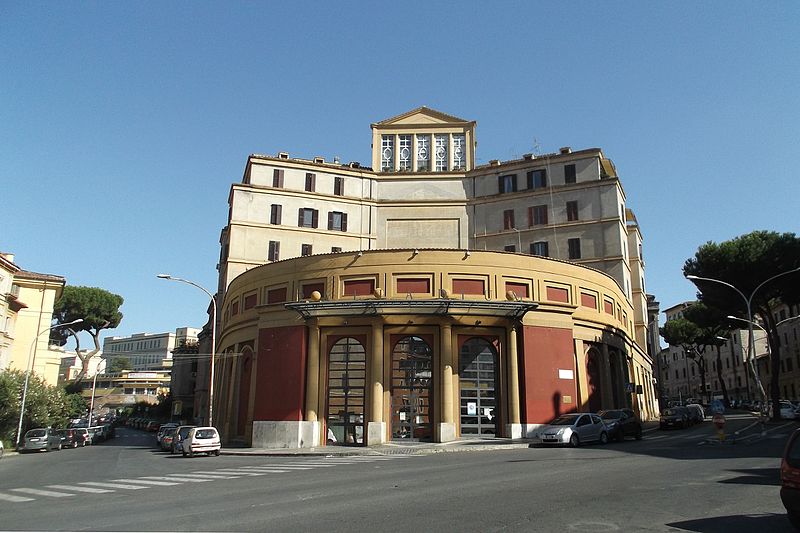
The Art Nouveau design of the Teatro Palladio, a well-known feature of the Garbatella district
The Art Nouveau design of the Teatro Palladio,
a well-known feature of the Garbatella district
Travel tip:

Although traditionally working class, the Garbatella neighbourhood of Rome, where Giorgia Meloni grew up, is becoming increasingly trendy among young Romans, drawn to it having the feeling of a village within the metropolis.  Situated in Municipio VIII district south of the city centre near the Ostiense railway station, Garbatella was built in the 1920s, inspired by the English garden city, largely made up of single-family houses grouped around communal garden courtyards. It has some interesting architectural styles, including the Teatro Palladio in Piazza Bartolomeo Romano, an example of Art Nouveau style designed by Innocenzo Sabbatini in 1927. Garbatella today has a population of more than 45,000.

The Palazzo Monticitorio was chosen as the home of the Italian Chamber of Deputies in 1871
The Palazzo Monticitorio was chosen as the home
of the Italian Chamber of Deputies in 1871
Travel tip:

The Italian Chamber of Deputies, the lower house of the Italian parliament, sits at the Palazzo Montecitorio, which can be found between the Pantheon and the Spanish Steps. The Palazzo Chigi, official residence of Italian prime ministers, is nearby. Palazzo Montecitorio was originally designed by Gian Lorenzo Bernini for Ludovico Ludovisi, the nephew of Pope Gregory XV. Following Italian unification, the palace was chosen as the seat of the Chamber of Deputies in 1871 but the building proved inadequate for their needs, with poor acoustics and a tendency to become overheated in summer and inhospitably cold in winter. After extensive renovations had been carried out, with many Stile Liberty touches introduced by the architect Ernesto Basile, the chamber returned to the palace in 1918.

Also on this day: 

1623: The death of writer and statesman Paolo Sarpi

1926: The death of songwriter and sculptor Giambattista De Curtis

1935: The birth of football coach Gigi Radice

1971: The birth of rugby player Paolo Vaccari


Home