24 January 2023

Davide Valsecchi - racing driver and TV presenter

Double GP2 champion’s track career ended in frustration

Valsecchi was tipped by many for a career in Formula One
Valsecchi was tipped by many for
a career in Formula One
Davide Valsecchi, now a TV commentator but in his racing days rated as one of the best drivers never to be given a chance in Formula One, was born on this day in 1987 in Eupilio, a small town in the lake district of northern Italy.

Valsecchi was twice a champion in GP2, the category just below F1, but despite stints as a test driver and reserve driver for Lotus on the main Grand Prix circuit was never given a chance to compete at the top level. 

Frustrated because he thought he deserved an opportunity, Valsecchi quit the sport but soon forged a career in television coverage of F1, first as an analyst and then as a commentator, becoming a popular figure with viewers for his excitable style.

He also co-presents the Italian version of the hit British car show, Top Gear.

Valsecchi made his debut in the Formula Renault and Formula 3 classes as young as 16, making his Formula 3 debut the same year, although it was not until 2007, having stepped up to Formula Renault 3500, that he celebrated his first race victory.

That came at the Nürburgring in Germany, where he won the second of the two rounds on the same weekend. The other was won by a future four-times F1 world champion, Sebastian Vettel.  

Valsecchi pictured in a Team Lotus Renault in practice for the Malaysian Grand Prix
Valsecchi pictured in a Team Lotus Renault
in practice for the Malaysian Grand Prix. 
He won races in Monza and Shanghai for the Italian team, Durango, as he moved up to GP2 the following year. 

His breakthrough came after joining iSport International, a British team, for the 2009–10 GP2 Asia Series, which he won, with three races to spare, after achieving three wins and two second places in the first five races of the season.  In the main GP2 series in 2010, victory in the final race of the season enabled him to take eighth in the drivers' championship, his best performance so far.

Valsecchi could not improve on that eighth pace in 2011 but the following season, when 2011 GP2 champion Romain Grosjean stepped up to F1 with Lotus, it was to Valsecchi that Grosjean’s DAMS team turned for a replacement.

He did not let them down, establishing an early championship lead by winning three out of the four races held across two weekends in Bahrain and producing a strong end to the campaign, winning at Monza in his home round of the series to see off rival Luiz Razia and take the title by a 22-point margin.

Valsecchi is noted for his exuberant presenting style
Valsecchi is noted for his
exuberant presenting style
It was the biggest moment of Valsecchi’s career, enabling him to join a list of previous GP2 champions that included Nico Rosberg, Lewis Hamilton, Timo Glock, Nico Hulkenberg, Pastor Maldonado and Grosjean, all of whom graduated to F1. 

Having already done some test driving for Lotus at the end of the 2011 season, Valsecchi was hopeful his career would now follow a similar trajectory.  Those hopes rose still more after the conclusion of the GP2 series, when he topped the standings in the F1 Young Driver test. The following March, he and Grosjean shared duties for Lotus at the preseason test sessions in Barcelona.

Yet as the 2013 season proper unfolded, he was unable to displace Grosjean as the number two Lotus driver despite his Swiss-born rival’s erratic form. Later, when No 1 Kimi Räikkönen had to drop out to undergo back surgery, instead of promoting Grosjean and giving Valsecchi the second car, Lotus turned instead to Heikki Kovalainen, telling Valsecchi he was too inexperienced.

Having made his feelings clear on the snub, Valsecchi was not offered anything in 2014 and his F1 career was effectively over before it had begun. 

It was not the end of his association with the sport, however. After landing a job as a race analyst with Sky Sport Italia for their F1 coverage, he was invited to provide colour commentary in 2017 for the international feed of the newly-formed FIA Formula 2 Championship.

His enthusiastic and passionate commentary style immediately gained him a following and today he fronts Sky Sport Italia F1 coverage alongside co-presenter Federica Masolin.

Since 2016, he has hosted Top Gear Italia on the Sky Uno channel, teaming up with Sky Sport Italia’s Moto GP commentator Guido Meda and Joe Bastianich, an American restaurateur who was previously a judge on the Italian version of Masterchef.

A view across Lake Pusiano taken from the  upper slopes of Monte Cornizzolo
A view across Lake Pusiano taken from the 
upper slopes of Monte Cornizzolo
Travel tip:

Eupilio, where Valsecchi was born and still lives, lies on the slopes of Monte Cornizzolo, between the small Segrino and Pusiano lakes of Lombardy, about midway between Como to the west and Lecco to the east. It is a municipality that has existed since 1927, when the villages of Penzano, Carella and Mariaga were merged to form one place.  The name is thought to have its origins in Historia naturalis, the study of natural history by Pliny the Elder written in around 77AD, in which he described a ‘Eupilis Lacus’, taken to be the stretch of water today known as Lake Pusiano, which the area overlooks. The calming peace of the lake is said to influence the slow, rarefied pace of life in the villages around it.  Eupilio has only 2,600 residents yet has five churches built between the 13th and 16th centuries. The area is thought to have been inhabited since approximately 3000BC. Situated about 18km (11 miles) east of Como and 14km (9 miles) west of Lecco, the landscape to the south is the northern edge of the gently hilly Brianza region, while to the north, beyond Lake Segrino, are the first steep slopes of the Pre-Alps.  It is an area popular with walkers.

The Duomo at Monza, home of the fabled Iron Crown
The Duomo at Monza, home
of the fabled Iron Crown
Travel tip:

The city of Monza is famous for its Grand Prix motor racing circuit, where Valsecchio numbered two important victories in his career. The city is also home to the Iron Crown of Lombardy - the Corona Ferrea - a circlet of gold with a central iron band, which according to legend, was beaten out of a nail from Christ’s true cross and was found by Saint Helena in the Holy Land. The crown is believed to have been given to the city of Monza in the sixth century and is kept in a chapel in the 13th century Basilica of San Giovanni Battista, the city’s cathedral. When Napoleon Bonaparte was declared King of Italy in 1805, he was crowned in the Duomo in Milan and the Iron Crown had to be fetched from Monza before the ceremony. During his coronation, Napoleon is reported to have picked up the precious relic, announced that God had given it to him, and placed it on his own head. 

Also on this day:

41: The assassination of Roman emperor Caligula

1444: The birth of Galeazzo Maria Sforza, Duke of Milan

1705: The birth of castrato opera star Farinelli

1916: The birth of actor and writer Arnaldo Foà

1947: The birth of footballer Giorgio Chinaglia


Home


23 January 2023

23 January

Silvio Gazzaniga - sculptor

Milanese artist who designed FIFA World Cup trophy

Silvio Gazzaniga, the sculptor and medal-maker who created the trophy held aloft every four years by the winners of football’s World Cup, was born in Milan on this day in 1921.  Gazzaniga designed the trophy, with its spiralling lines depicting two players, with arms outstretched in triumph, carrying a globe on their shoulders, in 1971, after entering a competition organised by football’s world governing body, FIFA.  The organisation had been faced with a dilemma after the 1970 World Cup, when champions Brazil earned the right to keep the Jules Rimet Trophy, the prize for which the competition was originally played, by winning for the third time.  In the knowledge that they would need a new trophy before the next tournament, in 1974, they invited designers to submit their ideas, eventually collecting 53 proposals from artists all over the world. Among them was the submission from Gazzaniga, a football fan and the artistic director of Bertoni, a small firm making medals and trophies now based at Paderno Dugnano, a town on the outskirts of Milan.  Gazzaniga did much of his work in a modest studio in the artists’ quarter of the Lombardy capital.  Read more…

______________________________________

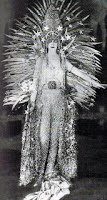
Luisa Casati – heiress and muse

Outrageous marchioness saw herself as a living work of art

The heiress, socialite and artist’s muse Luisa Casati, known for her outlandish dresses, exotic pets and hedonistic lifestyle, was born on this day in 1881 in Milan.  Casati, born into a wealthy background, married a marquis – Camillo, Marchese Casati Stampa di Soncino – when she was 19 and provided him with a daughter, Cristina, a year later, yet the marriage was never strong and they kept separate residences from an early stage.  It was not long before she tired of a life bound by formalities and the strict rules of etiquette and everything changed after she met the poet, patriot and lothario Gabriele D’Annunzio at a society hunt.  They became lovers and D’Annunzio introduced her to the world of writers and artists.  Tall, almost painfully thin and with striking looks, she became a creature of fascination for many young artists, who craved the attention of this eccentric aristocrat and the chance to paint her.  Their interest only encouraged the Marchesa Casati to indulge her taste for the extravagant, posing in ever-more outlandish dresses, embracing the culture of the Belle Époque. Her wealth enabled her to throw lavish parties.  Read more…

_____________________________________

Salvatore Lima - politician

Christian Democrat MEP murdered by Mafia

Salvatore Lima, a politician strongly suspected of being the Sicilian Mafia’s ‘man in Rome’ until he was shot dead near his seaside villa in 1992, was born on this day in 1928 in Palermo.  The Christian Democrat MEP, usually known as Salvo, had long been suspected of corruption, from his days as Mayor of Palermo in the 1950s and 60s to his time as a member of the Chamber of Deputies, between 1968 and 1979, when he formed a close association with Giulio Andreotti, the three-times Italian prime minister whose rise to power was helped considerably by the support Lima was able to garner for him in Sicily.  Lima's links with the Mafia were established by a magistrates’ enquiry into his death when it was concluded that he was killed on the orders of the then all-powerful Mafia boss Salvatore ‘Toto’ Riina as an act of revenge following Lima’s failure to have sentences against 342 mafiosi accused in the so-called 'maxi-trial' of 1986-87 annulled or at least reduced.  He had allegedly promised his Cosa Nostra paymasters that he would see to it that a Supreme Court judge with a reputation for overturning sentences against suspected Mafia members was appointed prosecutor.  Read more…

____________________________________

Giovanni Michelotti – car designer

The many Triumphs of Turin sports car genius

One of the most prolific designers of sports cars in the 20th century, Giovanni Michelotti died on this day in 1980 in Turin.   Known for his hard work and creative talent, Michelotti has been credited with designing more than 1200 different cars.  He worked for Ferrari, Lancia and Maserati in Italy but car firms abroad soon got to know about him and he also designed for Triumph and BMW.  Michelotti was born in Turin in 1921 and worked for coach building firms before opening his own design studio in 1959.  The first of his designs put into production was for an Alfa Romeo 6C 2500 in 1947.  Among the legendary sports cars designed by Michelotti in Italy are the Ferrari 166 MM and the Maserati Sebring.  In Britain he was responsible for many successful Triumphs, including the famous Spitfire, Stag and TR4. He also designed buses and trucks for British Leyland.  Under his own name he designed a beach car, the Shellette, with wicker seats. Only about 80 were made, but among the buyers were the Dutch royal family, who used it at their summer property in Porto Ercole, and Jacqueline Onassis.  Read more…

_____________________________________

Muzio Clementi – composer and pianist

Musician is remembered as ‘father of the piano’

Composer Muzio Clementi, whose studies and sonatas helped develop the technique of the early pianoforte, was born on this day in 1752 in Rome.  He moved to live in England when he was young, where he became a successful composer and pianist and started a music publishing and piano manufacturing business. He also helped to found the Royal Philharmonic Society in London.  Clementi was baptised Mutius Philippus Vincentius Franciscus Xaverius the day after his birth at the Church of San Lorenzo in Damaso in Rome.  His father was a silversmith, who soon recognised Clementi’s musical talent and arranged for him to have lessons from a relative, who was maestro di cappella at St Peter’s Basilica.  By the time he was 13, Clementi had already composed an oratorio and a mass and he became the organist at his parish church, San Lorenzo in Damaso, at the age of 14.  Sir Peter Beckford, a wealthy Englishman, was so impressed with Clementi’s musical talent and his skill with the harpsichord when he visited Rome in 1766 that he offered to take him to England and sponsor his musical education until he was 21.  Read more…


Home


22 January 2023

22 January

Antonio Todde - supercentenarian

Sardinian shepherd holds record as oldest Italian in history

Antonio Todde, who was the oldest living man in the world before he died at the age of 112 years 346 days in 2002 and remains the oldest Italian man in history, was born on this day in 1889 in Tiana, a mountain village in Sardinia.  There are 19 other Italians who have attained a higher age, but all are women. Maria Giuseppa Robucci, from Apulia, is still living at the age of 115 years 307 days but would need to survive a further year and 195 days to match Emma Morano, from Piedmont, who died in 2017 aged 117 years 137 days as the oldest Italian of all time.  Todde was the world’s most senior male centenarian from the death of the American John Painter on March 1, 2001 until his own death 10 months later.  He was born to a poor shepherd family in Tiana, about 140km (87 miles) north of Cagliari in the Gennargentu mountains, about 55km (34 miles) southwest of the provincial capital, Nuoro.  The area historically has a high number of centenarians and there was longevity in Todde’s family. His father Francesco lived to be 90 years old, and his mother Francesca 98. His sister Maria Agostina - one of 11 siblings - was still alive at the age of 97 at the time of his death and herself lived to be 102.  Read more…

_____________________________________

Frankie Yale - gang boss

Mobster who employed a young Al Capone

The gang boss who gave Al Capone one of his first jobs was born on this day in 1893 in Longobucco in Calabria.  Francesco Ioele, who would later become known as Frankie Yale, moved to the United States in around 1900, his family settling into the lower Manhattan area of New York City.  Growing up, Ioele was befriended by another southern Italian immigrant, John Torrio, who introduced him to the Five Points Gang, which was one of the most dominant street gangs in New York in the early part of the 20th century.  In time, Ioele graduated from petty street crime and violent gang fights to racketeering, changing his name to Yale to make him sound more American and taking control of the ice delivery trade in Brooklyn.  With the profits Yale opened a waterfront bar on Coney Island, which was called the Harvard Inn. It was there that he took on a young Capone as a bouncer and in a fight there that Capone acquired the facial scars that would stay with him for life.  Capone worked for Yale for two years until Torrio, by then based in Chicago, recruited him to his organisation, and Capone moved to the city with which his criminal activities would become associated.  Read more…

_____________________________________

Carlo Orelli – soldier

The last trench infantryman

Carlo Orelli, the last surviving Italian soldier to have served at the start of Italy's involvement in the First World War, died on this day in 2005 at the age of 110.  Orelli had signed up for active duty at the age of 21 and joined the Austro-Hungarian front after Italy joined the war on the side of Britain, France and Russia in May 1915.  He took part in combat operations near Trieste, experiencing the brutality of trench warfare and seeing many of his friends die violent deaths, but after receiving injuries to his leg and ear he spent the rest of the war in hospital.  Orelli was born in Perugia in 1894, but his family moved to Rome, where he was to spend most of the rest of his life living in the Garbatella district.  He came from a military background and had a grandfather who had helped to defend Perugia against Austrian mercenaries in 1849. His father had served in the Italian Abyssinian campaign in the 1880s and his elder brother had fought in Libya during the war between Italy and Turkey in 1911.  The wounds Orelli suffered during a confrontation with Austrian soldiers ended his military career and he spent the rest of the war recovering from an infection in hospital.  Read more…

_______________________________________

Papal Swiss Guard

Colourful uniforms camouflage highly trained security professionals

The Pope’s Swiss Guard was founded on this day in Vatican City in 1506.  A contingent of guards from Switzerland has continued to guard the Pope from that day to present times and it is one of the oldest military units still in existence.  The Swiss had been producing mercenary soldiers for hundreds of years with a reputation for loyalty and good discipline.  In the 15th century they were known for their good battle tactics and were employed by many European armies.  Pope Julius II ordered the first Swiss troops to guard the Vatican and they arrived in Rome on 22 January, 1506, the official date now given for the foundation of the Papal Swiss Guard.  The Pope later gave them the title ‘Defenders of the Church’s freedom’.  Recruits to the Pope’s Swiss Guard unit have to be Catholic men of Swiss nationality who have completed military training and can produce evidence of their good conduct.  Since the attempted assassination of Pope John Paul II in 1981, the Guards have received training in unarmed combat and in the use of modern weapons.  They are a colourful sight on ceremonial occasions at the Vatican in their blue, red, orange and yellow uniforms of Renaissance design.  Read more…

Booking.com


Home


21 January 2023

21 January

Gennaro Contaldo – Chef

TV cook is passionate about Amalfi’s speciality dishes

Celebrity chef Gennaro Contaldo was born on this day in 1949 in Minori in Campania.  Contaldo has made many appearances on British television alongside chefs such as the late Antonio Carluccio, Jamie Oliver and James Martin and he has also brought out several cook books.  It is well documented that he is the man responsible for inspiring Jamie Oliver’s interest in Italian food.  Contaldo grew up in the small seaside town of Minori near Amalfi and is a passionate advocate of the style of cooking in the area, cucina amalfitana.  From an early age he was interested in dishes cooked with local produce, going out to collect wild herbs for his mother, and he began helping out in local restaurants at the age of eight.  Contaldo moved to Britain in the late 1960s and travelled around the country working in village restaurants and studying the food growing wild in each area, such as herbs and mushrooms. He eventually went to London and worked in several restaurants, including Antonio Carluccio’s establishment in Neal Street.  Read more…

____________________________________

Giuseppe Savoldi - footballer

The world’s first £1 million player

Giuseppe Savoldi, whose transfer from Bologna to Napoli in 1975 made him the first footballer in the world to be bought for £1 million, was born on this day in 1947 in Gorlago, a municipality a short distance from the city of Bergamo in Lombardy.  A prolific striker, Savoldi’s big-money deal came four years ahead of the much heralded £1 million transfer of another striker, Trevor Francis, from Birmingham City to Nottingham Forest, which made him the first player in Britain to move for a seven-figure sum.  Napoli, who saw Savoldi as the last component in what they hoped would be a title-winning team, paid 1.4 billion lire in cash, plus two players, Sergio Clerici and Romario Rampanti, to secure his signature. The two players were valued at 600 million lire in total, which valued Savoldi at 2 billion lire, the equivalent at the time of about £1.2 million.  But where Francis, who later spent five seasons playing in Serie A, won two European Cups with Nottingham Forest, scoring the winning goal in the final in 1979, Savoldi’s move did not yield anything like the same kind of success.  Napoli had finished third and then second in Serie A in the seasons before Savoldi’s arrival but were unable to maintain their momentum. Read more…

___________________________________

Musician who found ‘accidental’ fame in Yugoslavia

The conductor and cellist Antonio Janigro, who spent more than two decades as an orchestra leader in Zagreb, Yugoslavia, was born on this day in 1918 in Milan.  An accomplished cello soloist in Italy, his adventure in Yugoslavia happened by accident, in a way.  He was on holiday there in 1939 when the Second World War began, leaving him stranded with no prospect of returning home.  Happily, Zagreb Conservatory offered Janigro a job as professor of cello and chamber music. This turned out to be a providential turn of fate and he was to remain in Yugoslavia for much of his life.  He founded the school of modern cello playing in Yugoslavia, formed the exemplary chamber orchestra I Solisti di Zagreb with Dragutin Hrdjok in 1954 and for 10 years led the Radio Zagreb symphony orchestra. Raised in a house on the Via Guido d’Arezzo in Milan, Janigro was born in a musical family, although his father’s dream of becoming a concert pianist had to be abandoned, sadly, when he lost his arm after being shot in the First World War.  Janigro himself studied piano from the age of six, and then began playing the cello in 1926, when he was eight years old.  Read more…

____________________________________

Camillo Golgi – neuroscientist

Nobel prize winner whose name lives on in medical science

Camillo Golgi, who is recognised as the greatest neuroscientist and biologist of his time, died on this day in 1926 in Pavia.  He was well known for his research into the central nervous system and discovering a staining technique for studying tissue, sometimes called Golgi’s method, or Golgi’s staining.  In 1906, Golgi and a Spanish biologist, Santiago Ramon y Cajal, were jointly awarded the Nobel Prize in Physiology or Medicine in recognition of their work on the structure of the nervous system.  Golgi was born in 1843 in Corteno, a village in the province of Brescia in Lombardy. The village was later renamed Corteno Golgi in his honour.  In 1860 Golgi went to the University of Pavia to study medicine. After graduating in 1865 he worked in a hospital for the Italian army and as part of a team investigating a cholera epidemic in the area around Pavia.  He resumed his academic studies under the supervision of Cesare Lombroso, an expert in medical psychology, and wrote a thesis about mental disorders. As he became more and more interested in experimental medicine he started attending the Institute of General Pathology headed by Giulio Bizzozero, who was to influence Golgi’s research publications.  Read more…

______________________________________

Pietro Rava - World Cup winner

Defender was the last survivor from Azzurri of 1938

Pietro Rava, who was the last survivor of Italy's 1938 World Cup-winning football team when he died in December 2006, was born on this day in 1916 at Cassine in Piedmont.  A powerful defender who could play at full back or in a central position, Rava won 30 caps for the national team between 1935 and 1946, finishing on the losing side only once and being made captain in 1940.  He was also a member of the Italy team that won the gold medal in the football competition at the 1936 Olympics in Berlin.  At club level, he spent most of his career with Juventus, forming a formidable defensive partnership with Alfredo Foni, alongside whom he also lined up in the national side.  Rava won a Championship medal in 1949-50, his final season at Juventus, although by then he had fallen out of favour with Jesse Carver, the Turin club's English coach, and made only six appearances, moving to Novara the following year.  At the time of his birth, Rava's family were living in Cassine, a small town near Alessandria, about 100km (62 miles) south-east of Turin, because of his father's job with a railway company.  Read more…

EN - 728x90


Home