Fascinating stories from each day of the year about the people and events that have shaped the culture and history of Italy
11 February 2023
11 February
10 February 2023
10 February
NEW - Roberto Bompiani – artist
Prolific painter recreated scenes from ancient Rome
Artist Roberto Bompiani, who became well known for his paintings depicting Rome in ancient times, was born on this day in 1821 in Rome. He became a successful landscape and portrait painter and later in his career he also worked as a sculptor. His portrait of Queen Margherita of Italy, which was painted in 1878, still hangs in the Palazzo Montecitorio in Rome. From a wealthy family, Bompiani was able to dedicate himself entirely to the study of art and enrolled at the Accademia di San Luca in Rome when he was 15. He was awarded a share of a first prize in design along with a fellow student in 1836, not long after joining the Academy. Within three years he was regularly winning prizes for sculpture and painting. As a painter, Bompiani depicted historical, mythological, and religious subjects in an idealised style making his figures physically perfect and giving them noble, spiritual expressions. His paintings of scenes from ancient Rome earned him the nickname of ‘The Italian Bouguereau’, referring to a French painter who made modern interpretations of classical subjects and was working at the same time as Bompiani. Read more…
______________________________________
Ernesto Teodoro Moneta – Nobel Prize winner
Supporter of Garibaldi was also an ‘apostle for peace’
Ernesto Teodoro Moneta, who was at times both a soldier and a pacifist, died on this day in 1918. Moneta was only 15 when he was involved in the Five Days of Milan uprising against the Austrians in 1848, but in later life he became a peace activist. He won the Nobel Peace Prize in 1907, but publicly supported Italy’s entry into the First World War in 1915. On the Nobel Prize official website he is described as ‘a militant pacifist’. Moneta was born in 1833 to aristocratic parents in Milan. He fought next to his father to defend his family home during the revolt against the Austrians and then went on to attend the military academy in Ivrea. In 1859 Moneta joined Garibaldi’s Expedition of the Thousand and fought in the Italian army against the Austrians in 1866. He then seemed to become disillusioned with the struggle for Italian unification and cut short what had been a promising military career. For nearly 30 years Moneta was editor of the Milan democratic newspaper, Il Secolo. Through the columns of his newspaper he campaigned vigorously for reforms to the army which would strengthen it and reduce waste and inefficiency. Read more…
_____________________________________
Francesco Hayez - painter
Artist who pushed boundaries of sensuality
The painter Francesco Hayez, regarded as the father of the Milanese Romanticism movement in the mid-19th century and an artist renowned for his depictions of historical events and for his political allegories, was born on this day in 1791 in Venice. His father, a fisherman, was French in origin and married a girl from Murano called Chiara Torcello, although they were a relatively poor family and Francesco was largely brought up by his wife’s sister, who had the good fortune to marry Giovanni Binasco, a wealthy ship-owner who dealt in antiques and collected art. It was Binasco who fostered in Hayez his love of painting and after initially beginning an apprenticeship as an art restorer became a pupil in the studio of the Venetian painter Francesco Maggiotto. He was admitted to the New Academy of Fine Arts in Venice in 1806. Hayez moved to Rome in 1809 after winning a one-year scholarship at the Accademia di San Luca. In the event, he stayed in Rome until 1814, then moved to Naples where he was commissioned by Joachim Murat, the French military commander and statesman who was King of Naples under Napoleonic rule, to paint a major work. Read more…
______________________________________
Luca della Robbia - sculptor
Renaissance ‘genius’ famed for glazed terracotta
Luca della Robbia, whose work saw him spoken of in the same breath as Donatello and Lorenzo Ghiberti among the great sculptors of the Renaissance, died on this day in 1482 in Florence. Della Robbia worked in marble and bronze initially but enjoyed considerable success after inventing a process for making statuary and reliefs in terracotta decorated with a colourful mineral glaze. Thought to be around 82 or 83 years old, he had shared the full details of the process only with his family. On his death, his nephew Andrea della Robbia inherited his workshop and other members of the family, notably his great-nephews Giovanni della Robbia and Girolamo della Robbia, continued to employ his methods with success into the 16th century. Terracotta literally means cooked earth and Della Robbia’s technique involved the application of colourful glazes made using lead, tin and other minerals to the fired clay. Sculpting in terracotta was not new, having been invented in the ancient world, but Della Robbia’s idea to coat the terracotta with a glaze that fused with the clay below gave the surface a brightness and shine and made the sculpture particularly durable. Read more…
____________________________________
ENI – oil and gas multinational
Italian energy company emerged after WW2
The Rome-based multinational oil and gas company ENI, one of the world’s largest industrial concerns, was founded on this day in 1953. The company, which operates in 79 countries, is valued at $52.2 billion (€47.6 billion) and employs almost 34,000 people. It is the 11th largest oil company in the world. Its operations include exploration for and production of oil and natural gas, the processing, transportation and refining of crude oil, the transportation of natural gas, the storage and distribution of petroleum products and the production of base chemicals and plastics. A wholly state-owned company until 1995, ENI is still to a large extent in the control of the Italian government, which owns just over 30 per cent of the company as a golden share, which includes preferential voting rights, almost four per cent through the state treasury, and a further 26 per cent through the Italian investment bank, Cassa Depositi e Prestiti. ENI came into being as Italy was rebuilding after the Second World War, which had left its economy in ruins. Enrico Mattei, an industrialist and a Christian Democrat deputy, was assigned the task of winding down the existing state-owned oil company Agip, which was seen as unsustainable. Read more…
______________________________________
Andrea Silenzi - footballer
Forward was the first Italian to play in the English Premier League
The footballer Andrea Silenzi, who made history in 1995 when he became the first Italian to be signed by a Premier League club, was born on this day in 1966 in Rome. A 6ft 3ins centre forward, Silenzi had enjoyed Serie A success with Torino in particular, his form persuading Nottingham Forest to offer £1.8 million - the equivalent of about £3.5 million (€4 million) today - to bring him to England. When Forest manager Frank Clark proudly announced his new man before the 1995-96 season, it was seen as an important moment for the fledgling Premier League, then only three seasons old. The Italian League at the time was the most glamorous in Europe, wealthy enough to hire stars from all around the world, including many British players; it was rare for Italian players to move abroad. Yet Silenzi, a teammate of Diego Maradona during a two-year stay with Napoli who had won a call-up to the Italian national team after his 17 goals for Torino in the 1993-94 season, had agreed to come to England. Forest gave Silenzi a contract worth £360,000 a year, a considerable sum at that time. Read more…
______________________________________
Raffaele Lauro – author and politician
Sorrentine's talents include writing, film directing and song
Italian Senator and journalist Raffaele Lauro was born on this day in 1944 in the resort of Sorrento in Campania. A prolific writer, Lauro has also been an important political figure for more than 30 years. He was born in Sorrento and as a young man worked as a receptionist at a number of hotels along the Sorrento peninsula. After finishing school he went to the University of Naples where he was awarded degrees in Political Science, Law and Economics. Lauro then won a scholarship from Italy’s Ministry of Foreign Affairs and studied first at their diplomatic institute and later in Paris. He later studied for a degree in journalism in Rome and became director of a scientific magazine, moving from there to become a commentator on new technology for Il Tempo in Rome and Il Mattino in Naples. He also studied film directing while living in Rome and taught Law of Mass Communications at Rome University. His political career began when he was elected as a Councillor for Sorrento in 1980. He went on to become Deputy Mayor and Councillor for finance, personnel and culture, in which role he opened the Public Library of Sorrento. Read more…
Roberto Bompiani – artist
Prolific painter recreated scenes from ancient Rome
![]() |
| Roberto Bompiani: a self-portrait painted in about 1896 |
He became a successful landscape and portrait painter and later in his career he also worked as a sculptor.
His portrait of Queen Margherita of Italy, which was painted in 1878, still hangs in the Palazzo Montecitorio in Rome.
From a wealthy family, Bompiani was able to dedicate himself entirely to the study of art and enrolled at the Accademia di San Luca in Rome when he was 15. He was awarded a share of a first prize in design along with a fellow student in 1836, not long after joining the Academy. Within three years he was regularly winning prizes for sculpture and painting.
As a painter, Bompiani depicted historical, mythological, and religious subjects in an idealised style making his figures physically perfect and giving them noble, spiritual expressions. His paintings of scenes from ancient Rome earned him the nickname of ‘The Italian Bouguereau’, referring to a French painter who made modern interpretations of classical subjects and was working at the same time as Bompiani.
An art historian wrote that despite Bompiani’s conservative approach, he showed himself to be open to new ideas and emancipated himself in his best work almost entirely from what was narrow and conventional in the style that had been imposed upon him by his early training.
![]() |
| Bompiani's Two Pompeian Ladies, an example of his work depicting scenes from ancient Rome |
In later years, Bompiani painted landscape watercolours and in the 1870s he also began painting portraits. In addition to his painting of the Queen of Italy, he painted a portrait of his own wife and portraits of various members of the Borghese family.
He also painted frescoes for churches and a cemetery in Rome and paintings for a theatre and a church in Santiago in Chile.
Some of his classical works were on display at the Centennial Exhibition in Philadelphia in 1876 and he won an award for his 1872 portrait of his fellow painter Giovanni Battista Canevari, when it was exhibited in Vienna. The painting now hangs in the Academy of San Luca. One of his sculptural works from the 1860s, Sappho, is in the Palazzo Castellani in Rome.
Bompiani served as a professor and ultimately as the president of the Roman Academy of San Luca. He died in Rome in 1908.
One of his sons, Augusto Bompiani, and one of his daughters, Clelia Bompiani, who were both his pupils and both studied at the Academy of San Luca, went on to become professional painters.
The Accademia di San Luca, where Roberto Bompiani and his children studied art, was founded in the 16th century and named after St Luke the Evangelist, the patron saint of painters. It is now located at Piazza Accademia di San Luca close to the Trevi Fountain but was based near the Forum in Rome after it was founded in 1577. The Academy’s original building no longer exists, but the Academy Church of Santi Luca and Martina, which was designed by Pietro da Cortona, still stands overlooking the Forum.
![]() |
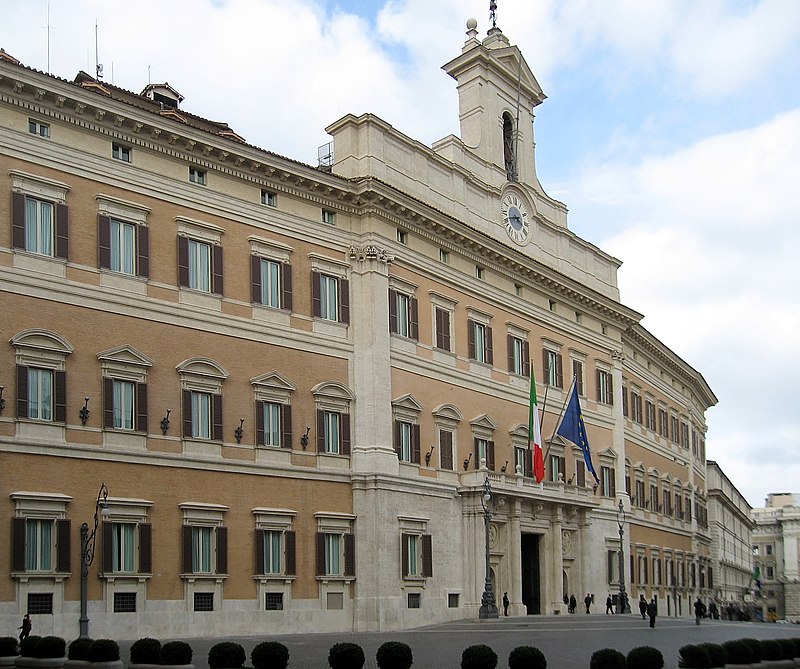
| The Camera dei Deputati has been the permanent seat of the Chamber of Deputies since 1918 |
The Camera dei Deputati - the Chamber of Deputies - one of Italy’s houses of parliament, meets at Palazzo Montecitorio in Rome. The palace was originally designed by Gian Lorenzo Bernini and completed by Carlo Fontana in 1697 and stands to the north of the Pantheon. The building was originally intended for the nephew of Pope Gregory XV. It was chosen as the seat of the Chamber of Deputies in 1871 but the building proved inadequate for their needs and extensive renovations were required before it became the chamber's permanent home, in 1918.
More reading
Gian Lorenzo Bernini - Italy's last universal genius
Pius IX - the longest papal reign in history
Giovanni Boldini - painter who captured elegance of Belle Époque
Also on this day:
1482: The death of sculptor Luca della Robbia
1791: The birth of painter Francesco Hayez
1918: The death of Nobel Prize-winning pacifist Ernesto Teodoro Moneta
1944: The birth of author and politician Raffaele Lauro
1953: The founding of Italian energy giant ENI
1966: The birth of footballer Andrea Silenzi
(Picture credits: Bompiani portrait uploaded by Spino; Accademia San Luca by Warburg; Palazzo Montecitorio by Manfred Heyde; via Wikimedia Commons)
9 February 2023
9 February
Vito Antuofermo - world champion boxer
Farmer's son from deep south who won title in Monaco
Vito Antuofermo, who went from working in the fields as a boy to becoming a world champion in the boxing ring, was born on this day in 1953 in Palo del Colle, a small town in Puglia, about 15km (9 miles) inland from the port of Bari. He took up boxing after his family emigrated to the United States in the mid-1960s. After turning professional in 1971, he lost only one of his first 36 fights before becoming European light-middleweight champion in January 1976. In his 49th fight, in June 1979, he beat Argentina's Hugo Corro in Monaco to become the undisputed world champion in the middleweight division. Antuofermo's success in the ring, where he won 50 of his 59 fights before retiring in 1985, opened the door to a number of opportunities in film and television and he was able to settle in the upper middle-class neighbourhood of Howard Beach in New York, just along the coast from John F Kennedy Airport. He and his wife Joan have four children - Lauren, Vito Junior, Pasquale and Anthony. He grew up in rather less comfort. The second child of Gaetano and Lauretta Antuofermo, who were poor tenant farmers, he was working in the fields from as young as seven years old. Read more…
____________________________________
Ezechiele Ramin – missionary
Priest from Padua who was murdered in Brazil
Ezechiele Ramin, a Comboni missionary who was shot to death by hired killers after standing up for the rights of peasant farmers and traditional tribesmen in a remote rural area in Brazil, was born on this day in 1953 in Padua. Ramin was only 32 when he was murdered in July 1985, having worked in the South American country for about a year and a half. He had already completed missionary assignments in North and Central America, worked to help victims of the Irpinia earthquake in Campania and organised a demonstration against the Camorra in Naples before being posted to Brazil. He was based in the state of Rondônia, an area in the northwest of Brazil next to the border with Bolivia, where small farmers found themselves oppressed, by legal and illegal means, by wealthy landowners, and where government measures had been introduced to curb the freedom of the indigenous Suruí tribes. Ramin, an easy-going and popular man who amused himself by making sketches and playing the guitar, tried to solve the problems by arranging for a lawyer, paid for by the Brazilian Catholic Church through the Pastoral Land Commission, to act on behalf of the peasant farmers to see that their legal rights were properly observed. Read more…
_____________________________________
Ferdinando Carulli - classical guitarist and composer
Neapolitan wrote first guide to playing the instrument
The composer Ferdinando Carulli, who published the first complete method for playing the classical guitar as well as writing more than 400 works for the instrument, was born on this day in 1770 in Naples. Carulli was also influential in changing the design of the guitar, which had a smaller body and produced a less resonant sound when he started out, to something much more like the classical guitars of today. The son of an intellectual advisor to the Naples Jurisdiction, Carulli first trained as a cellist and received instruction in musical theory from a local priest. He became interested in the guitar in his 20s and became so enthusiastic about the instrument he decided to devote himself to it entirely. The guitar was little played and there were no guitar teachers in Naples in the late 18th century, so Carulli had to devise his own method of playing. In time, he began to give concerts in Naples, playing some pieces of his own composition. These were popular, attracting large audiences who enjoyed the different sound that the guitar produced. This encouraged Carulli to venture further afield and he engaged on a tour of Europe. Read more…
_______________________________________
Pope Gregory XV
Legally-trained pontiff was against witchcraft and for secret ballots
Pope Gregory XV, who was christened Alessandro Ludovisi, was elected on this day in 1621. He was the last Pope to issue a papal ordinance against witchcraft with his ‘Declaration against Magicians and Witches’, put out in March 1623. He was already 67 years of age and in a weak state of health when he was chosen as Pope and relied heavily on his 25-year-old nephew, Ludovico Ludovisi, to assist him in his duties. Born in Bologna in 1554, the young Alessandro Ludovisi was educated at a Jesuit college in Rome before going to Bologna University to study law. He worked in various roles for the church until he was appointed Archbishop of Bologna in 1612, having at some stage been ordained. In 1616 he was sent by Pope Paul V to mediate between Charles Emmanuel 1, Duke of Savoy and Philip III of Spain, who were involved in a dispute. The Pope elevated him to the rank of Cardinal in the same year. He went to Rome after the death of Pope Paul V to take part in the conclave. He was chosen as Pope on February 9, 1621, the last Pope to be elected by acclamation. His nephew, Ludovico, was made a cardinal. Read more…
____________________________________
Pietro Nenni - politician
Orphan who became influential leader of Italian Socialist Party
The politician Pietro Sandro Nenni, who was a major figure of the Italian left for five decades, was born on this day in 1891 in Faenza in Emilia-Romagna. Nenni was general secretary of the Italian Socialist Party (PSI) on three occasions and rose to high office in the Italian government, twice serving as foreign affairs minister and several times as deputy prime minister, notably under the progressive Christian Democrat Aldo Moro in the centre-left coalitions of the 1960s. He was a recipient of the Stalin Peace Prize in 1951 but returned the $25,000 that came with the honour in protest at the Soviet invasion of Hungary in 1956. Born into a peasant family, Nenni lost both his parents before he was five years old and grew up in an orphanage, having been placed there by the aristocratic landowners for whom his father had worked. His experiences there seemed to stir in him a desire to rebel against authority. He was only nine years old when, on learning of the assassination of King Umberto I by the anarchist Gaetano Bresci, he is said to have written ‘Viva Bresci’ on a wall in the orphanage. Read more…
.jpg)


.jpg)