20 June 2025

20 June

Giannina Arangi-Lombardi – opera singer

Soprano’s superb voice was captured in early recordings

Soprano Giannina Arangi-Lombardi was born on this day in 1891 in Marigliano near Naples in Campania.  She studied singing at the Conservatory of San Pietro a Majella in Naples and made her debut on the stage in Rome in 1920. Arangi-Lombardi sang mezzo-soprano roles for the next three years at theatres in Rome, Sicily, Parma, Florence and Naples.  She then underwent further study and returned to the stage as what is known as a spinto soprano, a singer who can reach the high notes of the lyric soprano but can also achieve dramatic climaxes with her voice.  Arangi-Lombardi’s second debut, this time as a soprano, was in 1923. The first time she sang the role of Aida in Verdi's opera of the same name the audience was stunned by her voice and her fame quickly spread.  She appeared on stage at Teatro alla Scala in Milan for the first time in 1924 singing Elena in Boito’s Mefistofele. The orchestra for her debut performance was conducted by Arturo Toscanini.  She sang regularly at La Scala until 1930 and appeared at many other opera houses in Europe as well as in South America.  Read more…

_______________________________________

Gian Galeazzo Sforza - Duke of Milan

Ruler who never truly held power

Gian Galeazzo Sforza, the third member of the Sforza family to have the title Duke of Milan, was born on this day in 1469 in Abbiategrasso, a town in the Po Valley about 22km (14 miles) north of Milan.  He was the sixth Duke of Milan in all, the title having previously been the property of the Visconti family.  However, Gian Galeazzo had only a short life and never truly held any power, having inherited the Duchy at the age of seven when his father, Galeazzo Maria Sforza, was assassinated in the porch of Basilica di Santo Stefano Maggiore in Milan, on December 26, 1476, where he was attending a celebration for the Festa di San Stefano.  Gian Galeazzo could not legally inherit the Duchy until he reached the age of majority, which in Renaissance times was 14. Until then, Milan would be ruled by his mother, Galeazzo Maria’s widow, Bona of Savoy.  But Gian Galeazzo’s uncle, Ludovico Sforza, had designs on the Duchy as Galeazzo Maria’s brother and the next five years encompassed a bitter struggle for the regency.  With the help of her powerful counsellor, the ducal secretary Cicco Simonetta, Bona managed to repel Ludovico’s first bid to seize power, but not for long.  Read more…

______________________________________

Luigi de Magistris - politician

Popular and progressive Mayor of Naples

Luigi de Magistris, who was Mayor of Naples for 10 years following a shock win in the 2011 local elections, was born on this day in 1967.  A former public prosecutor with a reputation for standing up against corruption and organised crime, De Magistris was the Member of the European Parliament for Southern Italy between 2009 and 2011, when he ran for Italy of Values, the centre-left party founded by another former magistrate, Antonio di Pietro.  He stood in the 2011 mayoral elections in Naples with the support of minor parties on the left and the right and won in the second round of voting with 65 per cent of the vote, defeating Gianni Lettieri, the candidate for a centre right coalition led by Silvio Berlusconi’s People of Freedom party.  In office, De Magistris faced difficult times because of the city’s precarious financial situation, which at times saw local transport suspended because fuel bills were not paid and rubbish piling up in the streets because of continuing problems with the disposal of domestic refuse that had reached a peak in 2008.  De Magistris claimed year-on-year improvements in refuse collection as one of his success stories.  Read more…

EN - 728x90


Armando Picchi - footballer

Star defender captained ‘La Grande Inter’

The footballer Armando Picchi, who was captain of the Inter-Milan team of the 1960s known as La Grande Inter and one of Italian football’s most accomplished players in the libero position, was born on this day in 1935 in the Tuscan port of Livorno.  Under his captaincy, the Inter side managed by the Argentina-born coach Helenio Herrera won the European Cup twice as well as three Serie A titles and two Intercontinental Cups between 1963 and 1966.  After retiring as a player at 34, Picchi embarked on a coaching career of his own, but after his progress with Varese and hometown club AS Calcio Livorno earned him the chance to take the helm at Juventus his life was cut tragically short in 1971, when he developed an aggressive form of cancer and died just three months after being diagnosed.  Picchi grew up 30km (19 miles) south of Livorno in the coastal resort of Vada.  He had the good fortune to have a brother, Leo, who was already a professional footballer when he was growing up. Leo, 14 years’ his senior, nurtured Armando’s early development and recommended him to Livorno, then playing in Serie C.  Read more…

______________________________________

Valerio Evangelisti - novelist

Writer's stories of the Inquisition are bestsellers

The bestselling novelist Valerio Evangelisti, best known for his science fiction, fantasy, historical novels and horror stories, was born in Bologna on this day in 1952.  He is famous in Italy for his series of novels featuring the inquisitor Nicolas Eymerich and for the Magus trilogy, all of which have been translated into many languages.  Eymerich is a real historical character, a member of the order of the Dominicans and of the Spanish Inquisition who was born in 1320 in Girona, Catalonia.  Evangelisti portrays him as a cruel and ruthless man who acts without mercy to protect the Catholic Church against threats of both natural and supernatural origin.  Evangelisti uses the Eymerich novels to investigate the mysterious phenomena in medieval Europe that strategically influenced the great historical events of the time, creating a dark and nightmarish picture of the epoch.  The Magus trilogy is a romanticised biography of the famous Middle Ages writer of prophecies, Nostradamus. The three novels, Il presagio (The Omen), L’inganno (The Deceit) and L'abisso (The Abyss) were also bestsellers in Italy.  Read more…

_______________________________________

Book of the Day: Opera: The Definitive Illustrated Story, by Alan Riding and Leslie Dunton-Downer

Immerse yourself in more than 400 years of the world's most celebrated operas and discover the fascinating stories behind them. Explore the lives of singers such as Maria Callas, Luciano Pavarotti, and Jonas Kaufmann. Meet composers such as Mozart, Wagner, and Britten, and the librettists with whom they collaborated to create the magical blend of words and music that make up opera. From its origins in the 17th-century courts of Italy to live screenings in public spaces today, Opera: The Definitive Illustrated Story follows the history of opera from Monteverdi's L'Orfeo in 1607, to Cosi fan tutte, La bohème, and modern operas such as Brokeback Mountain. It explains musical terminology, traces historical developments, and sets everything in cultural context.  Filled with photographs of key figures and performances, this book revels in the sets and costumes that make up the grand spectacle of opera. It also explores the great opera houses of the world, such as La Scala, Milan, the Met in New York, and the Sydney Opera House. It is essential reading for anyone who wants to understand and enjoy the constantly evolving world of this beloved art form.

Alan Riding is a British author and journalist. He was a long-time foreign correspondent for The New York Times.  Leslie Dunton-Downer is the co-author, with Alan Riding, of the Essential Shakespeare Handbook and Eyewitness Companions: Opera.

Buy from Amazon


Home


19 June 2025

19 June

NEW
- Luca Pacioli - mathematician and geometrist 

Friar who became known as ‘Father of Accounting’

Luca Pacioli, the Franciscan friar and mathematician who would become known as the ‘Father of Accounting’, died on this day in 1517 in Sansepolcro, a town in eastern Tuscany in the province of Arezzo.  Taking advantage of the development of the printing press, Pacioli is thought to have published at least 10 mathematical textbooks, of which the best known is his Summa de arithmetica, geometria, Proportioni et proportionalita - usually known as simply Summa.  Published in Venice in 1494, it was a comprehensive treatise of every aspect of mathematical knowledge that had been explored to that date and the first to include a printed description of the double-entry bookkeeping system, widely used by Venetian merchants. The principals he outlined in Summa still influence business practices today.  Pacioli, who taught mathematics in several Italian cities and was appointed the first chair in mathematics at the University of Perugia, was a figure of influence in the arts world as well as commerce, having possibly been a student of Piero della Francesca and later a close friend of Leonardo da Vinci. Read more…

_____________________________________

Francesco Moser - Giro d’Italia winner

Only two riders have won more road races

The cycling champion Francesco Moser, winner of the 1984 Giro d’Italia and the 1977 World road racing championship among 273 road victories in his career, was born on this day in 1951 in Palù di Giovo, a village about 10km (6 miles) north of Trento in northern Italy.  Only the great Belgians Eddy Merckx (525) and Rik Van Looy (379) won more road races than Moser, who was at his peak during the late 1970s and early 1980s.  One of his proudest achievements was to break Merckx’s record for the greatest distance covered in one hour.  He became renowned as a specialist in the so-called Monuments, the five road races among what are generally termed the Classics considered to be the oldest, hardest and most prestigious one-day events in cycling.  Of those events, Moser won the Paris-Roubaix three times, the Giro di Lombardia twice and the Milan-San Remo once.  Moser attributed his cycling prowess to growing up on the family farm in Val di Cembra, working in steep-sided vineyards in an era when most of the work was carried out by hand, rather than machinery.  Family members used bicycles to move around the estate.  Read more…

_______________________________________

Pier Angeli - Hollywood star

Actress hailed for talent and beauty died tragically young

The actress Pier Angeli, a Hollywood star in the 1950s and 60s, was born on this day in 1932 in Cagliari, Sardinia.  She won awards in Italy and in America at the start of her career, when she was likened by some critics to the Swedish-born star Greta Garbo.  Described by the actor Paul Newman as "the most beautiful Italian actress of the century", Angeli was also a fixture in the gossip columns.  Linked romantically with a number of Hollywood's leading male actors, she dated Kirk Douglas and became close to the celebrated 'rebel' James Dean before marrying another star, the Italian-American actor and singer, Vic Damone.  It would be the first of two marriages.  She had a son, Perry, with Damone but they divorced after four years.  A second marriage, to the Italian composer, Armando Trovaioli, produced another son, Andrew, but they also divorced.  Born Anna Maria Pierangeli, the daughter of an architect, she had a twin sister, Maria Luisa, who would also become an actress.  Her mother, Enrica, used to dress the girls to resemble the American child star, Shirley Temple. The family moved to Rome when she was three.  Read more…


Marisa Pavan - actress

Twin sister of tragic star Pier Angeli

The actress Marisa Pavan, whose twin sister Pier Angeli was a Hollywood star in the 1950s and 1960s, was born on this day in 1932 as Maria Luisa Pierangeli in Cagliari, Sardinia.  Pavan’s career ran parallel with that of her sister, who was born 20 minutes before her, but she rejected the re-invention as an ultra-glamorous starlet that Pier Angeli underwent within the Hollywood studio system.  She turned roles down when she felt they did not have enough substance and did not hesitate to sack agents if she felt they were putting her forward for unsuitable parts.  She refused to sign up to any one studio.  Her biggest success was The Rose Tattoo, the 1955 film adaptation of a Tennessee Williams play in which she played the daughter of the central character, played by Anna Magnani - with whom she is pictured - one of postwar Italian cinema’s most respected actresses.  Magnani won an Oscar for Best Actress for her portrayal of a Sicilian widow, with Pavan receiving a nomination for best supporting actress at the Academy Awards and although that award went to someone else she did have the substantial compensation of winning a Golden Globe for the role.  Read more…

______________________________________

Francesco Baracca – flying ace

Italy’s most successful First World War fighter pilot

Italy’s top fighter pilot of the First World War, Francesco Baracca, died in action on this day in 1918.  He had been flying a strafing mission against Austro-Hungarian ground troops in support of an Italian attack on the Montello Hill, about 17km (11 miles) north of Treviso in the Veneto, on which he was accompanied by a rookie pilot, Tenente Franco Osnago.  They split from one another after being hit by ground fire but a few minutes later, Osnago saw a burning plane falling from the sky.  Witnesses on the ground saw it too. Osnago flew back to his base but Baracca never returned.  Only when the Austro-Hungarian troops were driven back was the wreckage of Baracca’s Spad VII aircraft found in a valley.  His body was discovered a few metres away.  A monument in his memory was later built on the site. Osnago, fellow pilot Ferruccio Ranza and a journalist recovered his body. It was taken back to his home town of Lugo in the province of Ravenna, where a large funeral was held.  It is thought that Baracca was seeking to provide Osnago with cover from above as he swooped on enemy trenches when he was attacked by an Austrian plane.  Read more…

______________________________________

Book of the Day: Piero della Francesca, by Carlo Bertelli 

Piero della Francesca has long been admired as one of the greatest of all Renaissance painters. Much archival and technical work has been done concerning him and his work (including the restoration of his great fresco cycle in Arezzo and of many of his other paintings and frescoes). Carlo Bertelli, presents both a synthesis of recent documentary and scientific research and the reflections of his own lifetime's study of Piero's work. The book incorporates a full-scale biography of the artist, which locates Piero's work in relation to that of his contemporaries, and goes on to analyse each of his surviving paintings. It concludes with a full catalogue of his works, and is illustrated in colour throughout with reproductions of the newly restored panels and frescoes.

Carlo Bertelli is an Italian art historian, a former civil servant in Italy’s Ministry of Culture and later a professor at the University of Lausanne in Switzerland, specialising in medieval art.

Buy from Amazon


Home


Luca Pacioli - mathematician and geometrist

Friar who became known as ‘Father of Accounting’

Jacopo de' Barbari's portrait of Luca Pacioli with an unknown geometry student attending
Jacopo de' Barbari's portrait of Luca Pacioli with
an unknown geometry student attending
Luca Pacioli, the Franciscan friar and mathematician who would become known as the ‘Father of Accounting’, died on this day in 1517 in Sansepolcro, a town in eastern Tuscany in the province of Arezzo.

Taking advantage of the development of the printing press, Pacioli is thought to have published at least 10 mathematical textbooks, of which the best known is his Summa de arithmetica, geometria, Proportioni et proportionalita - usually known as simply Summa.

Published in Venice in 1494, it was a comprehensive treatise of every aspect of mathematical knowledge that had been explored to that time and the first book to include a description of the double-entry book-keeping system, widely used by Venetian merchants. The principals he outlined in Summa still influence business practices today.

Pacioli, who taught mathematics in several Italian cities and was appointed the first chair in mathematics at the University of Perugia, was a figure of influence in the arts world as well as commerce.

Having possibly been a student of Piero della Francesca, a pioneer of the use of geometry and perspective in painting and, like Pacioli, a native of Sansepolcro, he later became a close friend of Leonardo da Vinci.


Da Vinci’s drawings illustrated another of his notable works, Divina proportione, an exploration of mathematical and artistic proportion, focussing especially on the so-called golden ratio of proportionality and its application in architecture.

The title page of a 1523 edition of Pacioli's Summa, his greatest work
The title page of a 1523 edition of
Pacioli's Summa, his greatest work
Pacioli was around 70 years old when he died, having been born between 1446 and 1448. He received an education based around maths and commerce in Sansepolcro, before moving to Venice in around 1464, continuing his studies there and being appointed tutor to the three sons of a wealthy merchant, Antonio Rompiasi.

From Venice, he moved to Rome, where he became friends with the architect, artist and mathematician Leon Battista Alberti, before returning to Sansepolcro to enter the Franciscan Order in 1470. In the following years, he taught mathematics in Perugia, Florence, Venice, Milan, Pisa, Bologna and Rome. 

After the publication of Summa in 1494, he accepted an invitation from Duke Ludovico Sforza to work in Milan. There he met and taught Leonardo da Vinci, for a time living with the polymath as a house guest. Da Vinci acquired his knowledge of geometry and its applications in art and architecture from his association with Pacioli.

Pacioli might have remained in Milan longer had the city not been overrun by Louis XII of France at the start of the Second Italian War. Ludovico Sforza fled the city, as did Pacioli and da Vinci, first to Mantua, and then Venice.  

Although Pacioli left a significant intellectual legacy in the fields of accounting and mathematics, he was effectively accused of plagiarism by 16th-century artist and historian Giorgio Vasari.

Vasari was critical of the inclusion in Divina proportione - without credit - of the translated text of della Francesca’s book, originally written in Latin, De quinque corporibus regularibus, about the geometry of polyhedra - solid objects with polygonal faces, such as pyramids. Other scholars, though, argue that the edition of Divina proportione that Vasari read may have been appended to include della Francesca’s work after Pacioli’s death.

Pacioli’s final university teaching post is thought to have been in Rome during 1514 and 1515, before returning to Sansepolcro as his health began to decline.

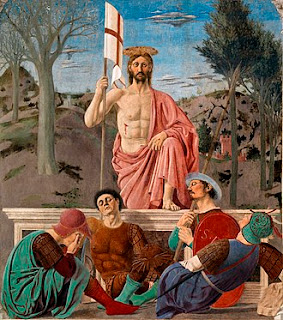
Piero della Francesca's The Resurrection, which spared Sansepolcro a WW2 attack
Piero della Francesca's painting, The Resurrection,
which may have spared Sansepolcro a WW2 attack
Travel tip:

Sansepolcro, a town nestled in the Valtiberina valley at the foot of the Apennines, has a rich artistic and cultural heritage. As well as being the home town of Luca Pacioli,  it is known as the birthplace of Renaissance master Piero della Francesca, whose brilliant painting, The Resurrection, is housed in the Museo Civico di Sansepolcro. The presence of the painting probably saved the town from destruction in World War Two after Tony Clarke, an art-loving British Royal Horse Artillery officer who, halted a planned  Allied artillery attack. Another treasure, a 12th-century polychrome wooden crucifix known as the Volto Santo, can be seen in the town’s beautiful Romanesque duomo, the Cattedrale di San Giovanni Evangelista. Look out also for The Lamentation over the Dead Christ, by the Mannerist painter Rosso Fiorentino, in the church of San Lorenzo. Other museums include the Aboca Museum, dedicated to the history of medicinal herbs, featuring antique books, laboratory tools, and botanical collections, as well as the Bernardini-Fatti Museum of Antique Windows, the world’s first museum dedicated to stained glass windows. Sansepolcro’s medieval streets, fortified walls, and historic palazzos make it a delightful place to explore. 

One of Arezzo's notable sights is its sharply sloping medieval main square, Piazza Grande
One of Arezzo's notable sights is its sharply
sloping medieval main square, Piazza Grande
Travel tip:

Arezzo is one of the wealthiest cities in Tuscany. It is situated about 80km (50 miles) southeast of Florence, at the confluence of four valleys - Tiberina, Casentino, Valdarno and Valdichiana. Its medieval centre suffered massive damage during the Second World War yet the Basilica di San Francesco, with its beautiful frescoes by Piero della Francesca, the central Piazza Grande, with its sloping pavement in red brick, and the Medici Fortress, the duomo and a Roman amphitheatre survived, among other historic sights.  Arezzo’s original cathedral was built on the nearby Pionta Hill, over the burial place of Donatus of Arezzo, who was martyred in 363. In 1203 Pope Innocent III had the cathedral moved within the city's walls, to the current site in another elevated position a short walk from Piazza Grande.  The interior contains several notable artworks, including a relief by Donatello, entitled Baptism of Christ, and a cenotaph to Guido Tarlati, lord of Arezzo until 1327, said to be designed by Giotto, near to which is Piero della Francesca's Mary Magdalene.  The wooden choir of the Grand Chapel was designed by Giorgio Vasari, who was born in Arezzo. The city is home to an annual medieval festival called the Giostra del Saracino (Saracen Joust), in which "knights" on horseback representing different areas of the town charge at a wooden target attached to a carving of a Saracen king and score points according to accuracy. Arezzo had a starring role in Roberto Benigni's film Life Is Beautiful, which won three Academy Awards, as the place in which the main characters live before they are shipped off to a Nazi concentration camp.

Also on this day:

1918: The death in action of WW1 fighter pilot Francesco Baracca

1932: The birth of actress twin sisters Pier Angeli and Marisa Pavan

1951: The birth of Giro d’Italia-winning cyclist Francesco Moser


Home


18 June 2025

18 June

Fabio Capello - football manager

Won Champions League and five Serie A titles 

Fabio Capello, one of European club football's most successful managers, was born on this day in 1946 in San Canzian d'Isonzo, close to the border of Italy and Slovenia.  Capello won five Serie A titles as a coach and four as a player, plus two La Liga titles as manager of Real Madrid, and the Champions League with AC Milan. He coached the national teams of both England and Russia.  At the time of his birth, San Canzian d'Isonzo was in an area occupied by Allied forces after the end of the Second World War.  His uncle, Mario Tortul, who was from the same village near Trieste, had been a professional footballer, playing in Serie A with Sampdoria, Triestina and Padova and making one appearance for the Italian national team.  Capello began his playing career at the Ferrara-based SPAL club and went on to represent Roma, Juventus and AC Milan.  A midfielder with an eye for goal, he was a Serie A champion three times with Juventus and once with Milan, also winning the Coppa Italia with Roma and Milan.  He represented Italy 32 times, playing at the 1974 World Cup finals in West Germany.  He scored the only goal against England in 1973 as Italy won at Wembley for the first time in their history. Read more…

_____________________________________

Isabella Rossellini - actress and model

Daughter of ‘cinema royalty’ who became star in her own right 

The actress and model Isabella Rossellini, famed for her roles in the David Lynch-directed mystery Blue Velvet and the Oscar-winning black comedy Death Becomes Her and for 14 years the face of luxury perfume brand Lancôme, was born on this day in 1952 in Rome. Her parents were the Swedish triple Academy Award-winning actress Ingrid Bergman and the Italian director Roberto Rossellini, one of the pioneers of the neorealism movement that spawned some of Italy’s finest films. She is the eldest by 34 minutes of twin girls. Resident in the United States since 1979, when she married the American director Martin Scorsese, she has a home on Long Island, New York, where she keeps a number of animals. An active campaigner for various wildlife conservation causes, Rossellini has a MA in Animal Behaviour & Conservation after studying the subject at Hunter College, New York. Although her acting career continues, she moved in a less conventional direction by writing, directing and appearing in a series of short documentary films about sexual and reproductive behaviour in animals entitled Green Porno. Read more…

____________________________________

Bartolomeo Ammannati – sculptor and architect

Florentine artist created masterpieces for his home city

Bartolomeo Ammannati, whose buildings in Italy marked the transition from the Renaissance to the Baroque style, was born on this day in 1511 at Settignano near Florence.  Ammannati began his career as a sculptor, carving statues in a number of Italian cities during the 1530s.  He trained first under Baccio Bandinelli and then under Jacopo Sansovino in Venice, working with him on the Library of St Mark - the Biblioteca Marciana -  in the Piazzetta.  Pope Julius III called Ammannati to Rome in 1550 on the advice of architect and art historian Giorgio Vasari. Ammannati then worked with Vasari and Giacomo da Vignola on the Villa Giulia, which belonged to the Pope.  In the same year, Ammannati married the poet Laura Battiferri and they spent the early years of their marriage in Rome.  Cosimo I de' Medici brought Ammannati back to Florence in 1555, and it was where he was to spend the rest of his career.  His first job was to finish the Laurentian Library begun by Michelangelo. He interpreted a clay model sent to him by Michelangelo to produce the impressive staircase leading from the vestibule into the library.   Read more…


Raffaella Carrà - entertainer and TV presenter

Much-loved star with long and varied career

Raffaella Carrà, the singer, dancer, television presenter and actress often simply known as la Carrà or Raffaella, was born in Bologna on this day in 1943.  Carrà has become a familiar face on Italian TV screens as the host of many variety shows and, more recently, as a judge on the talent show The Voice of Italy.  She has also enjoyed a recording career spanning 45 years and was a film actress for the best part of 25 years, having made her debut at the age of nine.  Her best-known screen role outside Italy was alongside Frank Sinatra in the hit American wartime drama, Von Ryan’s Express.  Carrà was born Raffaella Maria Roberta Pelloni. Shew grew up in the Adriatic resort of Bellaria-Igea Marina, just north of Rimini, where her father ran a bar and her maternal grandfather an ice cream parlour.  At the age of eight, she won a place at the National Dance Academy in Rome and from there moved to the Centro Sperimentale di Cinematografia, Italy’s oldest film school.  Her film career was never more than modestly successful. Although she has a long list of credits, she was cast mainly in small parts.   Read more…

_____________________________________

Franco Modigliani – economist

Writer and professor developed theories about spending and saving

Nobel prize winner Franco Modigliani, who was an originator of the economic life-cycle hypothesis that attempts to explain the level of spending in the economy, was born on this day in 1918 in Rome.  He wrote several books outlining his economic theories, became a professor at three American universities, and received the Nobel Memorial Prize in Economics in 1985.   Modigliani also formulated the Modigliani-Miller theorem for corporate finances, which is based on the idea that the value of a private firm is not affected by whether it is financed by equity or by debt.  Born and brought up in a Jewish family, Modigliani enrolled in the Faculty of Law at the Sapienza University of Rome at the age of 17. In his second year at Sapienza, his entry in a national economics contest won first prize and he was presented with it by the Fascist dictator, Benito Mussolini.  Modigliani went on to write essays for the Fascist magazine Lo Stato, displaying an inclination for the fascist ideals that were critical of liberalism at the time.  He argued the case for socialism in an article for the magazine about the organisation and management of production in a socialist economy.  Read more…

____________________________________

Ottaviano dei Petrucci – music printer

Pioneer in printing who worked for a Doge and a Pope

Ottaviano dei Petrucci, who was the first person to print a book of polyphonic music from movable type, was born on this day in 1466 in Fossombrone near Ancona.  It is thought that Petrucci was educated at Urbino, possibly at the humanist court of Guidobaldo da Montefeltro, who was Duke of Urbino apart from a brief period from 1482 until his death in 1508.  To learn the art of printing, in 1490 Petrucci went to Venice, then the most advanced centre for printing in Italy.  In 1498, Petrucci petitioned the Doge, Agostino Barbarigo, for the exclusive right to print music for the next 20 years, which was granted. There are no examples of printed music produced by other Venetian printers until 1520.  Over the years, he continued to refine his technique and he held music printing monopolies in Venice until 1511. He produced books of printed music at the rate of a new book every few months.  His collection of 96 chansons, secular songs under the title of Harmonice Musices Odhecaton - One Hundred Songs of Harmonic Music - published in Venice in 1501, was the first book of polyphonic music to be printed from movable type.  Read more…

_______________________________________

Book of the Day: Capello: The Man Behind England's World Cup Dream, by Gabriele Marcotti

Fabio Capello is a born winner. As a midfielder with Roma, Juventus and Milan, he won four Italian league championships and two cups, and played for his country 32 times, scoring a goal at Wembley in 1973 in Italy's first ever win in England. As a manager, Capello's fierce determination has seen him win championships - nine of them in 16 years - with every club he has taken charge of, from the great Milan team he helped create in the early 1990s to Real Madrid with David Beckham in 2007. Next he took on what he regarded as his greatest challenge - to restore England to the top of the world football tree, to take his adopted country to the World Cup in South Africa in 2010, and to win it.  Award-winning writer Gabriele Marcotti travels from Capello's early days in Italy to his first months in his new job at Soho Square to tell the story of the man behind the steely glare, the method behind the sometimes manic behaviour. Capello's drive for success at any cost has seen him make more than a few enemies, and Marcotti spoke to them all, as well as his closest associates. Capello: The Man Behind England’s World Cup Dream is the story not just of a remarkable career, but of the life of a truly extraordinary man.

Gabriele Marcotti is an Italian sports journalist, sports author, radio and television presenter.  Born in Italy and now based in London, he was raised in the United States, Poland, Germany and Japan.

Buy from Amazon


Home