1 November 2021

Annibale Bergonzoli - soldier

Commander who was both decorated and imprisoned by the British
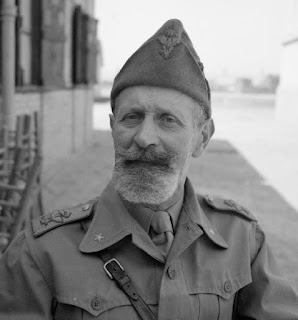
Bergonzoli's beard made him an instantly recognisable figure among Italian generals
Bergonzoli's beard made him an instantly
recognisable figure among Italian generals
The military commander Annibale Bergonzoli, who served the Italian army in both world wars and led an Italian expeditionary force supporting General Francisco Franco’s nationalists in the Spanish Civil War, was born on this day in 1884 in Cannobio, a town on the shore of Lago Maggiore.

Bergonzoli had the distinction of being awarded a medal for bravery by the British during World War One only to be held by them as a prisoner of war after being captured during World War Two.

As a boy, Bergonzoli always had a taste for adventure. He completed a 1.5 mile (2.4km) swim across Lago Maggiore at the age of seven. He enrolled at the Military Academy of Modena, graduating with the rank of sub-lieutenant in 1907.

He joined the Royal Italian Army in 1911 and was immediately sent to take part in the Italo-Turkish War, helping to take control of the areas of the Ottoman Empire in Libya that became known as Italian Tripolitania and Cyrenaica, as well as some islands in the Aegean Sea.  He remained in Libya for some years after the conflict.

In the First World War, after initially declaring neutrality, Italy sided with Britain, France and Russia against Germany and Austria-Hungary and Bergonzoli was awarded the British Military Cross for bravery for his defence of Monte Rovegno in Liguria. He had a prominent role in the Salonika Campaign in the Balkans, in which he became part of the Allied High Command as a combined force of Austria, Germany and Bulgaria was defeated.

Some of the 30,000 Italians taken prisoner  following the damaging defeat at Bardia
Some of the 30,000 Italians taken prisoner 
following the damaging defeat at Bardia
By the time the First World War ended, Bergonzoli had risen to the rank of Lieutenant Colonel and was Chief of Staff of the XXV Division. Promotion to Colonel soon followed.  Red-haired, he had also grown an extravagant and striking beard that gained him the nickname barba elettrica - ‘electric whiskers’.

When the Fascists took control of Italy in 1922 and reformed the army, Bergonzoli retained his rank and was put in control of three regiments.

Elevated to Brigadier General in 1935, he participated in the Italian invasion of Ethiopia, playing a major role in the capture of the city of Neghelli as Italy annexed the country to the Kingdom of Italy.

Commended by Benito Mussolini, the Fascist leader who was by then ruling Italy as a dictator, he was then sent to Spain as the head of an infantry division of the Corpo Truppe Volontarie, an expeditionary force sent to support Franco in the Spanish Civil War. He was awarded the Gold Medal of Military Valour by Mussolini for leading the capture of Santander on behalf of Franco’s nationalists. 

Further promoted to Major General and then Lieutenant General, Bergonzoli, he was put in charge of the XXIII Italian Army Corps as an Italian invasion of Egypt was attempted in World War Two, in which the British were now his enemies.

He fared less well this time. He was commander of the Italian garrison in Bardia, a strongly defended seaport in the east of Libya, close to the border with Egypt, that fell in January 1941 following an assault by a combined force of British and Australian troops.
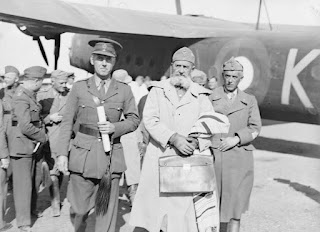
The captive Bergonzoli with other Italian officers after disembarking at Cairo in February, 1941
The captive Bergonzoli with other Italian officers
after disembarking at Cairo in February, 1941
It was a serious defeat for the Italians, who lost almost 5,500 personnel killed or wounded, with a further 30,000 taken prisoner along with a considerable quantity of armaments and vehicles. Bergonzoli managed to avoid being captured and escaped with other soldiers to Tobruk, crossing some 120km of desert on foot.

As the Allies advanced into Libya, he left Tobruk before the town was captured, retreating further to the west, but as the Italians prepared to evacuate they were engaged again at Beda Fomm on the Gulf of Sirte. This time, Bergonzoli was taken prisoner by Australian troops among 25,000 more Italian personnel. 

As a prisoner of war, Bergonzoli was taken first to Yol, a British camp in India, in the far north of the country towards the Himalayan mountain range, and then transferred to the United States, to be held first in Monticello, Arkansas and later Hereford, Texas.

After the Italian surrender and the armistice of September 1943, Bergonzoli refused any form of collaboration with the Anglo-Americans, who in turn refused to allow him to return to Italy, declaring him mad and holding him for a further two and a half years in the psychiatric ward of the Long Island military hospital, New York.

Finally released in March 1946, he was reinstated to the army of the new Italian Republic and given the rank of lieutenant general in 1947 before being permanently discharged later that year at the age of 62.

In retirement, Bergonzoli returned to live in Cannobio until his death in May, 1973. He is buried in a modest tomb at the town’s cemetery.

Cannobio is a pretty town on the western shore of Lago Maggiore, not far from the Swiss border
Cannobio is a pretty town on the western shore
of Lago Maggiore, not far from the Swiss border
Travel tip:

Cannobio, where Bergonzoli was born and died, can be found on the western shore of Lago Maggiore towards the northern end of the lake, only a few kilometres from the border between Italy and Switzerland. It is regarded as one of the prettiest towns on the western side of the lake, with a long waterfront, the centrepiece of which is the lakeside Piazza Vittorio Emanuele, which was refurbished in 2004 and completely relaid in cobblestones and granite slabs.  In history, the people of Cannobio are remembered for their bravery in repelling an Austrian attack in 1859, while fighting on the side of Giuseppe Garibaldi during the struggle for unification, and for rising up against the Nazi and Fascist regime in 1944.
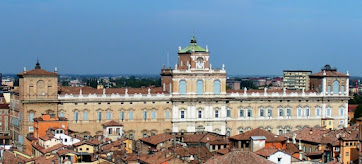


The Baroque 17th century Ducal Palace, which dominates the skyline of the city of Modena
The Baroque 17th century Ducal Palace, which
dominates the skyline of the city of Modena
Travel tip:

The military academy where Bergonzoli enrolled as a young would-be soldier is today Italy's national military academy. It is housed within Modena’s huge, Baroque Ducal Palace, the prominent feature of the city’s skyline, which was built in the 17th century by the architect Luigi Bartolomeo Avanzini on behalf of Francesco I on the site of a former castle in 1635. Modena, on the south side of the Po Valley in the Emilia-Romagna region of Italy, is known for its car industry - Ferrari, De Tomaso, Lamborghini, Pagani and Maserati have all been located there - and for producing balsamic vinegar. Operatic tenor Luciano Pavarotti and soprano Mirella Freni were both born in Modena.

Also on this day:

1512: The first public viewing of Michelangelo’s ceiling frescoes in the Sistine Chapel

1546: The death of painter and architect Giulio Romano

1596: The birth of painter and architect Pietro da Cortona

1757: The birth of sculptor Antonio Canova


Home


31 October 2021

31 October

Eduardo De Filippo - Neapolitan dramatist

Playwright captured essence of city's spirit

One of Italy’s greatest dramatists, Eduardo De Filippo, died on this day in 1984 in Rome at the age of 84.  An actor and film director as well as a playwright, De Filippo – often referred to simply as Eduardo – is most remembered as the author of a number of classic dramas set in his native Naples in the 1940s that continue to be performed today.  Arguably the most famous of these was Filomena Marturano, upon which was based the hit movie Marriage, Italian Style, which starred Sophia Loren and Marcello Mastroianni under the direction of Vittorio de Sica.  De Filippo’s other memorable works included Napoli Milionaria, Le voci di dentro and Sabato, domenica e lunedi.  All of these plays showcased De Filippo’s ability to capture the essence of life in Naples in his time, particularly in the working class neighbourhoods that he felt were the beating heart of the city.  Rich in Neapolitan dialect, they were often bittersweet comedies of family life. They were social commentaries in which typical themes were the erosion of morals in times of desperation, the struggle of the downtrodden to retain their dignity and the preservation of family values even in the most poverty-stricken households.  Read more…

____________________________________________________________

Bud Spencer – swimmer-turned-actor

Competed at two Olympics before turning to screen career

The actor known as Bud Spencer was born Carlo Pedersoli on this day in 1929 in Naples.  He was best known for the series of so-called spaghetti westerns and comedies he made with another Italian-born actor, Terence Hill.  Hill was from Venice and his real name was Mario Girotti.  They began their partnership in 1967 in a spaghetti western directed by Giuseppe Colizzi called God Forgives…I Don’t! and were asked to change their names so that they would sound more American.  Pedersoli came up with Bud Spencer because his movie idol was Spencer Tracy and his favourite American beer was Budweiser.   The two would go on to make 18 movies together, with westerns such as Ace High (1968) and They Call Me Trinity (1970) winning them box office success.  As Carlo Pedersoli, he had already achieved a measure of fame as a swimmer, the first Italian to swim the 100m freestyle in less than one minute.  He represented Italy at the Olympics in Helsinki in 1952 and Melbourne four years later, on each occasion reaching the semi-final in the 100m freestyle.  He also played professional water polo, winning an Italian championship with SS Lazio and a gold medal at the 1955 Mediterranean Games in Barcelona.  Read more…

___________________________________________________________

Galileo Ferraris - electrical engineer

Pioneer of alternating current (AC) systems

The physicist and electrical engineer Galileo Ferraris, who was one of the pioneers of the alternating current (AC) system for transmitting electricity and invented the first alternators and induction motors, was born on this day in 1847 in Piedmont.  The AC system was a vital element in the development of electricity as a readily-available source of power in that it made it possible to transport electricity economically and efficiently over long distances.  Ferraris did not benefit financially from his invention, which is still the basis of induction motors in use today. Another scientist, the Serbian-born Nikola Tesla, patented the device after moving to the United States to work for the Edison Corporation.  Tesla had been working simultaneously on creating an induction motor but there is evidence that Ferraris probably developed his first and as such is regarded by many as the unsung hero in his field.  He saw himself as a scientist rather than an entrepreneur and, although there is no suggestion that his ideas were stolen, openly invited visitors to come in and see his lab.  Unlike Tesla, he never intended to start a company to manufacture the motor and even had doubts whether it would work.  Read more…


Home


30 October 2021

30 October

Charles Atlas - bodybuilder

Poor immigrant from Calabria who transformed his physique

The bodybuilder Charles Atlas was born Angelo Siciliano on this day in 1893 in the Calabrian town of Acri.  Set 720m above sea level straddling two hills in the province of Cosenza, on the edge of what is now the mountainous Sila National Park, Acri was a poor town and while Angelo was growing up his father, Santos, began thinking about joining the growing number of southern Italians who had gone to forge a new life in America. They made the move when Angelo was 11.  The journey by sea from Naples took around two weeks. After registering their arrival at Ellis Island, the immigrant inspection station in New York Bay, the family settled in Brooklyn.  Most accounts of Angelo’s life suggest that his father, a farmer, returned to Italy within a short time but his mother remained, taking work as a seamstress and endeavouring to make a better life for her children.  Angelo’s path to becoming Charles Atlas and enjoying worldwide fame began with a classic story of bullying. Like many Italian children of his time, having been born in part of the country where living conditions were difficult and good food was in short supply, he was sickly and scrawny, an easy target to be picked on. Read more…

_________________________________________________________

Antonino Votto – conductor

Outstanding operatic conductor made recordings with Callas

Operatic conductor Antonino Votto was born on this day in 1896 in Piacenza in Emilia-Romagna.  He became famous in the 1950s because he conducted the orchestra for the acclaimed recordings made by soprano Maria Callas for EMI.  Votto was also considered one of the leading operatic conductors of his time on account of his performances at La Scala in Milan, where he worked regularly for nearly 20 years.  After Votto had attended the Naples conservatory for his music studies he went to work at La Scala, where he became an assistant conductor to Arturo Toscanini.  He made his official debut there in 1923, leading a performance of Puccini’s Manon Lescaut.  Votto went on to build a reputation as one of the most outstanding conductors of Italian opera, appearing at many other operatic venues in Italy and abroad.  In 1941 he began teaching at the Giuseppe Verdi conservatory in Milan as the war limited operatic activity in Italy and in most parts of Europe.  One of his students was the present day Italian orchestra conductor, Riccardo Muti.  Recordings of Votto conducting opera live in the theatre were a great success. He conducted Bellini’s Norma in 1955 with Callas at La Scala.  Read more…

_________________________________________________________

Poggio Bracciolini – scholar and humanist

Calligrapher who could read Latin changed the course of history

Gian Francesco Poggio Bracciolini, who rediscovered many forgotten Latin manuscripts including the only surviving work by the Roman poet and philosopher, Lucretius, died on this day in 1459 in Florence.  For his services to literature he was commemorated after his death with a statue by Donatello and a portrait by Antonio del Pollaiuolo.  Bracciolini was born in 1380 at Terranuova near Arezzo in Tuscany. In 1862 his home village was renamed Terranuova Bracciolini in his honour.  He studied Latin as a young boy under a friend of the poet, Petrarch, and his linguistic ability and talent for copying manuscripts neatly was soon noted by scholars in Florence.  He later studied notarial law and was received into the notaries guild in Florence at the age of 21.  After becoming secretary to the Bishop of Bari, Bracciolini was invited to join the Chancery of Apostolic Briefs in the Roman Curia of Pope Boniface IX.  He was to spend the next 50 years serving seven popes, first as a writer of official documents and then working his way up to becoming a papal secretary.  Read more…


Home


29 October 2021

29 October

King appoints Mussolini Prime Minister

Victor Emmanuel turned to Fascist leader after fearing civil war

Victor Emmanuel III, the king of Italy, invited Benito Mussolini to become Prime Minister on this day in 1922, ushering in the era of Fascist rule in Italy.  History has largely perceived the decision as a moment of weakness on the part of the king, a man of small physical stature who had never been particularly comfortable in his role.  Yet at the time, with violent clashes between socialist supporters and Mussolini’s Blackshirts occurring almost daily with both sides bent on revolution, Victor Emmanuel feared that Italy was on the brink of civil war.  The First World War had been financially crippling for Italy, even though they had emerged with a victory of sorts in that the Austro-Hungarians were finally pushed out of northern Italy.  In the poverty that followed, the country shifted sharply to the left and in the 1919 general election the Italian Socialist Party (PSI) gained 32 per cent of the vote, amounting to 156 seats in the Chamber of Deputies, the largest representation in their history.  But for all the support for the PSI, particularly among factory workers in urban areas, there were just as many Italians who felt uncomfortable about their advance, and not only those who belonged to the moneyed elite.  Read more…

____________________________________________________________

Franco Corelli - 'Prince of Tenors'

Self-taught singer who wowed New York

The great Italian tenor Franco Corelli died in Milan on this day in 2003 aged 82 after suffering heart problems.  Corelli was renowned for the power and vibrancy of his voice, described by some as generating a 'white heat' on the stage when he performed.  In a career spanning more than a quarter of a century he mastered all the major tenor roles and appeared at the greatest opera theatres in the world.  He was a fixture at the Metropolitan Opera in New York, where he performed 19 roles over 15 seasons in some 365 appearances.  As well as possessing outstanding vocal range, he used his natural assets – he stood 6ft 1ins tall and weighed 200lbs – to develop a charismatic stage presence.  Blessed with movie star looks, he had the appearance of an opera-singing Errol Flynn. He was nicknamed the 'Prince of Tenors'.  Corelli was born in 1921 in Ancona on Italy’s Adriatic coast, in a house just yards from the shore.  His father was a shipbuilder for the Italian navy and as he neared adulthood it seemed that Corelli’s destiny was to pursue the same profession. He obtained a place at Bologna University to study naval engineering.  It was while he was in Bologna that a friend dared him to enter a singing competition. Read more…

__________________________________________________________

Carlo Emanuele Ruspoli – Duke of Morignano

Noble architect is now a prolific writer

Carlo Emanuele Maria Ruspoli was born on this day in 1949 in Rome.  He became the third Duke of Morignano in 2003, succeeding his father, Prince Galeazzo Ruspoli. Carlo had previously graduated as a Doctor of Architecture from the Sapienza University of Rome and he now works as a researcher and writer.  He is a prolific author of works on history and anthropology as well as historical novels, drawing on his own family heritage and his fascination with the East.  The House of Ruspoli is one of the great aristocratic families of Rome and all members hold the title of Prince of the Holy Roman Empire.  The family’s origins can be traced back to their ancestor, Marius Scotus, in the eighth century, the Ruspoli family of Florence in the 13th century, and the Marescotti family of Bologna.  A branch of the Ruspoli family moved to Rome in the 17th century. Their last descendant, Vittoria Ruspoli, Marchioness of Cerveteri, married Sforza Marescotti, Count of Vignanello, a descendant of the Farnese family, but to make sure the House of Ruspoli continued, one of Vittoria’s sons, Francesco Maria Marescotti Ruspoli, took on the name and coat of arms of the House of Ruspoli.  Read more…

___________________________________________________________

Fabiola Gianotti - particle physicist

First woman to be director-general of CERN

The particle physicist Fabiola Gianotti, who in 2016 became the first woman to be made director-general in the 64-year history of the European Organisation for Nuclear Research, was born on this day in 1960 in Rome. She led one of the two teams of physicists working for the organisation - generally known as CERN after its title in French - whose experiments in 2012 resulted in the discovery of the Higgs boson, the particle that explains why some other elementary particles have mass.  The discovery was regarded as so significant in the advancement of scientific knowledge that it was nicknamed the “God particle.”  As the project leader and spokesperson of the ATLAS project at CERN, which involved a collaboration of around 3,000 physicists from 38 countries, Dr. Gianotti announced the discovery of the particle.  Their work involved the Large Hadron Collider (LHC), the world's largest and most powerful particle collider and the largest machine of any kind on the planet, which lies in a tunnel 27km (17 miles) in circumference, 175 metres (574 ft) beneath the France–Switzerland border near Geneva.  Read more…


Home


28 October 2021

28 October

Eros Ramazzotti - singer-songwriter

Best-selling Italian star has enduring appeal

The best-selling Italian singer and songwriter Eros Ramazzotti was born on this day in 1963 in Rome.  Ramazzotti, whose style has developed from pure pop to a contemporary soft rock genre with elements of classical crossover, has sold around 65 million records in a career spanning almost 40 years, putting him among the top 12 Italian recording artists of all time.  He is popular throughout Europe and in Spanish-speaking countries in South America, so much so that he records most of his albums in Spanish as well as Italian.  Among his 13 studio albums, three compilations and six live albums, 12 have reached No 1 in the Italian charts and 10 in the Swiss charts.  In addition, Ramazzotti has had No 1s in Austria, Switzerland, the Netherlands, Belgium, Germany and Sweden.  Twice - with 9 in 2003 and e2 in 2007 – he sold more records in that year in Italy than any other artist.  Other major selling albums have been In ogni senso, Tutte storie, Dove c'è musica, Stilelibero and Calma apparente.  His appeal is said to stem from his unique voice - a vibrant, slightly nasal tenor – his energetic delivery of catchy pop numbers and the passion he brings to often semi-autobiographical ballads.  Read more…

_________________________________________________________

Battle of the Milvian Bridge in Rome

How Christianity became official religion of the Roman Empire

Roman emperor Constantine defeated his rival Maxentius in a battle at the Milvian Bridge (Ponte Milvio), a vital point for crossing the River Tiber, on this day in 312 in Rome. The battle was a crucial moment in a civil war that ended with Constantine I as sole ruler of the Roman Empire and Christianity established as the empire’s official religion. The Roman Empire was being torn apart by different factions at war with each other at the beginning of the fourth century.  Although Constantine - known also as Constantine the Great - was declared Emperor at York in 306, his brother in law and rival, Maxentius, later claimed the imperial title in Rome.  In 312, Constantine led a force to march on Rome. Troops fighting for Maxentius lay in wait for them next to the River Tiber at Pons Milvius (Ponte Milvio, which had been partially dismantled to stop the attacking force crossing the river).  It is said that Constantine had a dream before the battle and saw the sun, the object of his own worship, overlain by the figure of a cross. Beneath the cross was the message in hoc signo vinces (in this sign prevail).  Read more…

_________________________________________________________

Sergio Tòfano – actor and illustrator

The many talents of stage and screen star

Comic actor, director, writer and illustrator Sergio Tòfano died on this day in 1973 in Rome.  He is remembered as an intelligent and versatile theatre and film actor and also as the creator of the much-loved cartoon character Signor Bonaventura, who entertained Italians for more than 40 years.  Tòfano was born in Rome in 1886, the son of a magistrate, and studied at the University of Rome and the Academy of Santa Cecilia. He made his first appearance on stage in 1909.  He soon specialised as a comic actor and worked with a string of famous directors including Luigi Almirante and Vittorio de Sica.  He became famous after his performance as Professor Toti in Luigi Pirandello’s comic play, Pensaci, Giacomino!   Also a talented artist and writer, Tòfano invented his cartoon character Signor Bonaventura for the children’s magazine, Il Corriere dei Piccoli, signing himself as Sto.  Signor Bonaventura made his first appearance in 1917. The character wore a red frock coat and a hat and his fans interpret him as showing how good people, despite making mistakes, can avoid the bad outcome they seem fated to experience, even in complicated situations.  Read more…

__________________________________________________________

Stefano Landi – composer

Musician whose works influenced development of opera

Stefano Landi, an influential early composer of opera, died on this day in 1639 in Rome.  He wrote his most famous opera, Sant’Alessio, in 1632, which was the earliest to be about a historical subject, describing the life of the fourth-century monastic, Saint Alexis.  It was also notable for Landi interspersing comic scenes drawn from the contemporary life of Rome in the 17th century.  Born in Rome, Landi had joined the Collegio Germanico as a boy soprano in 1595.  He took minor orders in 1599 and began studying at the Seminario Romano in 1602. He is mentioned in the Seminary’s records as being an organist and singer in 1611.  By 1618 he had moved to northern Italy and he published a book of five-voice madrigals in Venice. He wrote his first opera while in Padua, La morte d’Orfeo, which was probably for part of the festivities for a wedding.  In 1620 he returned to Rome, where his patrons included the Borghese family, Cardinal Maurizio of Savoy, and the Barberini family, who were to be his major employers throughout the late 1620s and 1630s.  It was for the Barberini family that he wrote the work for which he is most famous, Sant’Alessio. It was used to open the Teatro delle Quattro Fontane in 1632.  Read more…


EN - 728x90

Home 


27 October 2021

27 October

NEW
- Niccolò Paganini - musician and composer

Extraordinary talent aroused bizarre suspicions

The musician and composer Niccolò Paganini, widely regarded as one of the greatest violinists of all time, was born on this day in 1782 in Genoa. Paganini’s ability was so far ahead of his contemporaries that to some observers it defied comprehension. He possessed unusually long fingers, a memory that enabled him to play entire pieces without the need for sheet music, and could play at up to 12 notes per second.  This, combined with his appearance - he was tall and thin, with hollow cheeks, pale skin and a fondness for dressing in black - as well as a habit of making wild, exaggerated movements as he played, gave rise to outlandish theories that he was possessed by the Devil, or even was the Devil himself. He also pursued a somewhat dissolute lifestyle, drinking heavily, gambling and taking advantage of his fame to engage in numerous affairs.  The suspicion of demonic associations stayed with him all his life to the extent that after his death at the age of 58 it was four years before his body was laid to rest because the Catholic Church would not give him a Christian burial, their reticence not helped by his refusal to accept the last rites.  Read more...

__________________________________________________________

Enrico Mattei – industrialist and entrepreneur

Death in plane crash remains an unsolved mystery

Enrico Mattei, one of the most important figures in Italy’s post-War economic rebirth, was killed on this day in 1962 in a plane crash near the village of Bascapè in Lombardy.  Accompanied by a Time-Life journalist, William McHale, Mattei was returning to Milan from Catania in Sicily in a French-built four-seater Morane-Saulnier jet being flown by Irnerio Bertuzzi, a respected pilot who had flown many daring missions during the Second World War.  They were on their descent towards Milan Linate when the crash happened, less than 17km (10.5 miles) from the airport.  Mattei, a politically powerful industrialist, best known for turning round Italy’s seemingly unviable oil industry, was not short of enemies and after his death there was considerable speculation that it did not happen by accident.  A government-led investigation, overseen by the then Italian Defence Minister Giulio Andreotti, concluded that a storm was to blame for the crash, even though the pilot was highly experienced and very unlikely to have allowed bad weather to bring him down.  Questions about the initial inquiry’s findings led to a second inquiry being opened in 1966 but shelved without reaching a conclusion.  Read more…

__________________________________________________________

Roberto Benigni - Oscar winner

How Life is Beautiful made Tuscan actor and director famous

Roberto Benigni, whose performance in the 1997 film Life is Beautiful won him an Oscar for Best Actor, was born on this day in 1952 in rural Tuscany, around 20km south of Arezzo.  The Academy Award, for which he beat off strong competition from Nick Nolte (Affliction) and Tom Hanks (Saving Private Ryan) among others, put him in the company of Anna Magnani (1955) and Sophia Loren (1961) as one of just three Italian winners of best actor or actress.  Benigni, who also directed Life is Beautiful, had won the Oscar for Best Foreign Language Film earlier in the awards ceremony, which delighted him so much he famously clambered on to the back of the seats of audience members in the row in front of his to lead the applause before stepping up to the stage to receive the award from Sophia Loren.  When Helen Hunt called out his name for Best Actor - the first since Loren to win the most coveted prize with a foreign language film - he began his acceptance speech by apologizing for having "used up all my English", before proceeding to deliver another joyously emotional expression of gratitude.  Read more…

___________________________________________________________

Simone Moro - mountaineer

Bergamo climber with unique record

The mountaineer Simone Moro, who is the only climber whose list of achievements includes the first winter ascent of four of the so-called eight-thousanders, was born on this day in 1967 in the city of Bergamo in Lombardy.  The eight-thousanders are the 14 peaks on Earth that rise to more than 8,000m (26,247ft) above sea level. All are located in the Himalayan and Karakoram mountain ranges in Asia.  A veteran of 15 winter expeditions, he completed the winter ascent of Shisha Pangma (8,027m) in 2005, Makalu (8,485m) in 2009, Gasherbrum II (8,035m) in 2011 and Nanga Parbat (8,126m) in 2016.  He has scaled Everest (8,848m) four times, including the first solo south-north traverse in 2006. In total he has completed more than 50 expeditions, conquering peaks in Tien Shan, Pamir, Andes, Patagonia and Antarctica as well as the Himalayas and Karakoram.  Moro is also renowned for his courage and bravery. During his 2001 attempt on the Everest-Lhotse traverse, he abandoned his ascent at 8,000m and battled through the most dangerous conditions in darkness to save the life of British climber Tom Moores.  Read more…


Home


Niccolò Paganini - musician and composer

Extraordinary talent aroused bizarre suspicions

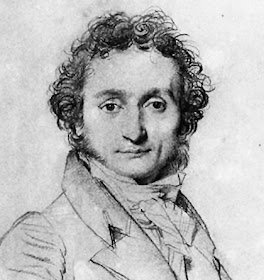
Niccolò Paganini is widely regarded as one of history's greatest violinists
Niccolò Paganini is widely regarded
as one of history's greatest violinists
The musician and composer Niccolò Paganini, widely regarded as one of the greatest violinists of all time, was born on this day in 1782 in Genoa.

Paganini’s ability was so far ahead of his contemporaries that to some observers it defied comprehension. He possessed unusually long fingers, a memory that enabled him to play entire pieces without the need for sheet music, and could play at up to 12 notes per second.

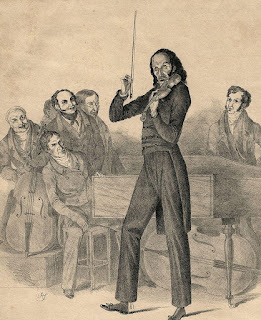
This, combined with his appearance - he was tall and thin, with hollow cheeks, pale skin and a fondness for dressing in black - and a habit of making wild, exaggerated movements as he played, gave rise to outlandish theories that he was possessed by the Devil, or even was the Devil himself.

He also pursued a somewhat dissolute lifestyle, drinking heavily, gambling and taking advantage of his fame to engage in numerous affairs.  

The suspicion of demonic associations stayed with him all his life to the extent that after his death at the age of 58 it was four years before his body was laid to rest because the Catholic Church would not give him a Christian burial, their reticence not helped by his refusal to accept the last rites.

Only years later was it concluded that his long fingers were probably the result of a genetic disorder called Marfan syndrome, while the speed of his playing and jerky movements could have been symptoms of Ehlers-Danlos syndrome, another inherited condition, whose sufferers have increased flexibility but a lack of coordination.

Paganini has such an accurate memory that he could play without sheet music
Paganini has such an accurate memory
that he could play without sheet music
Paganini was born the third of six children. His father, Antonio, was a trader, albeit not a prosperous one, and would supplement his income by playing the mandolin. Niccolò soon learned to play the instrument and had moved on to the violin by the age of seven.

It was soon clear he was blessed with prodigious talent and was soon offered scholarships to study with local teachers in Genoa. His ability quickly outpaced what they could offer him, prompting his father to take him to Parma in search of more advanced tuition.

His progress was interrupted in 1796 when northern Italy was invaded by France and Paganini’s family left the city to move inland along the Polcevera river to Bolzaneto, where they owned another property. Paganini occupied himself by learning to play the guitar, again to an extraordinary standard, although it was an instrument he played largely for his own amusement and for close friends, rather than give public performances.

He embarked on his first solo violin tour at the age of 15, appearing at various places around Italy, but being away from home was not good for his mental health and it was thought that this pushed him towards drinking and gambling as an escape. 

After he recovered, he was appointed first violin of the Republic of Lucca, at that time one of the most powerful city states in Italy, but in 1805 Lucca was annexed by Napoleonic France, and the region was ceded to Napoleon's sister, Elisa Baciocchi.  Paganini stayed, becoming a violinist to the Baciocchi court.  It was during this time that he composed perhaps his most famous work, his 24 Caprices for solo violin.

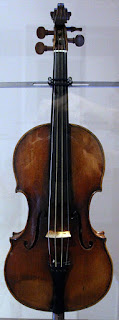
Paganini's violin Il Cannone Guarnerius
Paganini's violin Il
Cannone Guarnerius
Eventually, he decided to return to touring, giving concerts around Genoa and Parma, where he had attracted large audiences previously. He was still not well known outside Italy, even after beginning to make appearances at La Scala in Milan, gaining admirers among their international clientele. 

It was not until after Pope Leo XII had conferred upon him the Order of the Golden Spur, the papal equivalent of a knighthood, in 1827, that his fame spread across Europe. The following year, he was invited to play in Vienna, followed by a prolonged tour that saw him perform in almost all the major cities of Germany, Poland and Bohemia. Later, he performed in Paris and London.

Still, his phenomenal ability attracted suspicion. In Vienna, an audience member claimed he had seen the Devil on stage with Paganini. A story circulated that the sound of a woman’s scream could be heard emanating from his violin while he played, the consequence, it was said, of his murdering a woman and making strings from her intestines, while imprisoning her soul within the body of the instrument. 

Given such stories, it was hardly surprising that he made few friends. Two exceptions were Gioachino Rossini, the Italian composer he first met in Bologna in 1818 and for whom he once conducted an opera performance after the sudden death of the regular conductor, and Hector Berlioz, the French composer whom he compared with Beethoven and supported with large sums of money towards the end of his life.

Among his many romantic associations, the most enduring involved a singer from Como, Antonia Bianchi. After meeting in Milan in 1813 they gave concerts together throughout Italy. They had a son, Achille Ciro Alessandro, born in Palermo in 1825, but they were never married and split up in around 1828. 

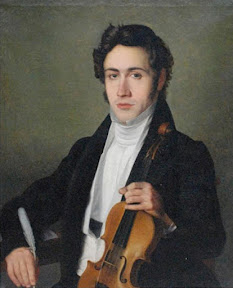
Paganini began learning the violin at the age of seven
Paganini began learning the violin
at the age of seven
Paganini’s health was never good. He was diagnosed with syphilis in 1922 and the treatment for it, which involved mercury and opium, did as much damage as it cured. In 1834 he developed tuberculosis while in Paris, which left him prone to infection and bouts of depression.

Touring soon became impossible and he returned to Genoa initially, giving lessons to a small number of pupils, including Camillo Sivori, who would go on to assume his mantle as Italy’s finest violinist. 

Restless, he went back to Paris in 1836 and unwisely invested much money in a casino, which failed so badly he was forced to auction off many of his prized collection of violins and guitars, including several made by Antonio Stradavari in Cremona, in order to recoup his losses. He left Paris for Marseille in 1838 and from there went to Nice, which is where he died in 1840, apparently from internal bleeding as a result of cancer of the larynx. It was the Bishop of Nice who arranged for a local priest to visit him and perform the last rites, but Paganini refused to accept his life was nearing its end and dismissed the priest.

The local church refused to bury him on consecrated ground and his embalmed body remained in the house where he died for more than a year and in the Nice area for almost four years while his son, Achille, pleaded with the Catholic Church to allow his body to be moved back to Italy. Ultimately, Achille’s entreaties were answered by Pope Gregory XVI and Paganini’s body was finally laid to rest at La Villetta cemetery in Parma.

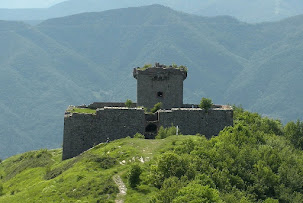
The Fratello Minore fortress above the Polcevera valley outside Bolzaneto
The Fratello Minore fortress above the
Polcevera valley outside Bolzaneto
Travel tip:

Bolzaneto, where the Paganini family had a house while Niccolò was growing up, was once a hamlet located outside the city of Genoa in the Polcevera valley. Today it is a suburb of Genoa, surrounded by many small industries and business firms. On the mountains behind Bolzaneto, at the left side of Polcevera valley, are two fortresses, which are part of the external fortresses of Genoa: the Fort Diamante and a smaller fortress known as Fratello Minore. Close to the Bolzaneto exit of the A7 motorway that runs from Genoa to Milan is what used to be Bolzaneto’s castle, built in the early 14th century but subsequently destroyed in clashes between the Guelphs and Ghibbelines before being rebuilt and destroyed several times thereafter, finally as a grand residence at the beginning of the 20th century.

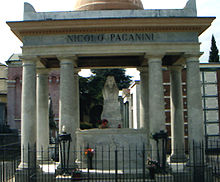
Paganini's tomb memorial at the La Villetta cemetery in Parma
Paganini's tomb memorial at the
La Villetta cemetery in Parma
Travel tip:

La Villetta, the monumental cemetery at Parma where Paganini’s body was finally buried and an elaborate memorial erected, takes its name after the farm that Duchess Marie Louise of Austria, the second wife of Napoleon, chose as the site for the city's burial ground during her rule of the city from 1816 to 1847. Designed by the engineer Giuseppe Cocconcelli in neoclassical style, it contains the tombs among others of the poet Angelo Mazza and the composer Ildebrando Pizzetti. Paganini’s tomb, housed under a domed portico supported by eight Doric columns, is on the left side of the entrance, opposite the main chapel dedicated to San Gregorio Magno.

Also on this day:

1952: The birth of Oscar-winning actor Roberto Benigni

1962: The death in a plane crash of industrialist Enrico Mattei

1967: The birth of mountaineer Simone Moro


Home