17 December 2022

17 December

NEW
- Remains of exiled monarch returned to Italy

Repatriation of Vittorio Emanuele III sparked anger

The remains of Italy’s wartime king, Vittorio Emanuele III, were returned to Italian soil on this day in 2017, 70 years after his death in exile in Egypt.  His body had been buried in St. Catherine’s Catholic Cathedral in Alexandria since 1947, when he died at the age of 78, a year and a half after abdicating in favour of his son, Umberto II.  His remains were flown to Italy by military aircraft for reburial at his family’s mausoleum at the Sanctuary of Vicoforte, a church in the province of Cuneo, Piedmont. At the same time, the body of his wife, Queen Elena, who had died in France in 1952, was flown to Italy from Montpelier, so that they could be buried side by side.  Vittorio Emanuele’s coffin, draped in a flag bearing the coat of arms of the Savoy family, was taken from the plane at Cuneo’s small Levaldigi airport and escorted to the Sanctuary solely by local officials, including the prefect vicar, the local village mayor and the president of Cuneo’s Chamber of Commerce. Only a handful of people were allowed in the church for the interment ceremony.  Read more…

__________________________________________

NATO boss seized by Red Brigades

Brigadier-General James L Dozier held for 42 days

Three years after the kidnap and murder of the former Italian prime minister Aldo Moro shocked Italy and the wider world, terrorists representing the ultra-left group Brigate rosse - the Red Brigades - returned to the headlines on this day in 1981 with the abduction of the high-ranking United States Army officer James L Dozier.  Brigadier-General Dozier, who was serving in Italy as deputy Chief of Staff of NATO's Southern European land forces, was seized and taken from his apartment in Verona and held for 42 days before being rescued by Italian special forces. The kidnap took place at between 5.30 and 6pm when four men turned up at the door of the apartment posing as plumbers.  The general was overpowered and then struck over the head before his wife, Judith, who was initially held at gunpoint, was tied up with chains and plastic tape.  According to his wife, 50-year-old General Dozier was then bundled into what she described as a "steamship trunk", which the men carried out to a waiting van.  Mrs Dozier was left in the apartment, alerting neighbours later by banging on the walls.  It was the first time the Red Brigades had held a member of the American military, or any foreign national.  Read more…

________________________________________

Domenico Cimarosa – opera composer

Musician who developed the model for ‘comic opera’

A prolific composer of operas, Domenico Cimarosa was born on this day in 1749 in Aversa, between Naples and Caserta in Campania.  Cimarosa wrote more than 80 operas during his lifetime, including Il matrimonio segreto (The Secret Marriage), which is considered to be his finest work.  Other composers judge it to be among the greatest examples of opera buffa, the Italian term for comic opera and Verdi considered it to be the model for the genre.  Cimarosa attended a free school connected to a monastery in Naples where the organist taught him music and as a result obtained a scholarship to attend a musical institute in the city for 11 years. He wrote his first opera at the age of 23 and, after several successes in theatres in Naples, he was invited to Rome where he produced another comic opera, L’Italiano in Londra.  He travelled throughout Italy, writing operas for theatres in Naples, Rome and Florence until he was invited to St Petersburg by Empress Catherine II. He remained at her court for four years composing music for important occasions.  He then went to Vienna at the invitation of Leopold II where he produced his masterpiece, Il matrimonio segreto.  Read more…

_______________________________________

Ettore Tito - painter
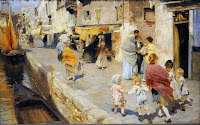
Artist who captured life in Venice

The painter Ettore Tito, whose landscapes and scenes from contemporary life in Venice earned him a substantial following in the late 19th and early 20th centuries, was born on this day in 1859 in Castellammare di Stabia, near Naples.  Despite his southern roots, Tito spent most of his life in Venice. His Campanian father captained merchant ships but his mother was Venetian and they moved to Venice when Ettore was still a child.  His prodigious talent for art emerged at an early age. He was taken under the wing of the Dutch artist Cecil van Haanen and was accepted by the Accademia di Belle Arti at the age of 12, graduating at 17 after studying under Pompeo Marino Molmenti, a distinguished professor.  Tito appreciated the beauty of Venice but wanted his paintings to capture the character of the city and its people. He earned the first important recognition of the quality of his work when his 1887 painting Pescheria vecchia a Venezia, a busy scene of traders and customers at the fish market by the Rialto bridge, won great praise at the Esposizione Nazionale Artistica in Venice and was subsequently bought by the Galleria Nazionale d'Arte Moderna in Rome.  Read more…

________________________________________

Pope Paul III excommunicates Henry VIII

The day a pontiff finally lost patience with the Tudor king

Pope Paul III announced the excommunication of King Henry VIII of England from the Catholic Church on this day in 1538 in Rome.  Henry had been threatened with excommunication by the previous pope, Clement VII, in 1533 after he married Anne Boleyn. However, Clement did not act on his threat straight away, hoping Henry might come to his senses.  Henry had been awarded the title of Defender of the Faith by a previous pope because he had written a defence of the seven sacraments of the Catholic church against the protestant leader Martin Luther.  But Clement died the following year and a new pope had to be elected.  Pope Paul III, who was born Alessandro Farnese, became pontiff in 1534 and took on the job of organising the Counter Reformation as well as using nepotism to advance the power and fortunes of the Farnese family.  When it became clear Henry was intent on demolishing the Catholic Church in England, Paul III issued the original papal bull - edict - drawn up by Clement VII.  He lost patience with Henry after he declared himself head of the Church of England and started ordering the execution of anyone who stood in his way.  Read more…

________________________________________

Leopoldo Eleuteri - flying ace

World War I pilot claimed eight aerial victories

First World War pilot Leopoldo Eleuteri, who was credited with seven of the eight combat victories he claimed, was born in Castel Ritaldi, a small town in Umbria about 60km (37 miles) by road southeast of Perugia, on this day in 1894.  Eleuteri did not begin flying active combat sorties as a fighter pilot until February 1918 but progressed rapidly with the 70th Squadron of the Corpo Aeronautico Militare, the airborne arm of the Royal Italian Army.  He went on to fly more than 150 sorties and between April 1918 and October 1918 claimed eight enemy planes shot down, being eventually credited with seven successes in his own right.  Passionate about all forms of mechanised flight since he was a boy, Eleuteri volunteered for aeronautical service as soon as he was old enough.  He was a student in a technical school until he was conscripted in 1915. At first, he was assigned to duty in ordnance factories before being sent to join the 3rd Infantry Regiment of the Royal Italian Army.  There, he was allowed to begin aviation training. In October 1916, he qualified as a pilot at Gabardini's flying school at Cameri in Piedmont.  Read more…

_____________________________________

Rome falls to the Ostrogoths

Sacking in 546 left city a shadow of its former self

The Ostrogoths, the Germanic tribe that took over large parts of the Italian peninsula with the collapse of the Western Roman Empire, achieved a symbolic victory on this day in 546 when an army under the leadership of King Totila captured and sacked Rome following a year-long siege of the Eternal City.  The event was part of the Gothic War between the Ostrogoths, who had originated on the Black Sea in the area now known as Crimea, and the Byzantine (Eastern) Empire, between 535 and 554.  Totila led a fightback by the Ostrogoths after the fall of the Gothic capital at Ravenna in 540 signalled the apparent reconquest of Italy by the Byzantines.  He had swept south with his forces and was based at Tivoli, east of Rome, as he plotted how he would recapture the region of Latium. In 545, he laid siege to the city.  Bessas, the commander of the imperial garrison charged with protecting the city, was stubborn but cruel to the Roman citizens.  Although he had a stock of grain, he would not let it be used to feed the population unless they paid for it, while at the same time refusing requests from citizens to leave the city.  Read more…

Booking.com


Home


Remains of exiled monarch returned to Italy

Repatriation of Vittorio Emanuele III sparked anger

Vittorio Emanuele III's original funeral, which took place in Alexandria, Egypt in 1947
Vittorio Emanuele III's original funeral, which
took place in Alexandria, Egypt in 1947
The remains of Italy’s wartime king, Vittorio Emanuele III, were returned to Italian soil on this day in 2017, 70 years after his death in exile in Egypt.

His body had been buried in St. Catherine’s Catholic Cathedral in Alexandria since 1947, when he died at the age of 78, a year and a half after abdicating in favour of his son, Umberto II.

His remains were flown to Italy by military aircraft for reburial at his family’s mausoleum at the Sanctuary of Vicoforte, a church in the province of Cuneo, Piedmont. At the same time, the body of his wife, Queen Elena, who had died in France in 1952, was flown to Italy from Montpelier, so that they could be buried side by side.

Vittorio Emanuele’s coffin, draped in a flag bearing the coat of arms of the Savoy family, was taken from the plane at Cuneo’s small Levaldigi airport and escorted to the Sanctuary solely by local officials, including the prefect vicar, the local village mayor and the president of Cuneo’s Chamber of Commerce. Only a handful of people were allowed in the church for the interment ceremony. 

Vittorio Emanuele III, pictured with Mussolini (left) and Hitler in Rome in 1938, was a flawed figure to many Italians
Vittorio Emanuele III, pictured with Mussolini (left) and Hitler
in Rome in 1938, was a flawed figure to many Italians 
For all that it was a low-key affair, the repatriation made headlines, and much of the reaction in Italy was critical.

Vittorio Emanuele enjoyed popularity at times during his 46-year reign, enjoying the nickname Re soldato - the soldier king - after Italy’s victory in World War One, and Sciaboletta - little sabre - because his diminutive size - he was only five feet tall - required the sword of his military uniform to be shortened.

But his reputation was fatally damaged by the decisions he took during the time of Benito Mussolini’s Fascists.

When Mussolini's Blackshirts marched on Rome in 1922, he not only refused the government request to declare martial law, he then handed power to Mussolini, inviting him to be prime minister.

Many refused to forgive him for signing Mussolini’s 1938 racial laws that harshly discriminated against Jews.

He did order Mussolini’s arrest in 1943 when it became obvious that Italy’s war was going to end in defeat. But he attracted more criticism for taking 40 days to agree an armistice with the Allies, which gave the Germans time to entrench themselves in northern Italy and even to free Mussolini from his house arrest in the mountains of Abruzzo.

Vittorio Emanuele as a baby with his mother, Queen Margherita
Vittorio Emanuele as a baby with
his mother, Queen Margherita
Vittorio Emanuele then fled Rome, which was seen as an act of cowardice. His decision to hand power to his son in 1946, shortly before the referendum in which Italians would vote to become a republic, was a desperate attempt to save the monarchy.

It was not enough to persuade Italian voters, however. Following the referendum result, all male members of the monarchy and their descendants were ordered to leave the country in a ban that remained in place until 2002.

The decision to bury the late monarch in relative obscurity attracted criticism from members of his family. Italy’s first two Savoy kings, Vittorio Emanuele II and Umberto I, and its first queen, Margherita, were all buried at the Pantheon in Rome. 

Emanuele Filberto, Vittorio Emanuele III and Elena’s great-grandson, was quoted as saying that while he was pleased with the return of his ancestors to Italy, he believed that all members of the House of Savoy deserved to be in the Pantheon.  

But this was strongly opposed by historians, on the grounds that the circular former Roman temple was traditionally a place where Italians of high esteem were laid to rest.

It also provoked an angry response from Rome’s Jewish community. Like other Italians of Jewish heritage, they could never forgive the king’s co-operation with Mussolini. But they were also sensitive to the proximity of the Pantheon to the city’s former ghetto, which saw more than 1,000 residents rounded up and sent to their death in concentration camps in 1943.

The ex-monarch's tomb at the Sanctuary of Vicoforte
The ex-monarch's tomb at
the Sanctuary of Vicoforte
Travel tip:

The city of Cuneo, which developed at the confluence of the Stura and Gesso rivers, is set out in a grid system with a large, elegant central square, Piazza Galimberti, one of the largest squares in Italy, after Piazza del Plebiscito in Naples. Surrounded by neo-classical buildings, it has a large statue of Giuseppe Barbaroux, the author of the Albertine Statute that formed the constitution of the Kingdom of Sardinia-Piedmont in 1848. The square is named after Duccio Galimberti, one of the heroes of the Italian resistance in the Second World War.   Cuneo had been acquired by the Duchy of Savoy in 1382 and remained an important stronghold of the Savoy state for many centuries.

The Pantheon in Rome, built in AD 118, contains the remains of many notable Italians
The Pantheon in Rome, built in AD 118, contains
the remains of many notable Italians

Travel tip

The Pantheon in Piazza della Rotonda in Rome is considered to be Rome’s best preserved ancient building. It was built in AD 118 on the site of a previous building dating back to 27 BC. It was consecrated as a church in the seventh century. In addition to Vittorio Emanuele II, his son, Umberto I, and his wife, Queen Margherita, the Pantheon contains the tombs of the painters Raphael and Annibale Carracci, the architect Baldassare Peruzzi and the composer Arcangelo Corelli.

Also on this day:

546: Rome falls to the Ostrogoths

1538: Pope Paul III excommunicates Henry VIII of England

1749: The birth of composer Domenico Cimarosa

1859: The birth of painter Ettore Tito

1894: The birth of WW1 pilot Leopoldo Eleuteri

1981: Red Brigades seize NATO boss Dozier


Home


16 December 2022

16 December

The founding of AC Milan

English roots of one of Italy’s football giants

The football club that would eventually become known as AC Milan was founded on this day in 1899.  Although Juventus have won twice as many domestic Serie A titles - 36 to their 18 - AC Milan have been Italy’s most successful club in international club football, winning 18 trophies, including the European Cup/Champions League on seven occasions.  Yet the club owes its existence largely to five expatriate Englishmen, who conceived the idea of forming a football club - a cricket and football club, to be more accurate - during an evening at the Fiaschetteria Toscana bar, a few steps from the Duomo in the centre of Milan, where they would meet frequently to socialise.  The group comprised Alfred Edwards, a businessman from Shropshire, players Samuel Davies, from Manchester, David Allison and Edward Nathan Berra, both English but born in France, and Herbert Kilpin, who is remembered as the club’s driving force.  Kilpin, a butcher’s son from Nottingham, was both a footballer and a businessman. He had been a founder-member of the Garibaldi Reds, the amateur team in which Nottingham Forest has its roots.  Read more…

_________________________________________

Giovanni Agnelli – entrepreneur

Founder of Fiat had keen eye for a good investment

Giovanni Agnelli, the businessman who founded the Fiat car manufacturing company, died on this day in 1945 in Turin.  As soon as Agnelli heard about the idea of a ‘horseless carriage’, he recognised it as a business opportunity and in 1898 met up with an inventor looking for investors for his project.  In 1899 he became part of a group who founded the Fabbrica Italiana di Automobili Torino. Within a year he had become managing director of the company and by 1903 the business was making a small profit.  Giovanni had been born in Villar Perosa, a small town near Pinerolo in Piemonte, in 1866.  He embarked on a military career after finishing his studies but returned to his home town to follow in his father’s footsteps and become Mayor.  Fiat continued to grow and went public before the start of the First World War. After the war the first Fiat car dealership was established in the United States and the company continued to expand internationally.  Although Giovanni Agnelli had many other business interests he remained actively involved with Fiat until his death on 16 December 1945 at the age of 79.  Read more…

______________________________________

Santo Versace - businessman and politician

Entrepreneurial brain behind Versace fashion empire

Santo Versace, sometime politician and the business brain behind Italy's world famous luxury fashion label, was born on this day in 1944 in Reggio Calabria.  Along with his brother and sister, Gianni and Donatella, Santo grew up in Italy's southernmost major city, which is situated right on the "toe" of the Italian peninsula and separated from the island of Sicily by barely 10km of the Strait of Messina.  Unlike his younger siblings, who were inspired by their mother, Francesca, a dressmaker who owned a small clothes shop, to become designers, Santo took after their father, Antonio, a coal merchant who in time became an interior decorator, in wishing to become a business entrepreneur.  He helped his father hump sacks of coal while still a child and learned the basics of running a business as a teenager before attending the University of Messina, from which he graduated in 1968 with a degree in economics.  At first, Santo worked in banking for Credito Italiano in Reggio Calabria before switching to teaching economics and geography to high school students. In 1972, after completing his military service, he set up as an accountant and management consultant in Reggio Calabria.  Read more…

________________________________________

Francesco Graziani - World Cup winner

Forward injured seven minutes into 1982 final

The footballer Francesco Graziani, who played in all of Italy’s matches in the 1982 World Cup in Spain but had the misfortune to be reduced to the status of a spectator when injury struck just seven minutes into the final, was born on this day in 1952 in Subiaco, in Lazio.  Graziani, a striker with Fiorentina who had made his name with Torino, scored a vital goal in Italy’s final match of the opening group phase against Cameroon, securing the draw that was enough to take the azzurri through to the second stage of the competition.  He played in Italy’s epic victories over Argentina and Brazil in the second group phase and in the thumping semi-final win over Poland but was replaced by Alessandro Altobelli after damaging a shoulder in the opening moments of the final against West Germany.  Altobelli went on to score Italy’s third goal as they overcame the Germans 3-1 to lift the trophy for a third time.  With 23 goals in 64 appearances for the national team, Graziani - nicknamed ‘Ciccio’ - achieved a strike rate in international football similar to his goals-per-game ratio in his career at domestic level, which brought him 142 goals in 413 league appearances.  Read more…

______________________________________

Ivana Spagna – singer-songwriter

Dance track made 30 years ago still holds record

The singer and songwriter Ivana Spagna, whose single Call Me achieved the highest placing by an Italian artist in UK chart history when it reached number two in 1987, was born on this day in 1954 in the town of Valeggio sul Mincio, in the Veneto.  Often performing as simply Spagna, she has sold more than 10 million copies of her singles and albums in a career spanning 46 years, having released her first single in 1971 at the age of 16.  She began to sing professionally in the early 1980s, when she provided the vocals for a number of disco tracks lip-synched by other artists, and when she relaunched her recording career in her own right she met with immediate success.  The single Easy Lady, recorded in 1986 and which she tends to regard as her debut single as a professional artist, sold more than two million copies, as did Call Me, which was released the following year.  Spagna defied the expectations of her record company, who had misgivings about promoting an Italian singing in English under the stage name “Spain” but were pleasantly surprised by her popularity.  Call Me topped the European singles chart and reached No 13 in the Billboard dance chart in the United States.  Read more…

EN - 728x90


Home


15 December 2022

15 December

Comunardo Niccolai - footballer

‘King of own goals’ was also a champion

The footballer Comunardo Niccolai, a central defender with a propensity for scoring calamitous own goals, was born on this day in 1946 in Uzzano, a beautiful hill town in Tuscany.  Niccolai scored six own goals in his Serie A career, which contributed to his standing as something of a cult figure in Italian football.  He was actually an exceptionally talented player - good enough to be picked for the Italian squad for the World Cup in 1970, where the azzurri finished runners-up, as well as a key figure in the Cagliari team that won the Serie A title in 1970.  But he seemed unable to avoid moments of freakish bad luck and he acquired such unwanted notoriety as a result that people outside the game still reference his name when describing someone doing something to their own disadvantage.  For example, during the course of one of the regular political crises in Italy in the late 1990s, the right-wing politician Francesco Storace said of a policy decision taken by prime minister Massimo D’Alema, “Ha fatto un autogol alla Niccolai” - meaning that he had “scored an own goal Niccolai-style”.  Read more…

____________________________________

John Paul Getty III released

Heir to world’s biggest fortune held by kidnappers for 158 days

A story that dominated the Italian press and newspapers around the world ended on this day in 1973 when police responding to a tip-off found a shivering, malnourished and deeply traumatised American teenager inside a disused motorway service area in a remote part of southern Italy.  John Paul Getty III, grandson of the richest man in the world, the oil tycoon John Paul Getty, had been held in captivity for more than five months by a kidnap gang who had demanded $17 million for his safe return.  The boy’s 80-year-old grandfather, whose personal fortune would equate today to almost $9 billion but who was notoriously mean, at first refused to pay a penny and stuck to that position until late November, when a letter containing a lock of hair and a human ear arrived at the offices of a daily newspaper in Rome.  After a further letter arrived containing a photograph of John Paul Getty III minus one ear, the octogenarian’s representatives made contact with the kidnappers and negotiated his release for $3 million.  Even then, John Paul Getty Senior refused to pay more than $2.2 million, which his lawyers allegedly told him was the maximum he could claim as a tax-deductible expense.  Read more…

________________________________________

Frankie Dettori - champion jockey

Milan-born horseman among all-time greats

Lanfranco "Frankie" Dettori, the three-times British champion jockey, was born on this day in 1970 in Milan.  As well as winning the UK jockeys' title in 1994 and 1995 and again in 2004, Dettori has won more than 500 Group Races around the world, including 20 British Classics.  He won his first Classic in 1994 on Balanchine in the Oaks. He won his first St Leger in 1995 on Classic Cliche, his first 2,000 Guineas in 1996 on Mark of Esteem and his first 1,000 Guineas in 1998 on Cape Verdi, finally completing the set at the 15th attempt when Authorized won the Derby at Epsom in 2007. Dettori won the Derby for a second time in 2015 on Golden Horn, which he rates as the best horse he has ever ridden.  English-bred and owned by the diamond dealer Anthony Oppenheimer, Golden Horn won the Derby, the Eclipse Stakes, the Irish Champion Stakes and the Prix de l'Arc de Triomphe for Wiltshire trainer John Gosden during the 2015 season, each time with Dettori in the saddle.  Apart from his big-race successes, which also include 24 Group Race wins in Italy and all of the Irish Classics, Dettori is best known for his unprecedented and so-far unequalled achievement of riding the winners of all seven races on a single day at Ascot in 1996.  Read more…

___________________________________

The Good, the Bad and the Ugly

Spaghetti western has steadily gained critical acclaim

The film, The Good, the Bad and the Ugly, was released on this day in Italy in 1966.  It was the third and final instalment in the Dollars Trilogy, following A Fistful of Dollars and For A Few Dollars More.  Despite mixed reviews to begin with, it was a financial success, grossing more than $25 million at the box office.  The film has gained respect over the years and is now seen as a highly influential example of the Western film genre and has been acclaimed as one of the greatest films of all time.  Directed by Sergio Leone, the film, known in Italian as Il buono, il brutto, il cattivo, was made partly at the Cinecittà studio in Rome and partly on location.  It became categorised as a 'spaghetti western' and was distinctive because of Leone’s film–making style, which involved juxtaposing close-ups with lengthy long shots.  Clint Eastwood, Lee Van Cleef and Eli Wallach star in the title roles. They are three gunslingers out to find buried gold against the backdrop of the violence of the American Civil War.  The score for the film was composed by Ennio Morricone and the iconic main theme for the film became a popular hit in 1968.  Read more…


Home