23 March 2023

23 March

Lorenzino de’ Medici - assassin

Mystery over motive for killing cousin

Lorenzino de’ Medici, who became famous for the assassination of his cousin, the Florentine ruler Alessandro de’ Medici, was born on this day in 1514 in Florence.  The killing took place on the evening of January 6, 1537.  The two young men - Alessandro was just four years older - were ostensibly friends and Lorenzino was easily able to lure Alessandro to his apartments in Florence on the promise of a night of passion with a woman who had agreed to meet him there.  Lorenzino, sometimes known as Lorenzaccio, left him alone, promising to return with the woman in question, at which point Alessandro dismissed his entourage and waited in the apartments.  When Lorenzino did return, however, it was not with a female companion but with his servant, Piero, and the two attacked Alessandro with swords and daggers. Although a struggle ensued, they killed him.  The motive has been debated for centuries. One theory was that it was an act of revenge following a legal controversy the previous year, when Alessandro sided against Lorenzino in a dispute over the inheritance of his great, great grandfather, Pierfrancesco the Elder.  Read more…

_____________________________________

Ugo Tognazzi - comic actor

Achieved international fame through La Cage aux Folles

Ugo Tognazzi, the actor who achieved international fame in the film La Cage aux Folles, was born on this day in 1922 in Cremona.  Renowned for his wide repertoire in portraying comic characters, Tognazzi made more than 62 films and worked with many of Italy's top directors.  Along with Vittorio Gassman, Alberto Sordi and Nino Manfredi, Tognazzi was regarded as one of the four top stars of commedia all'italiana - comedy the Italian way - in the 1960s and 1970s.  In 1981 he won the award for best actor at the Cannes International Film Festival for his role in Bernardo Bertolucci's Tragedia di un Uomo Ridicolo (The Tragedy of a Ridiculous Man).  His work was widely acclaimed in Italy, but it was not until he was cast in the role of homosexual cabaret owner Renato Baldi in the French director Édouard Molinaro's 1979 movie La Cage Aux Folles that he became known outside Italy.   The film became in its time the most successful foreign language film ever released in the United States, with box office receipts of more than $20 million.  The film spawned two sequels in which Tognazzi reprieved the role of the mincing Baldi, who in the story was the joint owner of a night club in St Tropez that specialised in drag acts.  Read more…

______________________________________

Franco Battiato – singer-songwriter

Long career of a musical philosopher

One of the most popular singer-songwriters in Italy, Franco Battiato, was born on this day in 1945 in Ionia in Sicily.  Nicknamed Il Maestro, Battiato has written many songs with philosophical and religious themes. He has also had a long-lasting professional relationship with Italian singer Alice, with whom he represented Italy at the 1984 Eurovision Song Contest.  Battiato graduated from high school at the Liceo Scientifico Archimede in Acireale, a city in the province of Catania in Sicily.  He went to Rome and then moved on to Milan, where he won his first musical contract. After his first single, La Torre, was released, Battiato performed the song on television. After some success with the romantic song E l’amore, he released the science fiction single La convenzione, which was judged to be one of the finest Italian progressive rock songs of the 1970s.  The albums of electronic music he produced in the ‘70s, obscure at the time, are now sought after by collectors.  His popularity grew after he moved away from progressive rock to a more mainstream pop style, producing music that was regarded as elegant, yet easy to listen to. Read more…

_____________________________________

The founding of the Italian Fascists

Mussolini launched party at 1919 Milan rally

Italy's notorious dictator Benito Mussolini officially formed what would become known as the National Fascist Party on this day in 1919 at a rally in Milan's Piazza San Sepolcro.  A war veteran and former socialist activist who had moved towards a more nationalist political stance, Mussolini initially drew his followers together as the Fasci Italiani di Combattimento (Italian Combat Group).  This group evolved into the Partito Nazionale Fascista (PNF) two years later, sweeping to power in 1922 when King Victor Emmanuel III, fearing civil war after 30,000 of Mussolini's supporters, the Blackshirts, marched on Rome, asked Mussolini to form a government.  Born the son of a blacksmith in Predappio, in Emilia-Romagna, Mussolini had been an active socialist, first in Switzerland, where he had moved as a 19-year-old to seek work and avoid military service, and again when he returned to Italy.  He became a leading figure in the Italian Socialist Party (PSI) and edited the left-wing newspaper Avanti.  But he was expelled by the PSI because of his opposition to the party's neutral stance on the First World War.  Read more…


Home


22 March 2023

22 March

NEW - Vittorio Emanuele II Monument - Rome landmark

‘Altar of the Fatherland’ built to honour unified Italy’s first king

The foundation stone of Rome’s huge Monument to Vittorio Emanuele II was laid on this day in 1885 in the presence of his son and successor Umberto I and his family.  The monument, which took half a century to fully complete, occupies a site on the northern slope of the Capitoline (Campidoglio) Hill on the south-eastern side of the modern city centre, a few steps from the ruins of the Forum, the heart of ancient Rome.  Built in white Botticino marble, the multi-tiered monument is 135m (443 ft) wide, 130m (427 ft) deep, and 70m (230 ft) high, rising to 81m (266ft) including the two statues of a chariot-mounted winged goddess Victoria on the summit of the two propylaea.  Its appearance has earned it various nicknames, ranging from the ‘wedding cake’ to the ‘typewriter’, although it is officially known as Vittoriano or Altare della Patria.  The Altar of the Fatherland is actually just one part of the monument, at the front and in the centre, consisting of an inset statue of the goddess Roma and the Tomb of the Unknown Soldier, where two soldiers guard an eternal flame.  Above it is a large bronze horse-back statue of Vittorio Emanuele II himself on a central plinth in front of the broad upper colonnade.  Read more…

____________________________________

Michele Sindona - fraudster and killer

Failed banker ordered murder of investigating lawyer

The shadowy banker Michele Sindona, who had links to underworld figures in Italy and America as well as prominent politicians, died in hospital in the Lombardy town of Voghera, 70km (43 miles) south of Milan, on this day in 1986.  His death, attributed to cyanide poisoning, came four days after he had been sentenced to life imprisonment for ordering the killing of a lawyer investigating the collapse of his $450 million financial empire.  His own lawyer claimed Sindona had been murdered but although it was never established beyond doubt, the circumstances of his death, caused by drinking coffee laced with the poison at breakfast in Voghera's maximum-security prison, pointed towards suicide.  During his chequered career, which also saw him sentenced to 25 years' jail in America for fraud following the failure of the Franklin National Bank on Long Island, Sindona had links with Mafia bosses in Sicily and New York, with the illegal Propaganda Due masonic lodge and with the controversial head of the Vatican Bank, the American Archbishop, Paul Marcinkus.  He had close ties with another Vatican Bank client who met an untimely death, Roberto Calvi. Read more…

_____________________________________

Nino Manfredi - actor and director

Totò fan became maestro of commedia all’italiana

The actor and director Saturnino ‘Nino’ Manfredi, who would become known as the last great actor of the commedia all’italiana genre, was born on this day in 1921 in Castro dei Volsci, near Frosinone in Lazio.  Manfredi made more than 100 movies, often playing marginalised working-class figures in the bittersweet comedies that characterised the genre, which frequently tackled important social issues and poked irreverent fun at some of the more absurd aspects of Italian life, in particular the suffocating influence of the church.  He was a favourite of directors such as Dino Risi, Luigi Comencini, Ettore Scola and Franco Brusati, who directed him in the award-winning Pane and cioccolata (Bread and Chocolate), which evoked the tragicomic existence of immigrant workers and was considered one of his finest performances.  It helped him fulfil his dream of following in the footsteps of his boyhood idol Totò, the Neapolitan comic actor whose eccentric characters took enormous liberties in mocking Italian institutions, and to be spoken off in the company of Ugo Tognazzi, Vittorio Gassman and Alberto Sordi as a true maestro of commedia all’italiana.  Read more…

_____________________________________

'La Castiglione' – model and secret agent

Beautiful woman helped the cause of Italian unification

Virginia Oldoini, who became known as La Castiglione, was born on this day in 1837 in Florence.  She became the mistress of the Emperor Napoleon III of France and also made an important contribution to the early development of photography.  She was born Virginia Oldoini to parents who were part of the Tuscan nobility, but originally came from La Spezia in Liguria. At the age of 17 she married the Count of Castiglione, who was 12 years older than her, and they had one son, Giorgio.  Her cousin was Camillo, Count of Cavour, who was the prime minister to Victor Emmanuel II, the King of Sardinia, later to become the first King of a united Italy.  When the Countess travelled with her husband to Paris in 1855, Cavour asked her to plead the cause of Italian unity with Napoleon III.  Considered to be the most beautiful woman of her day, she became Napoleon III’s mistress and her husband demanded a separation. During her relationship with Napoleon III she influenced Franco-Italian political relations, mingled with European nobility and met Otto von Bismarck.  She became known both for her beauty and elaborate clothes.  Read more…


Home


Vittorio Emanuele II Monument - Rome landmark

 ‘Altar of the Fatherland’ built to honour unified Italy’s first king

The Monument's multi-layered construction in white marble has earned it the nickname the 'wedding cake
The Monument's multi-layered construction in white
marble has earned it the nickname the 'wedding cake'
The foundation stone of Rome’s huge Monument to Vittorio Emanuele II was laid on this day in 1885 in the presence of his son and successor Umberto I and his family.

The monument, which took half a century to fully complete, occupies a site on the northern slope of the Capitoline (Campidoglio) Hill on the south-eastern side of the modern city centre, a few steps from the ruins of the Forum, the heart of ancient Rome.

Built in white Botticino marble, the multi-tiered monument is 135m (443 ft) wide, 130m (427 ft) deep, and 70m (230 ft) high, rising to 81m (266ft) including the two statues of a chariot-mounted winged goddess Victoria on the summit of the two propylaea. 

Its appearance has earned it various nicknames, ranging from the ‘wedding cake’ to the ‘typewriter’, although it is officially known as Vittoriano or Altare della Patria - the Altar of the Fatherland.

The Altare della Patria is actually just one part of the monument, at the front and in the centre, consisting of an inset statue of the goddess Roma and the Tomb of the Unknown Soldier, where two soldiers guard an eternal flame.

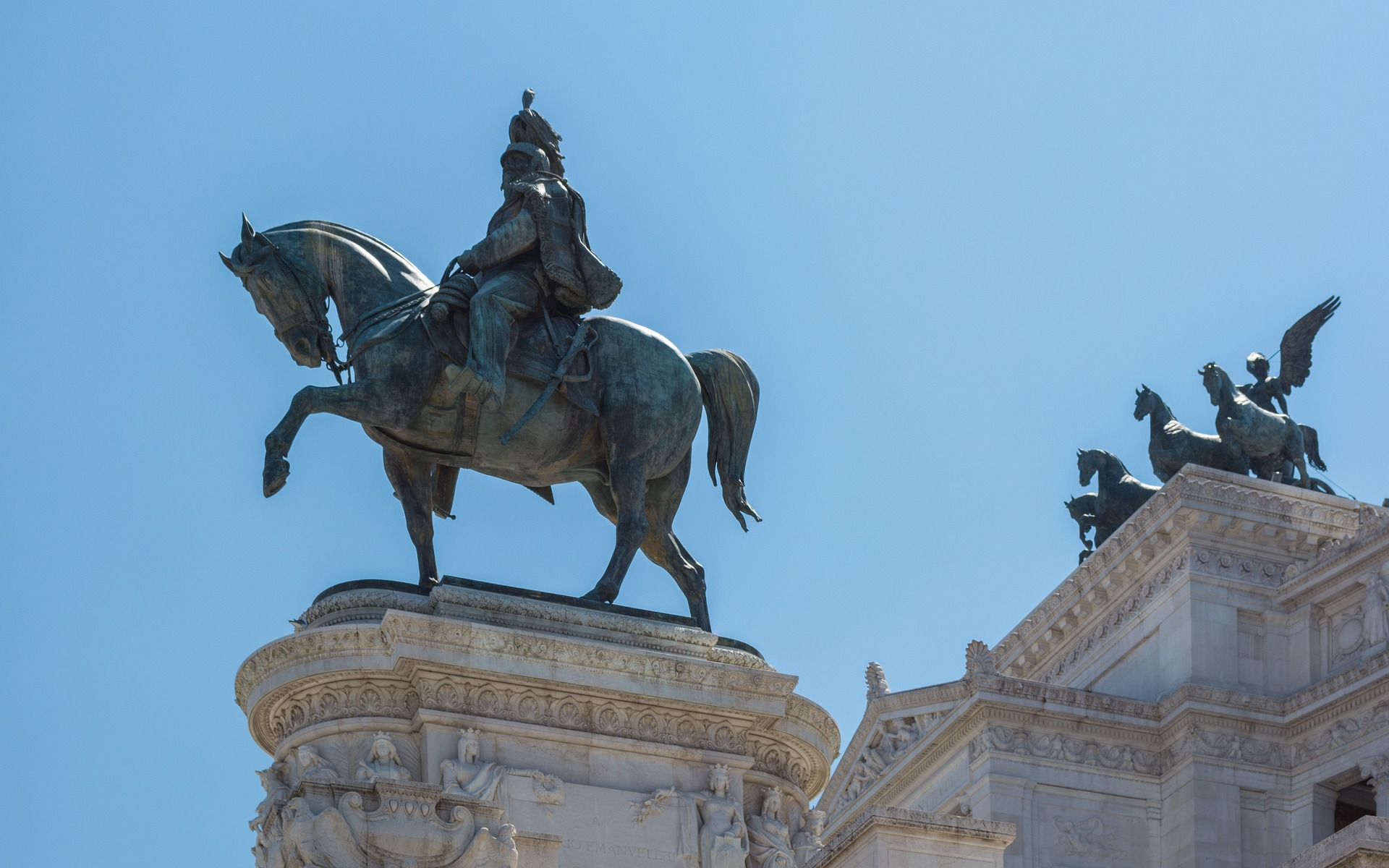
Vittorio Emanuele II is commemorated with a huge bronze statue at the front of the monument
Vittorio Emanuele II is commemorated with a
huge bronze statue at the front of the monument
Above it is a large bronze horse-back statue of Vittorio Emanuele II himself on a central plinth in front of the broad upper colonnade.  The statue, 10m (33ft) long and 12m (40ft) high, is said to have been made with 50 tons of bronze obtained by melting down army cannons.

Officially opened in 1911 on the 50th anniversary of the Unification of Italy, the monument has become a national symbol of Italy, representing the values of freedom and unity, which are represented in the two chariots atop the propylaea - on the left is the Quadriga dell'Unità by Carlo Fontana, on the right the Quadriga della Libertà by Paolo Bartolini.

The Vittoriano has an important ceremonial role. On three occasions each year - on Liberation Day (April 25), Republic Day (June 2) and Armed Forces Day (November 4) - the President of the Republic lays a laurel wreath at the Tomb of the Unknown Soldier to honour those who sacrificed their lives in the service of the country.

It also houses the Museo Centrale del Risorgimento Italiano al Vittoriano, the museum that commemorates the decades-long struggle for Italian unification, known as the Risorgimento.

The idea of building a permanent monument to Vittorio Emanuele II was first mooted soon after his death in 1878, when a Royal Commission set up to have responsibility for the project invited architects to put forward their ideas in a competition.

The Tomb of the Unknown Soldier, where the Italian president lays a laurel wreath on state occasions
The Tomb of the Unknown Soldier, where the Italian
president lays a laurel wreath on state occasions
The winner was a French designer, Henri-Paul Nénot. However, the idea of entrusting a non-Italian with what would become a symbol of the nation provoked such fierce opposition, not least because Nénot’s entry was one he had previously submitted for a project in Paris, that the contest was declared void and another one staged.

After the Commission could not decide between designs submitted by the Italians Manfredo Manfredi and Giuseppe Sacconi, and the German Bruno Schmitz, a third contest took place, which was won by Sacconi, an architect from Le Marche, whose design envisaged a neoclassical interpretation of the nearby Forum.

Such was the scale of the project, including the vast Piazza Venezia that the monument overlooks, a wide area of mediaeval and Renaissance streets and buildings had to be demolished. A small building to the right of the Vittoriano, at the foot of the stairway leading to the adjoining Basilica di Santa Maria in Ara Coeli, is all that remains.

Building proceeded slowly and was still some way from complete when Sacconi died in 1905. The project was continued by Gaetano Koch, Manfredi and Pio Piacentini and though it was inaugurated during the international exhibition for the 50th anniversary of unification in 1911, it was not considered complete until 24 years later.

During this time, the body of the Italian Unknown Soldier was placed in the crypt under the statue of the goddess Roma. This took place on Armed Forces Day in 1921, when the remains of an unidentified soldier killed in the First World War were interred in a solemn ceremony and the eternal flame was lit.

Finally, in 1935, the monument was declared to be fully completed with the addition of the museum of the Risorgimento, which occupies the space between the propylaea on the upper level. 

The entrance to the Museo del Risorgimento can be found on Via San Pietro in Carcere
The entrance to the Museo del Risorgimento
can be found on Via San Pietro in Carcere
Travel tip:

Open to the public since 1970, the Museo Centrale del Risorgimento Italiano - the National Museum of the Risorgimento - takes visitors on a tour of the Risorgimento in 14 stages, beginning with the Napoleonic period at the end of the 18th century and ending with the First World War, marking major events such as the uprising known as the Five Days of Milan, the two wars of independence and Giuseppe Garibaldi’s Expedition of the Thousand. It celebrates the roles of Garibaldi, the revolutionary philosopher Giuseppe Mazzini, the politician Cavour (Camillo Benso, Count of Cavour) and Vittorio Emanuele II himself. Visitors access the museum via an entrance on Via San Pietro in Carcere, to the rear of the monument.

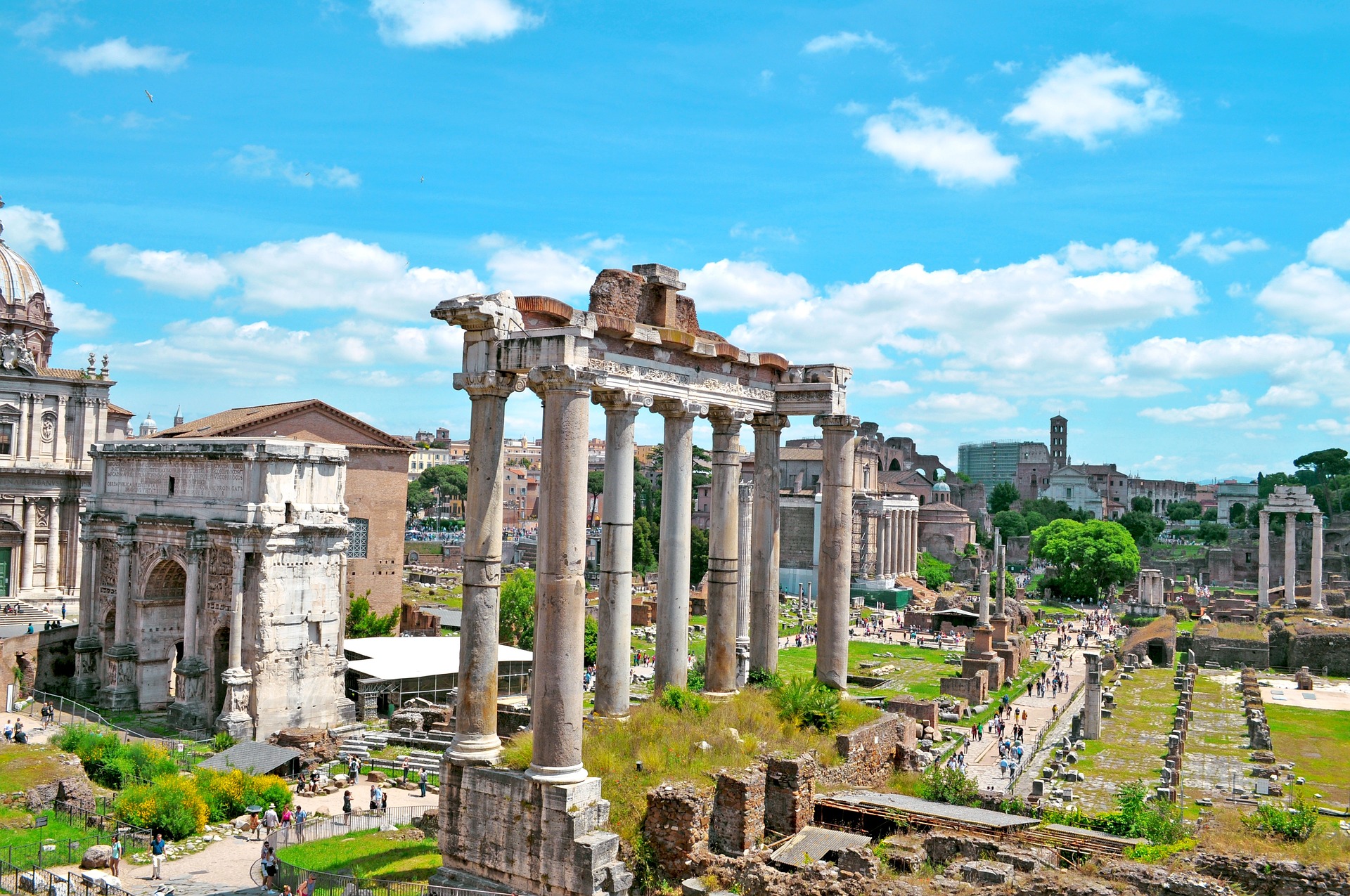
Rome's ancient Forum, an area of extensive ruins, is one of the city's most popular attractions
Rome's ancient Forum, an area of extensive ruins,
is one of the city's most popular attractions
Travel tip:

Rome's historic Forum, the ruins of which can be found immediately behind the Vittoriano, was at the heart both of the ancient city of Rome and the Roman Empire itself, the nucleus of political affairs and commercial business, a place where elections took place and great speeches were made.  The site fell into disrepair with the fall of the empire and over time buildings were dismantled for the stone and marble, with much debris left behind.  Eventually it was abandoned and became overgrown and was used mainly for grazing cattle.  Attempts at uncovering and restoring buildings began in the early 19th century and the process of excavating areas long buried continues today.  The impressive and extensive ruins are now one of Rome's major tourist attractions.  The site opens at 8.30am and closes one hour before sunset and visitors should allow at least two hours to explore.

Also on this day:

1837: The birth of ‘La Castiglione’ - mistress of Napoleon III

1921: The birth of actor and director Nino Manfredi

1986: The death of fraudster Michele Sindona


Home


21 March 2023

21 March

Alberto Marvelli - Rimini's Good Samaritan

Heroic deeds helped victims of bombing raids

Alberto Marvelli, who came to be seen as a modern day Good Samaritan after risking his life repeatedly to help the victims of devastating air raids in the Second World War, was born on this day in 1918 in Ferrara.  He died in 1946 at the age of only 28 when he was struck by a truck while riding his bicycle but in his short life identified himself to many as a true hero.  He was beatified by Pope John Paul II in 2004.  Marvelli's acts of heroism occurred mainly in Rimini, his adopted hometown, which suffered heavy bombing from the Allies due to its proximity to the Gothic or Green Line, a wide belt of German defensive fortifications that ran across the whole peninsula from La Spezia to the Adriatic coast.  As well as giving aid and comfort to the wounded and dying and to those whose homes and possessions had been destroyed, Marvelli also rescued many Rimini citizens from trains destined for concentration camps.  Alberto was the second of six children born to Luigi Marvelli and Maria Mayr. Growing up, he was set a powerful example by his mother, who always kept open house for the poor and regularly gave away food intended for her own family.  Read more…

_____________________________________

AC Milan pay record fee for Ruud Gullit

Signing of Dutch star sparked new era of success

A new golden era in the history of the AC Milan football club effectively began on this day in 1987 when the club agreed a world record transfer fee of £6 million - the equivalent of about £14.5 million (€16.8 million) today - to sign the attacking midfielder Ruud Gullit from the Dutch champions PSV Eindhoven.  The captain of The Netherlands national team that would be crowned European champions the following year, Gullit was regarded as one of the world’s best players at the time and his arrival in Milan caused huge excitement.  Thousands of Milan supporters turned out to greet him on the day he arrived in the city, so many that the car taking him from the airport to the club’s headquarters needed a police escort with sirens blaring in order to forge a path through the crowds.  Those fans correctly sensed that Gullit’s signing would bring a change of fortunes for the rossoneri after a dark period in their history.  Traditionally one of Italian football’s most powerful clubs, Milan had won the scudetto - the Italian championship - for the 10th time in 1979 but the following year were embroiled in the match-fixing scandal known as Totonero and as a punishment were relegated to Serie B - the second division - for the first time in their history.  Read more…

___________________________________

Benedetta Cambiagio Frassinello – Educator

Nun who promoted the rights of girls to a quality education

The Feast Day of Saint Benedetta Cambiagio Frassinello, who founded the Benedictine Sisters of Providence, is celebrated on this day, the anniversary of her death in 1858.  Benedetta carried out pioneering work by rescuing poor and abandoned girls and promoting their rights to a good education. She was made a saint by Pope John Paul II in 2002.  Benedetta was born in 1791 in Genoa but her family later moved to Pavia. As a young girl she wanted to consecrate her life to God, but obeying her parents’ wishes, she married Giovanni Battista Frassinello when she was 24.  After two years of marriage, during which they had no children, they decided to live a celibate life and stay together as brother and sister. They both later joined religious orders but Benedetta was forced to leave and return to live in Pavia again because of ill health.  When she was well again she dedicated herself to the education of the many young girls who had been abandoned or who were at risk in the area. There was so much work that the local Bishop asked her husband to leave his religious order to help her.  She was helped by young women volunteers.  Read more…

___________________________________

Angela Merici – Saint

Nun dedicated her life to educating girls

Angela Merici, who founded the monastic Ursuline Order, was born on this day in 1474 in Desenzano del Garda, then part of the republic of Venice.  The Ursulines are the oldest order of women in the Roman Catholic Church dedicated to teaching and were the first to work outside a convent in the community.  Merici was orphaned at the age of 15 and sent to Salò to live in the home of an uncle, where she became deeply religious and joined the Third Order of Saint Francis.  She returned to Desenzano after the death of her uncle when she was 20 and found that many of the young girls in her home town received no education and had no hope of a better future.  Merici gathered together a group of girls to teach the catechism to the young children.  Then, in 1506, while praying in the fields, she had a vision that she would found a society of virgins in the town of Brescia.  It is claimed Merici became suddenly blind when she was on the island of Crete on her way to the Holy Land but continued on her journey. She is believed to have been cured of her blindness on her return, while praying at exactly the same place where she had been afflicted.  Read more…

Booking.com

Home