14 May 2025

15 May

Salvatore Fisichella - operatic tenor

Singer was called the most outstanding interpreter of Bellini of his day

Opera singer Salvatore Fisichella, who won international acclaim for his interpretations of the leading roles in Bellini’s operas, was born on this day in 1943 in Catania in Sicily.  Recognised for the ease and vocal brilliance of his singing, Fisichella has specialised in performing in bel canto operas, especially those of Gioachino Rossini, Gaetano Donizetti and Vincenzo Bellini.  He began singing when he was a small child at family parties. He was taught music at the local seminary and from the age of ten sang solos during church services.  After leaving the seminary, Fisichella attended a secondary school that had a science-based curriculum and then studied to become a surveyor.  Once he had qualified as a surveyor, he had little time for singing, but one day he was invited to the wedding of one of his clients. Fisichella had drawn up the plans for the couple’s new home, but on the day of the wedding he found himself filling in for the tenor, who had been scheduled to perform but whose arrival was delayed.  The bride, who had specifically requested Ave Maria, was so upset she threatened to postpone the wedding. Read more… 

_______________________________________

Battle of Calatafimi

The Expedition of the Thousand gets off to a good start

Garibaldi won his first victory during his invasion of Sicily on this day in 1860 at Calatafimi near Trapani.  His army of Redshirts beat a larger number of Neapolitan troops representing The Kingdom of the Two Sicilies, who had been sent from Palermo to block the roads to the Sicilian capital. Four days before the battle, Garibaldi’s ‘Thousand,’ known as I Mille in Italian, had landed at Marsala and set off on a direct route to Palermo.  A Neapolitan Brigadier General, Francesco Landi, was sent to intercept Garibaldi and his volunteer troops before they could get to Palermo.  Landi deployed 2,700 men, as well as cannons and horse artillery, on a terraced hill called Pianto dei Romani, forcing Garibaldi into having to attack them uphill to get past them and continue with his journey. The Neapolitan troops were better armed than Garibaldi’s men and had modern rifles, but the Redshirts made a series of determined bayonet charges, causing the Neapolitans to have to move back to the terraces above to avoid their opponents getting too close with their weapons.  The Neapolitans were pushed back to the top of the hill and Garibaldi’s men captured one of their cannons.  Read more…


Anna Maria Alberghetti - singer and actress

Child prodigy who rejected Hollywood to become Broadway star

The actress and operatic singer Anna Maria Alberghetti was born on this day in 1936 in the Adriatic resort of Pesaro.  She moved with her family to the United States in her teens and became a Broadway star, winning a Tony Award in 1962 as best actress in a musical for her performance in Bob Merrill’s Carnival, directed by Gower Champion.  Alberghetti was a child prodigy with music in her blood. Her father was an accomplished musician, an opera singer and concertmaster of the Rome Opera Company, who also played the cello. Her mother was a pianist.  They influenced the direction in which her talent developed and by the age of six she was singing with symphony orchestras with her father as her vocal instructor.  After success touring Europe, Anna Maria was invited to perform in the United States and made her debut at Carnegie Hall in New York at the age of 14. Given the state of Italy after the Second World War, the idea of settling permanently in America became too attractive for the family to resist.   At that time, Anna Maria’s focus was on a career as an opera singer but the American cinema industry was obsessed with European actresses.  Read more…

________________________________________

Debut of Italy’s national football team

Illustrious history began with victory over France

The first official international football match involving Italy took place on this day in 1910 in Milan.  Officially formed four months earlier, the Azzurri made their debut at the Arena Civica in Milan, beating France 6-2 in front of a crowd said to number 4,000 spectators.  The match was refereed by Henry Goodley, an Englishman.  The team’s first goal was scored after 13 minutes by Pietro Lana, a forward with the AC Milan club, who went on to score a hat-trick, including a penalty kick.  In a team dominated by Milan-based players, the other goals were scored by Internazionale’s Virgilio Fossati, Giuseppe Rizzi of the Ausonia-Milano club and Enrico Debernardi, who played for Torino. Fossati, tragically, was killed six years later while fighting for the Italian Army in World War One.  Organised football had begun in Italy in 1898 with the founding of the Federazione Italiana Giuoco Calcio - the Italian Football Federation - who arranged the first national championship, won by Genoa.  The FIGC was primarily concerned with domestic football and it was the newspaper La Stampa, a daily journal published in Turin, who first mooted the idea of a team to represent the nation.  Read more…

______________________________________

Pippo Barzizza - band leader

Musician was an Italian pioneer of jazz and swing

The musician and bandleader Giuseppe ‘Pippo’ Barzizza, who helped popularise jazz and swing music in Italy during a long and successful career, was born on this day in 1902 in Genoa.  Barzizza was active in music for eight decades but was probably at the peak of his popularity in the 1930s and 40s, when he led the Blue Star and Cetra orchestras.  He continued to be a major figure in popular music until the 1960s and thereafter regularly came out of retirement to show that his talents had not waned.  He died at his home in Sanremo in 1994, just a few weeks before his 93rd birthday.  As well as arranging the music of others, Barzizza wrote more than 200 songs of his own in his lifetime, and helped advance the careers of such singers as Alberto Rabagliati, Otello Boccaccini, Norma Bruni, Maria Jottini and Silvana Fioresi among others.  In addition to his skills as a writer, conductor and orchestra leader, Barzizza was an accomplished player of a range of instruments, including violin, piano, saxophone, banjo and accordion.  A child prodigy on the violin, Barzizza was able to play a Mozart symphony almost before he could read.  Read more…

_____________________________________

Claudio Monteverdi – composer

Baroque musician who gave us the first real opera

The composer and musician Claudio Monteverdi was baptised on this day in 1567 in Cremona in Lombardy.  Children were baptised soon after their birth in the 16th century so it is likely Monteverdi was born on 15 May or just before.  He was to become the most important developer of a new genre, the opera, and bring a more modern touch to church music.  Monteverdi studied under the maestro di cappella at the cathedral in Cremona and published several books of religious and secular music while still in his teens.  He managed to secure a position as a viola player at Vincenzo Gonzaga’s court in Mantua where he came into contact with some of the top musicians of the time. He went on to become master of music there in 1601.  It was his first opera, L’Orfeo, written for the Gonzaga court, that really established him as a composer.  In the early 17th century, the intermedio, the music played between the acts of a play, was evolving into the form of a complete musical drama, or opera. Monteverdi’s L’Orfeo was the first fully developed example of this and is the earliest opera still being regularly staged.  Read more…

____________________________________

Book of the Day: The Life of Bellini: Musical Lives, by John Rosselli
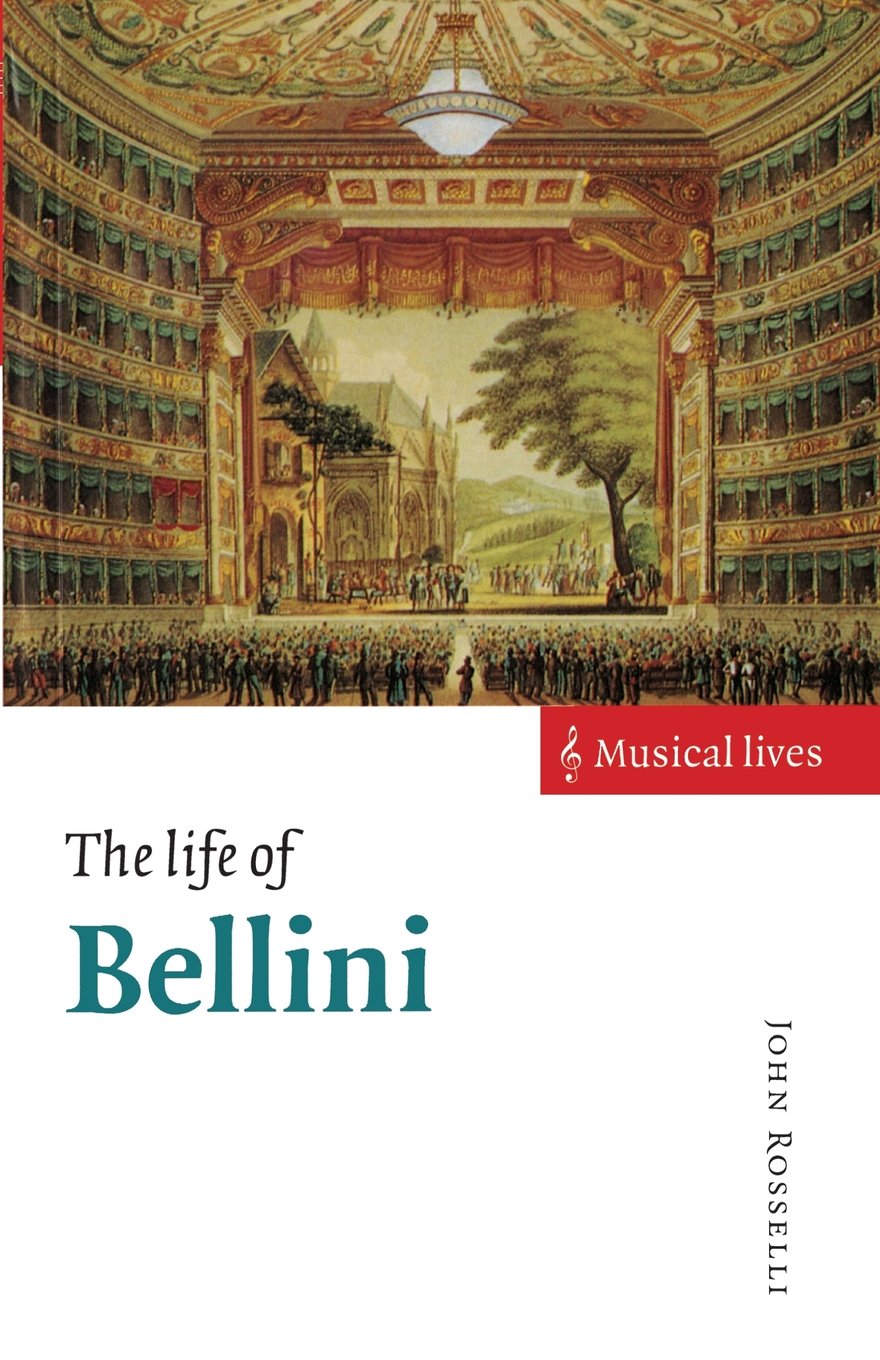
'A sigh in dancing pumps' was Heine's view of Bellini. His physical beauty, boundless success and untimely death at the age of thirty-three combined to give Bellini instant mythical status. But both the facts and the fantasies were to be embroidered by Bellini's close friend and eventual biographer Francesco Florimo, who distorted the posthumous image of the composer to the extent of altering or destroying letters in his possession. In John Rosselli's The Life of Bellini, a new picture of the composer emerges. He provides a more accurate view of Bellini's personality, his relationships and his short but dazzling career in Naples, Milan and Paris. He introduces the operatic world of the early 19th century, the singers of Bellini's roles, and, above all he explains the writing and performance of the operas themselves.

John Rosselli was an Italian-born British historian, academic, journalist, music critic, and writer on music. He worked as a features writer, editor, and critic for The Guardian before leaving to teach history at the University of Sussex. His books include several about the history of Italian opera and the lives of composers. 

Buy from Amazon


Home


14 May

Marco Zanuso - architect and designer

Innovative ideas put Italy at the forefront of contemporary style

Marco Zanuso, the architect and industrial designer whose innovative ideas helped revolutionise furniture and appliance design in Italy after the Second World War, was born in Milan on this day in 1916.  Influenced by the Rationalist movement that emerged in the 1920s, he was one of the pioneers of the Modern movement, which brought contemporary styling to mass-produced consumer products.  His use of sculptured shapes, bright colours, and modern synthetic materials helped make Italy a leader in furniture fashion.  Italy had for many years been something of a trendsetter in interior design but during the post-War years, with the fall of fascism and the rise of socialism, there was a sense of liberation among Italian creative talents.  With the recovery of the Italian economy there was a substantial growth in industrial production and mass-produced furniture. By the 1960s and 1970s, Italian interior design reached its pinnacle of stylishness.  Zanuso was at the forefront, producing designs that used tubular steel, acrylics, latex foam, fibreglass, foam rubber, and injection-moulded plastics.   Read more…

_____________________________________

Battle of Agnadello

The day Venice lost most of its mainland territory

Venetian forces were defeated by troops fighting on behalf of France, Spain and the Pope on this day in 1509 at Agnadello in Lombardy.   As a result, the Republic of Venice was forced to withdraw from much of its territory on the mainland of Italy. The writer Niccolò Machiavelli later wrote in his book, The Prince, that in one day the Venetians had ‘lost what it had taken them 800 years of exertion to conquer.’  Louis XII of France, the Emperor Maximilian, Ferdinand II of Aragon and Pope Julius II had formed the League of Cambrai with the aim of dismantling the mainland empire of Venice as they all had their own claims to areas held by the Venetians.  The French army left Milan on April 15 and invaded Venetian territory. Venice had organised a mercenary army near Bergamo commanded by the Orsini cousins, Bartolomeo d’Alviano and Niccolò di Pitigliano, who had been ordered to avoid direct confrontation with the advancing French but just to engage them in light skirmishes.  By May 9 Louis had crossed the Adda river at Cassano d’Adda and the Orsini cousins decided to move south towards the River Po in search of better positions.  Read more…

EN - 728x90


Aurelio Milani - footballer

Centre forward helped Inter win first European Cup

Aurelio Milani, who helped Inter-Milan become the second Italian football club to win the European Cup, was born on this day in 1934 in Desio, about 25km (15 miles) north of Lombardy’s regional capital.   Inter beat Real Madrid 3-1 in the final in Vienna in 1964 to emulate the achievement of city rivals AC Milan, who had become the first European champions from Italy the previous year.  Milani, a centre forward, scored the all-important second goal in the 61st minute after his fellow attacker Sandro Mazzola had given Inter the lead in the first half, receiving a pass from Mazzola before beating Real goalkeeper Vicente Train with a shot from outside the penalty area.  Madrid, whose forward line was still led by the mighty Alfredo di Stefano with Ferenc Puskas playing at inside-left, pulled a goal back but Mazzola added a third for Inter.  But this was the so-called Grande Inter side managed by the Argentinian master-tactician Helenio Herrera, who coached them to three Serie A titles in four years and retained the European Cup by defeating Eusebio’s Benfica 12 months later, when the final was played in their home stadium at San Siro in Milan.  Read more…

_____________________________________

Ludovico Manin - the last Doge of Venice

Surrender to Napoleon ended La Serenissima’s independence 

The man who would become the last of Venice’s 120 Doges, Ludovico Giovanni Manin, was born on this day in 1725. The Doge was the highest political office in Venice, its history going back to the seventh century, when the Venetian Lagoon was a province of the Byzantine (Eastern) Roman Empire and, in common with other provinces, was governed by a Dux (leader).  By the 11th century, when Venice had become an independent republic, the Doge was more of a figurehead, the head of a ruling council, and the title tended to be given to one of the oldest and most respected members of Venetian nobility.  Manin was 64 by the time he was elected but his eight years in post were significant in that they ended with the fall of La Serenissima - as the Venetian Republic was grandly known - its 1,100 years of independence ending with surrender to the French army of Napoleon Bonaparte, who subsequently handed control of the city to Austria.  The eldest of five sons of Lodovico III Alvise and Lucrezia Maria Basadonna, the great-granddaughter of cardinal Pietro Basadonna, Ludovico went straight into public life after completing his studies at the University of Bologna.  At 26 he was elected captain of Vicenza, then of Verona and finally Brescia, before being appointed ultra prosecutor of Saint Mark's Basilica in 1764.  Read more…

_____________________________________

Book of the Day: Design: A Concise History, by Thomas Hauffe

Design is everywhere. In recent years, design has become a subject of general interest - hardly confined to “serious journals”, it is commonly covered by the general press and even on television, which regularly reports on outstanding exhibits, new designs and “the designer scene”. Books on special themes, glitzy articles in lifestyle magazines, exhibition catalogues, and books that are themselves objects of design flood the market. This popular aspect of design is in addition to exhibitions of individual epochs, such as Art Deco, the “swinging fifties”, and even the “wild eighties”. Aiming to place design developments in their broader context, Design: A Concise History describes the history of design from its emergence as a separate discipline around 1750 to the present. Arranged chronologically, and with colour-coded pages for ease of reference, the book includes time-lines and designers' biographies, as well as feature spreads on notable designers and companies. There is also a detailed list of major design museums and collections.  

Dr Thomas Hauffe is an art historian. He wrote his doctorate on the "New German Design" of the 1980s and has published numerous articles on the history of design and art.

Buy from Amazon


Home


13 May 2025

13 May

NEW
- Luciano Benetton - entrepreneur

Co-founder of iconic clothing and accessories brand

The entrepreneur Luciano Benetton, co-founder of a family clothing company that became a worldwide success story in the 1980s and 1990s, was born in Treviso on this day in 1935.  Along with his sister, Giuliana, and their brothers, Carlo and Gilberto, Luciano launched the Benetton Group in 1965, specialising at first in colourful knitwear. From its original store in Belluno, a town in the northern part of the Veneto region, opened in 1965, the group enjoyed a rapid expansion in the 1970s and 80s and at the peak of its success had as many as 6,000 outlets around the world.  Although it has faced tougher trading conditions in more recent years, the group continues to preside over more than 3,500 stores.  Since 1989, the Benetton empire has traded under the name United Colors of Benetton, a brand adopted as part of a long-running collaboration with photographer Oliviero Toscani, who masterminded the group’s provocative and often controversial advertising campaigns.  The Benetton story began in 1955 when Luciano, who had left school at age 14 to work in a clothing store after the death of his father, was working as a knitwear salesman.  Read more… 

_______________________________________

The first Giro d'Italia

Tour of Italy cycle race ran from Milan to Naples and back

A field of 127 riders left Milan on this day in 1909 as Italy's famous cycle race, the Giro d'Italia, was staged for the first time.  Those who lasted the course returned to Milan 13 days later having covered a distance of 2,447.9 kilometres (1,521 miles) along a route around Italy that took them through Bologna, Chieti, Naples, Rome, Florence, Genoa and Turin.  The winner was Luigi Ganna, an Italian cyclist from Lombardy who had finished fifth in the Tour de France in 1908 and won the Milan-San Remo race earlier in 1909.  Only 49 riders finished.  Second and third places were also filled by Italian riders, with Carlo Galetti finishing ahead of Giovanni Rossignoli.  The race was run in eight stages with two to three rest days between each stage. It was a challenge to the riders' stamina. The stages were almost twice as long as those that make up the Giro today, with an average distance of more than 300 km (190 miles). The modern Giro covers a greater distance in total at 3,481.8 km (2,163.5 miles).  Thankfully, the route was primarily flat, although it did contain a few major ascents, particularly on the third leg between Chieti in Abruzzo and Naples, which took the race across the Apennines.  Read more…


Daniele Manin - Venetian leader

Lawyer who led fight to drive out Austrians

The Venetian patriot Daniele Manin, a revolutionary who fought to free Venice from Austrian rule and thereby made a significant contribution to the unification of Italy, was born on this day in 1804 in the San Polo sestiere.  Manin had Jewish roots. His grandfather, Samuele Medina,  from Verona, had converted to Christianity in 1759 and took the name Manin because Lodovico Manin, the last Doge of Venice, had sponsored his conversion.  He studied law at the University of Padua and then took up practice in Venice. As his practice developed, he gained a reputation as a brilliant and profound jurist.  He harboured a deep hatred and resentment towards the Austrians, to whom control of the city passed after the defeat of Napoleon in 1814. The city became part of the Austrian-held Kingdom of Lombardy-Venetia.  Manin's first physical act to advance the cause of liberation was the presentation of a petition in 1847 to a body called the Venetian Congregation, an advisory assembly that had no actual powers. The petition listed the grievances of the Venetian people but Manin’s frankness was not to the liking of the Austrians, who arrested him in January 1848 on charges of treason.  Read more…

______________________________________

Francesco Pistocchi – singer and composer

Child prodigy who wrote many operas and also taught

Francesco Pistocchi, a singer who became known to audiences as Pistocchino, died on this day in 1726 in Bologna.  Pistocchi left the world many operas, oratorios and cantatas he had composed, which are now highly regarded for their melodic elegance and colourful harmony.  Born Francesco Antonio Mamiliano Pistocchi in Palermo in 1659, Pistocchi became a child prodigy because of his beautiful soprano voice. He began performing as a singer in public at the age of three and the first music he composed, Capricci puerili, was published when he was just eight years old.  Believed to have become a castrato, Pistocchi made regular appearances as a singer in Bologna’s cappella musicale at the Basilica of San Petronio, where his father was a violinist, from 1670 onwards.  He later had a brilliant opera career as a contralto, touring in Italy and Germany and serving at the court in Parma in the 1680s.  His opera, Il leandro, was premiered at Teatro alle Zattere in Venice in 1679.  In 1696 Pistocchi became Court Kapellmeister for the Duke of Ansbach in Germany. His operas, Il narciso and Le pazzie d’amore e dell’interesse, were presented in Ansbach in the late 1690s.  Read more…

_______________________________________

Giuliano Amato – politician

‘Doctor Subtle’ worked into his 80s

Giuliano Amato, who has twice served as prime minister of Italy and today sits in Italy’s Constitutional Court, was born on this day in 1938 in Turin.  During his first period as prime minister, for 10 months between 1992 and 1993, a series of corruption scandals rocked Italy, sweeping away the careers of many leading politicians. Amato was never implicated, despite being close to Bettino Craxi, the leader of the Italian Socialist party, who was investigated by Milan judges in the probe into corruption that became known as Mani pulite, which literally means ‘clean hands’. Craxi was eventually convicted of corruption and the illicit financing of his party.  Amato has earned the nickname ‘dottor sottile’ the sobriquet of the medieval Scottish philosopher John Duns Scotus, which is a reference to his perceived political subtlety.  Born into a Sicilian family living in Turin at the time, Amato spent his early years growing up in Tuscany.  He attended the Collegio Medico Giuridico, which is today the Sant’Anna School of Advanced Studies, part of Pisa University, and obtained a degree in law. He also received a Masters degree in comparative law from Columbia Law School.  Read more…

_______________________________________

Book of the Day: Benetton: The Family, the Business and the Board, by Jonathan Mantle

Benetton is the story of an extraordinary family and the business they built from humble origins to a skilfully orchestrated worldwide phenomenon. For no family and business arouse such controversy and embody so many apparently contradictory qualities. No other team name has such an ability to charm and shock, to subvert and yet preach conformism, to blend radicalism with capitalism, as Benetton. Behind the united colours and the seamless brand, there are also darker shades and looser threads. These include marginalised members of the family, aggrieved franchise holders and banks. This is a success story from the frontline of the retail company, where soft fabrics mix with the smell of high-octane petrol and Grand Prix motor racing, and coloured condoms combine with Catholicism and capitalism in their most red-blooded forms.

Jonathan Mantle is the author of the best-selling For Whom the Bell Tolls: Lessons of Lloyd's of London, Benetton: The Family, the Business and the Brand, as well as biographies of Andrew Lloyd Webber and Jeffrey Archer. He lives in London.

Buy from Amazon


Home


Luciano Benetton - entrepreneur

Co-founder of iconic clothing and accessories brand

Luciano Benetton, who turns 90 today, has been active in the business much of his life
Luciano Benetton, who turns 90 today, has
been active in the business much of his life
The entrepreneur Luciano Benetton, co-founder of a family clothing company that became a worldwide success story in the 1980s and 1990s, was born in Treviso on this day in 1935.

Along with his sister, Giuliana, and their brothers, Carlo and Gilberto, Luciano launched the Benetton Group in 1965, specialising at first in colourful knitwear. From its original store in Belluno, a town in the northern part of the Veneto region, opened in 1965, the group enjoyed a rapid expansion in the 1970s and 80s and at the peak of its success had as many as 6,000 outlets around the world.

Although it has faced tougher trading conditions in more recent years, the group continues to preside over more than 3,500 stores.

Since 1989, the Benetton empire has traded under the name United Colors of Benetton, a brand adopted as part of a long-running collaboration with photographer Oliviero Toscani, who masterminded the group’s provocative and often controversial advertising campaigns.

The Benetton story began in 1955 when Luciano, who had left school at age 14 to work in a clothing store after the death of his father, was working as a knitwear salesman. He had the idea to launch his own business, selling sweaters based on the colourful garments that his sister, Giuliana, designed and knitted for friends and family.


To raise the money needed to buy a knitting machine, he and Giuliana reportedly sold Luciano's accordion and a bicycle belonging to Carlo.  Giuliana was responsible for making the sweaters, which Luciano sold to shops in and around Treviso, using his own bicycle to deliver them.

The subtext of much of Benetton's advertising has reflected the company's embrace of diversity
The subtext of much of Benetton's advertising has
reflected the company's embrace of diversity

As the business grew, they were joined by Carlo and Gilberto. Together, they launched the Benetton Group and opened the company’s first factory in 1965 in Ponzano Veneto, a small town about 6.5km (four miles) north of Treviso, where the group still has its headquarters at the historic Villa Minelli.

The first Benetton shop was opened shortly afterwards, about 70km (43 miles) further north in the beautiful and prosperous town of Belluno in the Eastern Dolomites.  

More outlets were opened in Italy and in 1969 Benetton ventured outside their home country to open a store in Paris. By the early 1970s, the company had a network of 200 shops around Europe. 

The business steadily grew throughout the decade, expanding its range beyond simply sweaters. In 1974, the French fashion company, Sisley, became part of the Benetton Group. 

The first Benetton store in New York opened in 1980, followed by a store in Tokyo in 1982. By the mid-1980s, a Benetton store was opening almost daily. This decade, and the early ‘90s, saw the business at its peak.

United Colors of Benetton was adopted as the company's brand name from the late 1980s
United Colors of Benetton was adopted as the
company's brand name from the late 1980s
Apart from the quality and originality of its clothing ranges, the Benetton name maintained its high profile thanks to the controversial advertising campaigns devised by Toscani, appointed by Luciano as his creative director.

Luciano wanted his advertising to reflect the company’s values, namely having a social conscience and being advocates of tolerance and diversity, but much of it was designed to shock, particularly after Toscani became involved. Billboard images such as those showing a duck drenched with crude oil, a naked man with “HIV Positive” branded on his buttock, and an unwashed new-born baby with umbilical cord still attached, all labelled with United Colors of Benetton, became the company’s stock in trade. 

The campaigns prompted a number of lawsuits in different countries but at the same time ensured the Benetton brand remained in the public eye. 

Luciano also identified sports sponsorship as a way to consolidate public awareness of the company name. After first sponsoring Treviso’s rugby team, AS Rugby Treviso, which became a major force in Italian rugby, Benetton became an even bigger influence in motor racing.

Benetton took their colourful image into the world of Formula One racing with considerable success
Benetton took their colourful image into the world
of Formula One racing with considerable success
Benetton sponsored Formula One teams starting with Tyrrell in 1983, then Alfa Romeo, and eventually set up their own Benetton F1 team, which competed from 1986 to 2000 and achieved significant success under the management of Flavio Briatore. Michael Schumacher won the first two of his seven world championships driving for Benetton. 

As the clothing market became more challenging, Benetton’s success began to wane in the 2000s and Luciano and the other family members stepped back from management roles, although Luciano would twice return to the boardroom out of concern for the company’s ailing fortunes, resigning from his latest stint only in 2024, at the age of 89.  

Away from business, Luciano Benetton served as a senator for the Italian Republican Party from 1992 to 1994, while his Fondazione Benetton Studi Ricerche has developed the Imago Mundi Collection, a vast collection of contemporary art.

In Treviso, where he still lives, his Gallerie delle Prigioni - so called because it is housed in an historic prison from the Habsburg era - provides an exhibition space dedicated to contemporary culture. 

Piazza dei Signori is the beautiful square at the centre of the city of Treviso
Piazza dei Signori is the beautiful square
at the centre of the city of Treviso
Travel tip:

For many visitors to Italy, Benetton’s home town of Treviso in the Veneto is no more than the name of the airport at which they might land en route to Venice, yet it is an attractive, historic city worth visiting in its own right, rebuilt and faithfully restored after the damage suffered in two world wars. Canals are a feature of the urban landscape – not on the scale of Venice but significant nonetheless – and the Sile river blesses the city with another stretch of attractive waterway, lined with weeping willows. The arcaded streets fanning out from the central square, Piazza dei Signori, have an air of refinement and prosperity and there are plenty of restaurants, as well as bars serving prosecco from a number of vineyards. The prime growing area for prosecco grapes in Valdobbiadene is only 40km (25 miles) away to the northeast.  Treviso also claims to be the birthplace of the famous Italian dessert, tiramisu. 

Benetton's headquarters remains the Villa Minelli in Ponzano Veneto, which the family bought in 1968
Benetton's headquarters remains the Villa Minelli in
Ponzano Veneto, which the family bought in 1968
Travel tip:

The Benetton Group headquarters is located in Villa Minelli, in Via Villa Minelli in Ponzano Veneto. It is a building complex built in the 17th century by a family of merchants, which includes a central villa, two colonnades and a small church. After the Minelli family, the villa was abandoned for over 150 years until the Benetton family purchased it in 1968. The renovation project was granted to Afra and Tobia Scarpa, the same architects responsible for the construction of the company’s first factory, the Maglierie Benetton, also in Ponzano Veneto. The renovation took over 15 years to complete. The architects won praise for preserving the solemnity of the villa while also transforming it into an efficient working place, with offices and meeting rooms. The villa is surrounded by vineyards and the park.

Also on this day:

1726: The death of singer and composer Francesco Pistocchi

1804: The birth of Venetian revolutionary leader Daniele Manin

1909: The first Giro d’Italia cycle race

1938: The birth of politician Giuliano Amato 


Home


12 May 2025

12 May

Giovanni Battista Viotti – violinist and composer

Brilliant musician wrote the melody for the Marseillaise

Violinist Giovanni Battista Viotti, who was to become court musician to Marie-Antoinette and composed 29 violin concertos, was born on this day in 1755 in Fontanetto Po in the region of Piedmont.  Among Viotti’s many compositions for the violin, string quartets and the piano, his violin concerto No. 22 in A Minor became particularly well known.  He is also credited with having composed the original music of La Marseillaise, the national anthem of France, 11 years before it was officially published by another composer.  Viotti’s musical talent was spotted early and he was taken into the household of Principe Alfonso dal Pozzo della Cisterna in Turin, where he received a musical education.  This prepared him to become a pupil of the virtuoso violinist and composer Gaetano Pugnani, while still a teenager, funded by the prince.  Viotti served at the Savoy court in Turin from 1773 to 1780, before travelling with Pugnani in Germany, Poland and Russia.  He went to France alone, where he made his debut as a violinist in 1782 in Paris.  He was an instant sensation and became court musician to Marie-Antoinette at Versailles.  Read more…

_________________________________________

Silvio Scaroni - fighter pilot

World War I ace was air force commander in World War II

Silvio Scaroni, a fighter pilot whose tally of aerial victories in the First World War was bettered only by Francesco Baracca among Italian flying aces, was born on this day in 1893 in Brescia.  Flying mainly the French-designed Hanriot HD.1 single-seater biplane, Scaroni had 26 confirmed successes out of 30 claimed.  Baracca, who was shot down and killed only a few months before the war ended, was credited with 34 victories.  Recalled to service, Scaroni became commander of the Italian air forces in Sicily during the Second World War, in which role he clashed with Luftwaffe chief Hermann Goering, who claimed Scaroni did not provide enough support to Germany’s attempts to destroy strategically vital British bases on Malta.  Scaroni enlisted first with the Italian Army as a corporal in the 2nd Field Artillery. With the Italian entry to the First World War looking more likely - they took a neutral position at first - he transferred to the Italian Air Service in March, 1915, flying his first missions in September of that year as a reconnaissance pilot. Piloting French-built Caudron G.3 aircraft, he carried out 114 scouting missions in 20 months.  Read more…


Cosimo II de' Medici - patron of Galileo

Grand Duke of Tuscany maintained family tradition

Born on this day in Florence in 1590, Cosimo II de' Medici, who was Grand Duke of Tuscany from 1609 until his premature death in 1621, was largely a figurehead ruler during his 12-year reign, delegating administrative powers to his ministers.  His health was never good and he died from tuberculosis aged only 30 yet made his mark by maintaining the Medici family tradition for patronage by supporting the astronomer and physicist Galileo Galilei.  Galileo, from Pisa, had been Cosimo's childhood tutor during the time that he was Professor of Mathematics at the University of Padua.  From the beginnings of the Medici dynasty, with Cosimo the Elder's rise to power in 1434, the family supported the arts and humanities, turning Florence into what became known as the cradle of the Renaissance.  Cosimo the Elder gave his patronage to artists such as Ghiberti, Brunelleschi, Donatello and Fra Angelico.  His grandson, Lorenzo the Magnificent, supported the work of such Renaissance masters as Botticelli, Leonardo da Vinci and Michelangelo.  Galileo, who also had the patronage of Cosimo's eldest son and heir, Ferdinando II de' Medici, dedicated his treatise Sidereus Nuncius, an account of his telescopic discoveries, to Cosimo.  Read more…

_____________________________________

Zeno Colò - Olympic skiing champion

Downhill ace reached speeds of almost 100mph with no helmet

Zeno Colò, the first Italian to win an Olympic alpine skiing title when he took the downhill gold at the 1952 Oslo Winter Games, died on this day in 1993, aged 72.  The winner, too, of the downhill and giant slalom World championship titles in Aspen in 1950, Colò achieved his success during a brief window in a life spent on skis.  Deprived of prime competitive years by the Second World War, part of which he spent as a prisoner of war, he began his career late, in 1947 at the age of 27, only to be banned for life in 1954 under the strict rules defining amateur status after he endorsed a brand of ski boots and a ski jacket.  Colò was born in Tuscany but in a mountainous part of the region in the village of Cutigliano, which is 678m (2,044ft) above sea level and is just 14km (9 miles) from Abetone, one of the largest ski resorts in the Apennines, with more than 50km (31 miles) of ski slopes, several of which were designed by Colò himself.   He began competitive skiing at the age of 14 and was selected for the Italian national team at 15. The outbreak of war brought his career to a stop but he maintained his skills as a member of an army alpine patrol in Cervinia, close to the Swiss border.  Read more…

________________________________________

Book of the Day: Amico: The Life of Giovanni Battista Viotti, by Warwick Lister

Giovanni Battista Viotti was unquestionably the most influential violinist of his time, and his style continues to pervade to the present day. The last great representative of the Italian tradition that Corelli began, Viotti is often considered the founder of the modern or 19th-century French school of violin playing. In Amico: The Life of Giovanni Battista Viotti, author Warwick Lister provides the first complete biography in English of this continuously significant violinist. Much of the documentary material Lister cites is previously unknown or not translated. Lister's biography takes the reader on a fascinating journey over the European continent and into the musical culture of the late 18th century. Born one year prior to Mozart and dying three years before Beethoven's death, Viotti rose from the humble origins of a blacksmith's son in a village near Turin, Italy, to international fame. His multifarious career as a concert performer, composer, teacher, opera theater director, and impresario was played out against the backdrop of a dramatically changing world - he served as a court musician for no less a figure than Marie Antoinette before founding an opera house in Paris. Viotti also knew tragedy as well as success: he was forced to flee the French Revolution, he was exiled from England for an extended period based on suspicions of certain Jacobin tendencies, his attempt to establish himself in business met with failure, and he died heavily in debt. 

Warwick Lister is a Canadian-born violinist and musicologist. He has played in the American Symphony Orchestra (Stokowski), the Concertgebouw Orchestra of Amsterdam and, from 1983 to 2001, the orchestra of the Maggio Musicale Fiorentino.

Buy from Amazon


Home


11 May 2025

11 May

Filippo De Pisis - painter and poet

Artist known for extravagant lifestyle

The painter and poet Filippo De Pisis, whose works grace the Museum of Modern Art in New York, the Peggy Guggenheim Collection in Venice and the Palazzo Ruspoli in Rome among other galleries, was born Luigi Filippo Tibertelli De Pisis in Ferrara on this day in 1896.  A close associate for a while of Giorgio de Chirico and Carlo Carrà, De Pisis is best known for his cityscapes, metaphysically-inspired maritime scenes, and still life pictures, especially depicting flowers.  De Pisis, who was homosexual, also made many homoerotic sketches of the male nude. Later in life, he lived in Venice and became somewhat eccentric, travelling everywhere in his personal gondola.  Born into a noble family, as a boy he was known as Gigi. He was educated at home and was strongly influenced by his sister, Ernesta Tibertelli, who was a distinguished illustrator with libertarian views, and who probably introduced De Pisis to mystical writings.  De Pisis spent his childhood reading, drawing, collecting butterflies and wildflowers and writing poetry. He studied literature and philosophy at the University of Bologna, and published a volume of poems, Canti della Croara, in 1916.  Read more…

____________________________________

Valentino Garavani - fashion icon

Designer favoured by the world's best dressed women

The fashion designer best known simply as Valentino was born in Voghera, a town about 70km (43 miles) south of Milan in the province of Pavia, on this day in 1932.  The favourite designer of the world’s best dressed women from the 1960s onwards, he built up a business that he eventually sold for $300 million.  Born Valentino Clemente Ludovico Garavani, he became interested in fashion while still in primary school. After working initially for his aunt Rosa, with the financial support of his parents he moved to Paris to pursue his interest, studying at the École des Beaux-Arts and at the Chambre Syndicale de la Couture Parisienne.  His first taste of working life came in the salons of Jean Dessès and Guy Laroche.  Armed with the knowledge and experience he gained at the feet of two French masters, he left Paris in 1959 to set up his first fashion house in Rome, on the fashionable Via Condotti. He quickly gained kudos for his bright red dresses, in a shade that became widely known as "Valentino red."  In July 1960, Valentino met Giancarlo Giammetti at the Café de Paris on the Via Veneto in Rome.  Read more…


Ignazio Fiorillo – composer

Talented Neapolitan influenced music in Germany

Ignazio Fiorillo, who is remembered as an opera seria composer, was born in Naples on this day in 1715.  Fiorillo often composed music for the libretti of the acclaimed writer, Pietro Metastasio, creating the type of noble and serious operas that were fashionable in Europe in the 18th century.  After studying music at the Naples Conservatory, Fiorillo composed the opera L’egeste, which premiered in Trieste in 1733.  Another of his operas, Mandane, was first performed at the Teatro Sant’Angelo in Venice in 1736.  Fiorillo was later engaged as a composer for an ensemble specialising in performances for children and toured Europe with them.  In 1749 they stayed in Braunschweig in Germany at the court of Carl I von Braunschweig-Wolfenbüttel. Fiorillo was appointed court composer the following year and during his remaining time at Braunschweig composed most of his operas.  He became composer to the court of Frederick II Landgrave of Hesse-Kassel in 1762 and went on to improve significantly the quality of court opera in Kassel. He also composed intermezzi and stage music for court theatre.  Read more…

________________________________________

Fanny Cerrito - ballerina

Neapolitan star thrilled audiences across Europe

One of the most famous ballerinas of the Romantic era, Francesca 'Fanny' Cerrito was born on this day in 1817, in Naples.  Her talent for dancing emerged early and after training in the ballet school of the famed Naples opera house Teatro di San Carlo she made her debut there in 1832, aged only 15.  She quickly became the darling of San Carlo and wowed dance audiences in many Italian cities. By the age of 21 she had obtained the position of prima ballerina at La Scala in Milan, working under the direction of Carlo Blasis, another Neapolitan, who was renowned for his rigorous and exacting classes.  When Cerrito and the Swedish-born ballerina, Marie Taglioni, who had Italian heritage, danced in the same programme in Milan, the event caused considerable excitement in the city, with audiences divided in their support for one or the other.  Cerrito's fame spread around Europe and for nine seasons between 1840 and 1848 she became a major attraction at Her Majesty’s Theatre, London, where she worked with the French choreographer Jules Perrot and enjoyed what many critics regarded as her finest performance in Cesare Pugni's Ondine.  Read more…

_____________________________________

Book of the Day: Peggy, by Rebecca Godfrey with Leslie Jamison

Venice, 1958. Peggy Guggenheim, heiress and now legendary art collector, sits in the sun at her white marble palazzo on the Grand Canal. Hers has been a thrilling, tragic, near-impossible journey. She has defied every expectation, followed her heart, and finally found contentment. She is independent. She is a true original. And she will never stop believing in the transformative power of art.  Peggy is 14 when her father dies on the Titanic and her cloistered life is turned upside down. The youngest daughter of two Jewish dynasties, Peggy is determined to pursue a life of passion and personal freedom. But unexpected restrictions come with her vast fortune.  As society changes and war sweeps through Europe, she navigates the decadent, sexist and anti-Semitic art worlds of New York and Paris. She loves and is loved - sometimes for herself, often for her money - yet no one ever takes her intellect, talent or vision seriously. Until she learns to believe in it herself.  Peggy - Rebecca Godfrey's final book, completed by her friend, the acclaimed bestseller Leslie Jamison, following Godfrey''s death in 2022 - brings to life the singular woman who helped make the Guggenheim name synonymous with art and genius.

Rebecca Godfrey was a Canadian novelist and non-fiction writer. Her first novel, The Torn Skirt (2001), was shortlisted for the Ethel Wilson Fiction Prize. Her second book, Under the Bridge (2005), an investigation into the murder of Reena Virk, a Canadian girl of Indian heritage who was beaten to death by a group of teenagers, received British Columbia's National Award for Canadian Non-Fiction.  Leslie Jamison is an American novelist and essayist.

Buy from Amazon


10 May 2025

10 May

Miuccia Prada – fashion designer

Talented businesswoman studied politics and mime

Miuccia Prada, the businesswoman behind the fashion label Prada, was born Maria Bianchi on this day in 1949 in Milan.  The youngest granddaughter of the fashion firm’s founder, Mario Prada, she took over the family business in 1978 having previously been a mime student and a member of the Italian Communist Party.  Since then the company, which is famous for its luxury goods, has gone from strength to strength and taken over other labels. Prada has been listed as the 75th most powerful woman in the world, worth an estimated $11 billion.  After graduating with a PhD in political science from the University of Milan, Maria Bianchi trained at the Piccolo Teatro di Milano in mime and was a performer for five years.  As a member of the Italian Communist party she became involved in the women’s rights movement.  She took the name Miuccia Prada in the 1980s, making her first impact on the fashion world with an unusual handbag design in 1985, which was followed by her first women’s ready-to-wear collection.  The Miu Miu line was introduced in 1992 as a less expensive womenswear line.  Read more…

_____________________________________

Antonio Priuli - Doge of Venice

Doge clamped down on Spanish ‘spies’

Antonio Priuli, who was the 94th Doge of Venice, was born on this day in 1548 in Venice.  He took office in 1618 in the midst of allegations that the Spanish were conspiring to invade Venice. He immediately began a brutal process of ferreting out individuals suspected of plotting against La Serenissima, the Most Serene Republic of Venice.  The so-called ‘spy war’ did not end until 1622 and resulted in the imprisonment and deaths of many innocent people.  Priuli was the son of Girolamo Priuli and Elisabetta Cappello. He grew up to enjoy a successful career as a sailor and a soldier and married Elena Barbarigo, with whom he had 14 children.  In 1618 Priuli was appointed provveditore, a type of governor, of Veglia, an island in the Adriatic, which now belongs to Croatia.  That same year, following the death of Doge Nicolo Donato, Priuli was recalled from Veglia to become the next Doge.  At the time it was believed that the Spanish, led by the Spanish Ambassador to Venice, Alfonso de la Cueva, 1st Marquis of Bedmar, had landed mercenaries on Venetian territory. It was thought Bedmar had successfully infiltrated the Venetian military.  Read more…

_______________________________________

William II - Sicily’s last Norman king

Young monarch who enjoyed prosperous reign

William II, the last Norman king of Sicily, succeeded his father, William I, as the island’s monarch on this day in 1166.  The succession was brought about by the death of his father. William II was only 12 years old at the time and was placed under the regency of his mother before ruling in person from his 18th birthday in 1171.  History does not remember him as a particularly effective ruler, certainly not able to arrest the decline of the Norman Kingdom of Sicily, but he became known posthumously as William the Good on account of the peace and prosperity that the kingdom enjoyed during his 23-year reign.  This was largely a result of his policy of clemency and justice toward the towns and the barons, in contrast with his father’s time, when the rebellious barons across Sicily grew more powerful and demanded greater autonomy from the crown.  The new king spent much of his time in seclusion, enjoying the pleasures of  palace life at Palermo, where his court became a centre of culture and learning, attracting scholars, poets, and artists from across Europe and the Arab world.  His own contributions to the cultural and architectural heritage of the island include commissioning the magnificent cathedral at Monreale.  Read more…

EN - 728x90


Ettore Scola - screenwriter and film director

Master of dark comedy and social drama

The screenwriter and director Ettore Scola, whose films encompassed elements of commedia all’italiana and neorealism, was born on this day in 1931 in Trevico, a mountainous village in Campania.  Scola, regarded by some as the last in the line of brilliant postwar Italian filmmakers, is best remembered for his 1977 drama Una giornata particolare (A Special Day), starring Sophia Loren and Marcello Mastroianni, which won a Golden Globe for Best Foreign Film in 1978.  A Special Day was also nominated for an Academy Award as were three other films that Scola directed or co-directed during a career that spanned more than 60 years.  Scola made his first movie as a director in 1964 with the comedy Se permettete parliamo di donne - Let’s Talk About Women - which starred Vittorio Gassman. He was only 33 but was already a widely respected scriptwriter, which had been his profession since the age of 21.  He had regularly sent suggestions for gags and sketches to the Italian comic actor Totò and others when he was a 15-year-old at high school.  Scola was born to parents who were themselves both actors.  His home village, high up in the Campanian Apennines more than 60km (37 miles) from the city of Avellino, had no cinema. Read more…

_________________________________________

Carlo Filangieri - military general

Brilliant soldier who served several masters

The military general Carlo Filangieri, who fought for both the Napoleonic and Bourbon leaders of Naples in the 19th century and is best known for his suppression of the Sicilian uprising of 1848, was born on this day in 1784 in Cava de’ Tirreni in Campania.  Filangieri was a key strategist for Joachim Murat, the flamboyant cavalry leader Napoleon had made King of Naples, achieving a major victory at personal cost in Murat’s ultimately failed campaign against Austria in 1815.  When Murat was defeated and the Bourbon monarch Ferdinand IV was reinstated as King of Naples, Filangieri was retained, going on to serve his successor, Ferdinand II of the Two Sicilies, under whose orders he put down the revolution of 1848.  Filangieri was from a noble family in Naples, the son of Gaetano Filangieri, a celebrated philosopher and jurist who had the title of Prince of Satriano, a town in Calabria, which Carlo would inherit.  His family were staying at the Villa Eva in Cava de’ Tirreni at the time of his birth, because it was felt his father’s poor health would benefit from living away from Naples.  Read more…

______________________________________

Antonio Ghirelli - journalist

Neapolitan writer specialised in football and politics

Antonio Ghirelli, a patriarch of Italian journalism, was born on this day in 1922 in Naples.  As passionate about football as he was about politics, Ghirelli was equally at home writing about both. At different times he edited the three principal Italian sports daily newspapers, La Gazzetta dello Sport, Tuttosport and Corriere dello Sport, but also wrote with distinction in the editorial and opinion pages of such respected titles as L'Unità, Paese Sera, Avanti!, Corriere della Sera, Il Mondo and Il Globo.  Sandro Pertini, who was President of Italy from 1978 to 1985, so respected his wisdom that he invited him to be head of the Quirinale press office. His politics were in line with those of the Socialist Pertini, as they were with Bettino Craxi, Italy’s first Socialist prime minister, for whom he was principal press officer during Craxi’s two spells in office.  Ghirelli’s first taste of politics came at university in Naples, when he wrote for a young Fascist journal.  Any sympathies he might have had with the Fascists soon disappeared, however, as Mussolini’s early socialist ideals became corrupted by his fervent nationalism and intolerance of political opponents.  Read more…

______________________________________

Book of the Day: Iconic: The Masters of Italian Fashion, by Megan Hess

Internationally renowned fashion illustrator Megan Hess explores ten of Italy’s best-known designers to show how they have changed the thread of style. For centuries, Italian fashion has been known for its craftsmanship and luxury, but also for its creativity and, most of all, its passion. Lace, leopard print and show-stopping red dresses – the masters of Italian fashion know how to make a statement. From the workshops of Florence to the runways of Milan, join Megan Hess on an unforgettable journey beneath the seams of ten iconic Italian designers: Giorgio Armani, Dolce & Gabbana, Fendi, Missoni, Prada, Miu Miu, Gucci, Versace, Emilio Pucci and Valentino. Complete with Megan’s spectacular illustrations of Italian fashion’s most dramatic outfits – including power suits, psychedelic kaftans and haute couture gowns – Iconic: The Masters of Italian Fashion is a lavish celebration of one of the world’s leading fashion destinations.

Illustrator Megan Hess’s clients include Vogue, Vanity Fair, Harper’s Bazaar, The New York Times, Chanel, Dior, Cartier, Prada, Fendi, Louis Vuitton and Tiffany & Co. Her bestselling fashion books and Claris series for children have sold over a million copies worldwide.

Buy from Amazon


Home