Mother of 11 was Italy’s first female professional painter
Bolognese Mannerist artist Lavinia Fontana, who became famous for her portraits, died on this day in 1614 in Rome. She has come to be regarded as the first female professional painter in both Italy and throughout western Europe because her family lived on her income from commissioned works. Her husband worked as her assistant and agent and helped her bring up their 11 children..jpg "A detail from Fontana's Self-Portrait at the Clavichord with a Servant, painted in 1577")
A detail from Fontana's Self-Portrait at the
Clavichord with a Servant, painted in 1577
Lavinia was born in Bologna in 1552 and baptised at the Basilica di San Petronio in the city. Her father, Prospero, was a prominent artist of the Bolognese school and trained Lavinia to follow in his footsteps. This allowed her to become an artist at a time when women were not widely accepted in the profession.
Her earliest known work, Child of the Monkey, was painted in 1575 when she was 23, but is now lost. Another early painting, Christ with the Symbols of the Passion, which was painted in 1576, is now in the El Paso Museum of Art in Texas.
Bologna society was largely supportive of Lavinia’s career, providing opportunities that were not given to women artists in other areas of Italy. She is thought to be the first woman artist working within the same sphere as her male counterparts to live outside a court or a convent.
Lavinia began working professionally by painting small devotional pictures on copper, which had popular appeal as papal and diplomatic gifts. By the 1580s she was in demand as a portrait painter of Bolognese noblewomen, who competed for her services and paid large sums of money for her work because of her close attention to detail.
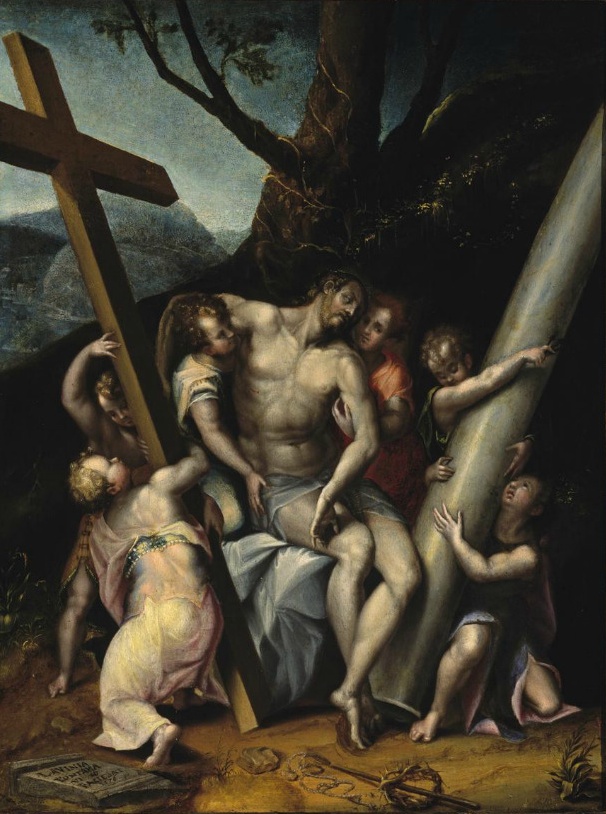 |
| Mancini's Christ with the Symbols of Passion, at the El Paso Museum of Art |
Lavinia married another painter, Gian Paolo Zappi, in 1577, at the age of 26, and continued to paint professionally, adding the name Zappi to her signature.
Her husband helped her take care of the household and worked as her painting assistant and agent. He would paint minor elements of her canvases, such as draperies. Lavinia attended Bologna University and was listed as one of the city’s ‘donne addotrinate’, women with doctorates, in 1580.
In 1589, Lavinia painted the altarpiece Holy Family with the Sleeping Christ Child for El Escorial in Madrid.
At the invitation of Pope Clement VIII, Lavinia and her family moved to Rome in 1604 and she was appointed Portraitist in Ordinary at the Vatican. Pope Paul V was later among her sitters.
In 1604, Lavinia painted her largest work, The Martyrdom of St Stephen, an altarpiece for San Paolo Fuori le Mura - Saint Paul Outside-the-Walls - in Rome.
Among the honours she received was a bronze portrait medallion of herself cast by sculptor and architect Felice Antonio Casoni in 1611. She was also elected into the Accademia di San Luca of Rome, which was rare for a woman.
 |
| Minerva Dressing (1613), thought to be the first female nude painted by a woman |
One of Lavinia’s masterpieces is considered to be the Self-Portrait at the Clavichord with a Servant, which she painted as a gift to the Zappi family before her wedding, describing herself as a virgin in the signature. She also stated that she painted it while looking at herself in a mirror as a testament to it being an accurate depiction of her.
Over 100 of her works have been documented, but only 32 signed and dated are still known today. Another 25 have been attributed to her, giving her the largest collection of works by any female artist before 1700.
Lavinia’s religious and mythological paintings sometimes featured nude figures. Her painting, Minerva Dressing, for Cardinal Scipione Borghese, nephew to Pope Paul V, is believed to be the first female nude executed by a woman in Italy. This can be seen in the Galleria Borghese in Rome. It has also been claimed Lavinia was the first female artist to paint mythological subjects.
Lavinia was immortalised by being the subject of Portrait of a Woman by Paolo Veronese, painted in 1595, when she was 43. She was the only woman to be featured in the 17th century book Considerazioni sulla pittura - Considerations on Painting - written by the physician and art collector Giulio Mancini, where the beauty of her paintings was likened to her own physical attractions by the writer.
It was rare for a woman painter to achieve such success and to profit from her talent during the Renaissance period. Some experts would argue that, to this day, Lavinia Fontana remains insufficiently appreciated as an artist.
Travel tip:
The Basilica of San Petronio in Bologna
is the sixth largest church in Europe
The Basilica di San Petronio, where Lavinia Fontana was baptised, dominates Bologna’s Piazza Maggiore. Standing 47m (154ft) tall, 132m (144yds) long and 60m (66yds) wide, it is the sixth largest church in Europe and is seen as a symbol of the city. Strangely, it was not consecrated as a church until 1954 - 574 years after it was built. It was constructed as a civic temple and not transferred from the city to the diocese until 1929. It is notable for its unfinished facade, the red and brick marble of Domenico da Varignana’s design abandoned when it had barely reached one third of the building’s height, following the intervention of Pope Pius IV, who considered the project too expensive and ambitious.
Travel tip:
The Basilica of St Paul Outside-the-Walls is
one of Rome's four major Papal Basilicas
St Paul Outside-the-Walls is one of the four major Papal Basilicas in Rome, along with St John in the Lateran (San Giovanni in Laterano), St Peter’s (San Pietro in Vaticano) and St Mary Major (Santa Maria Maggiore). Originally built in the fourth century, it was founded by the Roman emperor Constantine I over the burial place of St Paul. It was damaged and rebuilt after Saracen raids in the ninth century and an earthquake in the 14th century and almost completely destroyed by a fire in 1823, after which Pope Leo XII ordered it to be reconstructed to exactly resemble the original, consecrated in 324, although this turned out to be an unrealistic ambition. The new basilica bears only a general resemblance to the original. The tomb of St Paul is below a marble tombstone in the basilica’s crypt.
Also on this day:
1492: The election of Rodrigo Borgia as Pope Alexander VI
1902: The birth of cycling champion Alfredo Binda
1967: The birth of football coach Massimiliano Allegri
