24 July 2022

24 July

NEW - Ermanno Olmi - film director

Won most prestigious awards at Cannes and Venice festivals

The film director Ermanno Olmi, who won both the coveted Palme d’Or at Cannes and the Venice Film Festival’s equivalent Golden Lion with two of his most memorable films, was born on this day in 1931 in the Lombardy city of Bergamo.  His 1978 film L'albero degli zoccoli - The Tree of Wooden Clogs - a story about Lombard peasant life in the 19th century that had echoes of postwar neorealism in the way it was shot, won the Palme d’Or - one of the most prestigious of film awards - at the Cannes Film Festival of the same year.  A decade later, Olmi won the Golden Lion, the top award at the Venice Film Festival, with La leggenda del santo bevitore - The Legend of the Holy Drinker - a story adapted from a novella by the Austrian author Joseph Roth about a homeless drunk in Paris, who is handed a 200-francs lifeline by a complete stranger and vows to find a way to pay it back as a donation to a local church.  He also won three David di Donatello awards  - the Italian equivalent of the Oscars - as Best Director, for Il posto - The Job - his first full length feature film, in 1962, for The Legend of the Holy Drinker, and for Il mestiere delle armi - The Profession of Arms - in 2002. Read more…

___________________________________

Eugene de Blaas - painter

Austro-Italian famous for Venetian beauties

Eugene de Blaas, a painter whose animated depictions of day-to-day life among ordinary Venetians - especially young Venetian women - were his most popular works, was born on this day in 1843 in Albano Laziale, just outside Rome.  Sometimes known as Eugenio Blaas, or Eugene von Blaas, he was of Austrian parentage. His father, Karl, also a painter, was a teacher at the Accademia di Belle Arti (Academy of Fine Arts) in Rome. His brother, Julius, likewise born in Albano, was also a painter.  In 1856, the family moved to Venice after his father was offered a similar position at the Venetian Academy. At that time, Venice attracted artists from all over Europe and the young De Blaas grew up in a social circle that was largely populated by painters and poets.  Like his father, he became interested in the school known as Academic Classicism, a style which seeks to adhere to the principles of Romanticism and Neoclassicism.  He exhibited at the Venice Academy when he was only 17 years old.  Religious painting was still in demand and one of his earliest important commissions, in 1863, was an altarpiece for the parish church of San Valentino di Merano.  Read more…

_____________________________________

Giuseppe Di Stefano – tenor

Singer from Sicily who made sweet music with Callas

The opera singer Giuseppe Di Stefano, whose beautiful voice led people to refer to him as ‘the true successor to Beniamino Gigli’, was born on this day in 1921 in Motta Sant’Anastasia, a town near Catania in Sicily.  Di Stefano also became known for his many performances and recordings with the soprano, Maria Callas, with whom he had a brief romance.  The only son of a carabinieri officer, who later became a cobbler, and his dressmaker wife, Di Stefano was educated at a Jesuit seminary and for a short while contemplated becoming a priest.  But after serving in the Italian army he took singing lessons from the Swiss tenor, Hugues Cuenod. Di Stefano made his operatic debut in Reggio Emilia in 1946 when he was in his mid-20s, singing the role of Des Grieux in Massenet’s Manon. The following year he made his debut at La Scala in Milan in the same role.  Di Stefano made his debut at the Metropolitan Opera in New York in 1948 as the Duke of Mantua in Verdi’s Rigoletto. After his performance in Manon a month later, a journalist wrote in Musical America that Di Stefano had ‘the rich velvety sound we have seldom heard since the days of Gigli.’  Read more…

_____________________________________

Victor Emmanuel of Sardinia

The first king to be called Victor Emmanuel

The King of Sardinia between 1802 and 1821, Victor Emmanuel I was born on this day in 1759 in the Royal Palace in Turin.  He was the second son of King Victor Amadeus III of Sardinia and was known from birth as the Duke of Aosta.  When the King died in 1796, Victor Emmanuel’s older brother succeeded as King Charles Emmanuel IV of Sardinia.  Within two years the royal family was forced to leave Turin because their territory in the north was occupied by French troops.  After his wife died, Charles Emmanuel abdicated the throne in favour of his brother, Victor Emmanuel, because he had no heir.  The Duke of Aosta became Victor Emmanuel I of Sardinia in June 1802 and ruled from Cagliari for the next 12 years until he was able to return to Turin.  During his reign he formed the Carabinieri, which is still one of the primary forces of law and order in Italy.  On the death of his older brother in 1819, he became the heir general of the Jacobite succession as Victor Emmanuel I of England, Scotland and Ireland, but he never made any public claims to the British throne.  He abdicated in favour of his brother, Charles Felix, in 1821 and died three years later at the Castle of Moncalieri in Turin.  Read more…

EN - 728x90


Home

Ermanno Olmi - film director

Won most prestigious awards at Cannes and Venice festivals

Ermanno Olmi's films won some of  cinema's most prestigious awards
Ermanno Olmi's films won some of 
cinema's most prestigious awards 
The film director Ermanno Olmi, who won both the coveted Palme d’Or at Cannes and the Venice Film Festival’s equivalent Golden Lion with two of his most memorable films, was born on this day in 1931 in the Lombardy city of Bergamo.

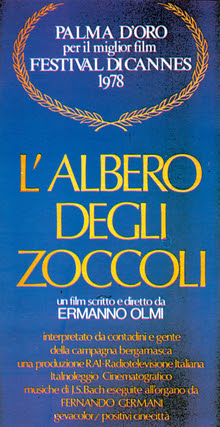
His 1978 film L'albero degli zoccoli - The Tree of Wooden Clogs - a story about Lombard peasant life in the 19th century that had echoes of postwar neorealism in the way it was shot, won the Palme d’Or - one of the most prestigious of film awards - at the Cannes Film Festival of the same year.

A decade later, Olmi won the Golden Lion, the top award at the Venice Film Festival, with La leggenda del santo bevitore - The Legend of the Holy Drinker - a story adapted from a novella by the Austrian author Joseph Roth about a homeless drunk in Paris, who is handed a 200-francs lifeline by a complete stranger and vows to find a way to pay it back as a donation to a local church.

He also won three David di Donatello awards  - the Italian equivalent of the Oscars - as Best Director, for Il posto - The Job - his first full length feature film, in 1962, for The Legend of the Holy Drinker, and for Il mestiere delle armi - The Profession of Arms - in 2002.

Born in the Malpensata district of Bergamo, near the railway station, Olmi grew up in Treviglio, a town in Bergamo province about 40km (25 miles) east of Milan. His mother worked in a cotton mill. His father, a railway worker and a staunch anti-Fascist, was killed during World War Two.

As a young man, Olmi enrolled at the Academy of Dramatic Art in Milan to take acting lessons, at the same time taking a job as a messenger at the electric company, Edison-Volta, where his mother also found work.

The original poster for the film seen as Olmi's masterpiece
The original poster for the
film seen as Olmi's masterpiece
The company entrusted Olmi with organising leisure activities and entertainment for employees. By now, the film industry was becoming the focus of his ambitions and he persuaded Edison-Volta to sponsor him to make documentaries promoting the company, which he saw as an opportunity to develop his skills behind the camera.

Edison-Volta were impressed with Olmi’s work, in particular his 1959 mini-feature film, Il tempo si รจ fermato - Time Stood Still, a story about a friendship between a student and the guardian of an isolated hydro-electric dam high in the mountains, which he filmed at the Sabbione Dam in Val Formazza, an Alpine valley in Piedmont, close to the Swiss border.

Subsequently, they agreed to support his first full-length feature, Il posto (1961), a semi-autobiographical and gently humorous story about the aspirations of two young men from rural areas whose first jobs are with big firms in Milan in the postwar years. In the tradition of Roberto Rossellini, the neorealist director whom he particularly admired, Olmi cast non-professional actors in many of the roles, one of whom, Loredana Detto, he would later marry. 

The success of Il posto, in terms of both critical acclaim and the doors opened by winning a David di Donatello and the critics’ prize at the Venice Film Festival, enabled Olmi to devote himself to film-making. His next few films, including a biographical feature about Angelo Giuseppe Roncalli, the Bergamo cardinal who became Pope John XXIII, enjoyed relatively modest success, but in 1978 came the movie regarded by many critics as his masterpiece.

Inspired by the stories he was told by his grandmother about the peasant community in rural Lombardy, L’albero degli zoccoli revolves around the lives of four peasant farming families earning a meagre living on land owned by the same landlord. 

Olmi followed in the tradition of the neorealist era in using non-professional actors
Olmi followed in the tradition of the
neorealist era in using non-professional actors
Set against the turbulent political background of late 19th century Italy, its focus is the plight of one of the families who want to give their son the opportunity to better himself and cut down a tree so that the father of their household can make wooden clogs for him to wear on his long daily walk to school. The fragility of their existence is then underlined when the landlord is so incensed he throws them off their land, with the other families looking on in dismay.

As well as winning the Palme d’Or, the movie won critical acclaim in Europe, Britain and the United States, where the actor Al Pacino many years later described it as his favourite film and where the New York Times in 2003 listed The Tree of Wooden Clogs in a feature entitled The Best 1,000 Movies Ever.

Il mestiere delle armi focuses on a battle between a Papal Army led by Giovanni de’ Medici and the army of the Holy Roman Emperor, Charles V, in 1526, highlighting the harsh conditions and ultimate lack of glory in warfare.  It was shot in Bulgaria and featured several Bulgarian actors.

In the late 1960s, Olmi and his wife moved to a home he had built at Asiago, in the mountains above Vicenza. It was a story he was told by the residents of Asiago that inspired him to make I recuperanti (The Scavengers), his 1970 film about how the deprivations of World War Two forced local people to dig for scrap metal buried in the ground to sell for cash. 

Olmi spent the rest of his life in Asiago, where he died in 2018 after struggling for a number of years with the degenerative neurological condition Guillain-Barrรฉ syndrome. Fabio Olmi, one of Ermanno and Loredana's three children, also works in the world of cinema as a director of photography.

The Basilica of San Martino in the city of Treviglio
The Basilica of San Martino
in the city of Treviglio
Travel tip:

The small city of Treviglio in Lombardy can be found about 20km (13 miles) south of Bergamo and 40km (25 miles) northeast of Milan, in an area known as Bassa Bergamasca. Treviglio, the second most populous city in Bergamo province with 30,000 inhabitants, developed from a fortified town in the early Middle Ages and, having been at times controlled by the French and the Spanish. It became part of the Kingdom of Italy in 1860.  Its most visited attraction is the Basilica of San Martino, originally built in 1008 and reconstructed in 1482, with a Baroque faรงade from 1740, which is in Piazza Manara. In 1915, the town was chosen by Italy’s future dictator Benito Mussoloni for his civil marriage to the long-suffering Rachele Guidi. 

The alpine landscape around the town of Asiago in the northern Veneto region
The alpine landscape around the town of
Asiago in the northern Veneto region
Travel tip:

Asiago, where Olmi lived from the late 1960s onwards, is in the province of Vicenza in the Veneto, halfway between Vicenza to the south and Trento, the capital of Trentino-Alto-Adige, to the west. It is now a major ski resort and famous for producing Asiago cheese. It is situated on a high plateau known as the Altopiano di Asiago - the Asiago upland - in an area that has been favoured by emigrants from Germany for more than 1,000 years. The widely spoken local dialect, known as Cimbro, is very similar to German. The landscape over the years has been dotted with fortresses. The Interrotto in Camporovere, in the centre of the town, is a barracks-fortress whose construction goes back to the middle of the 1800s.  The area also has many reminders of the Battle of Asiago, a major confrontation of Italian and Austro-Hungarian forces in World War One that resulted in more than 25,000 deaths.

Also on this day:

1759: The birth of Victor Emanuel I of Sardinia

1843: The birth of painter Eugene de Blaas

1921: The birth of tenor Giuseppe Di Stefano


Home


23 July 2022

23 July

Damiano Damiani – screenwriter and director

Filmmaker behind the hit Mafia drama series La piovra

Damiano Damiani, who directed the famous Italian television series La piovra, which was about the Mafia and its involvement in Italian politics, was born on this day in 1922 in Pasiano di Pordenone in Friuli.  Damiani also made a number of Mafia-themed films and he was particularly acclaimed for his 1966 film, A Bullet for the General, starring Gian Maria Volontรจ, which came at the beginning of the golden age of Italian westerns.  Damiani studied at the Accademia di Brera in Milan and made his debut in 1947 with the documentary, La banda d’affari. After working as a screenwriter, he directed his first feature film, Il rossetto, in 1960.  His 1962 film, Arturo’s Island, won the Golden Shell at the San Sebastian International film festival.  During the 1960s, Damiani was praised by the critics and his films were box office successes.  A Bullet for the General is regarded as one of the first, and one of the most notable, political, spaghetti westerns. Its theme was the radicalisation of bandits and other criminals into revolutionaries.  Damiani’s 1968 film, Il giorno della civetta - The Day of the Owl - starring Claudia Cardinale, Franco Nero and Lee J Cobb, started a series of films that blended social criticism with spectacular plots.  Read more…

_____________________________________

Francesco Cilea – opera composer

Calabrian remembered for beautiful aria Lamento di Federico 

Composer Francesco Cilea was born on this day in 1866 in Palmi near Reggio di Calabria.  He is particularly admired for two of his operas, L’arlesiana and Adriana Lecouvreur.  Cilea loved music from an early age. It is said that when he was just four years old he heard music from Vincenzo Bellini’s opera, Norma, and was moved by it.  When he became old enough, he was sent to study music in Naples and at the end of his course of study there he submitted an opera he had written, Gina, as part of his final examination. When this was performed for the first time it attracted the attention of a music publisher who arranged for it to be performed again.  Cilea was then commissioned to produce a three-act opera, meant to be along the lines of Pietro Mascagni's Cavalleria rusticana, by the same publisher.  The resulting work, La Tilda, was performed in several Italian theatres, but the orchestral score has been lost, which has prevented it from enjoying a modern revival.  In 1897, Cilea’s third opera, L’arlesiana was premiered at the Teatro Lirico in Milan.  In the cast was the young Enrico Caruso, who performed, to great acclaim, the famous Lamento di Federico, often known by its opening line, รˆ la solita storia del pastore.  Read more…

_____________________________________

Sergio Mattarella – President of Italy

Anti-Mafia former Christian Democrat is Italy's 12th President

The first Sicilian to become President of Italy, Sergio Mattarella, was born on this day in 1941 in Palermo.  Mattarella, who has occupied the office since 2015, went into politics after the assassination of his brother, Piersanti, by the Mafia in 1980. His brother had been killed while holding the position of President of the Regional Government of Sicily.  Their father, Bernardo Mattarella, was an anti-Fascist, who with other prominent Catholic politicians helped found the Christian Democrat (Democrazia Cristiana) party. They dominated the Italian political scene for almost 50 years, with Bernardo serving as a minister several times. Piersanti Mattarella was also a Christian Democrat politician.  Sergio Mattarella graduated in Law from the Sapienza University of Rome and  a few years later started teaching parliamentary procedure at the University of Palermo.  His parliamentary career began in 1983 when he was elected a member of the Chamber of Deputies in a left-leaning faction of the DC that had supported an agreement with the Italian Communist Party led by Enrico Berlinguer. The following year he was entrusted with cleansing the Sicilian faction of the party from Mafia control.  Read more…

____________________________________

Licia Albanese – soprano

Butterfly had a long career

Operatic soprano Licia Albanese, whose portrayal of Verdi and Puccini heroines delighted audiences all over the world during the last century, was born on this day in 1909 in Bari in the region of Puglia.  She made her operatic debut unexpectedly in 1934 at the Teatro Lirico in Milan during a performance of Madama Butterfly. Albanese was understudying the title role and when the soprano became ill during Act One, she was hustled on to the stage to take over in Act Two.  She was a great success and during the next 40 years sang more than 300 performances in the role of Cio-Cio-San, the geisha who is better known as Madama Butterfly.  Her connection with the opera began early when she was studying with the singer, Giuseppina Baldassare-Tedeschi, who was a contemporary of the composer, Giacomo Puccini, and had been the greatest Butterfly of her day.  Albanese went on to appear at La Scala, Covent Garden and many other European houses, also winning praise for her portrayals of Mimi, Violetta and Manon Lescaut.  She was fortunate to have as tenor partners, singers of the calibre of Tito Schipa, Beniamino Gigli and Giacomo Lauri-Volpi.  Read more…


Home


22 July 2022

22 July

Palermo falls to the Allies

Capture of Sicilian capital triggered ousting of Mussolini

One of the most significant developments of the Second World War in Italy occurred on this day in 1943 when Allied forces captured the Sicilian capital, Palermo.  A battle took place between General George S Patton’s Seventh Army and some German and Italian divisions but it was not a prolonged affair.  The Sicilians themselves by then had little appetite to fight in a losing cause on behalf of the Germans and the invading soldiers were greeted by many citizens as liberators.  It was not a decisive victory for the Allies but it had a symbolic value, signifying the fall of Sicily only 12 days after Allied forces had crossed the Mediterranean from bases in North Africa and landed at Pachino and Gela on the south coast of the island.  In fact, the Americans and the British were still meeting German resistance around Catania and Messina in the northeastern corner of the island, although it would be only a matter of time before their resistance ceased.  When news reached Rome that Palermo had fallen, the Fascist Grand Council, who had for some time given only uneasy support to Mussolini, knew that something had to be done to limit the damage of what now looked like an inevitable defeat for the Axis powers in Italy.  Read more…

____________________________________

Massimo Carlotto - novelist

Writer wrongly jailed for murder now best-selling author

Massimo Carlotto, the best-selling novelist who spent three years on the run, eight years in jail and a further 11 years clearing his name over a murder he did not commit, was born on this day in 1956 in Padua.  Carlotto, who began his writing career in 1995 with a fictionalised autobiography, Il fuggiasco (The Fugitive), about his time on the run, is best known for his dark crime series featuring an unlicensed investigator, Marco Buratti, nicknamed L’alligatore (The Alligator), six of which have been published in English.  The so-called Carlotto Case became one of the most controversial episodes in Italian legal history.  It began in 1976, at the height of the period of intense political tension and unrest in Italy known as the Years of Lead, when the 19-year-old Carlotto, then a student, was a member of the ultra left activist group, Lotta Continua.  In January of that year, according to his own testimony, he was cycling past the house in Padua where his sister, Antonella, had an apartment, when he heard the cries of a young woman in distress. He entered the building, discovered that the cries were coming not from his sister’s apartment but from that of her neighbour, the front door of which was wide open.  Read more…

___________________________________

Gorni Kramer - jazz musician

Multi-talented composer of more than 1,000 songs

The songwriter, musician and band leader Gorni Kramer was born on this day in 1913 in the village of Rivarolo Mantovano, near Mantua.  An accomplished accordion and double bass player, Kramer later became a record producer, arranger and television writer.  His embrace of the jazz and swing genres developed in spite of them being banned from being played on Italian state radio during the Fascist era.  He was a prolific composer thought to have written more than 1,000 songs during a career that spanned 60 years.  Kramer’s non-Italian sounding name led to a popular misconception that he was born in another country, yet it was his real name - reversed.  He was born Francesco Kramer Gorni, so named because his father was a fan of the American cycling world champion Frank Kramer.  It was from his father that Gorni inherited his passion for music, having played the accordion in his father’s band.  Gorni studied double bass at the Conservatory in Parma and obtained his diploma in 1930. He began to work as a musician for dance bands, then in 1933, aged 20, formed his own jazz group.  Read more…

___________________________________

Indro Montanelli – journalist

Veteran writer who cast a critical eye on Italian politics and society

A writer and journalist regarded as one of the greatest of 20th century Italy, Indro Montanelli, died on this day in 2001 in Milan.  The previous year he had been named as one of 50 World Press Freedom Heroes by the International Press Institute.  Montanelli had been a witness to many of the major events of the 20th century. He was in Danzig when Hitler rejected the ultimatum from Britain and France in September 1939. He was in the streets of Budapest in 1956 when Soviet tanks rolled in and he was shot in the legs by Red Brigades terrorists on an Italian street in 1977.  Montanelli was born Indro Alessandro Raffaello Scizogene Montanelli in 1909 at Fucecchio near Florence.  He studied for a law degree at the University of Florence in the early 1920s and began his journalistic career by writing for the Fascist newspaper, Il Selvaggio.  He then worked as a crime reporter for Paris Soir before serving as a volunteer with Italian troops in the Eritrean Battalion in Ethiopia - Abyssinia as it was then - where he wrote war reports which later formed the basis for the first of his 40 books.  It was a book that honestly conveyed what Montanelli had seen, some of which caused him to change his mind about Benito Mussolini, the Fascist leader.  Read more…

_______________________________________

St Lawrence of Brindisi

Talented linguist who converted Jews and Protestants

St Lawrence of Brindisi was born Giulio Cesare Russo on this day in 1559 in Brindisi.  He became a Roman Catholic priest and joined the Capuchin friars, taking the name Brother Lawrence.  He was made St Lawrence in 1881, remembered for his bravery leading an army against the Turks armed only with a crucifix.  Lawrence was born into a family of Venetian merchants and was sent to Venice to be educated. He joined the Capuchin order in Verona when he was 16 and received tuition in theology, philosophy and foreign languages from the University of Padua. He progressed to be able to speak many European and Semitic languages fluently.  Pope Clement VIII gave Lawrence the task of converting Jews living in Rome to Catholicism because of his excellent command of Hebrew. Lawrence also established Capuchin monasteries in Germany and Austria and brought many Protestants back to Catholicism.  While serving as the imperial chaplain to the Holy Roman Emperor, Rudolph II, he led an army against the Ottoman Turks threatening to conquer Hungary armed only with a crucifix and many people attributed the subsequent victory to his leadership.  Read more…


Home