8 April 2023

8 April

Lorenzo the Magnificent - Renaissance ruler

Patron of the arts who sponsored Michelangelo and Botticelli

Lorenzo de’ Medici, the ruler of Florence usually known as Lorenzo the Magnificent, died on this day in 1492 in the Medici villa at Careggi, just to the north of the city.  He was only 43 and is thought to have developed gangrene as a result of an inherited genetic condition.  He had survived an assassination attempt 14 years earlier in what became known as the Pazzi Conspiracy, in which his brother, Giuliano, was killed.  The grandson of Cosimo de’ Medici, Lorenzo was a strict ruler but history has judged him as a benevolent despot, whose reign coincided with a period of stability and peace in relations between the Italian states.  He helped maintain the Peace of Lodi, a treaty agreed in 1454 between Milan, Naples and Florence which was signed by his grandfather.  However, he is most remembered as an enthusiastic patron of Renaissance culture, providing support for poets, scholars and artists, notably Michelangelo and Botticelli.  He contributed more than anyone to the flowering of Florentine genius during the second half of the 15th century.  Read more…

_____________________________________

Federico Caprilli - equestrian pioneer

Study of horses revolutionised jumping techniques

Federico Caprilli, the Italian cavalry officer who revolutionised the way horse riders jump fences, was born on this day in 1868 in Livorno.  One of four children born to Enrico Caprilli and his wife, Elvira, Federico was bent on an army career from an early age. He enrolled as a cadet at military college in Florence at 13 years old, subsequently transferring to Rome and then Modena. He had no riding experience at the start, and when he graduated with the rank of lieutenant, though an excellent gymnast and proficient fencer, his horsemanship was marked as ‘poor’.  Nonetheless, he was assigned to the Royal Piedmont cavalry regiment, where his job, at a time when the introduction of weapons such as the Gatling Gun was negating any battlefield advantage a soldier had from being mounted, was to train horses for new combat roles, such as springing surprise attacks in difficult terrain.  It was there that he observed the way horses jumped obstacles and concluded that conventional beliefs about the way a horse should be ridden over jumps were entirely wrong.  Until Caprilli came along, it was accepted that the rider should use long stirrups and approach a fence leaning back in the saddle.  Read more…

___________________________________

Gaetano Donizetti - operatic genius

The day the music died

A prolific composer of operas in the first half of the 19th century, Gaetano Donizetti died on this day in 1848 in Bergamo in Lombardy.  Donizetti had returned to his native city after a brilliant international career to spend his last days in the Palazzo Scotti in the Città Alta, the upper town.  By then seriously ill, he was looked after by friends in the gracious surroundings of the palazzo until his death. His tomb is in the Basilica di Santa Maria Maggiore, where it is marked by a white, marble monument.  Donizetti has since become acknowledged as the greatest composer of lyrical opera of all time. He was a major influence on Verdi, Puccini and other composers who came after him.  His best and most famous operas are considered to be Lucia di Lammermoor, Don Pasquale and L’elisir d’amore.  In Via Sentierone in Bergamo’s lower town there is an elaborate white marble monument to the composer next to Teatro Donizetti, which was renamed in his honour in 1897 on the centenary of his birth.  Donizetti’s casa natale (birthplace), is in Via Borgo Canale just outside the walls of the upper town. It has now been declared a national monument and is open free to visitors every weekend.  Read more…

_____________________________________

Renzo De Felice - historian

Mussolini biographer whose views on fascism aroused anger

The controversial historian Renzo De Felice, best known for his 6,000-page four-volume biography of Benito Mussolini, was born on this day in 1929 in Rieti, the northernmost city in Lazio.  Although De Felice was Jewish and his other major work described in detail the persecution of Jews in Italy under Mussolini’s rule, he sparked considerable anger by arguing that the postwar world view of Fascism should be revised to recognise that the ideology in itself was not inherently evil.  De Felice contended that fascism as a political movement in Italy was not the same as Fascism as a regime, arguing that the former was a revolutionary middle-class ideology that had its roots in the progressive thinking of the Age of Enlightenment.  He argued that the ideology was effectively hijacked by Mussolini to provide the superstructure for his dictatorship and personal ambition and that fascism itself, as distinct from Mussolini’s interpretation, was a valid political concept, not just something to be demonized and dismissed in simplistic terms.  It was an argument that was respected by many intellectuals, even some who were staunchly anti-Fascist.  Read more…

Booking.com


Home


7 April 2023

7 April

NEW - Gino Severini - painter and mosaicist

Tuscan was leading figure in Futurist movement

The painter and mosaicist Gino Severini, who was an important figure in the Italian Futurist movement in the early 20th century and is regarded as  one of the most progressive of all 20th century Italian artists, was born on this day in 1883 in the hilltop town of Cortona in Tuscany.  He divided his time largely between Rome and Paris, where he died in 1966. Although he was a signatory - along with Umberto Boccioni, Carlo Carrà, Luigi Russol and Giacomo Balla - of Filippo Tommaso Marinetti’s Manifesto of Futurist Painters in 1910, his work was not altogether typical of the movement.  Indeed, ultimately he rejected Futurism, moving on to Cubism, having become friends with Cubist painters Georges Braque and Pablo Picasso in Paris, before ultimately turning his interest to Neo-Classicism and the Return to Order movement that followed the First World War.  He attracted criticism among his peers by his associations with the Fascist-supporting Novecento Italiano movement, whose work became closely linked with state propaganda. Severini was involved with Benito Mussolini's "Third Rome" project, supplying murals and mosaics for Fascist architectural structures inspired by imperial Rome. Read more…

______________________________________

Domenico Dragonetti - musician

Venetian was best double bass player in Europe

The composer and musician Domenico Dragonetti  - Europe's finest double bass virtuoso - was born on this day in 1763 in Venice.  Apart from the fame his talent brought him, Dragonetti is remembered as the musician who opened the eyes of Ludwig van Beethoven and other composers to the potential of the double bass.  They met in Vienna in 1799 and experts believe it was Dragonetti’s influence that led Beethoven to include passages for double bass in his Fifth Symphony.   From 1794 onwards until his death in 1846 at the age of 83, Dragonetti lived in London but it was in Venice that he established his reputation.  The son of a barber who was also a musician, Domenico Carlo Maria Dragonetti taught himself to play the guitar and the double bass as a child using his father’s instruments.  It was not long before word of his precocious ability spread and he was sent to the Ducal Palace of San Marco for tuition from Michele Berini, who was widely respected as the best double bass player in Venice.  Berini declared after only 11 lessons that there was nothing more he could teach the young Dragonetti.  Read more…

______________________________________

The 1906 Vesuvius eruption

Deadliest incident of the 20th century

One of the most violent eruptions in the history of Mount Vesuvius reached its peak on this day in 1906, killing probably in excess of 200 people. The volcano, most famous for the 79AD eruption that buried the city of Pompeii and may have claimed  between 13,000 to 16,000 victims, had been spewing lava for almost 11 months, treating the residents of nearby Naples to regular fireworks displays.  On 5 April, 1906, an indication that a major eruption was imminent came in a failure in the water supply drawn from wells on the mountain sides, with such water as was still flowing having a strong taste of sulphur. The expulsions of lava became more explosive and an ash cloud began to form in the sky above the crater.  In the preceding days, there had been an earthquake on the island of Ustica some 130km (81 miles) away, which was thought to be connected to the Vesuvius eruption.  On the evening of 7 April came the biggest explosion, as well as three earthquakes felt in the city of Naples, which were said to cause much panic, but no particular damage.  That could not be said of some of the villages at the foot of the mountain, in particular Boscotrecase.  Read more…

_____________________________________

Giovanni Battista Rubini - opera singer

Tenor was as famous in his day as Caruso

Giovanni Battista Rubini, born on this day in 1794, was a tenor as famous in his day as Enrico Caruso would be almost a century later, his voice having contributed to the popularity of opera composers Vincenzo Bellini and Gaetano Donizetti.   He was the first 19th-century non-castrati singer to become a major international star after two centuries in which audiences and composers were obsessed with the castrati.  Rubini's exceptionally high voice could match the coloratura of the castrati and he effectively launched the era of the bel canto tenor, which signalled the end of the dominance of the castrati.  Rubini was just 12 when he was taken on as a violinist and chorister at the Riccardi Theatre in Bergamo, not far from his home town of Romano di Lombardia. He was 20 when he made his professional debut in Pietro Generali’s Le lagrime d’una vedova at Pavia in 1814, then sang for 10 years in Naples in the smaller, comic opera houses.  Famed for a voice capable of reaching beyond the range of conventional tenors, particularly in the higher registers, in 1825 he sang the leading roles in Gioachino Rossini’s La Cenerentola, Otello, and La donna del lago in Paris.  Read more…

_____________________________________

Marco Delvecchio - footballer

Striker who became TV dance show star

The former Roma and Italy striker Marco Delvecchio, who launched a new career in television after finishing runner-up in the Italian equivalent of Strictly Come Dancing, was born on this day in 1973 in Milan.  Delvecchio scored 83 goals in exactly 300 appearances for Roma, where he was part of the side that won the Scudetto in 2000-01 and where he became a huge favourite with fans of the giallorossi because of his penchant for scoring against city rivals Lazio.  His record of nine goals in the Rome derby between 2002 and 2009 was the best by any player in the club’s history until that mark was overtaken by the Roma great Francesco Totti, whose career tally against Lazio was 11.  Delvecchio’s talents were somewhat underappreciated at international level. He made 22 appearances for the azzurri and the first of his four goals was in the final of Euro 2000 against France, although he finished on the losing side. Yet after being favoured by Dino Zoff, he was not so popular with Zoff’s successor as head coach, Giovanni Trapattoni, who took him to the 2002 World Cup but did not give him a game, and omitted him from his squad for the 2004 Euros.  Read more…


Home


Gino Severini - painter and mosaicist

Tuscan was leading figure in Futurist movement

Gino Severini, typically sporting a monacle, was an influential figure
Gino Severini, typically sporting a monacle, was
an influential figure in 20th century Italian art 
The painter and mosaicist Gino Severini, who was an important figure in the Italian Futurist movement in the early 20th century and is regarded as  one of the most progressive of all 20th century Italian artists, was born on this day in 1883 in the hilltop town of Cortona in Tuscany.

He divided his time largely between Rome and Paris, where he died in 1966. Although he was a signatory - along with Umberto Boccioni, Carlo Carrà, Luigi Russolo and Giacomo Balla - of Filippo Tommaso Marinetti’s Manifesto of Futurist Painters in 1910, his work was not altogether typical of the movement.  

Indeed, ultimately he rejected Futurism, moving on to Cubism, having become friends with Cubist painters Georges Braque and Pablo Picasso in Paris, before ultimately turning his interest to Neo-Classicism and the Return to Order movement that followed the First World War. 

He attracted criticism among his peers by his associations with the Fascist-supporting Novecento Italiano movement, whose work became closely linked with state propaganda. Severini was involved with Benito Mussolini's "Third Rome" project, supplying murals and mosaics for Fascist architectural structures inspired by imperial Rome. 

Working in mosaics became an increasing focus for Severini in his later years, particularly after he rediscovered his Catholic faith. His religious mosaics displayed such refined technique he was dubbed the “father of modern mosaics". 

Severini was also the author of many essays and several books on painting, including Du cubism au classicisme (From Cubism to Classicism) in 1921 and The Life of a Painter, a vivid account of his early career. 

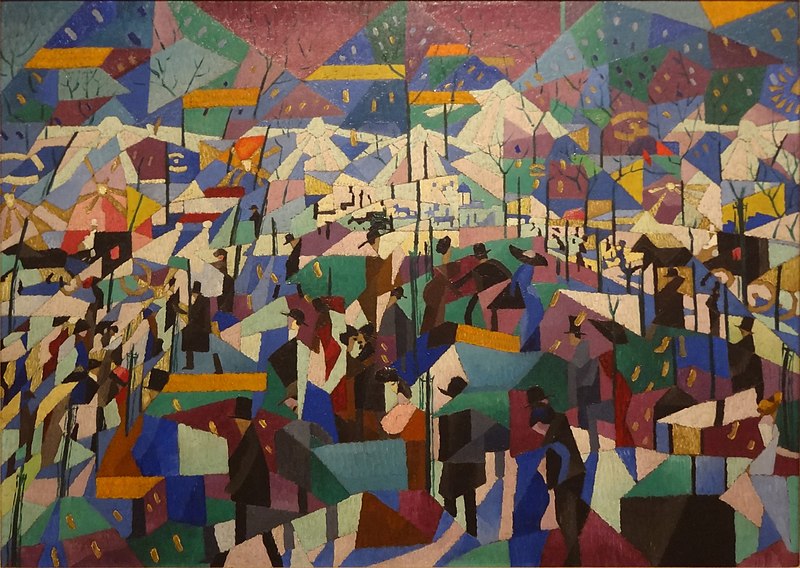
Severini's Le Boulevard (1913), his Futurist  interpretation of Parisian street life
Severini's Le Boulevard (1913), his Futurist 
interpretation of Parisian street life
Born into a family of modest means in Cortona, where his father a junior court official and his mother a dressmaker, Severini studied at the Scuola Tecnica in Cortona until the age of 15, at which point his formal education ceased when he and other classmates were caught trying to steal exam papers. They were expelled and probably lucky to escape prison. 

In 1899, his mother took him to Rome, thinking his prospects would be better there. He gained employment as a shipping clerk. He painted in his spare time and, thanks to the patronage of a fellow Cortonese with whom he had become friends, was able to attend art classes at the Rome Fine Arts Institute, studying nudes. He was not a disciplined student, however, and found himself cut adrift when his frustrated patron cancelled his allowance. 

Left to fend for himself when his mother returned to Cortona, Severini was so poor he lived in a room that was essentially a store cupboard in a kitchen in Via Sardegna in Ostiense. In 1900 he met Umberto Boccioni and Giacomo Balla for the first time. Balla took him on as a student, introducing him to the technique of pointillism, a painting method where effects were created by dotting the canvas or other surface with contrasting colours according to the principles of optical science.  The technique would have a major influence on Severini's early work and on Futurist painting in general.

Severini (right) with Luigi Russolo, Carlo Carrà, Filippo
Tommaso Marinetti and Umberto Boccioni in Paris in 1912
He moved to Paris in 1906 with Balla’s encouragement. Declaring the French capital to be his spiritual home, he settled in Montmartre, befriending another Italian, Amedeo Modigliani, and getting to know most of the city’s upcoming artists, including the Cubists Jean Metzinger, Albert Gleizes, Juan Gris and Picasso.

It was through Severini that some of the leading Italian Futurists visited Paris in 1911, absorbing some of Severini’s influence by adopting some of the humanist features of Cubism, namely the human figure in motion, as further means of expressing pictorial dynamism.  

Severini’s own Futurist work had been based on human figures, nightclub dancers or simply people in the street, rather than the cars or machines that had been central to the attempts of many of his fellow Futurist artists to depict speed and dynamism in painting.  In his nightclub scenes, he would evoke the sensations of movement and sound through rhythmic forms and flickering colours. His Dynamic Hieroglyph of the Bal Tabarin (1912) and The Boulevard (1913) were examples of his best work in Paris. 

However, Severini did produce some of the finest Futurist war art, notably his Red Cross Train Passing a Village (1914), Italian Lancers at a Gallop (1915) and Armoured Train (1915). 

His work over the next few years could be categorised as an idiosyncratic form of Cubism with elements of pointillism and Futurism before he began to experiment with a Neoclassical figurative style in portraits such as Maternity (1916). 

Severini's Mosaic of San Marco in his hometown of Cortona
Severini's Mosaic of San Marco
in his hometown of Cortona
Severini had married in 1913, his bride Jeanne Paul Fort, the 16-year-old daughter of the French poet Paul Fort. The couple were desperately poor and when Severini succumbed to pleurisy soon after the wedding, they moved to live with his parents, by then living in Montepulciano, where Jeanne became pregnant. They moved back to Paris, where their daughter, Gina, was born. A second child, Tonio, died from pneumonia, which was a factor in reigniting Severini’s Catholicism, which he had earlier renounced.

Only between the wars did Severini begin to find financial stability, realised mainly through his commissions to create frescoes and mosaics. 

He produced mosaics for the Palazzo di Giustizia in Milan (1936), the Palazzo delle Poste in Alessandria (1936) and mosaics and frescoes at the University of Padua (1937).  He worked for the Mussolini regime at the Foro Italico, a multi-venue sports complex, and the Palazzo degli Uffici, the inaugural building of the EUR project. Severini’s association with the Fascists was roundly condemned within the international artistic community, although none of Severini’s work was overtly pro-Fascist. 

After the fall of Mussolini and the end of the Second World War, Severini received lucrative commissions to decorate the offices of the Italian airline companies KLM and Alitalia among other organisations. 

His Cubist-inspired Mosaic of San Marco (1961), which adorns the facade of the Church of San Marco in Cortona, is seen as a signature work. He died in Paris in 1966 at the age of 82 but was buried in Cortona.

Cortona's elevated position gives it commanding views over the surrounding countryside
Cortona's elevated position gives it commanding
views over the surrounding countryside
Travel tip:

Cortona, founded by the Etruscans, is one of the oldest cities in Tuscany. Its Etruscan Academy Museum displays a vast collection of bronze, ceramic and funerary items reflecting the town’s past. The museum also includes an archaeological park that includes city fortifications and stretches of Roman roads. Outside the museum, the houses in Via Janelli are some of the oldest houses still surviving in Italy. Powerful during the mediaeval period, Cortona was defeated by Naples in 1409 and then sold to Florence.  Characterised by its steep narrow streets, Cortona’s hilltop location - it has an elevation of 600 metres (2,000 ft) - offers sweeping views of the Valdichiana, including Lago Trasimeno, where Hannibal ambushed the Roman army in 217 BC during the Second Punic War.

The Piramide Cestia and Porta San Paolo are two highlights of the Ostiense neighbourhood
The Piramide Cestia and Porta San Paolo are
two highlights of the Ostiense neighbourhood
Travel tip:

Severini’s earliest home in Rome was in the Ostiense neighbourhood, which can be found to the south of the Trastevere district. Bordered by the working class areas of Garbatella and Testaccio, Ostiense itself has shed its own down-at-heel reputation to become an increasingly trendy part of the city, populated by young professionals and boasting a thriving nightlife. The home of the majestic Basilica San Paolo Fuori le Mura - the Basilica of St Paul Outside the Walls - with its gold-plated ceilings, of the Roman  Piramide Cestia and the 3rd century Porta San Paolo, the district was built around the Via Ostiense, the ancient road linking the city with the Roman harbour at Ostia. 


Also on this day:

1763: The birth of musician Domenico Dragonetti

1794: The birth of opera singer Giovanni Battista Rubini

1906: Vesuvius erupts, killing more than 200 people

1973: The birth of footballer Marco Delvecchio


Home


6 April 2023

6 April

Maurizio and Giorgio Damilano – race walkers

Maurizio won Olympic gold in Moscow

Twins Maurizio and Giorgio Damilano, both former race walkers, were born on this day in 1957 in Scarnafigi in the province of Cuneo in Piedmont.  Maurizio won the gold medal at the 1980 Moscow Olympics in the 20km race walk, while his brother, Giorgio, finished 11th.  In sympathy with the American-led boycott of the Moscow Games following the Soviet invasion of Afghanistan, the Italian athletes competed under the Olympic flag rather than the Italian tricolore.  Damilano was one of eight Italians to win gold medals in Moscow.  Giorgio was less successful than Maurizio, but did win the 20km race walk at the 1979 Italian Athletics Championships.  Maurizio was also the 1987 and 1991 World Champion in the 20km race walk. He had 60 caps for representing the national team between 1977 and 1992. He was supported through much of his career by the Italian car manufacturer, Fiat.  He also achieved a world record for the 30km race walk in 1992 with a time of 2:01:44.1, which he set in Cuneo.  Maurizio won two more Olympic medals, picking up the bronze medal for the 20km race walk at both the 1984 Games in Los Angeles and the 1988 Olympics in Seoul, South Korea.  Read more…

_______________________________________

Sergio Franchi – tenor

Budding opera star became popular for singing romantic ballads

The tenor and actor Sergio Franchi was born Sergio Franci Galli on this day in 1926 in Codogno in the province of Lodi in northern Italy.  Franchi earned recognition as a performer in Britain in the 1960s and subsequently went to America where he became such a success he was once invited by John F Kennedy to sing the US national anthem at a rally.  Franchi was born to a Neapolitan father and a Ligurian mother who were living in Codogno in the Lombardy region. As a child he sang with his father who played the piano and guitar.  When he was 16, Franchi formed a band to earn extra money and went on to sing with a male group in jazz clubs.  Franchi’s father was a successful businessman but he lost all his assets during the German occupation of Italy in World War II.  After the war a family friend suggested to Franchi’s father that he should emigrate to South Africa where there were more opportunities for work. The whole family moved to Johannesburg in 1947.  Franchi worked initially for his father but also began singing in informal concerts. His voice soon attracted attention and he was offered roles in musicals.  Read more…

_____________________________________

Raphael - Renaissance painter and architect

Precocious genius from Urbino famous for Vatican frescoes

The Renaissance painter and architect commonly known as Raphael was born Raffaello Sanzio in Urbino, in the Marche region of Italy, on this day in 1483.  Raphael is regarded as one of the masters of the Renaissance, along with Michelangelo and Leonardo da Vinci.  He was more prolific than Da Vinci and, some argue, more versatile than Michelangelo, and was certainly influenced by both.  The young Raphael was taught to paint by his father, Giovanni Santi, who was a painter for the Duke of Urbino, Federico da Montefeltro, but his talents surpassed those of his father, who died when he was just 11 years old.  He was soon considered one of Urbino's finest painters and was commissioned to paint for a church in a neighbouring town while still a teenager.  In 1500, Raphael moved to Perugia in Umbria to become assistant to Pietro Vannucci, otherwise known as Perugino, absorbing considerable knowledge of his master's technique and incorporating it in his own style.  From 1504 onwards, Raphael spent a good deal of his time in Florence, studying the works of Fra Bartolommeo, Da Vinci, Michelangelo and Masaccio.  Read more…

_____________________________________

The L’Aquila Earthquake

Shock measuring 6.3 magnitude killed more than 300

The central Italy region of Abruzzo suffered a major disaster on this day in 2009 when an earthquake with a magnitude of 6.3 caused extensive damage and considerable loss of life in the city of L’Aquila and surrounding villages.  The main shock struck at 3.32am, when many of the victims would have been asleep, although there had been two smaller tremors the day before in an area with a long history of seismic turbulence, giving rise to speculation that a major quake was imminent.  The epicentre was only a little outside L’Aquila, a city with a population of about 70,000, damaging up to 11,000 buildings in the 13th century city.  A total of 309 people lost their lives and such was the scale of devastation that up to 65,000 people were left homeless in the city and neighbouring villages.  It was the deadliest earthquake to hit Italy since the Irpinia quake in Campania killed almost 2,500 people in 1980.  The dead in L’Aquila, a university city, included 55 students killed when their halls of residence collapsed.  The 309 victims were of 11 different nationalities, including Italians.  The main shock was felt 92 km (57 miles) away in the Italian capital, Rome.  Read more…

____________________________________

Pier Giorgio Frassati – social activist

Brave Catholic has inspired youth of the world

Pier Giorgio Frassati, who was dedicated to social justice issues and spent his brief life helping the poor, was born on this day in 1901 in Turin.  He was beatified by Pope John Paul II in 1990, who dubbed him ‘the Man of the Eight Beatitudes,’ alluding to a passage in the Gospel According to Matthew.  Frassati’s father, Alfredo, owned the newspaper La Stampa, and his mother Adelaide, was a painter, whose works were purchased by King Victor Emmanuel III.  Although he was from a wealthy background, even as a child Frassati showed compassion for the poor. He was educated at a school run by Jesuits and grew up to become dedicated to social action as a means of combating inequalities.  He was an ardent opponent of Fascism and was arrested in Rome for protesting with the Young Catholic Workers Congress, continuing to hold his banner aloft while being attacked by the police.  One night a group of Fascists broke into his family’s home to attack him and his father, but Frassati fought them off single-handedly and chased them away down the street.  He joined Catholic Action in 1919 and later became a member of the Third Order of Saint Dominic.  Read more…

EN - 728x90


Home