4 May 2023

4 May

Anthony Martin Sinatra - father of Frank

Sicilian who became a professional boxer in New York

Saverio Antonino Martino Sinatra, who at various times was a fireman, a professional boxer and the owner of a bar, was born on this day in 1894 in Lercara Friddi, a mining town in Sicily, about 70km (44 miles) south-east of the island’s capital, Palermo.  Usually known as Antonino, after emigrating to the United States he married Natalie Garaventa, a girl from near Genoa who lived in his neighbourhood in New York City.  They set up home in New Jersey and had a son, whom they christened Francis Albert, who would grow up to be better known as Frank Sinatra, one of the most popular entertainers of all time.  Lercara Friddi today is a town of between 7,000 and 8,000 inhabitants, which at the time of Antonino’s birth was an important centre for the mining of sulphur.  His father, Francesco, worked there as a shoemaker and married Rosa Saglimini. They had seven children, although two of them were believed to have died during an outbreak of cholera.  Early in Antonino’s life, Francesco decided to join the growing number of Sicilians who believed their prospects of escaping a life of poverty in their homeland were slim and after sailing to Naples boarded a ship bound for New York.  Read more…

_______________________________________

Osbert Sitwell – English writer

Baronet’s love for a Tuscan castle

Sir Francis Osbert Sacheverell Sitwell died on this day in 1969 at the Castello di Montegufoni near Florence in Tuscany.  Like his famous elder sister, Edith Sitwell, who was a poet, and his younger brother, Sacheverell, an art and music critic and a prolific writer, Osbert devoted his life to art and literature.  His father, Sir George Reresby Sitwell, had purchased the Castle of Montegufoni, which is 20 km from Florence, in 1909 when it was derelict and restored it beautifully to become his personal residence.  Osbert inherited the castle after his father’s death in 1943 along with the baronetcy and he reigned over Montegufoni for the rest of his life.  Osbert was born in 1892 and grew up at the family homes in Derbyshire and Scarborough. In 1911 he joined the Sherwood Rangers Yeomanry but soon transferred to the Grenadier Guards and was based at the Tower of London, enabling him to go to the theatre and art galleries when he was off duty.  In 1914 he was sent to the trenches near Ypres in French, where the experience inspired him to write his first poems.  He left the Army with the rank of Captain and contested the 1918 general election as a Liberal.  Read more…

____________________________________

Bartolomeo Cristofori - inventor of the piano

Instrument maker adapted harpsichord to play soft and loud notes

Bartolomeo Cristofori, the man widely credited with inventing the piano, was born on this day in 1655 in Padua.  He came up with the idea while working for the Grand Prince Ferdinando de' Medici in Florence, who had hired him to look after his collection of harpsichords and other instruments. It is thought that Cristofori, who was assumed to have been an established maker of musical instruments when Ferdinando invited him to Florence in around 1690, wanted to create a keyboard instrument similar to a harpsichord but capable of playing notes of varying loudness.  An inventory of Medici instruments from 1700 described an "arpi cimbalo", which resembled a harpsichord but which created sounds through hammers and dampers rather than the plucking mechanism employed by the harpsichord. It was said to be "newly invented by Bartolomeo Cristofori".  In 1711, Scipione Maffei, a poet and journalist, referred to Cristofori's "gravicembalo col piano, e forte" (harpsichord with soft and loud), the first time it was called by its eventual name, pianoforte. A Florentine court musician, Federigo Meccoli, noted that the "arpi cimbalo del piano e forte" was first made by Cristofori in 1700, which is regarded as the birth date for the piano.  Read more…

____________________________________

Marella Agnelli - noblewoman and socialite

Married for 50 years to Fiat patriarch Gianni Agnelli

Donna Marella Caracciolo di Castagneto, the noblewoman from an old Neapolitan family who married the jet-setting chairman of car giants Fiat, Gianni Agnelli, was born on this day in 1927 in Florence.  Simply known as Marella Agnelli, she was propelled by her marriage at the age of 26 into a world in which she became a socialite and style icon, devoting her life to collecting art, decorating the numerous homes she and her husband kept in Europe and beyond, and attending and hosting lavish, exclusive parties.  The couple would eventually have homes in Rome, Paris, New York,  Corsica and Saint-Moritz, as well as several houses in and around Agnelli’s home city of Turin, including the Agnelli estate in the foothills of the Italian Alps.  As a member of the House of Caracciolo, she was regarded as high Italian nobility, although she admitted that the conservative aristocratic circles in which she grew up were a long way removed from the new life she took on at Agnelli’s side.  Her father was Don Filippo Caracciolo, 8th Prince di Castagneto, 3rd Duke di Melito, and hereditary Patrician of Naples, who married an American whiskey heiress, Margaret Clarke.  Read more…

Home


3 May 2023

3 May

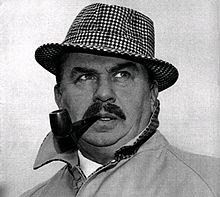
NEW - Gino Cervi - actor

Star best known for Don Camillo and Maigret

The actor Gino Cervi, a star of cinema and television screens in Italy for more than four decades as well as an accomplished stage performer, was born on this day in 1901 in Bologna.  Although his movie credits run to more than 120, he is probably best known for his portrayal of the Communist mayor Peppone in the Don Camillo films of the 1950s and ‘60s, and for playing Chief Inspector Maigret in the Italian TV series of the ‘60s and ‘70s based on the crime novels of Georges Simenon.  Cervi was the father of Italian film producer Tonino Cervi and the grandfather of actress Valentina Cervi.  Born Luigi Cervi in the historic Santo Stefano district of Bologna, Gino’s interest in acting had its roots in his journalist father Antonio’s appointment as theatre critic for Il Resto del Carlino, the city’s daily newspaper.  As a boy, he persuaded his father to take him to the theatre, soon developing an ambition to be a stage actor, which is where his talents first became known.  After his stage debut in 1924 - sadly, too late to be witnessed by his father, who died in 1923 - Cervi was invited the following year to join the company of the Teatro d’Arte di Roma. Read more…

_______________________________________

Philosopher and polymath with a playboy lifestyle

The multi-talented writer, philosopher and art connoisseur Francesco Algarotti, one of the most prominent and colourful individuals in 18th century intellectual society, died on this day in 1764 in Pisa.  Algarotti, who wrote many essays and a number of books, was something of a polymath in his breadth of knowledge on a wide number of subjects, including architecture and music as well as art. He was also a charismatic figure who became friends with most of the leading authors of his day, including Voltaire, Jean-Baptiste de Boyer, Marquis d'Argens and Pierre-Louis de Maupertuis.  His urbane manner and suave good looks, combined with his considerable intellect, led him to acquire admirers of both sexes. Indeed, at one time he is said to have found himself at the centre of a colourful bisexual love triangle involving John Hervey, the English peer and politician, and Lady Mary Wortley Montagu, the aristocratic travel writer, who became infatuated with Algarotti at the same time as Hervey, her one-time lover.  Algarotti was often engaged by the courts of European monarchs to acquire or commission paintings.  Read more…

_____________________________________

Niccolò Machiavelli – writer and diplomat

Political scientist fathered belief that ‘the ends justify the means’ 

Statesman and diplomat Niccolò Machiavelli, whose name has become synonymous with the idea of political cunning, was born on this day in 1469 in Florence.  The ideas he put forward in his writing were to make the word ‘machiavellian’ a regularly used pejorative adjective and the phrase ‘Old Nick’ a term to denote the devil in English.  The son of an attorney, Machiavelli was educated in grammar, rhetoric and Latin. After Florence expelled the Medici family in 1494 he went to work for the new republic in the office that produced official Florentine documents.  Machiavelli also carried out diplomatic missions to Rome on behalf of the republic where he witnessed the brutality of Cesare Borgia and his father, Pope Alexander VI, as they tried to acquire large parts of central Italy.  He later became responsible for the Florentine militia and, because of his distrust of mercenaries, used citizens in the army. Under his command, Florentine soldiers defeated Pisa in battle in 1509.  But Machiavelli’s success did not last and in 1512 the Medici, using Spanish troops, defeated the Florentines at Prato. He was dismissed from office in Florence by a written decree issued by the new Medici rulers.  Read more…

____________________________________

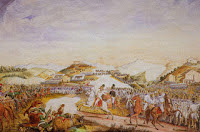
Battle of Tolentino

Murat is defeated but ignites desire for Risorgimento

Neapolitan troops were defeated by Austrian forces on this day in 1815 near Tolentino in what is now the Marche region of Italy.  It was the decisive battle in the Neapolitan War fought by the Napoleonic King of Naples, Joachim Murat, in a bid to keep the throne after the Congress of Vienna had ruled that the Bourbon Ferdinand IV, King of Sicily, should be restored.  The conflict was similar to the Battle of Waterloo, in that it occurred during the 100 days following Napoleon’s return from exile.  Murat had declared war on Austria in March 1815 after learning about Napoleon’s return to France and he advanced north with about 50,000 troops, establishing his headquarters at Ancona.  By the end of March, Murat’s army had arrived in Rimini, where he incited all Italian nationalists to go to war with him against the Austrians.  But his attempts to cross the River Po into Austrian-dominated northern Italy were unsuccessful and the Neapolitan army suffered heavy casualties.  The United Kingdom then declared war on Murat and sent a fleet to Italy. Murat retreated to Ancona to regroup his forces, with two Austrian armies pursuing him.  Read more…

_____________________________________

Raffaele Riario – Cardinal

Patron of arts linked with murder conspiracies

Renaissance Cardinal Raffaele Riario was born Raffaele Sansoni Galeoti Riario on this day in 1461 in Savona.  A patron of the arts, he is remembered for inviting Michelangelo to Rome and commissioning Palazzo della Cancelleria to be built. He was also embroiled in murder conspiracies which nearly cost him his life.  Although Riario was born in poverty, his mother was a niece of Francesco della Rovere, who became Pope Sixtus IV in 1471.  As a relative of the Pope he was created a Cardinal in 1477 and was named administrator of several dioceses, which gave him a good income at the age of 16, while he was studying canon law at the University of Pisa.  On his way to Rome in 1478, Riario stopped off in Florence, where he became a witness to the Pazzi conspiracy against the Medici. The Pazzi family wanted to replace the Medici as rulers of Florence. They attempted to assassinate Lorenzo, who was wounded but survived, and his brother Giuliano, who was killed, while they were attending mass in the Duomo. The conspirators were caught and executed and Riario was also arrested because he was related to Girolamo Riario, his uncle, who was one of the masterminds behind the plot.  Read more…


Home


Gino Cervi - actor

Star best known for Don Camillo and Maigret

Gino Cervi in his role as Peppone, the Communist mayor, in the first of the Don Camillo film series
Gino Cervi in his role as Peppone, the Communist
mayor, in the first of the Don Camillo film series
The actor Gino Cervi, a star of cinema and television screens in Italy for more than four decades as well as an accomplished stage performer, was born on this day in 1901 in Bologna.

Although his movie credits run to more than 120, he is probably best known for his portrayal of the Communist mayor Peppone in the Don Camillo films of the 1950s and ‘60s, and for playing Chief Inspector Maigret in the Italian TV series of the ‘60s and ‘70s based on the crime novels of Georges Simenon.

Cervi was the father of Italian film producer Tonino Cervi and the grandfather of actress Valentina Cervi.

Born Luigi Cervi in the historic Santo Stefano district of Bologna, Gino’s interest in acting had its roots in his journalist father Antonio’s job as theatre critic for Il Resto del Carlino, the city’s daily newspaper.

As a boy, he persuaded his father to take him to the theatre, soon developing an ambition to be a stage actor, which is where his talents first became known.

After his stage debut in 1924 - sadly, too late to be witnessed by his father, who died in 1923 - Cervi was invited the following year to join the company of the Teatro d’Arte di Roma, where the artistic director was the playwright, poet and future Nobel Prize winner Luigi Pirandello, working with actors of the quality of Lamberto Picasso, Ruggero Ruggeri and Marta Abba.

The writer Luigi Pirandello saw Cervi's acting talent
The writer Luigi Pirandello saw
Cervi's acting talent
After a decade in which his reputation grew year on year, he was invited to be lead actor at the Tofano-Maltagliati company, becoming an accomplished and lauded interpreter of the works of Goldoni, Sophocles, Dostoevsky and Shakespeare.  In 1938, jointly with with Andreina Pagnani, Paolo Stoppa and Rina Morelli, Cervi formed the company of the Teatro Eliseo in Rome, taking over as director in 1939.

By then he had already made his film debut but it was not until he formed a working relationship with Alessandro Blasetti, the director sometimes described as the father of modern Italian cinema, that his screen career really took off.

Blasetti directed him in a series of successful movies including Ettore Fieramosca (1938), Un'avventura di Salvator Rosa (1939) and La corona di ferro (1941), followed by 4 passi fra le nuvole (1942), the film considered to be the precursor of the neorealism movement that dominated Italian cinema for a period in the late 1940s and early ‘50s.

Yet Cervi’s star was to climb still higher in the 1950s, when he was chosen for the role of Peppone, the Communist mayor of a fictional town in northern Italy invented by writer Giovanni Guareschi, who is constantly at odds with the town’s rather hot-headed parish priest, Don Camillo.

The two characters made their screen debut in Le Petit Monde de don Camillo - The Little World of Don Camillo - in 1952, bringing fame both to Cervi and to Fernandel, the French comic actor cast as the priest. 

The movie, an Italian-French co-production directed by the French director Julien Duvivier, was the highest-grossing film of all-time in both Italy and France, attracting 13.2 million cinema admissions in Italy and 12.8 million in France. 

Cervi and Fernandel became firm friends and their on-screen relationship was central to the success of both the original feature and its four sequels between 1953 and 1965. A fifth was started in 1970 but was left unfinished because Fernandel was in failing health.

Cervi was oustanding in the role of Commissario Maigret on TV
Cervi was oustanding in the role of
Commissario Maigret on TV
For Cervi, a further chapter of success came in the shape of his portrayal of the French detective Jules Maigret, created by Georges Simenon, in an Italian series commissioned for national broadcaster Rai by Andrea Camilleri, then working in television as a producer, who would later create his own characterful police detective, Salvatore Montalbano.

Le inchieste del commissario Maigret - The Investigations of Commissioner Maigret - had four series over the course of eight years, comprising a total of 35 episodes. There was also a spin-off movie, Maigret a Pigalle, which was produced by Tonino Cervi.

Again, Cervi’s interpretation of the character garnered considerable critical acclaim, even from Simenon himself.

Cervi was married for much of his adult life to Angela Rosa Gardini - known as Ninì - a young actress he met in 1928 and married soon afterwards. In later life, they divorced and he married Erika Mayer.

Once a committed supporter of the Fascist party, he took part in the March on Rome in 1922, but would later denounce Mussolini’s regime. He switched his allegiance to the Christian Democrats after World War Two and later joined the Italian Liberal Party, for whom he served as a councillor in Lazio.

Although he retained an affection for Casalbuttano ed Uniti, a town near Cremona in Lombardy where his father had a house, Cervi spent his final days on the Tuscan coast at Punta Ala, a tiny coastal village on a headland opposite the island of Elba, where he died in 1974 at the age of 72, not long after he had retired from the stage.

He is buried alongside his first wife and their son, Tonino, who died in 2002, at the Flaminio cemetery in Rome.

The Piazza Santo Stefano in Bologna, looking towards the church of the Holy Sepulchre
The Piazza Santo Stefano in Bologna, looking
towards the church of the Holy Sepulchre 
Travel tip:

The centrepiece of the Santo Stefano district of central Bologna, in which Gino Cervi’s family lived, is the Basilica di Santo Stefano, unusual in that it is actually a complex of seven religious buildings from different eras, clustered around Piazza Santo Stefano. It is known locally as the Sette Chiese - the Seven Churches - as a result. The original building, designed to resemble the church of the Holy Sepulchre in Jerusalem, was built according to tradition by Saint Petronius in the fifth century, when he was a bishop of Bologna, over the site of a pagan temple to Isis.  The other buildings include the Lombard church of the Crucifix, the church of the Calvario, the church of Saint Vitale and Saint Agricola - the oldest part of the complex, dating back to the fourth century - and the Church of the Trinity, which was restructured between the 12th and 13th centuries.

The bronze statue of Peppone in front of Brescello town hall
The bronze statue of Peppone
in front of Brescello town hall
Travel tip:

The town of Brescello on the south shore of the Po river, a little over 20km (12 miles) northeast of Parma in Emilia-Romagna, has become a tourist attraction since being chosen as the location for the Don Camillo films in which Gino Cervi starred. The town, which has its origins in the Roman era, has a museum dedicated to the characters of Don Camillo and Peppone, which can be found in Via Edmondo de Amicis, a few steps from Chiesa di Santa Maria Nascente, the town’s main church, which overlooks Piazza Matteotti, the central square in which there are bronze statues of Don Camillo (in front of the church) and Peppone (by the door of the town hall). The statues were created by Andrea Zangani, a sculptor from the nearby province of Mantova, to mark the 50th anniversary in 2001 of the first Don Camillo film. 

Also on this day:

1461: The birth of Renaissance cardinal Raffaele Riario

1469: The birth of writer and diplomat Niccolò Machiavelli

1764: The death of philosopher and art collector Francesco Algarotti

1815: The Battle of Tolentino


Home


2 May 2023

2 May

Alessandro Scarlatti - composer

Prolific opera composer was ahead of his time

Baroque composer Alessandro Scarlatti was born on this day in 1660 in Palermo.  He is considered to be the founder of the Neapolitan School of opera, from which modern opera developed, and his two sons, Domenico and Pietro Filippo, also went on to become composers.  Scarlatti is believed to have been a pupil of Giacomo Carissimi in Rome. When his opera Gli equivoci nel sembiante was produced in the city he gained the support of Queen Christina of Sweden, an enthusiastic patron of the arts who had taken up residence there. He became her maestro di cappella and joined the Arcadian Academy she had founded.  Along with composers Bernardo Pasquini and Arcangelo Corelli, he regularly visited her home to perform music he had dedicated to her.  In 1684 Scarlatti became maestro di cappella to the royal family in Naples and produced a series of operas and music for state occasions for them.  Scarlatti also enjoyed the patronage of Ferdinando de' Medici and composed operas for his private theatre near Florence. He was also maestro di cappella for Cardinal Pietro Ottoboni who procured him a post at the Basilica di Santa Maria Maggiore in Rome.  Read more…

______________________________________

Pietro Frua - car designer

Built business from a bombed-out factory

The car designer and coachbuilder Pietro Frua, who built some of Italy’s most beautiful cars without achieving the fame of the likes of Giovanni Bertone or Battista “Pinin” Farina, was born on this day in 1913 in Turin.  He is particularly remembered for his work with Maserati, for whom he designed the A6G and the Mistral among other models.  The son of a Fiat employee, Carlo Frua, Pietro was an apprentice draftsman with Fiat and from the age of 17 worked alongside Battista Farina for his brother, Giovanni Farina, who had a coachbuilding business in Turin. He became director of styling for Stabilimenti Farina at the age of just 22.  After being obliged to diversify during the war, when he designed electric ovens and children’s model cars among other things, Frua bought a bombed-out factory building in 1944, restored it to serviceable order and hired 15 workers to help him launch his own business.  The first car he designed in his own studio was the soft-top Fiat 1100C sports car in 1946.  Subsequent work for Peugeot and Renault came his way and in 1955 he was approached by Maserati for the first time.  Read more…

_____________________________________

Michele Busiri Vici - architect

Key designer in Costa Smeralda project

The architect Michele Busiri Vici, whose distinctive work featured heavily in the development of the Costa Smeralda in Sardinia as an exclusive holiday playground in the 1960s, was born on this day in 1894 in Rome.  Along with the French architect Jacques Couelle and his fellow Italian, Luigi Vietti, Vici was commissioned by the Aga Khan, Prince Shah Karim al-Husseini, to develop the area at the northeastern tip of the island and build a new resort, Porto Cervo.  The prince, himself said to be worth $13.3 billion as one of the world’s richest royals, assembled a consortium of investors to finance the project, which began in 1961 and remains a destination popular with celebrities, business and political leaders and other wealthy individuals.  Vici’s contributions included the highly distinctive church of Stella Maris in Porto Cervo, the Hotel Romazzino and Hotel Lucia della Muntagna and numerous villas.  He also left his mark on Porto Rafael, a small resort founded by another wealthy individual, Raphael Neville, Count of Berlanga de Duero, in the late 1950s.  There he designed the Piazzetta, a chapel, and private villas.  Read more…

_______________________________________

Marco Pannella - campaigning politician

Radical voice who helped modernise Italian society

The Radical politician Marco Pannella, whose relentless campaigning on civil rights and other issues helped transform modern Italian society, was born on this day in 1930 in Teramo in Abruzzo.  Pannella’s party won only a 3.4 per cent share of vote in the most successful election he fought yet he forced referendums to be held on divorce, abortion, the abolition of nuclear power, the public funding of political parties and many other issues, many of which led to changes in the law.  He was so passionate about the causes for which he campaigned he regularly staged hunger strikes to demonstrate his commitment and to attract publicity.  In 1970, for example, he went 78 days without food, allowing himself to consume only vitamin pills and three cups of coffee per day, losing 27 kilos (60lb) in weight before parliament agreed to hold a debate over the divorce laws.  Pannella’s emotional speeches were legend, as were his broadcasts on Radio Radicale, the radio station he founded in 1976 as a vehicle for his own message, but also as a champion of free speech.  His parents named him Giacinto (Hyacinth) but he found the name embarrassing and went under the name of Marco instead.   Read more…

Booking.com


Home