Showing posts with label Futurism. Show all posts

11 February 2026

Anton Giulio Bragaglia - theatre director and photographer

Intellectual whose work sparked argument among Futurists

Photography was only part of Anton Giulio Bragaglia's artistic life
Photography was only part of Anton
Giulio Bragaglia's artistic life
Anton Giulio Bragaglia, a film and theatre director and writer whose early work with photography made him an important if controversial figure in the Italian Futurist movement, was born on this day in 1890 in Piglio, an historic hilltop town about 55km (33 miles) east of Rome, in Lazio.

Bragaglia began his working life in Italy’s nascent movie industry - his father, Francesco, was employed at a studio in Rome - and went on to influence Italy’s cultural life in many more ways as a theatre director, cinematographer and the founder or editor of a number of arts magazines, in addition to his work with photography.

He also founded in 1922 the Teatro Sperimentale degli Independenti, an alternative theatre built by adapting the ancient Roman baths of Septimius Severus in Via degli Avignonesi, a street that runs parallel with the top end of Via del Tritone, near Piazza Barberini.

Francesco Bragaglia, an engineer, was the first technical director of the Cines film studio, which opened in 1906 near Porta San Giovanni in the Italian capital.

Anton Giulio joined the studio as an assistant director in the same year, gaining considerable experience working alongside directors Mario Caserini and Enrico Guazzoni.

When he was 19, however, still to become established as the director, set designer, and cinematographer he would be remembered as, Bragaglia became excited by the fledgling Italian Futurist movement and their enthusiasm for speed, dynamism and technology.


He and his older brothers, Arturo and Carlo Ludovico, both of whom worked, like Anton Giulio, in the film business, wanted to become active participants in the movement, which rejected traditional art and would influence painting, literature, sculpture and architecture in Italy in the early part of the 20th century.

Through their experimental work with cameras, they found ways to capture movement, energy, and continuity in photographs, using long exposures to create blurred forms and the impression of movement. 

Anton Giulio set out their methods and vision in his 1911 manifesto, entitled Fotodinamismo futurista.  His photodynamic works, such as Waving and The Typist, were widely admired for demonstrating motion as the essence of modern life and through these he hoped to establish photography as a central medium of Futurist experimentation and a tool for expressing the rhythms of modernity. 

Bragaglia's The Typist, in which his open shutter technique was able to capture a sense of movement
Bragaglia's The Typist, in which his open shutter
technique was able to capture a sense of movement
Filippo Tommaso Marinetti, the founder of the Futurist movement, was supportive of their contribution and was happy to help them fund exhibitions of their work - although ultimately the movement expelled them in 1913 due to fundamental disagreements over whether photography could be considered as an art form.

This was mainly down to the influence of Umberto Boccioni, the painter and sculptor, who argued that photography was a mechanical medium that merely copied reality, not true creative art, and could undermine the high-art status of Futurist painting. 

Boccioni and others felt that Anton Giulio Bragaglia had been presumptuous in publishing his Fotodinamismo futurista manifesto, accusing him of trying to act as a spokesman for the movement without having the permission to do so. 

Despite their expulsion in 1913, Anton Giulio Bragaglia continued to contribute to the avant-garde movement, later founding the Casa d'arte Bragaglia in 1918, welcoming Futurist artists and giving them space to exhibit their work.

He continued to experiment with photography, his work being exhibited in Italy and abroad, including the Venice Biennale in 1924 and 1926.

By then Bragaglia had made a broader impression in the arts world. Having become editor-in-chief of the artistic and theatrical periodical L’Artista in 1911, he founded the magazine La Ruoto and the periodical Cronache di Attualità, attracting impressive lists of contributors to both that included Gabriele D'Annunzio, Grazia Deledda, Rudyard Kipling, Luigi Pirandello, Corrado Alvaro, the poet Trilussa and artists Giorgio De Chirico and Fortunato Depero. 

A section of the interior of  Bragaglia's Teatro Sperimentale
A section of the interior of 
Bragaglia's Teatro Sperimentale
He made a number of films, largely with a Futurist imprint, in no small part due to the avant-garde scenography of Enrico Prampolini. 

In 1918 he founded and directed the Casa d'Arte Bragaglia, which he inaugurated with a personal exhibition by the Futurist painter Giacomo Balla. The following year he directed his first play at the Teatro Argentina in Rome. 

In 1922 he opened the Teatro Sperimentale degli Indipendenti, which he directed until 1936, having entrusted the architect and artist Virgilio Marchi with the adaptation of the ancient Roman baths. He engaged Balla, Depero and Prampolini to take care of furnishings and decoration, again with a heavy accent on Futurist styles. 

The Teatro Sperimentale degli Indipendenti became a point of reference for the Italian avant-garde, although Bragaglia did not close the door on traditional theatrical forms. Although he embraced the innovations of international theatre, he was also keen to promote young Italian playwrights.

An intellectual with a considerable range of interests, he wrote extensively as a critic on cinema, theatre, dance, scenography and stagecraft, often travelling across Europe and to America to host exhibition and conference tours, while still working actively in the theatre, in which he eventually directed more than 50 productions.

He directed for the last time at the Rome Opera House in 1960, staging Pietro Mascagni's Le maschere, an opera written as an homage to Italian comic opera - opera buffa - and the traditions of commedia dell'arte.

Bragaglia died in July 1960 at the age of 70. His funeral and burial took place at the Verano monumental cemetery in Rome, not far from the Sapienza University.

Piglio occupies an elevated position with  sweeping views across the Sacco Valley
Piglio occupies an elevated position with 
sweeping views across the Sacco Valley
Travel tip:

Built on a spur of Monte Scalambra, a somewhat isolated mountain located on the border between the Metropolitan City of Rome and the Province of Frosinone, Bragaglia’s birthplace, Piglio, overlooks the Sacco Valley.  At the highest point of the small town stands the castle built by the Colonna family just over 1,000 years ago. The Colonnas lost control of the town but regained it in the 14th century and retained control until the early 19th century. With a history that goes back to ancient Roman times, the town’s strategic position has not always been to its advantage. A fierce battle between the Romans and Hannibal’s army in the valley during the Second Punic War, Napoleon’s armies largely burnt it down in the late 18th century and it was bombed by Allied planes in World War Two. Happily, it has been quieter in recent times and Pope John Paul II used to go there for moments of relaxation, a habit which is commemorated in a path laid out in the town, in which significant quotations attributed to him are engraved. Today, Piglio is known as part of the Cesanese DOCG red wine production area, staging a wine festival in October each year. 

Stay near Piglio with Expedia

The Palazzo Barberini, built in the 17th century, now houses one of Rome's major art museums
The Palazzo Barberini, built in the 17th century,
now houses one of Rome's major art museums
Travel tip:

Bragaglia opened his Teatro Sperimentale degli Independenti within some ancient Roman baths in the district of Rome known as Rione II - Trevi, an area right at the heart of one of Rome’s most visited areas. Naturally, it features the iconic Trevi Fountain, now more than 250 years old, which remains one of the city’s most popular attractions, so much so that the city now charges tourists a €2 euro fee for the privilege of seeing the fountain close up at peak times. Other major sights within the Trevi rione are the Palazzo Barberini, the Baroque palace built for the Barberini family in the 17th century that stands directly off the piazza and houses one of Rome’s major art museums; the Fontana del Tritone, Gian Lorenzo Bernini’s 1643 masterpiece which is the centrepiece of Piazza Barberini; and the Fontana delle Api, another Bernini fountain located just off the piazza.The Via Veneto, one of the city’s most famous boulevards thanks to its association with the Dolce Vita era, begins at Piazza Barberini, while the Quirinal Hill area, which includes several historic churches and the Palazzo Quirinale, the official residence of the Italian President, is also nearby. 

Find hotels in Rome with Hotels.com

More reading:

Umberto Boccioni, the leading Futurist artist who died tragically young

How Giacomo Balla’s paintings captured movement and speed

Giorgio De Chirico, founder of the scuola metafisica of Italian art

Also on this day:

1791: The birth of architect Louis Visconti

1881: The birth of Futurist painter Carlo Carrà

1917: The birth of film director Giuseppe De Santis

1929: Lateran Treaty gives independence to Vatican

1948: The birth of footballer Carlo Sartori

1995: The birth of singer Gianluca Ginoble


Home


9 August 2024

Emilio Vedova - painter

Self-taught Venetian became influential figure in 20th century Italian art

Emilio Vedova was one of the 20th century's most influential artists
Emilio Vedova was one of the 20th
century's most influential artists
The painter Emilio Vedova, regarded as one of the most influential Italian artists in the second half of the 20th century, was born in Venice on this day in 1919.

Vedova was known for his expressive abstract paintings, which often had a raw and violent character seemingly inspired by the tumultuous political climate of his time and the apprehension that clouded people’s lives.

A politically engaged figure, in 1942 he joined the Milanese anti-Fascist artists’ association known as Corrente, which included other painters such as Renato Guttuso and Renato Birolli, and fought in the Italian Resistance movement from 1943-45.

After World War Two, he was a co-signatory in 1946 with Corrente member Ennio Morlotti of the Oltre Guernica - Beyond Guernica - manifesto, which encouraged artists to use abstract notions rather than figures to reflect the reality of society.  A year later, he founded Fronte Nuovo delle Arti.  He described his paintings of this period as Geometrie nere (Black geometries).

Vedova is also associated with the Italian school of Arte Informale, a movement that emerged in various parts of Europe in the mid-1940s, which paralleled the Abstract Expressionism movement in the United States.  Both favoured an art based on spontaneous, expressive gestures and a rejection of traditional forms. In Italy, Vedova, Alberto Burri and Lucio Fontana were the most prominent painters in this movement.

Born in Venice into a working-class family, Vedova's father was a house painter. His own first employment - at the age of 11 - was in a factory, after which he was taken on as a photographer’s assistant before finding a position in a restoration workshop. 

Vedova's Image of Time/Barrier (1958) can be seen at the Peggy Guggenheim Collection in Venice
Vedova's Image of Time/Barrier (1958) can be seen
at the Peggy Guggenheim Collection in Venice
At the same time, he developed a passionate interest in drawing and painting. He studied the works of Titian, Tintoretto and Guardi in his native city but also Rembrandt, Goya and Daumier.  Some of his own early work was inspired by Venetian Baroque architecture, in particular the churches, in which he admired the dynamism of their lines and the way they made use of light.

He went to Florence to attend a free school of nude painting, mixing with other artists and artisans in the San Frediano district. It was there he made his first contacts within anti-Fascist circles. 

Returning to Venice, he struggled to make ends meet but with the help of the Opera Bevilacqua La Masa, which supported poor artists, managed to obtain an attic-studio in Palazzo Carminati. His first paintings on public view - mainly nudes and still lifes - were exhibited at the Galleria Ongania in Venice in 1940.

Appalled at the direction in which Italy was travelling under Mussolini, his attraction to the Corrente group in Milan was that he saw it as a counterpoint to the Novecento and Italian Futurism schools, both of which were regarded as nationalistic and pro-Fascist.

As a young painter, Vedova was fortunate to be provided with a studio by a charitable organisation
As a young painter, Vedova was fortunate to be
provided with a studio by a charitable organisation

Given his own passionate opposition to Fascism, it was no surprise that he was drawn to the Resistance movement. He took part in activities in Rome and in the hills around Belluno in the Veneto, where he was wounded.

When peace returned, he began to create pastels in which he expressed his state of mind as it was shaped by the experience of war.  In 1948 he participated for the first time in the Venice Biennale. By 1952, his work was seen as important enough to have a room at the exhibition entirely dedicated to him. 

In 1951, Vedova exhibited his first solo show in the United States at the Catherine Viviano Gallery in New York, where he began to be noticed by high-profile collectors such as Peggy Guggenheim. He received a Guggenheim International award in 1956 and the Grand Prize for Painting at the 1960 Venice Biennale.

As appreciation for his work spread, he spent time abroad, including spells in Brazil, Japan, the United States, Mexico and Berlin.  Back in Italy, the student revolts of the late 1960s and the instability of the so-called Years of Lead in the 1970s and ‘80s, informed his work in the same way as his wartime experience earlier.

Vedova was a restlessly inventive artist throughout his career. He collaborated with the avant-garde composer Luigi Nono, designing sets and costumes for the opera Intolleranza in 1960, and a light setting for Nono's opera Prometeo at La Fenice in 1984. 

He designed large-scale glass engravings, as well as numerous plurimi - freestanding, multi-panelled painted sculptures made of wood and metal.  In 1993 the Accademia dei Lincei awarded him the Feltrinelli Prize for painting, and in 1997 he received the Golden Lion for his work at the Venice Biennale.

His work began to find a permanent place in gallery and museum exhibitions at the Galleria Nazionale d'Arte Moderna in Rome and the Peggy Guggenheim Collection in Venice among others.

He kept a permanent home in Venice for much of his life and between 1975 and 1986 taught the city’s Accademia di Belle Arti.  He died in Venice in 2006 at the age of 87. He is buried in the monumental cemetery of San Michele, on an island in the lagoon.

An example of the studio spaces on offer to selected young artists at Palazzo Carminati
An example of the studio spaces on offer to
selected young artists at Palazzo Carminati
Travel tip:

The Palazzo Carminati, where Emilio Vedova had his first studio, is in the Santa Croce sestiere of Venice. Recently restored, in addition to offering a wonderful view of the city, the top floor of the historic building also houses seven studios for selected young artists under the auspices of the Bevilacqua La Masa foundation, and two guest houses reserved for residency programmes.  It can be accessed from the San Stae vaporetto stop by walking approximately 230m along Salizada San Stae and turning right into Ramo Carminati. 

The Peggy Guggenheim Collection is kept at the Palazzo Venier dei Leoni in Venice
The Peggy Guggenheim Collection is kept
at the Palazzo Venier dei Leoni in Venice
Travel tip:

Peggy Guggenheim died in 1979 but her legacy to Venice remains in the collection of modern art she accumulated, much of which is on display at the Peggy Guggenheim Collection, a museum located in the 18th century Palazzo Venier dei Leoni, on the Grand Canal in the Dorsoduro district, where the American heiress lived for three decades. Open to the public from 10am to 6pm, the Peggy Guggenheim Collection is home to the works of many prominent painters.  Two works by Emilio Vedova acquired by her in the 1950s remain in the collection: Image of Time/Barrier (1958) and Hostage City (1954). More recently, Vedova's monotype Opposite Space IV (2006) was donated to the Collection by the Emilio and Annabianca Vedova Foundation.

Also on this day:

1173: Work begins on the campanile later famous as the Leaning Tower of Pisa

1939: The birth of politician Romano Prodi

1973: The birth of footballer and coach Filippo Inzaghi


Home


7 April 2023

Gino Severini - painter and mosaicist

Tuscan was leading figure in Futurist movement

Gino Severini, typically sporting a monacle, was an influential figure
Gino Severini, typically sporting a monacle, was
an influential figure in 20th century Italian art 
The painter and mosaicist Gino Severini, who was an important figure in the Italian Futurist movement in the early 20th century and is regarded as  one of the most progressive of all 20th century Italian artists, was born on this day in 1883 in the hilltop town of Cortona in Tuscany.

He divided his time largely between Rome and Paris, where he died in 1966. Although he was a signatory - along with Umberto Boccioni, Carlo Carrà, Luigi Russolo and Giacomo Balla - of Filippo Tommaso Marinetti’s Manifesto of Futurist Painters in 1910, his work was not altogether typical of the movement.  

Indeed, ultimately he rejected Futurism, moving on to Cubism, having become friends with Cubist painters Georges Braque and Pablo Picasso in Paris, before ultimately turning his interest to Neo-Classicism and the Return to Order movement that followed the First World War. 

He attracted criticism among his peers by his associations with the Fascist-supporting Novecento Italiano movement, whose work became closely linked with state propaganda. Severini was involved with Benito Mussolini's "Third Rome" project, supplying murals and mosaics for Fascist architectural structures inspired by imperial Rome. 

Working in mosaics became an increasing focus for Severini in his later years, particularly after he rediscovered his Catholic faith. His religious mosaics displayed such refined technique he was dubbed the “father of modern mosaics". 

Severini was also the author of many essays and several books on painting, including Du cubism au classicisme (From Cubism to Classicism) in 1921 and The Life of a Painter, a vivid account of his early career. 

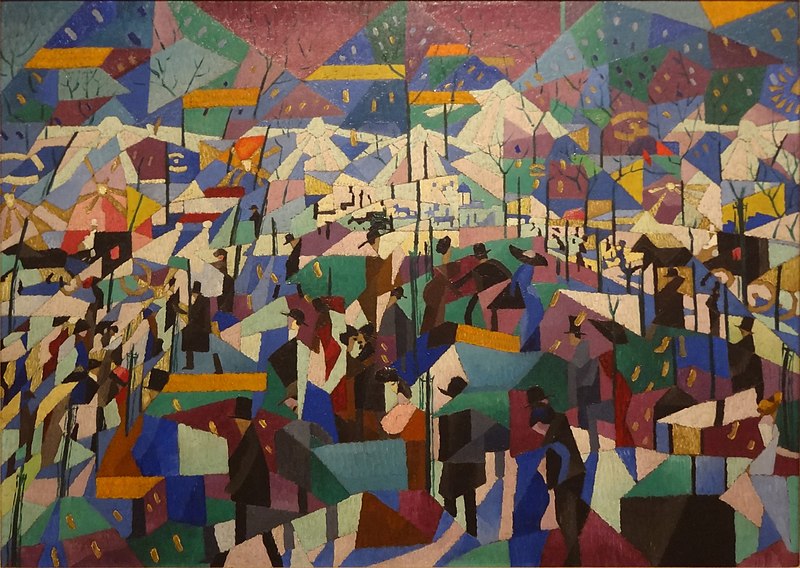
Severini's Le Boulevard (1913), his Futurist  interpretation of Parisian street life
Severini's Le Boulevard (1913), his Futurist 
interpretation of Parisian street life
Born into a family of modest means in Cortona, where his father a junior court official and his mother a dressmaker, Severini studied at the Scuola Tecnica in Cortona until the age of 15, at which point his formal education ceased when he and other classmates were caught trying to steal exam papers. They were expelled and probably lucky to escape prison. 

In 1899, his mother took him to Rome, thinking his prospects would be better there. He gained employment as a shipping clerk. He painted in his spare time and, thanks to the patronage of a fellow Cortonese with whom he had become friends, was able to attend art classes at the Rome Fine Arts Institute, studying nudes. He was not a disciplined student, however, and found himself cut adrift when his frustrated patron cancelled his allowance. 

Left to fend for himself when his mother returned to Cortona, Severini was so poor he lived in a room that was essentially a store cupboard in a kitchen in Via Sardegna in Ostiense. In 1900 he met Umberto Boccioni and Giacomo Balla for the first time. Balla took him on as a student, introducing him to the technique of pointillism, a painting method where effects were created by dotting the canvas or other surface with contrasting colours according to the principles of optical science.  The technique would have a major influence on Severini's early work and on Futurist painting in general.

Severini (right) with Luigi Russolo, Carlo Carrà, Filippo
Tommaso Marinetti and Umberto Boccioni in Paris in 1912
He moved to Paris in 1906 with Balla’s encouragement. Declaring the French capital to be his spiritual home, he settled in Montmartre, befriending another Italian, Amedeo Modigliani, and getting to know most of the city’s upcoming artists, including the Cubists Jean Metzinger, Albert Gleizes, Juan Gris and Picasso.

It was through Severini that some of the leading Italian Futurists visited Paris in 1911, absorbing some of Severini’s influence by adopting some of the humanist features of Cubism, namely the human figure in motion, as further means of expressing pictorial dynamism.  

Severini’s own Futurist work had been based on human figures, nightclub dancers or simply people in the street, rather than the cars or machines that had been central to the attempts of many of his fellow Futurist artists to depict speed and dynamism in painting.  In his nightclub scenes, he would evoke the sensations of movement and sound through rhythmic forms and flickering colours. His Dynamic Hieroglyph of the Bal Tabarin (1912) and The Boulevard (1913) were examples of his best work in Paris. 

However, Severini did produce some of the finest Futurist war art, notably his Red Cross Train Passing a Village (1914), Italian Lancers at a Gallop (1915) and Armoured Train (1915). 

His work over the next few years could be categorised as an idiosyncratic form of Cubism with elements of pointillism and Futurism before he began to experiment with a Neoclassical figurative style in portraits such as Maternity (1916). 

Severini's Mosaic of San Marco in his hometown of Cortona
Severini's Mosaic of San Marco
in his hometown of Cortona
Severini had married in 1913, his bride Jeanne Paul Fort, the 16-year-old daughter of the French poet Paul Fort. The couple were desperately poor and when Severini succumbed to pleurisy soon after the wedding, they moved to live with his parents, by then living in Montepulciano, where Jeanne became pregnant. They moved back to Paris, where their daughter, Gina, was born. A second child, Tonio, died from pneumonia, which was a factor in reigniting Severini’s Catholicism, which he had earlier renounced.

Only between the wars did Severini begin to find financial stability, realised mainly through his commissions to create frescoes and mosaics. 

He produced mosaics for the Palazzo di Giustizia in Milan (1936), the Palazzo delle Poste in Alessandria (1936) and mosaics and frescoes at the University of Padua (1937).  He worked for the Mussolini regime at the Foro Italico, a multi-venue sports complex, and the Palazzo degli Uffici, the inaugural building of the EUR project. Severini’s association with the Fascists was roundly condemned within the international artistic community, although none of Severini’s work was overtly pro-Fascist. 

After the fall of Mussolini and the end of the Second World War, Severini received lucrative commissions to decorate the offices of the Italian airline companies KLM and Alitalia among other organisations. 

His Cubist-inspired Mosaic of San Marco (1961), which adorns the facade of the Church of San Marco in Cortona, is seen as a signature work. He died in Paris in 1966 at the age of 82 but was buried in Cortona.

Cortona's elevated position gives it commanding views over the surrounding countryside
Cortona's elevated position gives it commanding
views over the surrounding countryside
Travel tip:

Cortona, founded by the Etruscans, is one of the oldest cities in Tuscany. Its Etruscan Academy Museum displays a vast collection of bronze, ceramic and funerary items reflecting the town’s past. The museum also includes an archaeological park that includes city fortifications and stretches of Roman roads. Outside the museum, the houses in Via Janelli are some of the oldest houses still surviving in Italy. Powerful during the mediaeval period, Cortona was defeated by Naples in 1409 and then sold to Florence.  Characterised by its steep narrow streets, Cortona’s hilltop location - it has an elevation of 600 metres (2,000 ft) - offers sweeping views of the Valdichiana, including Lago Trasimeno, where Hannibal ambushed the Roman army in 217 BC during the Second Punic War.

The Piramide Cestia and Porta San Paolo are two highlights of the Ostiense neighbourhood
The Piramide Cestia and Porta San Paolo are
two highlights of the Ostiense neighbourhood
Travel tip:

Severini’s earliest home in Rome was in the Ostiense neighbourhood, which can be found to the south of the Trastevere district. Bordered by the working class areas of Garbatella and Testaccio, Ostiense itself has shed its own down-at-heel reputation to become an increasingly trendy part of the city, populated by young professionals and boasting a thriving nightlife. The home of the majestic Basilica San Paolo Fuori le Mura - the Basilica of St Paul Outside the Walls - with its gold-plated ceilings, of the Roman  Piramide Cestia and the 3rd century Porta San Paolo, the district was built around the Via Ostiense, the ancient road linking the city with the Roman harbour at Ostia. 


Also on this day:

1763: The birth of musician Domenico Dragonetti

1794: The birth of opera singer Giovanni Battista Rubini

1906: Vesuvius erupts, killing more than 200 people

1973: The birth of footballer Marco Delvecchio


Home


18 July 2019

Giacomo Balla - painter

Work captured light, movement and speed


Giacomo Balla's work Le mani del violinista - The Hands of  the Violinist - stemmed from his fascination with movement
Giacomo Balla's work Le mani del violinista - The Hands of
 the Violinist - stemmed from his fascination with movement
The painter Giacomo Balla, who was a key proponent of Futurism and was much admired for his depictions of light, movement and speed in his most famous works, was born on this day in 1871 in Turin.

An art teacher who influenced a number of Italy’s most important 20th century painters, Balla became interested in the Futurist movement after becoming a follower of the poet Filippo Tommaso Marinetti, who is regarded as the ideological founder of Futurism.

Futurism was an avant-garde artistic, social and political movement. Its ethos was to embrace modernity and free Italy from what was perceived as a stifling obsession with the past.

Balla was one of the signatories of Il manifesto dei pittori futuristi - the Manifesto of Futurist Painters - in 1910.

Giacomo Balla was one of the signatories of the Manifesto of Futurist Painters
Giacomo Balla was one of the signatories
of the Manifesto of Futurist Painters 
He differed from some of the other artists who signed the Manifesto, painters such as Carlo Carrà and Umberto Boccioni, whose work tried to capture the power and energy of modern industrial machinery and the passion and violence of social change, in that his focus was primarily on exploring the dynamics of light and movement.

Giacomo Balla was the son of a seamstress and a waiter who was an amateur photographer. He lost his father at the age of nine, at which point he gave up an early interest in music and began working in a lithograph print shop. As he grew up, he decided to study painting and several of his early works were shown at exhibitions.

In 1895, after completing his academic studies at the University of Turin, Balla moved to Rome, where he married Elisa Marcucci and found work as an illustrator, caricaturist and portrait painter.  He also passed on his painting skills as a teacher.

After a period in Paris in 1900, where he spent seven months assisting the illustrator Serafino Macchiati, he became fascinated with French neo-impressionism and, on returning to Rome, he adopted the neo-impressionist style in his work.  Among his young students were Boccioni and Gino Severini, to whom he passed on his enthusiasm for contemporary French trends.

Balla's Dynamism of a Dog on a Leash  identified him as a Futurist painter
Balla's Dynamism of a Dog on a Leash
identified him as a Futurist painter
Influenced by Marinetti’s philosophy, Balla, Boccioni and Severini adopted the Futurism style. Balla was driven by the idea of creating a pictorial depiction of light, movement and speed.  Typical for his new style was his 1912 painting Dinamismo di un cane al guinzaglio - Dynamism of a Dog on a Leash - which is in the care of the Albright–Knox Art Gallery in Buffalo, New York.

Another notable work painted at around the same time is Le mani del violinista - The Hands of the Violinist - which depicts a musician's hand and the neck of a violin, blurred and duplicated to suggest the motion of frenetic playing.  The Hands of the Violinist is currently kept at the Estorick Collection of Modern Italian Art in Islington, north London.

If the theme of those two paintings was movement, Balla’s interest in breaking down the elements of light is exemplified in two other famous works.

Balla's extraordinary 1909 painting Street Light (Lampada ad arco)
Balla's extraordinary 1909 painting
Street Light (Lampada ad arco)
Street Light (Lampada ad arco), painted in 1909, which vividly depicts the glow of modern street lighting, can be seen in the Museum of Modern Art in New York City, while his 1914 work Mercury Passing Before the Sun (Mercurio transita davanti al sole), an almost kaleidoscopic representation of the planet and the sun seen through a telescope, is on long-term loan to the Peggy Guggenheim Collection in Venice.

In 1914, Balla branched out into designing Futurist furniture and even the so-called Futurist antineutral clothing. He also received some commissions as a sculptor.  His studio became a meeting place for young artists.

In 1935, he was made a member of Rome's Accademia di San Luca.  He died in Rome in March 1958, at the age of 86, and was buried at the Campo Verano cemetery.

The Basilica of San Lorenzo Fuori le Mura adjoins the Cemetary of Campo Verano
The Basilica of San Lorenzo Fuori le Mura adjoins the
Cemetary of Campo Verano
Travel tip:

The Cimitero Comunale Monumentale Campo Verano, where Balla is interred, is situated beside the Basilica of San Lorenzo Fuori le Mura, in the Tiburtino area of Rome. It is the city's largest cemetery, with some five million internments. The name 'Verano' is thought to date back to the Roman era, when the area was known as Campo dei Verani.

The Via Po in Turin, pictured here in 1930 is at
the heart of the city's café culture
Travel tip:

The city of Turin, once the capital of Italy and traditionally seat of the Savoy dynasty, is best known for its royal palaces but tends to be overlooked by visitors to Italy, especially new ones, who flock first to Rome, Florence, Venice and Milan. Yet as an elegant, stylish and sophisticated city, Turin has much to commend it, from its many historic cafés to 12 miles of arcaded streets and some of the finest restaurants in Piedmont. To enjoy Turin’s café culture, head for Via Po, Turin’s famous promenade linking Piazza Vittorio Veneto with Piazza Castello, or nearby Piazza San Carlo, one of the city’s main squares. In the 19th century, these cafès were popular with writers, artists, philosophers, musicians and politicians among others, who would meet to discuss the affairs of the day.

More reading:

Umberto Boccioni, the brilliant talent who died tragically young

How the funeral of an anarchist inspired Carlo Carrà

The 'noise music' of Futurist Luigi Russolo

Also on this day:

1610: The mysterious death of Caravaggio

1884: The birth of Alberto di Jorio, shrewd head of the Vatican Bank

1914: The birth of Gino Bartali, cycling champion and secret war hero


Home