11 August 2022

Lavinia Fontana – artist

Mother of 11 was Italy’s first female professional painter

A detail from Fontana's Self-Portrait at the Clavichord with a Servant, painted in 1577
A detail from Fontana's Self-Portrait at the
Clavichord with a Servant,
painted in 1577
Bolognese Mannerist artist Lavinia Fontana, who became famous for her portraits, died on this day in 1614 in Rome. She has come to be regarded as the first female professional painter in both Italy and throughout western Europe because her family lived on her income from commissioned works. Her husband worked as her assistant and agent and helped her bring up their 11 children.

Lavinia was born in Bologna in 1552 and baptised at the Basilica di San Petronio in the city. Her father, Prospero, was a prominent artist of the Bolognese school and trained Lavinia to follow in his footsteps. This allowed her to become an artist at a time when women were not widely accepted in the profession.

Her earliest known work, Child of the Monkey, was painted in 1575 when she was 23, but is now lost. Another early painting, Christ with the Symbols of the Passion, which was painted in 1576, is now in the El Paso Museum of Art in Texas.

Bologna society was largely supportive of Lavinia’s career, providing opportunities that were not given to women artists in other areas of Italy. She is thought to be the first woman artist working within the same sphere as her male counterparts to live outside a court or a convent.

Lavinia began working professionally by painting small devotional pictures on copper, which had popular appeal as papal and diplomatic gifts. By the 1580s she was in demand as a portrait painter of Bolognese noblewomen, who competed for her services and paid large sums of money for her work because of her close attention to detail. 
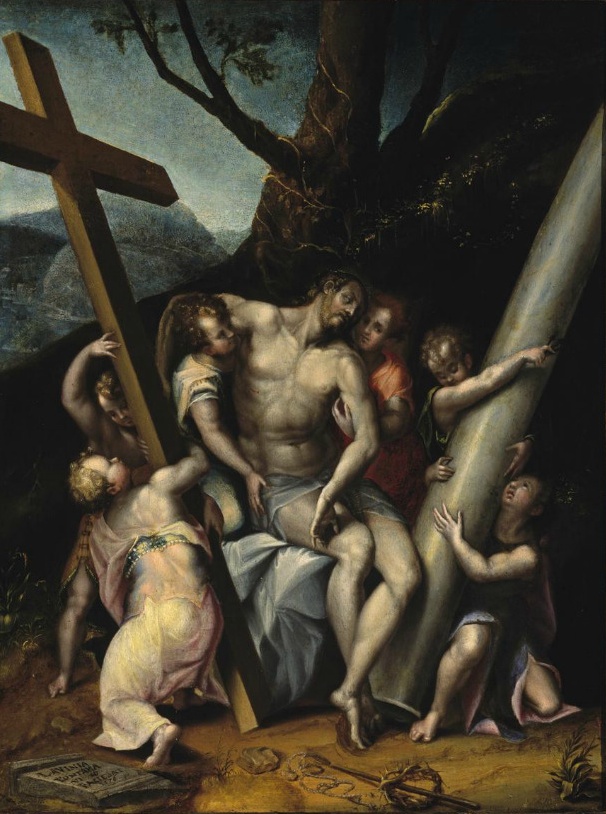
Mancini's Christ with the Symbols of Passion, at the El Paso Museum of Art
Mancini's Christ with the Symbols of
Passion,
at the El Paso Museum of Art
She displayed the wealth of the sitter by not neglecting any fashionable detail and by using bright colours for their clothes and jewellery. She also painted portraits of important people connected with the University of Bologna. As her career developed, she began creating large-scale paintings with religious or mythological themes. Among her most famous works are her large altarpieces for churches in Bologna.

Lavinia married another painter, Gian Paolo Zappi, in 1577, at the age of 26, and continued to paint professionally, adding the name Zappi to her signature.

Her husband helped her take care of the household and worked as her painting assistant and agent. He would paint minor elements of her canvases, such as draperies. Lavinia attended Bologna University and was listed as one of the city’s ‘donne addotrinate’, women with doctorates, in 1580.

In 1589, Lavinia painted the altarpiece Holy Family with the Sleeping Christ Child for El Escorial in Madrid.

At the invitation of Pope Clement VIII, Lavinia and her family moved to Rome in 1604 and she was appointed Portraitist in Ordinary at the Vatican. Pope Paul V was later among her sitters.

In 1604, Lavinia painted her largest work, The Martyrdom of St Stephen, an altarpiece for San Paolo Fuori le Mura - Saint Paul Outside-the-Walls - in Rome.

Among the honours she received was a bronze portrait medallion of herself cast by sculptor and architect Felice Antonio Casoni in 1611. She was also elected into the Accademia di San Luca of Rome, which was rare for a woman.

Minerva Dressing (1613), thought to be
the first female nude painted by a woman 
Lavinia died in Rome on 11 August 1614 and was later buried in Santa Maria sopra Minerva, one of the major Dominican churches in the capital.

One of Lavinia’s masterpieces is considered to be the Self-Portrait at the Clavichord with a Servant, which she painted as a gift to the Zappi family before her wedding, describing herself as a virgin in the signature. She also stated that she painted it while looking at herself in a mirror as a testament to it being an accurate depiction of her.

Over 100 of her works have been documented, but only 32 signed and dated are still known today. Another 25 have been attributed to her, giving her the largest collection of works by any female artist before 1700.

Lavinia’s religious and mythological paintings sometimes featured nude figures. Her painting, Minerva Dressing, for Cardinal Scipione Borghese, nephew to Pope Paul V, is believed to be the first female nude executed by a woman in Italy.  This can be seen in the Galleria Borghese in Rome. It has also been claimed Lavinia was the first female artist to paint mythological subjects.

Lavinia was immortalised by being the subject of Portrait of a Woman by Paolo Veronese, painted in 1595, when she was 43. She was the only woman to be featured in the 17th century book Considerazioni sulla pittura - Considerations on Painting - written by the physician and art collector Giulio Mancini, where the beauty of her paintings was likened to her own physical attractions by the writer.

It was rare for a woman painter to achieve such success and to profit from her talent during the Renaissance period. Some experts would argue that, to this day, Lavinia Fontana remains insufficiently appreciated as an artist.

The Basilica of San Petronio in Bologna is the sixth largest church in Europe
The Basilica of San Petronio in Bologna
is the sixth largest church in Europe
Travel tip:

The Basilica di San Petronio, where Lavinia Fontana was baptised, dominates Bologna’s Piazza Maggiore. Standing 47m (154ft) tall, 132m (144yds) long and 60m (66yds) wide, it is the sixth largest church in Europe and is seen as a symbol of the city. Strangely,  it was not consecrated as a church until 1954 - 574 years after it was built. It was constructed as a civic temple and not transferred from the city to the diocese until 1929.  It is notable for its unfinished facade, the red and brick marble of Domenico da Varignana’s design abandoned when it had barely reached one third of the building’s height, following the intervention of Pope Pius IV, who considered the project too expensive and ambitious.

The Basilica of St Paul Outside-the-Walls is one of Rome's four major Papal Basilicas
The Basilica of St Paul Outside-the-Walls is
one of Rome's four major Papal Basilicas
Travel tip:

St Paul Outside-the-Walls is one of the four major Papal Basilicas in Rome, along with St John in the Lateran (San Giovanni in Laterano), St Peter’s (San Pietro in Vaticano) and St Mary Major (Santa Maria Maggiore). Originally built in the fourth century, it was founded by the Roman emperor Constantine I over the burial place of St Paul. It was damaged and rebuilt after Saracen raids in the ninth century and an earthquake in the 14th century and almost completely destroyed by a fire in 1823, after which Pope Leo XII ordered it to be reconstructed to exactly resemble the original, consecrated in 324, although this turned out to be an unrealistic ambition. The new basilica bears only a general resemblance to the original. The tomb of St Paul is below a marble tombstone in the basilica’s crypt.

Also on this day:

1492: The election of Rodrigo Borgia as Pope Alexander VI

1902: The birth of cycling champion Alfredo Binda

1967: The birth of football coach Massimiliano Allegri 


Home

10 August 2022

10 August

Marina Berlusconi - businesswoman

Tycoon’s daughter who heads two of his companies

Marina Berlusconi, the oldest of business tycoon and former Italian prime minister Silvio Berlusconi’s five children, was born on this day in 1966 in Milan.  In 2003 she became chair of Arnoldo Mondadori Editore, Italy’s largest publishing company, and in 2005 president of Fininvest, the Berlusconi holding company that is also Mondadori’s parent company.  She is or at times has been a director of several other Berlusconi companies, including Mediaset, Medusa Film, Mediolanum and Mediobanca.  Forbes magazine once described her as the most powerful woman in Italy and one of the 50 most powerful women in the world.  Born Maria Elvira Berlusconi, her mother is Carla Elvira Lucia Dall’Oglio, a woman the businessman met for the first time at a tram stop outside Milan Centrale railway station in 1964 and married the following year, at a time when he was an enterprising but relatively obscure real estate broker.  They were divorced in 1985, much to the disappointment of Marina and her brother, Piersilvio, after their father had begun a relationship with the actress Veronica Lario, who would become his second wife and the mother of his third, fourth and fifth children.  Read more…

____________________________________

Carlo Rambaldi - master of special effects

Former commercial artist who created E.T.

Carlo Rambaldi, the brilliant special effects artist who created Steven Spielberg's ugly-but-adorable Extra-Terrestrial known as E.T. and Ridley Scott's malevolent Alien, died on this day in 2012 in Lamezia Terme, the city in Calabria where he settled in later life.  He was a month away from his 87th birthday.  Unlike modern special effects, which consist of computer generated images, Rambaldi's creatures were typically made of steel, polyurethane and rubber and were animated by mechanically or electronically powered rods and cables.  Yet his creations were so lifelike that the Italian director of one of his early films was facing two years in prison for animal cruelty until Rambaldi brought his props to the court room to prove that the 'animals' on screen were actually models.  It was during this time that Rambaldi, a former commercial artist who had graduated from the Academy of Fine Arts in Bologna, not far from his home town of Vigarano Mainarda in Emilia-Romagna, pioneered the use animatronics (puppets operated mechanically by rods or cables) and mechatronics, which combined mechanical and electronic engineering.  Read more…

______________________________________

Ippolito de' Medici – Lord of Florence

Brief life of a Cardinal, soldier and patron of the arts

Ippolito de' Medici, who ruled Florence on behalf of his cousin, Giulio, after he became Pope Clement VII, died on this day in 1535 in Itri in Lazio.  At the age of 24, Ippolito was said to have contracted a fever that turned into malaria, but at the time there were also rumours that he had been poisoned.  There were two possible suspects. The fatal dose could have been administered on behalf of Alessandro de' Medici, whose abuses he was just about to denounce, or on behalf of the new pope, Paul III, who was believed to want Ippolito’s lucrative benefices for his nephews.  Ippolito was born in 1509 in Urbino, the illegitimate son of Giuliano de' Medici. His father died when Ippolito was seven and he came under the protection of his uncle, Pope Leo X. When he died five years later, Ippolito’s cousin, Giulio, who had become Pope Clement VII, sent him to Florence to become a member of the government, destined to rule the city when he was old enough.  Ippolito ruled Florence on his behalf between 1524 and 1527 but then Clement VII chose his illegitimate nephew, Alessandro, to take charge of Florence instead.  Read more…

____________________________________

Francesco Zabarella – Cardinal

Reformer helped to end the Western Schism

Cardinal Francesco Zabarella, an expert on canon law whose writings on the subject were to remain the standard authority for centuries, was born on this day in 1360 in Padua.  Zabarella studied jurisprudence in Bologna and in Florence, graduating in 1385. He taught canon law in Florence until 1390 and in Padua until 1410.  He took minor orders and in 1398 was made an archpriest of the Cathedral of Padua.  Zabarella carried out diplomatic missions on behalf of Padua. In 1404 he was one of two ambassadors sent to visit King Charles VI of France to ask for his assistance against Venice, which was preparing to annex Padua.  But when Padua became part of the Venetian Republic in 1406, Zabarella became a loyal supporter of Venice.  In 1409 he took part in the Council of Pisa as councillor of the Venetian legate.  The antipope John XXIII appointed him Bishop of Florence and cardinal deacon of Santi Cosma and Damiano in Rome in 1411.  There were two antipopes at the time as a result of the Western Schism, which had begun in 1378 when the French cardinals, claiming that the election of Pope Urban VI was invalid, had elected antipope Clement VII as a rival to the Roman pope.  Read more…

Booking.com


Home


9 August 2022

9 August

Romano Prodi – politician


Il professore became prime minister and European Commission president

Romano Prodi, who has twice served as prime minister of Italy, was born on this day in 1939 in Scandiano in Emilia-Romagna.  A former academic, who was nicknamed Il professore by the Italians, Prodi was also president of the European Commission from 1999 to 2004.  Prodi graduated from the Catholic University in Milan in 1961 and studied as a postgraduate at the London School of Economics.  After moving up to become professor of economics at Bologna University, Prodi served the Italian government as minister for industry in 1978.  In 1996 after two productive stints as chairman of the Institute for Industrial Reconstruction, Prodi set his sights on becoming Italy’s prime minister and built a centre-left base of support known as the Olive Tree coalition.  While Silvio Berlusconi used television to campaign, Prodi went on a five-month bus tour around Italy, calling for more accountability in government. His approach appealed to the voters and his coalition won by a narrow margin.  Prodi was appointed prime minister of Italy for the first time on May 17, 1996.  He remained prime minister for two years and four months.  Read more…

_______________________________________

Leaning Tower of Pisa

Poor foundations created tourist attraction by accident

Work began on the construction of a freestanding bell tower for the Cathedral in Pisa on this day in 1173.  The tower’s famous tilt began during the building process. It is believed to have been caused by the laying of inadequate foundations on ground that was too soft on one side to support the weight of the structure.  The tilt became worse over the years and restoration work had to be carried out at the end of the 20th century amid fears the tower would collapse.  At its most extreme the tower leaned at an angle of 5.5 degrees but since the restoration work undergone between 1990 and 2001 the tower leans at about 3.99 degrees.  The identity of the architect responsible for the design of the tower is not clear but the problem with the structure began after work had progressed to the second floor in 1178.  It is thought the tower would have toppled had construction not been halted for almost a century while Pisa, a Tuscan seaport, fought battles with Genoa, Lucca and Florence. This allowed time for the soil beneath the tower to settle.  When construction resumed in 1272, the upper floors were built with one side taller than the other to compensate for the tilt.  Read more…

___________________________________

Filippo Inzaghi - football manager

World Cup winning player turned successful coach

The former Azzurri striker Filippo Inzaghi, who was a member of Italy’s 2006 World Cup-winning squad, was born on this day in 1973 in Piacenza.  A traditional goal poacher, known more for his knack of being in the right place at the right moment than for a high level of technical skill, Inzaghi scored 313 goals in his senior career before retiring as a player in 2012 and turning to coaching. He spent the 2019-20 season in charge of Serie B side Benevento, near Naples.  Inzaghi came off the substitutes’ bench to score the second goal as Italy beat the Czech Republic 2-0 to clinch their qualification for the knock-out stage of the 2006 World Cup in Germany but found it impossible to win a starting place in competition with Luca Toni, Alberto Gilardino, Francesco Totti and Alessandro Del Piero in Marcello Lippi’s squad.  He also picked up a runners-up medal in Euro 2000, hosted jointly by Belgium and the Netherlands, where he scored against Turkey in the opening group game and against Romania in the quarter-final but was overlooked by coach Dino Zoff in his team for the final.  Read more…

EN - 728x90


Home


8 August 2022

8 August

Dino De Laurentiis – film producer

Campanian pasta seller helped make Italian cinema famous 

The producer of hundreds of hit films, Agostino ‘Dino’ De Laurentiis was born on this day in 1919 at Torre Annunziata, near Naples in Campania.  He made Italian cinema famous internationally, producing Federico Fellini’s Oscar- winning La strada in 1954 in Rome.  After moving to the US he enjoyed further success with the film Serpico in 1973.  De Laurentiis was the son of a pasta manufacturer for whom he worked as a salesman during his teens.  While selling pasta in Rome in the 1930s he decided on impulse to enrol at the Centro Sperimentale di Cinematografia in the city as an actor.  He quickly realised he had more talent for producing and after gaining experience in the different sectors of the industry made his first film, L’amore canta - Love Song - in 1941 when he was just 22.  After serving in the army during the Second World War, De Laurentiis became an executive producer at one of Rome’s emerging film companies, Lux.  Among the films he produced for Lux was Riso amaro - Bitter Rice - starring Silvana Mangano, whom he later married and had four children with. The film was a box-office success both at home and abroad.  Read more…

____________________________________

Danilo Gallinari - basketball player

Giant from Lodi province who plays in America’s NBA

Danilo Gallinari, the only Italian-born player currently active in America’s National Basketball Association, was born on this day in 1988 in Sant’Angelo Lodigiano in Lombardy.  Only nine Italian-born players have participated in the NBA – America’s premier basketball league – since its formation in 1946.  Gallinari, who stands 6ft 10ins tall, has played for six NBA teams, the latest of which is Boston Celtics. Previously he had played for New York Knicks, under the coaching of Mike D’Antoni, is an American-born former player who is now an Italian citizen, the Denver Nuggets, Los Angeles Clippers, Oklahoma City Thunder and Atlanta Hawks.  Gallinari, whose father, Vittorio, played professional basketball for teams in Milan, Pavia, Bologna and Verona, began his career in 2004 with Casalpusterlengo, a third-level Italian team from a town about 25km (15 miles) from his home in Sant’Angelo Lodigiano.  He moved up a tier in 2005 by joining Armani Jeans Milano and then Edimes Pavia, where in 2006 he was named best Italian player in the Italian League Second Division, despite missing half the season through injury.  Read more…

______________________________________

Ugo Bassi - priest and patriot

Unarmed chaplain was a follower of Garibaldi

Catholic priest Ugo Bassi was executed by firing squad on this day in 1849 in Bologna.  Bassi had been a preacher of eloquent sermons that attracted large crowds and had travelled all over Italy helping the poor, often himself not having enough food to eat.  He was also strongly patriotic and had been a follower of Giuseppe Garibaldi in his fight for a united, independent kingdom of Italy. It was while he was with Garibaldi’s army battling French troops loyal to the Pope in Rome that he was captured and sentenced to death on a false charge of carrying a weapon.  His execution was said to have enraged Liberals all over Europe.  Bassi was born in 1801 in Cento, a small town in the province of Ferrara, in what is now Emilia Romagna. Although he was baptised as Giuseppe Bassi, he later changed his name to Ugo in honour of the patriotic and revolutionary poet, Ugo Foscolo.  An unhappy love affair led to Bassi becoming a novice in the Barnabite order at the age of 18 and, after studying in Rome, he entered the priesthood in 1833.  In 1848, when the revolutionary movement began in Italy, Pope Pius IX was known to be an Italian nationalist and liberal.  Read more…

______________________________________

Leo Chiosso – songwriter

Writer of lyrics and scripts was inspired by crime fiction

Prolific songwriter Leo Chiosso was born on this day in 1920 in Chieri, a town to the south of Turin in Piedmont.  He became well known for the songs he wrote in partnership with Fred Buscaglione, a singer and musician, but Chiosso also wrote many scripts for television and cinema.  Chiosso met Buscaglione in 1938 in the nightclubs of Turin, where Buscaglione was working as a jazz singer. They formed a songwriting duo that went on to produce more than 40 songs.  However, their friendship was interrupted by the Second World War.  Chiosso was taken prisoner and deported to Poland, where he became friends with the writer Giovanni Guareschi, while Buscaglione was sent to a US internment camp in Sardinia.  It was only when Chiosso heard Buscaglione playing in a musical broadcast by the Allied radio station in Cagliari that he knew his friend was still alive.  They were reunited in Turin after the war and continued to write songs together. Chiosso was an avid reader of American crime fiction, which inspired his lyrics and also suited Buscaglione’s amiable gangster image.  Their first hit was Che bambola in 1956, which turned humorous tough guy Buscaglione into a celebrity.  A subsequent hit was Love in Portofino, recently recorded by Andrea Bocelli and also the inspiration for one of his albums.  Read more…


Home