Showing posts with label 18th century. Show all posts

27 February 2026

Pietro Gnocchi – composer

Influential musician was inspired by geography

Pietro Gnocchi studied music in Venice
Pietro Gnocchi studied
music in Venice
Baroque composer and writer Pietro Gnocchi, who is remembered for the unusual titles he gave to his music, was born on this day in 1689 in Alfianello in the province of Brescia in the region of Lombardy.

As well as writing a large quantity of sacred music and being choirmaster at Brescia Cathedral, Gnocchi, who has come to be regarded as a polymath because of his wide knowledge, wrote about history, geography, and archaeology. His works included a treatise on memorial tablets in the Brescia region, and a 25-volume history of ancient Greek colonies.

Gnocchi was the second of four sons born into a middle class family and he grew up to study music and to train as a priest. He then went on to study music in Venice and later travelled to Hungary, Vienna, and Munich.

After returning to Brescia, he was appointed as maestro di cappella at the cathedral now known as Brescia's Duomo Vecchio in 1723. Ten years later he applied to be the organist there, but was unsuccessful. He also worked at an orphanage, Orfanelle della Pietà, where it is thought he may have been a music instructor.

Although Gnocchi’s music was never published, it still exists in manuscript form and is regularly performed today. His choral music, which reveals the influence of his early training in Venice, included more than 60 masses, with surprising titles, such as Europe, Asia, Africa, and America. He also composed Requiems, sets of Vespers, various settings of the Magnificat and settings of the Miserere, as well as hymns and motets.


One of his settings for the Magnificat is entitled ‘Il Capa di Buona Speranza’, The Cape of Good Hope, reflecting his interest in geography.

Gnocchi also wrote some secular music, which included concertos and sonatas for stringed instruments, and some songs.

Most of his music manuscripts are now stored in the archives of Brescia Cathedral and the Church of Madonna delle Grazie in Brescia.

In 1762, Gnocchi successfully reapplied for his old position as maestro di cappella at Brescia Cathedral, as well as for the position of organist. He was to hold both these appointments until his death at the age of 86 in 1775 in Brescia, where according to his wishes, he was buried in the Church of San Giorgio. 

Brescia's Duomo Vecchio, also known as the  Rotonda, where Gnocchi was maestro di cappella
Brescia's Duomo Vecchio, also known as the 
Rotonda, where Gnocchi was maestro di cappella
His treatise on memorial tablets in and around Brescia, and his history of ancient Greek colonies, were bought by Prince Faustino Lechi of Brescia, who was a student of Gnocchi, and later became his friend and patron. Many of Gnocchi’s manuscripts are still preserved in the Bibliotheca Civica Queriniana di Brescia.

Gnocchi influenced Italian music through teaching other musicians in Brescia and passing on Venetian traditions to them. The pupils he mentored adopted his musical style and went on to occupy key ecclesiastical roles themselves, continuing to evoke the atmosphere of choral music, as it was performed in St Mark’s Basilica, throughout Lombardy.

Scholarly interest in Gnocchi’s music has grown in the 20th and early 21st centuries and studies have been written comparing Gnocchi’s sonatas and concertos with those of Vivaldi, noting the shared Venetian traits as well as the differences.

Ensembles specialising in Baroque music have played Gnocchi’s sonatas using period instruments and released recordings of his works, which have also enabled contemporary listeners to make comparison with the music of Vivaldi. A CD of sacred music written by Gnocchi for the churches of Brescia, performed by the Coro Claudio Monteverdi, is currently available. 

Brescia is a mix of Renaissance architecture and ruins from its Roman past
Brescia is a mix of Renaissance architecture
and ruins from its Roman past
Travel tip:

Brescia, the birthplace of Pietro Gnocchi, is a town of great artistic and architectural importance but, although it is the second city in Lombardy after Milan, and has Roman remains and well-preserved Renaissance buildings, it is not well-known to tourists.  Brescia became a Roman colony before the birth of Christ and you can still see remains from the forum, theatre, and a temple. The town was fought over by different rulers in the middle ages but came under the protection of Venice in the 15th century. There is a distinct Venetian influence in the architecture of the Piazza della Loggia, an elegant square in the centre of the town, which has a clock tower remarkably similar to the one in Saint Mark’s square in Venice. The Santa Giulia Museo della Città covers more than 3000 years of Brescia’s history, housed within the Benedictine Nunnery of San Salvatore and Santa Giulia in Via Musei. The nunnery was built over a Roman residential quarter, but some of the houses, with their original mosaics and frescoes, have now been excavated and can be seen while looking round the museum.

Stay in Brescia with Hotels.com

Brescia's Cattedrale di Santa Maria Nuova, known also as the Duomo Nuovo
Brescia's Cattedrale di Santa Maria Nuova,
known also as the Duomo Nuovo
Travel tip:

The Cathedral of Santa Maria Assunta in Brescia, known as the Duomo Nuovo (new cathedral) stands next to the Duomo Vecchio (old cathedral) in Piazza Paolo VI in the centre of the city. The unusually shaped Duomo Vecchio, also known as la Rotonda, is open to the public.  Designed by architect Giovanbattista Lantana, who took over the commission after it was originally given to Andrea Palladio, the Duomo Nuovo, which has a Baroque facade in Botticino marble, was built on the remains of the old basilica of San Pietro de Dom starting from 1604. Financial constraints caused the construction of the new cathedral repeatedly to be delayed. It was not completed until 1825, with the addition of Luigi Cagnola’s dome, at 80 metres (262ft) the third tallest in Italy.  The present dome was rebuilt after destruction during the Second World War. The interior contains a monument to the Brescian Pope Paul VI, found on the left transept. The circular Duomo Vecchio, on which construction began in 1100 and where Gnocchi was maestro di cappella, is regarded as a Romanesque triumph.  Brescia was named as a Capital of Culture, along with the nearby city of Bergamo, by the Italian Government as a symbol of the hope and rebirth following the devastating effects on both cities caused by the volume of death during the Covid 19 pandemic. 

Let Expedia guide you to find accommodation in Brescia

More reading:

How Brescia businessman Giovanni Treccani used his wealth to encourage learning and culture 

Alessandro Bonvicino, the Brescia painter acclaimed for outstanding altarpieces 

Success and sadness in the life of Antonio Vivaldi

Also on this day:

1935: The birth of soprano Mirella Freni

1950: The birth of fashion designer Franco Moschino

1964: Italy's appeal for help with Leaning Tower

1973: The birth of singer and actress Chiara Iezzi

1978: The birth of dancer Simone di Pasquale

(Brescia photographs by Wolfgang Moroder via Wiki Commons)


Home


27 April 2025

Charles Emmanuel III – King of Sardinia-Piedmont

Savoy king won new territory and power for his descendants

Charles Emmanuel III was a skilled soldier who found himself in demand
Charles Emmanuel III was a skilled
soldier who found himself in demand
Charles Emmanuel III, a skilled soldier who ruled over Sardinia and the region of Piedmont, was born on this day in 1701 in Turin.

He became king after his father, Victor Amadeus II, abdicated his throne in 1730. Charles Emmanuel later had his father arrested when he tried to intervene in affairs of state, and had him confined to a castle for the remainder of his years.

Charles Emmanuel had a military and political education and, after he became an adult, other European countries often sought his aid in conflicts because of his skills. After becoming King of Sardinia-Piedmont, he joined in the War of the Polish Succession on the side of France and Spain. 

The war was supposedly to determine who was going to be the next King of Poland, but its main results were a redistribution of Italian territory and an increase in Russian influence over Polish affairs.

Charles Emmanuel sent troops to occupy Milan and then scored a brilliant success at the Battle of Guastalla, which took place in Emilia-Romagna in 1734. After the subsequent Treaty of Vienna, he gained the cities of Novara and Tortona in Piedmont.

During the War of the Austrian Succession, which began in 1740, Charles Emmanuel fought against the Spanish and French, who had designs on Milan, as he himself did. He inflicted a crushing defeat on the French at the Battle of Assietta in 1747. At the end of the war, because he was an astute negotiator, he was able to regain Nice and Savoy for his family and obtain Vigevano in Lombardy and territory in Pianura Padana, as a result of the Treaty of Aix-La-Chapelle in 1748.


He then concentrated on carrying out administrative reforms and maintaining a well-disciplined army and did not participate in the Seven Years War, which started in 1756 and involved many of the major European powers at the time. 

The Battle of Assieta, in which Charles Emmanuel scored a notable victory
The Battle of Assieta, in which Charles
Emmanuel scored a notable victory

He also restored the Universities of Sassari and Cagliari in Sardinia to help improve the poor conditions on the island.

His father, Victor Amadeus II, was the first head of the Savoy family to acquire a royal crown, having been given the Kingdom of Sicily because of the part he played in the war of the Spanish Succession. He was crowned King of Sicily, but was later forced to exchange Sicily for the less important Kingdom of Sardinia. 

However, Victor Amadeus II had begun to show signs of  melancholy (nowadays known as depression) after becoming King of Sardinia, and he abdicated his throne and retired from the royal court completely in 1730.

But after spending some time at his residence in Chambery in France, Victor Amadeus II started to intervene in his son’s government. He accused Charles Emmanuel of incompetence and reclaimed the throne, establishing himself in the Castle of Moncalieri, a Savoy residence in Piedmont.

Victor Amadeus III, who was
Charles Emmanuel's heir
He was suspected of planning an attack on Milan, which could have led to an invasion of Piedmont, so Charles Emmanuel had his father arrested and taken to the Castle of Rivoli in Turin, where he was confined until his death in 1732, without causing any further interference in his son’s reign.

Charles Emmanuel was married three times. His wives all died young, although between them they bore him 13 children.

He was a keen art collector and added to the collections of art treasures built up by his Savoy ancestors. The Flemish battle painter Jan Peeter Verdussen was his court painter and painted many of his military victories.

Charles Emmanuel died in 1773 in Turin at the age of 71 and was buried in the Basilica of Superga. He was succeeded by his eldest surviving son, who became Victor Amadeus III.

A view over the city of Turn at dusk, with the Alps forming a distant backdrop
A view over the city of Turn at dusk, with
the Alps forming a distant backdrop
Travel tip:

The region of Piedmont in northern Italy is the second largest after Sicily. It borders France, Switzerland and the Italian regions of Lombardy, Liguria, Aosta Valley and a small part of Emilia-Romagna. Piedmont was acquired by Otto of Savoy in 1046 and its capital was established at Chambery, which is now in France. The Savoy territory became the Duchy of Savoy in 1416 and the seat of the Duchy was moved to Turin in 1563 by Duke Emanuele Filiberto. After Victor Amadeus II became King of Sardinia in 1720, Piedmont became part of the Kingdom of Sardinia and Turin grew in importance as a European capital city. 

The Castello di Rivoli, where Charles Emmanuel II had his father confined, now houses a museum
The Castello di Rivoli, where Charles Emmanuel
II had his father confined, now houses a museum
Travel tip:

The Castello di Rivoli, where Charles Emmanuel III had his father confined, was acquired by the House of Savoy in the 11th century. It probably dates back to the ninth century. It became one of the many royal residences in Turin belonging to the Savoy family. It is currently home to a museum of contemporary art. In 1997 it was placed on the UNESCO World Heritage site list, along with 13 other residences belonging to the House of Savoy.  It is located in Rivoli, a municipality of almost 47,000 inhabitants about 15 km west of Turin, within the city’s metropolitan area. The castle complex suffered serious damage during repeated sieges inflicted by the French during the War of the Spanish Succession at the beginning of the 18th century and had to be rebuilt, with several architects playing a role, including Michelangelo Garove, Antonio Bertola and Filippo Juvarra.

Also on this day:

1538: The birth of painter Gian Paolo Lomazzo

1575: The birth of Maria de' Medici, Queen of France

1977: The birth of astronaut Samantha Cristoforetti

1925: The birth of chocolatier Michele Ferrero

1993: The birth of rugby player Tommaso Allan


Home

5 November 2015

Pietro Longhi - painter

Painter who allowed us to see inside 18th century Venice


The painter Pietro Longhi, who was renowned for his accurate scenes of every day life in Venice in the 18th century, was born on this day in 1702.


The Correr Museum can be found in
Piazza San Marco
Longhi was originally called Pietro Falca and was the son of a silversmith in Venice, but he changed his name after he began painting.


He started with historical and religious scenes but his work evolved after a stay in Bologna where he encountered Giuseppe Maria Crespi, who was considered one of the greatest Italian painters at the time.


Longhi’s son Alessandro later wrote that his father had a ‘brilliant and bizarre spirit’, which led him to accurately paint people in conversation and show us the love and jealousy going on in the background.


His paintings vividly depict Venetian life and show wonderful details of the clothes and possessions of the upper and middle classes.


For example, Longhi’s painting of The Hairdresser and the Lady, which is in the Correr Museum in Venice, shows a wealthy Venetian lady having her hair dressed by a man, while a maid stands to one side holding a child.


Longhi faithfully shows us how the clothing of each subject reflects the rank of the person wearing it and allows us to see the various objects scattered on the lady’s dressing table.


In The Duck Hunt, which is in the museum of Palazzo Querini Stampalia in Venice, Longhi depicts an archer in a smart coat and powdered wig being rowed out on the lagoon by people in their work clothes.


Longhi's The Charlatan is one of many
scenes depicting Venice's ridotti
He also painted many scenes of masked couples gambling or flirting in ridotti, the gaming salons that were popular in Venice at the time, allowing us to see the behaviour that went on.  The Charlatan, which is kept in the Ca' Rezzonico museum in Venice, is one such scene.


Longhi died in Venice in 1785. He has been compared to his English contemporary William Hogarth but his paintings are ironic rather than satirical and he shows us a more cheerful, prosperous society than the one painted by Hogarth.


While the great Canaletto has allowed us to see what Venice looked like on the outside in the 18th century, Longhi gives us the chance to see what went on indoors.


The Museo Correr occupies the upper floors at the southern end of the Piazza San Marco
The Museo Correr occupies the upper floors
at the southern end of the Piazza San Marco
Travel Tip:


The Correr Museum (Museo Correr) is in St Mark’s Square, Venice and is a great place to learn about the art and history of Venice. The museum, which occupies the upper floors of the Procuratorie Nuove at the southern end of the square, originated with the collection bequeathed to the city in 1830 by Teodoro Correr, from a noble Venetian family, who had dedicated most of his life to collecting works of art and documents or individual objects that reflected the history of Venice. Correr also left funds to be used in conserving and extending the collections and in making them available to the public. Other pieces have since been given to the museum by other wealthy Venetians. It is open daily from 10 am to 7 pm.

The church of Santa Maria Formosa is close to the palazzo
The church of Santa Maria
Formosa is close to the palazzo
Travel Tip:


The Museum of the Querini Stampalia Foundation in Venice contains several paintings by Pietro Longhi, as well as works by Bellini and Tiepolo, in the beautiful setting of a Venetian palazzo close to Campo Santa Maria Formosa in Castello.  Founded founded in 1869 at the behest of  Count Giovanni Querini, the last descendent of the Querini family, it was designed by architect Carlo Scarpa, who  designed the interior and exterior of the palace. The Foundation is open to the public for academic research.


Also on this day:


4 November 2015

First night at Teatro di San Carlo

Oldest opera house in the world opens its doors in Naples


Teatro di San Carlo in Naples was officially opened on this day in 1737, way ahead of Teatra alla Scala in Milan and Teatro La Fenice in Venice.


Teatro San Carlo opened on 4 November 1737 with a performance of Mestastasio's Achille in Sciro
Teatro di San Carlo opened on 4 November 1737 with
a performance of Mestastasio's Achille in Sciro

Built in Via San Carlo, close to Piazza del Plebiscito, the main square in Naples, Teatro di San Carlo quickly became one of the most important opera houses in Europe and renowned for its excellent productions.


Originally known as the Real Teatro di San Carlo, the theatre was designed by Giovanni Antonio Medrano for the Bourbon King of Naples, Charles I, and took just eight months to build.

Medrano was primarily a military architect, but he was advised by Angelo Carasale, the former director of the Teatro San Bartolomeo, which the San Carlo was to replace. 

Incorporating 184 boxes plus a 10-seater royal box, the theatre had a capacity of more than 3,000 people, although modern safety regulations limit today's theatre to 1,386 seats. 

The official inauguration was on the King’s saint’s day, the festival of San Carlo, on the evening of 4 November. There was a performance of Achille in Sciro by Pietro Metastasio with music by Domenico Sarro, who also conducted the orchestra for the music for two ballets.


This was 41 years before La Scala and 55 years before La Fenice opened. San Carlo is now believed to be one of the oldest, if not the oldest, remaining opera houses in the world.

Both Gioachino Rossini and Gaetano Donizetti served as artistic directors at San Carlo and the world premieres of Donizetti’s Lucia di Lammermoor and Rossini’s Mosè were performed there. 

Teatro di San Carlo is a short walk from the Piazza del Plebiscito in the heart of Naples
Teatro di San Carlo is a short walk from the
Piazza del Plebiscito in the heart of Naples
In the magnificent auditorium, the focal point is the royal box surmounted by the crown of the Kingdom of the Two Sicilies. 


It is a lasting demonstration of the power of the Bourbon King Charles I in Naples at the time, which, thankfully, he used to give the city, and the rest of the world, a magnificent opera house.

Since then, San Carlo has suffered partial destruction in a fire in 1816 and was damaged by bombing raids in World War Two, although not too severely. It was open for business again within two months of Naples being liberated by the Allies in October 1943, relaunching on 26 December of that year with a performance of Puccini's La bohème.

Ironically, the great Neapolitan tenor, Enrico Caruso, did not enjoy a good relationship with San Carlo. From 1901 onwards, after being booed by a section of the audience during a performance of Donizetti's L'elisir d'amore, Caruso refused to sing there again.

The Caffè Gambrinus has a long and illustrious
history as a meeting place in the heart of Naples
Travel Tip:

Close to Teatro San Carlo in the centre of Naples, Galleria Umberto I, Caffè Gambrinus, the church of San Francesco di Paola and Palazzo Reale are all well worth visiting.  The Gambrinus is an historic coffee house situated next to the start of Via Chiaia.  It was was founded in 1860 by Vincenzo Apuzzo, whose dream was to make his cafe the most important of the newly unified Italy. The next owner, Mario Vacca, began a refurbishment programme and commissioned numerous contemporary artists to provide decoration. Their artwork still graces the elegant Art Nouveau interiors. Later, the Gambrinus became known as a meeting place for intellectuals and artists, among them Gabriele D'Annunzio and Filippo Tommaso Marinetti, Oscar Wilde, Ernest Hemingway and Jean Paul Sartre.

President Sergio Matarella leads part of the ceremony in Rome in 2018
President Sergio Matarella leads part of
the ceremony in Rome in 2018
Travel Tip:

National Unity and Armed Forces Day (Giorno dell’Unità Nazionale e Festa delle Forze Armate) is a day of celebration held in Italy on or close to 4 November each year. Originally conceived as a way to to commemorate the victory over Austria-Hungary in 1918, which to many marked the completion of Italian unification, it was somewhat hijacked as a celebration of military strength under Mussolini, who renamed it as the Anniversary of Victory. After World War Two, there was a reassertion of the sense that the celebration was about unity rather than a battlefield triumph. A national holiday until 1976, it became a moveable celebration after that and declined in importance for a while in the 1980s and '90s before being revived by former president Carlo Azeglio Ciampi. You may still see parades and celebrations of the day, which was marked with particular ceremony on the centenary of the end of World War One in 2018, with events held in Trieste and Trento, two cities at the forefront of the victory in 1918, as well as in Rome.

More reading:


Also on this day:


(Picture credits: Teatro di San Carlo by Radomil Binek; Piazza del Plebiscito by Baku; Caffè Gambrinus by Armando Mancini; Sergio Matarella by Quirinale.it; via Wikimedia Commons)

1 November 2015

Antonio Canova - sculptor

Genius who could bring marble to life 


A self-portrait of Canova, painted in about 1790 (Uffizi, Florence)
A self-portrait of Canova, painted
in about 1790 (Uffizi, Florence)
Sculptor Antonio Canova was born on this day in 1757 in Possagno in the Veneto.


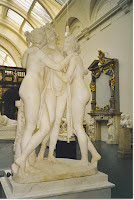
Considered to be the greatest Neoclassical sculptor of the late 18th and 19th centuries, Canova became famous for creating lifelike figures, possessing the ability to make the marble he worked with resemble nude flesh. One of his masterpieces is the group, The Three Graces, now in the Victoria and Albert museum in London.


Canova’s father and grandfather were both stone cutters and his grandfather taught him to draw at an early age.  By the age of 10, living in the care of his grandfather after his father died, he had carved two small shrines in Carrara marble.


The noble Falier family of Venice took an interest in Canova’s talent and brought him to the city at the age of 12 to learn his trade in the workshop of Giuseppe Bernardi, who was also known as Torretto.  He enrolled at the Accademia di Belle Arti di Venezia, where he won a number of prizes.

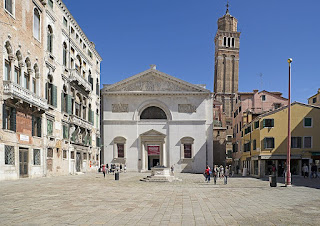
He was commissioned by Giovanni Falier, a senator, to produce statues of Orpheus and Eurydice for the garden at his villa in Asolo, another town in the Veneto.  In 1779, Canova opened his own studio in the Campo San Maurizio in Venice in the San Marco sestiere.

Canova also studied anatomy, history and languages and in 1780 moved to work in Rome, where he studied the work of Michelangelo among others. He opened a studio there there and his first big successes included a sculpture of Theseus and the Minotaur, commissioned by the Venetian ambassador to Rome and now housed at the Victoria and Albert museum in London, and his funerary monument to Clement XIV, which was inaugurated in the Basilica dei Santi Apostoli.

The Campo San Maurizio in Venice, where the young Canova opened his first workshop
The Campo San Maurizio in Venice, where the
young Canova opened his first workshop
He became the most celebrated artist in Europe, acquiring patrons from across the continent. He travelled to France, where he received several commissions from Napoleon Bonaparte, including a statue of the French leader as Mars the Peacemaker, which ultimately fell into the hands of the Duke of Wellington after his victory at the Battle of Waterloo.

He returned to Rome and was appointed Inspector-General of Antiquities and Fine Art of the Papal State, a position formerly held by Raphael. He was charged with restoring the tomb of Servilius Quartus, as part of a project to restore the Appian Way.

In 1816, Pope Pius VII  rewarded Canova with the title of marquis of Ischia after he arranged for the return of Italian art looted by the French. The title came with an annual pension. At the same time he was working on The Three Graces, a sculpture that would be considered one of his finest works.

Completed in 2017, it depicted the daughters of Zeus from Greek mythology, namely Euphrosyne, Aglaea and Thalia, who were meant respectively to represent mirth, elegance and youth or beauty.

The Three Graces at London's V&A
The Three Graces
at London's V&A
His first version, in terracotta, is now in a museum in Lyon. A marble version was made for the Empress Josephine, the estranged wife of Napoleon Bonaparte, which is now in a museum in St Petersburg, Russia.

He was commissioned to make another group of The Three Graces in 1814 for Woburn Abbey by the sixth Duke of Bedford, who visited the sculptor in his workshop in Rome. It is this version that can be seen in the Victoria and Albert museum in London.

Still working but in declining health, Canova died in Venice at the age of 64 and was buried in Tempio Canoviano in Possagno, the town of his birth. Canova’s heart was interred in a marble pyramid he had designed as a mausoleum for the painter, Titian, in the Frari church in Venice.


Canova's heart was buried at the Frari church in Venice
Canova's heart was buried at the
Frari church in Venice
Travel tip:


Canova’s heart is buried in a marble pyramid designed by himself, in the Basilica di Santa Maria Gloriosa dei Frari in Venice. This huge Gothic-style church, the largest in the city, is in the San Polo sestiere. It is one of three notable churches in Venice that still retain their Venetian Gothic appearance. The current edifice, work on which began in around 1340, took more than a century to complete. The Frari, as it is usually known, also houses the tombs of Monteverdi, Rossini and Doge Nicolo Tron as well as works of art by Titian, Bellini and Donatello. The church is open daily from 9.00 to 5.30 pm and on Sundays from 1.00 to 5.30 pm.

Stay in Venice with the help of Expedia


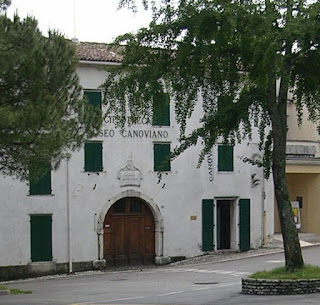
The Gipsoteca Canoviana museum has become a tourist attraction in Possagno
The Gipsoteca Canoviana museum has become
a tourist attraction in Possagno
Travel tip:

Possagno is a small hilltop town in the Veneto region, about 60km (37 miles) northwest of Venice and about 35km (22 miles) northwest of Treviso.  The Tempio Canoviano, a church built in a severe Neoclassical style, with a facade of eight marble columns designed, financed, and in part built by Antonio Canova, has become one of the city's landmarks along with the museum of the Gipsoteca Canoviana, which houses various plaster casts of his most famous works as well as many of his paintings. 

Find accommodation in Possagno with Expedia


(Picture credits: Campo San Maurizio, Frari church by Didier Descouens; The Three Graces by Colin Smith; Possagno museum by Caracas1830 via Wikipedia Commons)