Showing posts with label Mafia. Show all posts

9 August 2026

Antonino Scopelliti – prosecuting magistrate

Shocking killing of judge remains unpunished

Scopelliti was a highly respected and experienced prosecutor who had worked on many major cases
Scopelliti was a highly respected and experienced
prosecutor who had worked on many major cases
The murder of Antonino Scopelliti, a prosecutor in the Italian Supreme Court, is alleged to have been carried out by the ‘Ndrangheta on this day in 1991 in Piale, a frazione of Villa San Giovanni in the region of Calabria.

Scopelliti was thought to have been killed by ’Ndrangheta members who were acting on behalf of the Sicilian Mafia. The 'Ndrangheta is a powerful mafia-type criminal organization, which originated in Calabria in the 19th century. 

The judge was on holiday at the time, visiting his family, when he was ambushed on a road. At the time of his murder, he was preparing to argue the Italian Government’s case against Cosa Nostra - the Sicilian Mafia - in the final appeal in the ‘Maxi Trial’ in the Supreme Court.

It is believed the reason for killing him was to hold up the trial so that the legal terms of detention for the mafia bosses would expire, and they would be freed. The murder has never been solved and therefore no one has been convicted for carrying out the assassination.


Scopelliti was 56 at the time of his death. Born in Campo Calabro, near Reggio Calabria in the south of the region, he had returned to the area where he grew up, to spend his summer holiday away from work. He was killed as he was going home, having enjoyed a day at the seaside.

He had experienced an exceptionally successful career since entering the judiciary at the age of 24, becoming the number one Italian Deputy Prosecutor General at the Court of Cassation, which is the highest court of last resort for criminal matters, and is based in Rome.

Giovanni Falcone attended the funeral held for Scopelliti
Giovanni Falcone attended the
funeral held for Scopelliti
Scopelliti had handled major trials, involving mafia and terrorism. He had represented the prosecution in the Aldo Moro case during the first trial, in the hijacking of the Achille Lauro cruise ship, in the Piazza Fontana massacre, and in the Rapido 904 massacre. 

On the day of his murder, having spent the day at the beach, he was intercepted by his assassins, thought to be two people on a motorcycle, who were stationed by the road along which he was travelling. The ambush occurred at a bend, just before the straight road leading to the town of Campo Calabro. 

The killers shot him with 12-gauge shotguns. Scopelliti was struck by two shots to the head fired in rapid succession and was instantly killed. The car, which went out of control, ended up in an embankment, which is why it was initially thought to have been a road accident. 

When Scopelliti was murdered, he was preparing to reject the appeals filed by the defence lawyers on behalf of the most dangerous mafia members convicted in the first Cosa Nostra maxi-trial. According to 'Ndrangheta informants, it was the Sicilian Mafia that had asked the 'Ndrangheta to kill Scopelliti for them as ‘a favour’.

Two trials for his murder were held at the Court of Reggio Calabria. One was against Salvatore Riina and seven other mafia bosses, and the second was against Bernardo Provenzano and six other bosses. They were all convicted in the first instance, but subsequently acquitted in the Court of Appeal on the grounds of conflicting evidence. 

After years of judicial stalemate, in 2012, during a hearing against the 'Ndrangheta in Reggio Calabria, an informer asserted that the judge's murder was carried out by two men from Reggio Calabria at the request of Cosa Nostra, without, however, naming the alleged killers. 

The murder of Scopelliti has therefore remained unsolved, but the authorities are convinced that he was killed because he was doing his job well and maintaining high standards. He was so well thought of that the judge and prosecutor Giovanni Falcone, who was himself assassinated the following year, attended his funeral to show his respect for him.

Cosa Nostra boss Bernardo Provenzano was suspected of involvement in Scopelliti's murder
Cosa Nostra boss Bernardo Provenzano was
suspected of involvement in Scopelliti's murder
In 2007, Scopelliti’s daughter, Rosanna, established the Ammazzateci Tutti movement (Kill Us All) in his memory, an anti-mafia social movement against the ‘Ndrangheta. Since then, the national anti-mafia meeting, Legalitàlia, has been held every year in Reggio Calabria, on the anniversary of the judge’s murder, promoted by the Ammazzateci Tutti movement and the Scopelliti Foundation. 

The Puglia branch of Ammazzateci Tutti have organised the naming of a street in Bari after Scopelliti.

A garden in Mucinasso, a hamlet in the municipality of Piacenza, and a square in Casalgrande, both in Emilia-Romagna, have also been named in his memory. 

In 2012, the bunker courtroom in Palmi and a square in Polistena, both in Reggio Calabria, were named after Scopelliti. In 2014, a square in Miglierina, in the province of Catanzaro in Calabria, was named after him during the first Legalitàlia Day. 

Last year, 34 years after Scopelliti’s murder, police returned to the scene of the shooting to look for new evidence, following ballistic investigations that had been carried out on the weapon they believed was used to kill the judge.

Today, on the 35th anniversary of the Judge’s killing, the case remains unsolved, but the investigation is still active and ongoing.

Campo Calabro offers extraordinary
views over the Strait of Messina
Travel tip:

Campo Calabro, where Antonino Scopelliti was born, is a municipality in the province of Reggio Calabria in the region of Calabria, located about 110km (68 miles) southwest of Catanzaro, the regional capital, and about 12km (7 miles) north of Reggio Calabria. A street in Campo Calabro, and one in neighbouring Villa San Giovanni have been named after Antonino Scopelliti. The town, which has a population of roughly 4,450 residents, sits 138m (453ft) above sea level, its position on the hills above the Strait Of Messina offering wide sea views, as well as proximity to the foothills of the Aspromonte massif. The beaches at Villa San Giovanni are less than 3km (1.8 miles) away. There is evidence of a Roman settlement in the area, which had strategic importance in the Byzantine and Norman eras. Campo Calabro maintains strong Calabrian southern dialect traditions, with linguistic traces of Greek and Latin. The town’s patron saint, to whom the parish church is dedicated, is Santa Maria Maddalena, whose feast is celebrated on 22 July each year.

Villa San Giovanni hotels from Expedia

Travel tip: 

Reggio Calabria, the largest city in Calabria although not the regional capital, is located on the "toe" of the Italian peninsula and is separated from the island of Sicily by the Strait of Messina. It is situated on the slopes of the Aspromonte, a long, craggy mountain range that runs up through the centre of the region. Since 2007, the national anti-mafia meeting "Legalitàlia" has been held annually in Reggio Calabria on the anniversary of Scopelliti’s murder, promoted by the Ammazzateci Tutti movement and the Scopelliti Foundation.  The city is also the oldest city in Calabria, the most important in what became known as Magna Graecia - Great Greece - after settlers began to arrive in the eighth century BC.  Much of its heritage was destroyed in the massive earthquake that struck the area in 1908, killing at least 25,000 residents. The rebuilt city, which suffered again at the hands of the Allies in World War Two, is notable for its fine Liberty buildings and its linear plan.  The best of what could be salvaged of the Greek remains after the earthquake can be seen in the National Archaeological Museum of Magna Graecia, housed in Palazzo Piacentini. Reggio Calabria's seafront promenade, Lungomare Falcomatà, is  regarded as one of the most beautiful in Italy.

Stay in Reggio Calabria with Hotels.com

More reading:

Giovanni Falcone, the street kid from Palermo who became an anti-Mafia crusader

Paolo Borsellino, the judge who was murdered 57 days after colleague and friend Giovanni Falcone 

Bernardo Provenzano, Mafia boss who evaded police for 43 years

Also on this day:

1173: Work starts the Pisa bell tower that would become world famous

1919: The birth of painter Emilio Vedova

1939: The birth of politician Romano Prodi

1973: The birth of footballer and coach Filippo Inzaghi


Home


1 September 2024

Michele Giuttari – crime writer and police officer

Cop-turned-novelist with inside knowledge of police investigations

Michele Giuttari's novels draw on his experience as a high-ranking Italian police officer
Michele Giuttari's novels draw on his experience
as a high-ranking Italian police officer
Michele Giuttari, who headed the police in Florence and used his experience working on investigations into Mafia activities and dangerous criminals to become a successful crime writer, was born on this day in 1950 in Novara di Sicilia, a village in the province of Messina in Sicily.

After studying for a degree in Jurisprudence at the University of Messina, Giuttari qualified as a lawyer. He joined the Polizia di Stato as a commissario in 1978 and later rose through the ranks to take charge of the Florentine police between 1995 and 2003.

Giuttari first served in Calabria, where he held positions in the Squadra Mobile of Reggio Calabria and Cosenza. He then joined the Anti-Mafia investigation department and served first in Naples and then in Florence, where he became head of the Judicial Investigation section, and succeeded in jailing several key Mafia figures.

During his time in command of the Squadra Mobile in Florence, Giuttari was responsible for reopening the Monster of Florence case and proving that the so-called monster was not simply a lone serial killer but was, in fact, a group of killers.

After retiring from serving in the Polizia di Stato, Giuttari started crime writing and has now written a series of novels featuring his character, Commissario Michele Ferrara, the latest, entitled Sangue sul Chianti (Blood on Chianti), having been published in 2021.

Seven novels in the Ferrara series have been published in English, the first of which - entitled A Florentine Death - will fascinate readers who are interested in learning about the methods or seeing into the minds of the Italian police. The book had been published in Italy under the title Scarabeo.

Michele Giuttari has made many appearances on television in Italy to talk about his life and work
Michele Giuttari has made many appearances on
television in Italy to talk about his life and work
The hero, Commissario Ferrara - the equivalent of Chief Superintendent in the English police - is the head of the Squadra Mobile in Florence, about which Giuttari can write with authority. He can describe what really happens in  murder investigations, interviewing suspects, and organising armed police operations.

As well as providing an authentic account of police procedure in a multiple murder investigation, Giuttari delivers a cleverly plotted mystery that becomes increasingly more gripping as it reaches its dramatic conclusion.

A Death in Tuscany, the second Commissario Ferrara novel published in English, is also fascinating because it offers even more glimpses behind the scenes of an Italian police station and gives the readers the feeling that they are on the inside of a major police investigation.

In this novel, the reader finds out more about the man behind the job title and about his earlier life in Sicily.

Ferrara finds he is up against the Mafia as well as ruthless drugs bosses, and even his own Commissioner, who is enraged both by his unorthodox behaviour during the investigation and because he has fallen foul of the Carabinieri, pressures Giuttari himself has obviously experienced at times during his career.

The Death of a Mafia Don is available in English
The Death of a Mafia Don
is available in English  
The next in the series - The Death of a Mafia Don - starts with a bomb exploding near Commissario Ferrara’s car in the centre of Florence, leaving the head of the Squadra Mobile injured. There is an urgent need to find out who was responsible to prevent further atrocities, but with Ferrara  unconscious and in hospital, his loyal colleagues are forced to start the investigation without him.

This is a fast moving novel about terrorism and Mafia activity in Italy seen from the perspective of the security forces. It shows the way the police and the Carabinieri often work together and there is a realistic portrait of Florence as the backdrop for the action.

Former policeman Giuttari has now achieved international success with his crime novels, which have been published in more than 100 countries, and he has won several literary awards, including the Fenice Europa for La Loggia degli Innocenti and the Camaiore Letteratura Gialla for Il Basilisco.

In a film made about the Monster of Florence murders, the character of Giuttari was played by the actor Giorgio Colangeli.

A typical street in historic Novara di Sicilia
A typical street in historic
Novara di Sicilia
Travel tip:

Situated about 70km (43 miles) southwest of Messina in the northeastern corner of Sicily, Michele Guittari’s beautiful home village of Novara di Sicilia is rich in history and traditions. Built on a hillside at the point where the Nebrodi mountains meet the Peloritani range, it was founded and inhabited by Greeks, then by Romans and Arabs and later conquered by the Normans. The remains of a Norman castle can be found near the Chiesa di San Giorgio. In the village’s historic centre, the Duomo di Santa Maria Assunta, built in the 16th century, has a sandstone façade typical of the area, with a wide staircase leading to an essentially Renaissance interior. Just 5km (3.5 miles) from the centre of the village is the Abbazia di Santa Maria, which dates back to the 12th century and is said to be the best example of a Cistercian building in Sicily. 

Search accommodation in Novara di Sicilia with Hotels.com


The Cattedrale di Santa Maria Assunta - Cosenza's duomo - lies at the heart of the mediaeval city
The Cattedrale di Santa Maria Assunta - Cosenza's
duomo - lies at the heart of the mediaeval city
Travel tip:

Calabria is a part of Italy which did not traditionally attract large numbers of overseas tourists but is becoming more popular thanks to beautiful coastal towns and villages such as Tropea, San Nicola Arcella and Pizzo, while the inland city of Cosenza - where Michele Giuttari once worked - has been described as epitomising the “unkempt charm of southern Italy” with a history that can be traced back to the third century, when there was a settlement called Consentia, the capital of the Brutti tribe. Over subsequent years, the area was captured by the Visigoths, the Lombards, the Saracens, the Normans and the Spanish before the Risorgimento and unification saw it become part of the new Italy.  At the heart of the mediaeval old city, with its network of steep, narrow streets, is a cathedral originally built in the 11th century and modified many times subsequently.  The old town also boasts the 13th century Castello Svevo, built on the site of a Saracen fortification, which hosted the wedding of Louis III of Naples and Margaret of Savoy,  but which the Bourbons used as a prison.

Hotels in Cosenza from Expedia

Also on this day:

1576: The birth of Cardinal and art collector Scipione Borghese

1878: The birth of conductor Tullio Serafin

1886: The birth of vaudeville star Guido Deiro 

1922: The birth of actor Vittorio Gassman


Home


2 May 2024

Giuseppe Morello - gangster

Sicilian established first New York crime ‘family’

Morello was known as 'the claw' because of a deformed right hand
Morello was known as 'the claw'
because of a deformed right hand
The Mafia boss Giuseppe Morello, who is credited with building the first of the New York gangs to be known as a crime ‘family’, was born on this day in 1867 in the notorious Sicilian crime stronghold of Corleone, a small town in a mountainous area 50km (31 miles) inland from the island’s capital, Palermo.

Morello had a deformed right hand with a single finger that was always bent, on account of which he became known as Joe l’artiglio - Joe ‘the claw’.

Along with three half-brothers, Morello established the 107th Street Mob in the East Harlem district of Manhattan in the late 1890s, a time when it had a substantial Italian population. The gang is recognised as the organisation that would eventually evolve into the Genovese crime family, the oldest of the New York Mafia’s so-called Five Families.

Also known as Piddu, a Sicilian diminutive of Giuseppe, and sometimes Peter among other names, Morello is thought to have been brought up among the criminal underworld in Sicily on account of his widowed mother, Angelina, marrying Bernardo Terranova, a prominent member of the Corleonesi Mafia.

Giuseppe was only six years old at the time but when he reached maturity, he and his half-brothers, Vincenzo, Ciro and Nicolò, began to take part in Mafia activity.

The young Morello is thought to have emigrated to the United States in around 1892 to escape imprisonment in Sicily after a counterfeiting operation he was running had been exposed. He was also suspected of killing a witness to a murder in Corleone.

He settled initially in the south, taking labourer’s work on sugar cane plantations in Louisiana and cotton plantations in Texas, where he was later joined by other members of his family, including his mother and stepfather, his Sicilian wife, Rosa, and their son, Calogero.

East Harlem in the early 1900s was an area of New York with a large Italian community
East Harlem in the early 1900s was an area of
New York with a large Italian community
In 1897 Morello moved to New York, accompanied at first by Vincenzo, Ciro and Nicolò. Known as the East 107th Street Mob, they began extorting money from local businesses.

They established links with other criminals, notably another Corleonesi, Ignazio ‘the Wolf’ Lupo, the Mafia boss in Little Italy, Manhattan, who would later marry Morello's half sister, Salvatrice, and Vito Cascio Ferro, a Sicilian with connections to the notorious Black Hand gangsters who terrorised the Little Italy neighbourhood.

As the Morello crime family grew, their rackets extended to loan sharking, fake Italian lottery tickets and robbery and their territory expanded to other parts of Manhattan and The Bronx. They were the first criminal organisation in New York to develop sophisticated money laundering methods through legitimate businesses such as stores and restaurants. 

They also introduced the practice of extorting small amounts of money each week from business owners in exchange for "protection" rather than taking large sums that would put them out of business. 

The Morello gang maintained their grip by dealing ruthlessly with anyone who crossed them or tried to stand up to them. Lupo, his main enforcer, was said to be responsible for more than 60 murders in a 10-year period, often disposing of victims by forcing their dismembered corpses in large wooden barrels, which would then be dumped the sea, left on street corners or in back alleys, or shipped to other cities with labels carrying addresses that did not exist.

Ignazio Lupo was Morello's ruthless enforcer
Ignazio Lupo was Morello's
ruthless enforcer
In 1903, the group began a major counterfeiting ring. Cascio Ferro, known as Don Vito, printed $5 bills in Sicily and smuggled them into the United States.  By 1905, Morello had created the largest, most influential Sicilian crime family in New York City and was recognised as capo di tutti capi (boss of bosses) by other Mafia leaders.

It was Vito Cascio Ferro who is thought to have murdered the New York police detective Joe Petrosino in Palermo in 1909, in revenge for an investigation that ultimately saw Morello and Lupo jailed. 

Morello and Lupo were both released after serving only nine years of their sentences but emerged to find the New York crime scene dominated by conflicts between rival gangs.

Nicolò, the youngest of his three-half brothers, had taken control of Morello activities but in 1916 was killed by the Neapolitan boss in Brooklyn, Pellegrino Morano, as part of the Mafia-Camorra War.

Morello found himself under threat from Salvatore D’Aquila, his former lieutenant, who was now a boss himself and ordered Morello killed.

Morello fled to Sicily, where - thanks to his chief ally, Giuseppe Masseria - he foiled a plot to kill him in Sicily and returned to New York, becoming consigliere to Masseria, with whom he enjoyed some prosperity throughout the Prohibition years of the 1920s.

However, during the so-called Castellammarese War, between 1930 and 1931, in which Masseria and Morello fought against a rival group based in Brooklyn, led by Salvatore Maranzano and Joseph Bonanno, Morello was killed on August 15, 1930, while collecting cash receipts in his East Harlem office, his murderer almost certainly acting on the orders of Maranzano.

Masseria himself was killed the following year, shot dead in a restaurant in Brooklyn, the victim of a plot by some ambitious mobsters he had recruited himself but who now turned against him, including Charles ‘Lucky’ Luciano, Joe Adonis, Vito Genovese and Albert Anastasia, all of whom would go on to become powerful Mafia figures in their own right. Luciano took control of Morello-Masseria operations and the organisation was known as the Luciano family from 1931 until 1957, when power shifted to Genovese.

The church of San Domenico in one of the most
historic Corleone streets, Via XXIV Maggio

Travel tip:

Corleone, a town of around 12,000 inhabitants in the province of Palermo, was once dominated by Arabs before falling into the hands of the Normans.  Its strategic position overlooking the main routes between Palermo and Agrigento meant it was on the frontline in many wars.  At one time the town had two castles and was encircled by a defensive wall.  Its association with the Mafia began in the 1960s following the outbreak of violence that followed the killing of clan boss Michele Navarra. The link was solidified when author Mario Puzo decided his main character in The Godfather would be known as Vito Corleone after a United States immigration official processing the arrival of Vito Andolini mistook his place of origin for his surname. In fact, several real life Mafia bosses, including Tommy Gagliano, Gaetano Reina, Jack Dragna, Luciano Leggio, Leoluca Bagarella, Salvatore Riina and Bernardo Provenzano, came from Corleone and the Corleonesi clan dominated the Sicilian Mafia in the 1980s and 1990s, when they were seen as the most violent and ruthless group ever to take control.

Palermo's majestic Cathedral of the Assumption of the Virgin Mary has many architectural influences
Palermo's majestic Cathedral of the Assumption of
the Virgin Mary has many architectural elements
Travel tip:

Although Palermo’s reputation has suffered at times because of the Mafia’s presence, visitors to Sicily’s capital these days would normally witness nothing to suggest that the criminal underworld exerts any influence on daily life.  Situated on the northern coast of the island, Palermo is a vibrant city with a wealth of beautiful architecture bearing testament to a history of northern European and Arabian influences.  The church of San Cataldo on Piazza Bellini is a good example of the fusion of Norman and Arabic architectural styles, having a bell tower typical of those common in northern France but with three spherical red domes on the roof, while the city’s majestic Cathedral of the Assumption of Virgin Mary includes Norman, Moorish, Gothic, Baroque and Neoclassical elements. Palermo’s opera house, the Teatro Massimo, is the largest in Italy and the third biggest in Europe.

Also on this day:

1660: The birth of Baroque composer Alessandro Scarlatti

1894: The birth of architect Michele Busiri Vici

1913: The birth of car designer Pietro Frua

1930: The birth of campaigning politician Marco Pannella


Home

25 January 2024

Giangiacomo Ciaccio Montalto - magistrate

Brave investigator murdered by the Sicilian Mafia

Onlookers gather round Ciaccio Montalto's car the day after the magistrate was killed
Onlookers gather round Ciaccio Montalto's car
the day after the magistrate was killed
The magistrate Giangiacomo Ciaccio Montalto was assassinated by Mafia gunmen in Valderice, a small town near the Sicilian city of Trapani, on this day in 1983.

Ciaccio Montalto, a state prosecutor who had been involved in every major organised crime investigation in western Sicily over the previous 12 years, was a short distance from his home in the early hours of the morning when his Volkswagen Golf was forced off the road.

Three men armed with machine guns and pistols opened fire, hitting Ciaccio Montalto multiple times, leaving his bullet-ridden body slumped in the driver’s seat. Used to hearing gunshots, none of the nearby residents ventured out to see what had happened and it was not until 7.15am that a passing carabinieri patrol came across the car and discovered the magistrate’s body. He was 41 years old.

The VW’s clock, which police believed stopped working because of the damage to the car, was showing 1.12am, which suggested that Ciaccio Montalto had been dead for just over six hours.

Ciaccio Montalto was an Italian magistrate who was a public prosecutor in Trapani, known for his investigations into the Mafia’s involvement in drug trafficking and their links to the local business and banking community and politicians.

Ciaccio Montalto's work was dedicated to fighting the Mafia in Trapani
Ciaccio Montalto was a formidable
adversary of the Trapani Mafia
He had played a part in every major Mafia investigation in the western part of the island since 1971. 

Speculation linked his killing either to an investigation in 1982 that led to arrest warrants being issued for 40 Mafia members and businessmen in the Trapani area, or to the arrest of two leading politicians - a regional Liberal party secretary and a noted member of the Republican party - on charges of granting illegal building contracts to Mafia figures. 

His death did not have the same impact as the slaying of Giovanni Falcone and Paolo Borsellino almost a decade later, but was nonetheless a severe blow for the fight against the Mafia in Sicily, robbing the judiciary of a courageous and dedicated magistrate.

It was the Mafia's second major strike against the Italian state in just a few months following the killing of the carabinieri chief General Carlo Alberto Dalla Chiesa and his wife in Palermo the previous September. 

Ciaccio Montalto was born into a family of legal professionals. His father, Enrico, was a judge in the Court of Cassation, and his grandfather, Giacomo Montalto, a notary and former mayor of Erice, an historic hill town in Trapani province. Giangiacomo’s younger brother, Enrico, was a political activist who died in a car accident at the age of 22.

Although he was born in Milan, Ciaccio Montalto soon dedicated himself to the fight against crime in the city of his roots. He returned to Sicily in 1971, a year after beginning his legal career in the north, and rapidly rose to the level of Deputy Prosecutor of the Republic of Trapani.

Among the high-profile investigations he led was one into the so-called “Marsala monster” that ended with Michele Vinci, who was convicted of kidnapping three girls, including his niece, and leaving them to die in a well, being sentenced to 28 years in jail. 

Ciaccio Montalto was due to be transferred to Florence
Ciaccio Montalto was due to be
transferred to Florence
He also broke new ground during an investigation into the involvement of the mafiosi of the province of Trapani in drug trafficking and their links with the business and banking world of Trapani. He was one of the first magistrates to use asset tracing to follow the flow of “dirty money” after becoming convinced that money being laundered through Trapani’s banks was being used to fund a clandestine laboratory for the production of drugs in the Trapani area.

And thanks to Ciaccio Montalto’s work, the Minore brothers, a Mafia clan who controlled Trapani from the 1950s to the late ‘70s and were heavily involved in drug dealing and arms trafficking, as well as being suspected of carrying out many murders, were effectively driven out of the area, brothers Antonino - known as ‘Totò’ - Calogero, Giuseppe and Giacomo being forced to live as fugitives after the magistrate issued an arrest warrant for Totò Minore in 1979 for weapons trafficking. 

Ciaccio Montalto was realistic enough to know his success would put his own safety under threat. Soon after the 40 Mafia members and entrepreneurs he ordered to be arrested in 1982 were released due to lack of evidence, a black cross was painted on the bonnet of the car in which he would ultimately be killed. Unlike some high-profile investigators in the long fight against the Cosa Nostra, he did not have the security of an armour-plated vehicle or a police escort.

Disappointed with the result of that investigation and others, Ciaccio Montalto asked for a transfer to Florence, hoping to investigate the activities of an enclave of Trapani mafiosi who had settled there. The request was granted, but he was killed before it could happen.

Initial investigations into Ciaccio Montalto’s death pointed towards the Minore clan.  Salvatore Minore, in fact, was sentenced to life imprisonment in absentia for ordering the killing and two mafiosi for carrying it out, although all three were later acquitted by an appeal court. It was later discovered that Minore himself had been killed a year before Ciaccio Montalto.

Ultimately, on the basis of evidence provided by new witnesses and Mafia informers, the killing was attributed to the notorious Corleonesi mobster Salvatore ‘Totò’ Riina, who was seen as the capo di tutti capi - boss of all bosses - on Sicily, along with another leading mob figure, Mariano Agate. Riina, by then already in jail serving several life sentences, was handed another, along with Agate. Two corrupt lawyers, one of whom tipped off Riina after learning of Ciaccio Montalto’s intention to tackle the Trapani gangs in Florence, were acquitted on the grounds of unreliable testimony.

Ciaccio Montalto was granted a state funeral, conducted by the bishop of Trapani, Monsignor Emanuele Romano, at the cathedral of San Lorenzo, where 20,000 people gathered outside.

He was survived by his wife, Marisa La Torre, who would later be appointed deputy mayor of Trapani, and their three daughters Maria Irene, Elena and Silvia. 

The territory of Valderice includes mountain scenary and a sweep of coastline
The territory of Valderice includes mountain
scenary and a sweep of coastline 
Travel tip: 

The small town of Valderice, where Giangiacomo Ciaccio Montalto lived and sadly died while investigating crimes in Trapani province, has gone under that name only since 1958. It was previously known as Paparella but was renamed following the division of the Monte San Giuliano municipal area. Valderice, which is 8km (five miles) northeast of Trapani and about 95km (60 miles) west of Palermo, includes several scenic areas such as the stunning Zingaro Nature Reserve with its 7km of wild cliff top walks and the remains of a stone age settlement, and three beach areas: Bonagia, Lido Valderice and Rio Forgia.  In the town, the churches of Santa Maria della Misericordia, built in 1637, and Sant’Andrea Apostolo are among the oldest in the area. The Molino Excelsior is an old mill now converted to the Centro di Cultura Gastronomica, which every year provides gastronomic events, workshops and lessons to promote local customs and traditions. 

Erice is one of Sicily's most beautiful towns with an abundance of picturesque narrow streets
Erice is one of Sicily's most beautiful towns with
an abundance of picturesque narrow streets
Travel tip:

Dating back 3,000 years, Erice is one of Sicily’s most beautiful towns, a mediaeval gem that nestles some 2,464 feet above the sea, surrounded by vineyards in the mountains behind Trapani.  It is a fortified town with charming, narrow streets, echoing with history and blessed with a pace of life from a different age. Erice is watched over by an impressive 12th-13th century Norman castle, the Castello di Venere, where visitors can stroll around the grassy interior courtyard, flanked by an impressive stone wall allegedly built by Daedalus, the architect of Greek mythology. The castle offers spectacular panoramic views.  Erice has many churches and chapels, including the Norman-style church of San Martino, the church of Sant’Albertino degli Abbati and Chiesa Madre, dedicated to Santa Maria Assunta, with its quadrangular bell tower. One of the most attractive parts of Erice is the Spanish quarter, said to have been built in the period of Spanish domination to house Spanish soldiers, a requirement for every Sicilian city.

Also on this day:

1348: The Friuli earthquake

1755: The birth of physician Paolo Mascagni

1852: The birth of explorer Pierre Savorgnan de Brazza

1866: The birth of operatic baritone Antonio Scotti

1982: The birth of singer-songwriter Noemi


Home


6 January 2023

Piersanti Mattarella - assassination victim

President’s brother assumed to have been killed by Mafia

A newspaper front page reports the murder of the politician amid claims of terrorist involvement
A newspaper front page reports the murder of the
politician amid claims of terrorist involvement
The politician Piersanti Mattarella, whose brother, Sergio, is the current President of Italy, was shot dead on this day in 1980.

The 44-year-old Christian Democrat, who was president of the regional government of Sicily, was about to drive to Epiphany mass from his home in Via della Libertà in Palermo when a gunman or gunmen appeared at the side of his car.

Mattarella was shot at point blank range in front of his wife, Irma, their daughter Maria, and his wife’s mother, who were passengers in his Fiat 132. Sergio, at that time a lecturer at the University of Palermo, was called by his nephew, Bernardo, who had not been in the car. He was one of the first on the scene after the shooting and took his brother to hospital. His efforts were in vain; Piersanti was already dead.

Yet the identity of his killers was never established and doubts surrounding the motives for the attack never completely removed.

There was every reason to suspect Piersanti had been the victim of a Mafia assassination because of his drive to clean up political corruption on the island. His ambition was to break the cosy relationships the Mafia enjoyed with too many politicians, mostly in his own party. 

Piersanti had vowed to clean
up corruption in Sicily
His late father, also called Bernardo, who served as a government minister on the mainland in six administrations between 1953 and 1963, was himself accused on more than once occasion of having links with the Cosa Nostra, although none was ever proved.

Piersanti was aware that public works contracts inevitably went to Mafia-linked companies. He passed a law forcing Silician contractors to adhere to the same building standards used in the rest of Italy, which had the effect of making many of the Mafia's building schemes illegal.

But shortly after the murder had taken place, a claim for responsibility was reportedly made on behalf of a right-wing terrorist group, Nuclei Armati Rivoluzionari, which later in the year would be blamed for the worst terrorist atrocity in Italian history, the bombing of Bologna railway station, which killed 85 people.

Vehemently anti-communist, NAR might have had a credible motive, too. Mattarella had been an admirer of Aldo Moro, the politician who had been a central figure in the so-called Historic Compromise that brought about a political accommodation between the Christian Democrats and the Italian Communist Party (PCI) in the 1970s. Moro was kidnapped and killed in 1978.

Mattarella had sought and gained support from the PCI in Sicily when, as newly elected president in 1978, he sought to govern as head of a centre-left coalition. Although the role of the PCI was at that time external, their involvement in any form was viewed in Sicily, as on the mainland, as a step closer to direct participation in government, which those on the far right in Italian politics were determined to prevent.

Mattarella's Fiat 132 car, its windows blown out by gunshots, at the side of Via della Libertà
Mattarella's Fiat 132 car, its windows blown
out by gunshots, at the side of Via della Libertà
It was this hypothesis that formed the basis of an investigation into the killing by Giovanni Falcone, the anti-Mafia magistrate who would himself be murdered in 1992. He concluded that the killing of Piersanti Mattarella was carried out by Giuseppe Valerio Fioravanti and Gilberto Cavallini, two prominent NAR operatives.

Fioravanti, more often known as Giusva, was in Palermo at the time and his description matched that provided by Irma Mattarella, Piersanti’s widow, of one of the two involved in the attack.

But when, in 1995, Fioravanti and Cavallini eventually came to court to face charges, they were both acquitted for lack of evidence.

Meanwhile, during the 1993 trial of former prime minister Giulio Andreotti over alleged Mafia associations, a Mafia pentito - turncoat - by the name of Francesco Marino Mannoia, named four mafiosi - Salvatore Federico, Francesco Davì, Santo Inzerillo and Antonio Rotolo - as the killers, and pointed the finger at the 10 members of the Sicilian Mafia Commission, which purported to control criminal activity on the island, for ordering the murder. Andreotti, Mannoia said, had privately appealed to Mafia bosses not to kill Mattarella.

However, although all the members of the Commission, including the notoriously ruthless Salvatore ‘Toto’ Riina (whose elevation to capo di tutti capi - boss of all bosses - on the island began a bloody campaign to eliminate high-profile opponents), were convicted of the murder in 1995, Mannoia’s evidence was considered unreliable and none of the alleged physical killers was convicted.

Speculation remains that both the Mafia and the NAR were involved, with the latter perhaps carrying out the assassination on behalf of the mob in return for money or favours. But the theory remains unproven.

Sergio Mattarella, who was elected President of the Italian Republic for the first time in 2015 and re-elected in 2022, has said he decided to enter politics after his brother’s assassination, having previously been content with his career as a lawyer and academic. 

A memorial was placed close to the spot where Piersanti Matterella was killed
A memorial was placed close to the spot
where Piersanti Matterella was killed 
Travel tip:

Via della Libertà, where Piersanti Mattarella lived, is a long, straight road in the centre of Palermo, the Sicilian capital, linking the junction of Viale della Croce Rossa and Viale Diana with Via Dante. Stretching for just over 2.5km (1.2 miles), it passes the Parco Piersanti Mattarella, formerly called the Giardino Inglese, an area of gardens that dates back to 1851 and has been subsequently renamed in memory of the former politician. A memorial to Mattarella has been mounted at the side of the road close to his former home. Flowers are placed there at a ceremony each year on the anniversary of his death.

The harbour at Castellammare del Golfo, where Piersanti Mattarella was born
The harbour at Castellammare del Golfo,
where Piersanti Mattarella was born
Travel tip:

Castellammare del Golfo, where Piersanti Mattarella was born, is a fishing town and tourist resort in the province of Trapani on the northern coast of Sicily, about 65km (40 miles) by the coast road to the west of Palermo. Although Mattarella was on the side of law and order, the town is noted for having been the birthplace of many American Mafia figures, including Salvatore Maranzano, Stefano Magaddino, Vito Bonventre, John Tartamella and Joseph Bonanno. It takes its name from its castle overlooking a gulf, which dates back to the Arab occupation of Sicily in the ninth century and was fortified by the Normans in the 11th century. It originally sat right on the edge of the gulf at sea level, surrounded by water and connected to the land by a drawbridge.

Also on this day:

1695: The birth of oboe player Giuseppe Sammartini

1819: The birth of painter Baldassare Verazzi

1907: The first Montessori school opens in Rome

1938: The birth of singer Adriano Celentano

2016: The death of actress Silvana Pampanini

Befana - Italy’s 6 January tradition


Home


16 September 2022

Sette e mezzo: The Palermo revolt of 1866

Insurgents took control of city after a major uprising 

Sicily had seen previous uprisings in the 19th century, such as this depicted in 1860 during the unification campaign
Sicily had seen previous uprisings in the 19th century,
such as this depicted in 1860 during the unification campaign
The Sette e mezzo revolt - so named because it lasted seven and a half days - began in Palermo, the capital of Sicily, on this day in 1866.

The uprising - five years after the island became part of the new Kingdom of Italy - brought to the surface the tensions that existed in southern Italy following the Risorgimento movement and unification.

It was put down harshly by the new government of Italy, who laid siege to the city of Palermo, deploying more than 40,000 soldiers under the command of General Raffaele Cadorna.

It is not known exactly how many Sicilians were killed before the revolt was subdued. Several thousand died as a result of a cholera outbreak that swept through Palermo and the surrounding area, but it is thought that more than 1,000 may have been killed as a direct consequence of the siege.

Sicily did not take well to the imposition of a national government, bringing with it plans to modernise the traditional economy and political system. New laws and taxes and the introduction of compulsory military service caused resentment. There was a feeling also that the industrialisation of Italy was too heavily concentrated in the north, with little investment being made in the south.

Government officials installed in new municipal offices were almost exclusively from the north and many seemed to regard Sicilians almost as barbarians.

General Raffaele Cadorna led the troops who were ordered to crush the revolt
General Raffaele Cadorna led the troops
who were ordered to crush the revolt
The local ruling elites frequently tried to undermine attempts by the national government to establish a police force and a liberal justice system and from 1861 onwards there were a series of small uprisings, often encouraged by local brigands who feared for the future of their own criminally acquired wealth.

On the morning of September 16, 1866, however, something much bigger and organised took place, with thousands of people from villages around Palermo gathering at the edge of the city, under the command of some of the island’s disenfranchised former political leaders.

Many were armed, some as the result of storming small government army garrisons. More than 4,000 attacked the prefecture and police headquarters, killing the inspector general of the Public Security Guard Corps. 

Similar violence took place in neighbouring towns as word of the Palermo uprising spread, including Monreale, Altofonte and Misilmeri. It is thought that there were possibly as many as 35,000 insurgents in Palermo and its province.

On September 22, seven and a half days after the rioters had begun to mobilise around Palermo, the fighting ceased.  The rioters had control of the city and the organised nature of their campaign became clear when a Revolutionary Committee was formed. The secretary was Francesco Bonafede, a follower of the northern revolutionary, Giuseppe Mazzini, and its membership included many figures from the traditional Sicilian aristocracy, including princes, barons and even clergymen, among them the Archbishop of Monreale, Monsignor Benedetto Purchase.

Yet the response of the new national government was uncompromising. On September 27, ships of the Italian Royal Navy bombarded Palermo, destroying the homes of hundreds of citizens, after which the cholera outbreak only accelerated, eventually claiming almost 4,000 victims.

Bandit groups were blamed for stirring up anti-government sentiments
Bandit groups were blamed for stirring
up anti-government sentiments
The  bombardment paved the way for 40,000 troops to be landed in the city, a force ultimately too powerful for the insurgents. House-to-house fighting destroyed still more buildings and rioters were rounded up and summarily executed. Almost 2,500 citizens were arrested, although fewer than 200 were ultimately convicted.

Army casualties were put at just over 200, along with 42 policemen. The number of insurgents killed is unknown and the estimated figure of 1,000 is probably an under-estimate.

Although this uprising was ultimately quelled, Sicily’s problems did not go away. Outbreaks of less organised violence continued, often blamed on local bandits, and the island’s economic difficulties led to increased emigration, particularly to the United States. Left-wing political groups gained popularity.

Yet Italy’s politicians on the mainland never effectively dealt with the economic imbalance between the north and south and this can be blamed, along with the dismantling of the traditional structures of society, for the growth and influence of organised crime in the shape of the Sicilian Mafia, as well as the Camorra in Naples and its surrounds, the ‘Ndrangheta in Calabria and other groups.

Palermo's magnificent Cathedral of the  Assumption of the Virgin Mary
Palermo's magnificent Cathedral of the 
Assumption of the Virgin Mary
Travel tip:

Although Palermo has long been associated with the Mafia and organised crime, visitors to the city would normally witness nothing to suggest that the criminal underworld has any influence on daily life.  The Sicilian capital, on the northern coast of the island, is a vibrant city with a wealth of beautiful architecture bearing testament to a history of northern European and Arabian influences.  The church of San Cataldo on Piazza Bellini is a good example of the fusion of Norman and Arabic architectural styles, having a bell tower typical of those common in northern France but with three spherical red domes on the roof, while the city’s majestic Cathedral of the Assumption of Virgin Mary includes Norman, Moorish, Gothic, Baroque and Neoclassical elements. Palermo’s opera house, the Teatro Massimo is the largest in Italy and the third biggest in Europe.

The Cathedral of Santa Maria Nuova at Monreale is described as the finest Norman building in Sicily
The Cathedral of Santa Maria Nuova at Monreale
is described as the finest Norman building in Sicily
Travel tip:

Monreale, which was also the scene of an uprising in 1866,  is an historic hill town about 12km (7 miles) west of Palermo. Its Cathedral of Santa Maria Nuova and the adjoining cloisters have been described as the finest Norman buildings in Sicily, its extravagant features in part down to the competition with Palermo to build the island’s greatest cathedral. The buildings have their origin in the 12th century, commissioned by the Norman ruler William II. Mosaic making is still taught in Monreale today, with many workshops around the town. The local cuisine is a mix of traditional Sicilian and cookery of Arab origins. 

Also on this day:

1797: The birth of Sir Anthony Panizzi, librarian at the British Museum

1841: The birth of revolutionary politician Alessandro Fortis

2005: The arrest of Camorra boss Paolo di Lauro


Home


28 March 2022

Vincenzo Capone - prohibition agent

'War hero'-turned-lawman hid his family identity

When Vincenzo Capone became a town marshal in Nebraska, he called himself Richard James Hart
When Vincenzo Capone became a town marshal
in Nebraska, he called himself Richard James Hart
Vincenzo Capone, older brother of the notorious mobster Al Capone, was born on this day in 1892 in Angri, a town in Campania located between Salerno and Naples.

While Al drifted into crime as a teenager, Vincenzo wanted a different life. After running away to join a circus, he changed his name and invented a new background to conceal his true identity. He acquired a reputation as a war hero before forging a career in law enforcement, notably pitting himself against the criminal gangs of his brother’s world as an agent for the Bureau of Prohibition.

The first in a family of nine children, Vincenzo had just one sibling, his brother Ralph, when his father, Gabriele, a barber, and his mother, Teresa, emigrated to the United States in 1895. His father continued to work as a hairdresser, while Teresa’s skills as a seamstress enabled her to find a job. They settled in Brooklyn.

Over the years that followed, the family grew and Vincenzo and Ralph were joined by Frank, Alphonse, Ermina, John, Albert, Matthew and Mafalda. Sadly, Ermina did not survive her infancy.

As they grew up, most of his younger brothers became involved with petty crime. By contrast, Vincenzo, who had already adopted James as his “American” first name and would often take the ferry to Staten Island, where the fields and woods offered an escape from the overcrowded streets of the city. 

As a lawman, Capone modelled
himself on William "Two Gun" Hart
He offered to help out in stables and learned to ride horses. His father secured a job for him there after witnessing his son’s fascination with Buffalo Bill Cody and the Wild West Shows that were popular at the time.

It may have been his fascination with the wild west that led to his decision at the age of 16 to run away from home. It has been speculated that Alphonse, who was eight at the time, wanted to go with him but that Vincenzo told him to go home. The family knew nothing about where he had gone until a letter arrived from Vincenzo a year later, saying he was in Kansas, travelling with a circus.

The author Jeff McArthur, who wrote a book about Vincenzo, says that he joined the Miller Brothers Ranch Wild West Show and called himself James Hart, which is thought to have reflected his admiration for the silent movie actor William S Hart, who often starred in Westerns. He worked to shed his Brooklyn accent and explained away his swarthy southern Italian skin colour by claiming he was half American Indian.

His determination to adopt a new identity was confirmed when he joined the military under the name Richard James Hart, insisting he was born in Indiana and had worked as a farmer.  

Accounts vary of his time in service.  Some say that he fought in France in World War One, achieved the rank of lieutenant, was made a military policeman and was awarded a Distinguished Service Cross for ‘extraordinary heroism in action’. However, another story says that he joined the veterans organisation the American Legion after the war was over but was later expelled when it was found that the Department of the Army had no record of any war service. 

Al Capone - Vincenzo's younger brother - was head of the Chicago crime syndicate
Al Capone - Vincenzo's younger brother -
was head of the Chicago crime syndicate
Regardless of which version is true, Capone returned to America and changed his name legally to Richard James Hart. He married Kathleen Winch in 1919, and they had four sons, Richard, William, Sherman, and Harry. They made their home in Homer, Nebraska, where he became a town marshal and soon afterwards a federal prohibition agent. 

He was among the more eccentric agents. Mimicking the persona of his hero, William S Hart, he wore leather cowboy boots with spurs and a 10-gallon hat, carried two pearl-handled pistols and rode around on a horse, even though he owned a car.  After a series of successful raids against bootleggers, he gained the nickname of "Two-Gun" Hart - the same moniker the silent movie business bestowed upon his idol.  It was somewhat ironic that, at the time Vincenzo was locking up bootleggers under his new identity, Al Capone’s control of the illegal booze market in Chicago was a major part of his crime empire.

As Hart, Vincenzo joined the Bureau of Indian Affairs, where he was charged with investigating criminal activity on Indian reservations. He built further on his larger-than-life reputation and arrested at least 20 murderers in addition to smashing a number of moonshine liquor operations, although he was himself convicted of manslaughter after killing a man he claimed was refusing to surrender.

It did not stop him continuing to serve as a town marshal and a justice of the peace but when the Great Depression arrived in the 1930s his life began to unravel. Caught shoplifting from a grocery store, he was dismissed from both positions.  Soon, struggling to support his family, he contacted his brother Ralph - a key member of the Capone crime family - asking for financial help. He even attended a reunion at Ralph’s house when Al Capone was released from prison on parole in 1939, eight years into his jail sentence for tax evasion. 

In 1951, Ralph himself was tried for tax evasion in 1951. It transpired that he had been laundering money through Hart since 1941 and when Hart testified during his trial, he did so as James Vincenzo Capone. 

Hart was subpoenaed to appear before a grand jury in Chicago, on a date set in 1952. By this time, he was suffering from diabetes and could only walk with a stick. Shortly after testifying he died of a heart attack at the age of 60.

The Castello Doria in Angri, once ruled by the powerful Doria family from Genova
The Castello Doria in Angri, once ruled by the
powerful Doria family from Genova
Travel tip:

Vincenzo Capone’s hometown of Angri, which is also the birthplace of the mobster Frank Nitti, who worked for Al Capone, is situated where the urban sprawl that fans out around Vesuvius meets the Lattari mountains at the beginning of the Sorrentine Peninsula. It is rich in history. The scene of the battle that marked the victory of the Eastern Roman Empire over the Goths in 552, it became an important town under Bourbon rule and in the Kingdom of the Two Sicilies in the 19th century.  The Castello Doria, notable for its two concentric towers, is an example of the town’s rich architectural heritage, dating back to the period between the 17th and 18th centuries in which Angri was controlled by the Doria family of Genova.

Hotels in Angri by Booking.com

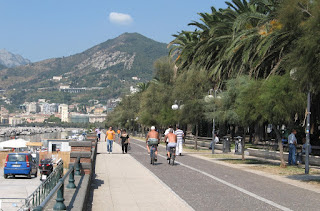
Palm trees line the waterfront at Salerno, a city often overlooked by visitors to Campania
Palm trees line the waterfront at Salerno, a city
often overlooked by visitors to Campania
Travel tip:

Salerno, situated some 25km (16 miles) from Angri, has a population of about 133,000. It is a city with a reputation as an industrial port and is often overlooked by visitors to Campania, who tend to flock to Naples, Sorrento, the Amalfi coast and the Cilento. Yet it has an attractive waterfront and a quaint old town, at the heart of which is the Duomo, originally built in the 11th century, which houses in its crypt the tomb of one of the twelve apostles of Christ, Saint Matthew the Evangelist. It is also a good base for excursions both to the Amalfi coast, just a few kilometres to the north, and the Cilento, which can be found at the southern end of the Gulf of Salerno. Hotels are also cheaper than at the more fashionable resorts.

Also on this day:

1472: The birth of Renaissance painter Fra Bartolommeo

1918: The birth of operatic baritone Anselmo Colzani

1925: The birth of film producer Alberto Grimaldi


Home