Showing posts with label Novelists. Show all posts

2 September 2026

Giovanni Verga - writer

Sicilian remembered as one of Italy’s greatest novelists

Giovanni Verga wrote short stories  and novels from an early age
Giovanni Verga wrote short stories 
and novels from an early age
The writer Giovanni Verga, regarded by some as the greatest Italian novelist after Alessandro Manzoni, was born on this day in 1840 in the Catania area of southeast Sicily.

Verga wrote romantic and historical novels in the early part of his career but later shifted his focus to what became known as verismo, a style rooted in stark realism, focused on unvarnished depictions of rural and working‑class life.

His major works include the novels I Malavoglia (1881) and Mastro-don Gesualdo (1889), which have come to be seen as his masterpieces, and his short story collections Vita dei campi (1880) and Novelle rusticane (1883). 

The opera composer Pietro Mascagni can be given some credit for introducing Verga’s work to wider audiences. His most famous composition, Cavalleria rusticana, which premiered in 1890, was based on a short story and play by Verga of the same name, written 10 years earlier.

Verga grew up as part of a bourgeois family with noble origins, whose forebears are thought to have arrived in Sicily from Aragon, in Spain. Though the family home was in Catania, where his birth was registered, some sources say he was born in a house in Vizzini, a hilltop town 60km (36 miles) south of Catania, others that he was born on a country estate in nearby Tiepidi, perhaps because the family relocated there during a cholera outbreak. 

Verga began writing in his teens and continued while ostensibly studying law at the University of Catania. His early works, such as Amore e Patria (Love and Homeland), I carbonari della montagna (The Carbonari of the Mountain) and Sulle lagune (On the Lagoons) had historical, patriotic themes.


At the time of Italian Unification, in 1860-61, Verga served with the Catania National Guard, which was charged with keeping order following Giuseppe Garibaldi’s conquest of Sicily. Several times between 1860 and 1864, this service required him to visit Florence.

During one extended stay in the Tuscan capital he wrote Una peccatrice (translated into English as A Mortal Sin), which was much different from his previous work in that its subject matter was a passionate romance. After settling in Florence, where he wrote Storia di una capinera - translated as The Sparrow - a novel about the plight of a girl forced by circumstance to become a nun, he began to be influenced by the Scapigliatura movement.

A 1907 edition of Verga's  acclaimed I Malavoglia
A 1907 edition of Verga's 
acclaimed I Malavoglia
The Scapigliatura - which literally translates as ‘dishevelment’ - were a somewhat bohemian, anti‑establishment artistic group based primarily in Milan from the late 1850s to the 1870s. Its writers were generally young and disillusioned, yet cosmopolitan, and determined to break with the polite, patriotic literature of post‑Unification Italy.

The movement’s rejection of romantic idealisation, its fascination with the darker edges of modern life, and its stylistic experimentation played a key part in Verga’s transition to verismo.

His 1873 novel Eva, in which the rejection of romanticism is a central theme, provided an early manifestation of this shift in style, which gained pace after he moved to Milan and became part of the city’s literary circle, fully embracing Scapagliato themes in his next two novels Tigre reale (The Royal Tigress) and Eros.

The evolution of Verga’s writing into the starker verismo that became his hallmark followed the arrival in Milan - by then the home of most of Italy’s major newspapers and publishing houses - of his close friend, Luigi Capuana, another Sicilian writer.  They were both deeply impressed by L'Assommoir - The Drinking Den - which is regarded as one of the finest works of Émile Zola, a major figure in the Naturalism movement in French literature.

This became the inspiration for the verismo movement, which they set out to create in order to fill a gap they perceived in Italian literature.

Encouraged by the reception for his short stories, exploring the verismo themes of poverty, fatalism, family duty, social immobility, honour codes, and the harsh economics of survival, often set in the fishing villages and rural communities of his native Sicily, Verga wrote I Malavoglia - published in English as The House by the Medlar Tree - and Mastro-don Gesualdo to great critical acclaim, even though the financial returns were modest. 

Verga is commemorated in many ways in Catania, including this bust in the Giardino Bellini
Verga is commemorated in many ways in Catania,
including this bust in the Giardino Bellini
He had planned that they would be the first two in a cycle of five novels - to be entitled I vinti (The Vanquished) - but no more were written.

This was probably for a variety of reasons. The first two novels had been enormously demanding projects, draining his creativity. He also became highly critical of his own prose, rewriting extensively but sometimes abandoning entire drafts.  He found writing for the theatre more rewarding financially, although he endured a long dispute with Mascagni over royalties from Cavalleria rusticana.

In any case, his income from family properties in Sicily provided him with a comfortable lifestyle. The management of these properties also took up time.

After spending decades in Milan, Verga increasingly retreated to Catania and his family estate. Never married, he became a public figure locally - a respected gentleman, landowner, and cultural authority, who was eventually named a Senator of the Kingdom of Italy - but his national literary engagement dwindled. New movements emerged, leaving verismo behind.

Moreover, by the second decade of the new century, he was elderly and ill. His last years were spent almost entirely in Catania, with no major writing projects. He died there in January, 1922.

If Verga’s ambitions remained unfulfilled, he left a deep influence on Italian literature. His work is still part of the curriculum in Italian schools. He sits alongside Luigi Pirandello and Leonardo Sciascia as part of the great triumvirate of Sicilian literature.

His legacy can also be seen in the neorealism movement that revived Italian cinema in the postwar years, in particular in the films of Luchino Visconti, who often drew on Verga’s themes. Visconti’s second major feature, his 1948 film La terra trema (The Earth Trembles) was an adaptation, if a loose one, of I Malavoglia.

The Verga family home in Catania now houses a museum
The Verga family home in
Catania now houses a museum
Travel tip:

The Verga family home at Via Sant'Anna 8 in Catania is now given over in part to the Casa Museo Giovanni Verga, a literary museum dedicated to preserving Giovanni Verga’s memory. The museum occupies the second floor of a late 18th century palazzo, which was declared a national monument in 1940. The preserved living spaces still retain the original furnishings. The writer's library, in his private study, consists of more than 2,600 volumes. Copies of Verga's manuscripts are exhibited inside the display cases, while the originals are kept in the library of the University of Catania. A lectern stands in front of the large window in the living room, at which Verga would write his poems and essays observing the daily life of people who passed by on Via Sant'Anna. Paintings, prints and engravings by artists who were friends of Verga adorn the walls. A collection of photographs, mainly of family and friends, taken by Verga himself was discovered at the house shortly after his death. Via Sant’Anna one of several streets linking Via Vittorio Emanuele II with the parallel Via Giuseppe Garibaldi, just a five-minute walk from Catania’s duomo, the Basilica Cattedrale di Sant’Agata.

Stay in Catania with Hotels.com

Luchino Visconti's 1948 film La terra trema was filmed in Aci Trezza
Luchino Visconti's 1948 film La
terra trema was filmed in Aci Trezza
Travel tip:

Aci Trezza, a picturesque fishing village on the Ionian coast, located about 15km (9 miles) north of Catania, was immortalised as the setting for his masterpiece novel I Malavoglia, which revolved around the struggles of the Toscano fishing family. A local museum, Casa del Nespolo, housed in a traditional 19th-century house, features memorabilia, photographs, and exhibits dedicated to Verga's work.  Luchino Visconti filmed La terra trema,  his 1948 neo-realist cinematic adaptation of Verga's novel, on location in Aci Trezza, with some local residents in the cast. Off the coast, jagged dark basalt sea stacks known as i faraglioni rise straight out of the water. Greek mythology holds that these massive volcanic rocks were hurled at Odysseus by the blinded giant Polyphemus as the hero escaped. Isola Lachea, another large offshore rock, functions as a protected nature reserve rich in local marine and plant species. Other attractions include the  Baroque architecture of the church of San Giovanni Battista and the Norman Castle, standing tall above the village, which also offers a vantage point from which to watch the annual Vele dei Malavoglia regatta. 

Find accommodation in Aci Trezza with Expedia

More reading:

Alessandro Manzoni, the writer credited with Italy’s greatest novel 

How Leonardo Sciascia mercilessly exposed Mafia links with Italian politics

Luigi Capuana, a leading figure in the verismo movement

Also on this day:

1753: The birth of Marie Josephine of Savoy

1898: The birth of baker and chocolatier Pietro Ferrero

1938: The birth of actor Giuliano Gemma

1964: The birth of businessman and coffee-maker Andrea Illy


Home


3 October 2025

Giovanni Comisso - writer

Novelist and journalist with distinctive literary voice

Giovanni Comisso spent much of his  writing life travelling abroad
Giovanni Comisso spent much of his 
writing life travelling abroad
The writer Giovanni Comisso, one of Italy’s most distinctive literary voices of the 20th century, was born on this day in 1895 in Treviso in the Veneto region.

He was acclaimed for his novel Giorni di guerra - Days of War - which drew on his experiences serving as a telegraph engineer in the First World War. Comisso’s work won critical praise for being deeply attuned to the emotional and philosophical currents of his time.

For much of his life, Comisso led a peripatetic career as a journalist and art dealer, as well as a writer. He traveled extensively across Europe, North Africa, and the Far East, taking work as a correspondent for Italian newspapers such as Corriere della Sera and La Gazzetta del Popolo.  For a while, he lived in Paris with the Italian painter Filippo De Pisis, leading what he described as a “disorderly and frenetic” existence within the city’s bohemian postwar artistic community.

Comisso was born into a comfortable, middle-class household, the son of an agricultural merchant. He attended the Antonio Canova classical high school in Treviso but failed his final exams and signed up for military service, taking a telegraph engineering course in Florence. By that time he had met Arturo Martini, a Trevisan sculptor six years his senior, with whom he developed a strong friendship.  Martini helped him find a publisher for his first collection of poems, also painting his portrait for the cover.

In common with so many young Italian men, the course of Comisso's life abruptly changed with the outbreak of World War One. His service with the Telegraph Corps of Engineers took him to the front line in the war against Austria-Hungary. He took part in the Battle of Caporetto, a disastrous defeat for the Italians in November 1917, and the Battle of the Piave River in June 1918, a decisive victory that was probably the beginning of the end for Austria-Hungary.


Following the armistice, he was transferred to Fiume - the city that is now Rijeka in Croatia but to which Italy felt they had an historic claim. He was there in September, 1919, when a rebel army led by the Italian Army officer Gabriele D'Annunzio occupied the city in a response to what Italians perceived as the unfairness of post-war division of territory by their allies. 

Comisso deserted and joined the rebel troops, an experience that deepened his fascination with rebellion and individualism. The occupation was short-lived but Fiume subsequently became part of Italy under the 1924 Treaty of Rome.

Giorni di guerra, the novel that drew on Comisso's war experience
Giorni di guerra, the novel that
drew on Comisso's war experience
While in Fiume, he enjoyed sailing in the Adriatic, which inspired his first novel, The Port of Love, published in 1924.

In the same year, Comisso completed the studies he had abandoned before WW1 and obtained a degree in law at the University of Siena. He never practised, instead combining travelling with writing, earning a living as a correspondent for a number of Italian newspapers and magazines. At different times, he ran a bookshop in Milan and was an art dealer in Paris. 

Among his varied experiences, his time aboard a sailing ship based in Chioggia, at the southern end of the Venetian Lagoon, led him to write Gente di Mare - Seafarers - which won him the Bagutta Prize in 1929.

In December of that year, as a special correspondent for Corriere della Sera, he made the Grand Tour of the Far East, visiting China, Japan, Siberia, and Russia, which he travelled across to reach Moscow. His trip lasted seven months. 

Back in Italy, he published his great wartime novel, Giorni di guerra, which initially caused him some problems with the Fascist regime, who were unhappy that it portrayed the Italian military in a raw, unheroic light. 

Comisso used the money he had earned from his newspaper work and literature to buy a house and some land in Zero Branco, a town in the Treviso area, about 14km (nine miles) to the southwest of the city.

He published books of his writings in Paris and the Far East, although his travelling was not finished. The Gazzetta del Popolo, based in Turin, sent him on a tour of the entire Italian peninsula, from which he reported his observations, and then to East Africa to document the birth of the new Fascist Empire.

Comisso's final home in the village of Santa Maria del Rovere, on the outskirts of Treviso
Comisso's final home in the village of Santa Maria
del Rovere, on the outskirts of Treviso
World War Two had devastating consequences for Comisso, whose family home in Piazza Fiumicelli was destroyed when Treviso was bombed in April 1944, although his mother and her housekeeper had been evacuated to Zero Branco.  

Meanwhile, his companion, Guido, with whom he shared his own home, was arrested by the Fascists, then released on condition that he joined a combat unit of the new Italian Social Republic, from which he deserted only to be shot dead by partisans, who suspected him of spying.

Comisso’s writing continued to be honoured. He won the Viareggio Prize in 1952 with Capricci italiani - Italian whims - and the Strega Prize in 1955 with Un gatto attraversa la strada - A Cat Crosses the Road - two collections of short stories.

After the deaths of his mother and both Arturo Martini and Filippo De Pisis, Comisso left Zero Branco to rent an apartment in Treviso, but moved again, to a house in Santa Maria del Rovere, on the outskirts of Treviso, where he continued to write.

His final work, a collection of stories entitled Attraverso il tempo - Through Time - was published just a few months before his death, in hospital in Treviso, in January 1969.

Comisso’s writing, distinguished by its lyrical prose, existential undertones, and a tension between rootedness and escape, left an indelible mark on Italian literature.

The pretty Piazza dei Signori is the  square at the heart of Treviso
The pretty Piazza dei Signori is the 
square at the heart of Treviso
Travel tip:

For many visitors to Italy, Treviso is no more than the name of the airport at which they might land en route to Venice, yet it is an attractive city worth visiting in its own right, rebuilt and faithfully restored after the damage suffered in two world wars. Canals are a feature of the urban landscape – not on the scale of Venice but significant nonetheless – and the Sile river blesses the city with another stretch of attractive waterway, lined with weeping willows. The arcaded streets have an air of refinement and prosperity and there are plenty of restaurants, as well as bars serving prosecco from a number of vineyards. The prime growing area for prosecco grapes in Valdobbiadene is only 40km (25 miles) away to the northeast. Treviso’s main sights include its historic squares, medieval walls, unique fountains, and art-filled museums.  Piazza dei Signori is the heart of Treviso’s historic centre, a 13th-century square lined with elegant cafĂ©s, boutiques, and civic buildings.  The city’s well-preserved walls date back to the 15th century and once protected the city. The Porta San Tomaso entrance to the city is a grand marble city gate from the 16th century, adorned with ornate carvings and the winged lion of Venice.

Hotels in Treviso from Hotels.com

The National Theatre in Rijeka, where the architecture bears a heavy Italian influence
The National Theatre in Rijeka, where the
architecture bears a heavy Italian influence
Travel tip:

Rijeka is a vibrant port city on Croatia’s northern Adriatic coast, yet between 1924 to 1947, it was known as Fiume and part of the Kingdom of Italy. During this period, Italian was the official language, and many public buildings, schools, and cultural institutions reflected Italian styles and values. Architecture flourished, with neoclassical and rationalist designs still visible today, especially in the city centre, while the Italian community thrived, contributing to Rijeka’s literary, musical, and culinary traditions. After World War II, the city was ceded to Yugoslavia, and many Italians left or were expelled. Yet traces of Italian heritage remain in street names and inscriptions, while many buildings still bear Italian influence.  The city’s dual identity is reflected in its cuisine, blending Mediterranean and Central European flavours.

Find accommodation in Rijeka with Expedia

Also on this day: 

The minister who persuaded Italy to switch sides in WW1

A poet who drew inspiration from the landscapes of the Veneto

How Gabriele d’Annunzio influenced Mussolini

Also on this day:

1808: The birth of record-breaking Palio jockey Francesco Bianchini

1858: The birth of actress Eleonora Duse

1938: The birth of world champion boxer Alessando Mazzinghi

1941: The birth of bass-baritone star Ruggero Raimondi


Home


8 September 2024

Matteo Strukul – writer

Author is published worldwide in 20 languages

Matteo Strukul's historical novels about the Medici family have been best sellers in Italy
Matteo Strukul's historical novels about the Medici
family have been best sellers in Italy
Writer and journalist Matteo Strukul, best known for his best-selling historical novels about the powerful Medici family, was born on this day in 1973 in Padua (Padova) in the Veneto region.

Strukul’s first novel was a dark thriller set in the Veneto, which was published in 2011 in Italian as La ballata di Mila. The novel was translated into English and issued in 2014 as The Ballad of Mila.

He then wrote four historical novels set in Florence between the 15th and 17th centuries following the rise of the house of Medici, which all became best sellers in Italy and have sold more than 500,000 copies worldwide. The first novel, I Medici, una dinastia al potere, was awarded the Premio Bancarella in 2017. This prestigious award has been won in the past by Ernest Hemingway, Boris Pasternak, Umberto Eco, and Ken Follett. The novel was published in English in 2019 as Medici Ascendancy. 

Strukul’s novels have now been translated into more than 20 different languages.

Matteo Strukul studied law at the University of Padua and went on to study for a PhD in European Contract Law at the Ca’ Foscari University of Venice.

Strukul's first Medici novel translated into English
Strukul's first Medici novel
translated into English
He is an adjunct professor of interactive storytelling at Link Campus University in Rome and writes in the cultural section of the weekly magazine Il venerdi di Repubblica. 

Strukul, whose first published works were biographies of singer-songwriters, has also written Vlad, a comic book trilogy, for the publishers Feltrinelli, based on the historic character of Vlad the Impaler. This was the man that gave Bram Stoker the inspiration for the character of Count Dracula.  Strukul's latest novel, La crypta di Venezia, was published in April this year.

In 2018, Strukul was recognized as Excellent Paduan by the Municipality of Padua and won the Premio Emilio Salgari for adventure literature for the novel Giacomo Casanova - La sonata dei cuori infranti (Giacomo Casanova, the sonata of broken hearts). 

He is the creator and founder of the literary movement Sugarpulp and artistic director of the festival of the same name. On the Sugarpulp website he says his favourite wine is Raboso del Piave, which is said to be an austere wine with aromas reminiscent of morello cherry, wild blackberry and plum, but also cinnamon, leather, vanilla and pepper

Strukul, who now lives between Padua, Milan, and Berlin, celebrates his 51st birthday today.

The Palazzo Bo' is the main building of the University of Padua, Italy's second oldest university
The Palazzo Bo is the main building of the University
of Padua, Italy's second oldest university
Travel tip:

The University of Padova, where Matteo Strukul studied for his waw degree, was originally established in 1222 and is one of the oldest universities in the world - second in Italy only to the University of Bologna. The main university building is Palazzo del Bo in Via 8 Febbraio, which was named after the tavern known as Il Bo (‘the ox’ in Venetian dialect) that had been acquired by the university as new premises in 1493. Originally this building housed the university’s renowned medical faculty and visitors can see the pulpit that was used by Galileo Galilei when he taught at the university between 1592 and 1610 and the anatomy theatre built in 1594, which is the oldest surviving medical lecture theatre in the world today.  Padua is also known as the home of the Scrovegni Chapel, the inside of which is covered with frescoes by Giotto, an artistic genius who was the first to paint people with realistic facial expressions showing emotion.


Ca' Foscari, the historic home of the University of
Venice, sits at the widest bend of the Grand Canal

Travel tip:

Ca’ Foscari University in Venice, where Matteo Strukul studied for his PhD,  was founded in 1868. Its main campus is a large Gothic palace which looks out over the Grand Canal in Venice, but there are other sites belonging to the university elsewhere in Venice, and in Mestre and Treviso. Ca’ Foscari was originally built for the Doge Francesco Foscari in 1453 and was designed by the architect Bartolomeo Bon in Venetian Gothic style. During the annual historic Regatta in Venice, a wooden platform known as La Macchina is placed in front of Ca’Foscari, from which the Venetian authorities watch the race. It is also the place on the Grand Canal where the race finishes and is where the prizes are distributed. The University has made parts of the palace accessible to the public, opening some of its most beautiful rooms, such as the Aula Baratto and the Aula Berengo, to visitors.

Also on this day:

1474: The birth of poet Ludovico Ariosto

1504: Michelangelo's David unveiled

2014: The death of soprano Magda Olivero


Home


1 September 2024

Michele Giuttari – crime writer and police officer

Cop-turned-novelist with inside knowledge of police investigations

Michele Giuttari's novels draw on his experience as a high-ranking Italian police officer
Michele Giuttari's novels draw on his experience
as a high-ranking Italian police officer
Michele Giuttari, who headed the police in Florence and used his experience working on investigations into Mafia activities and dangerous criminals to become a successful crime writer, was born on this day in 1950 in Novara di Sicilia, a village in the province of Messina in Sicily.

After studying for a degree in Jurisprudence at the University of Messina, Giuttari qualified as a lawyer. He joined the Polizia di Stato as a commissario in 1978 and later rose through the ranks to take charge of the Florentine police between 1995 and 2003.

Giuttari first served in Calabria, where he held positions in the Squadra Mobile of Reggio Calabria and Cosenza. He then joined the Anti-Mafia investigation department and served first in Naples and then in Florence, where he became head of the Judicial Investigation section, and succeeded in jailing several key Mafia figures.

During his time in command of the Squadra Mobile in Florence, Giuttari was responsible for reopening the Monster of Florence case and proving that the so-called monster was not simply a lone serial killer but was, in fact, a group of killers.

After retiring from serving in the Polizia di Stato, Giuttari started crime writing and has now written a series of novels featuring his character, Commissario Michele Ferrara, the latest, entitled Sangue sul Chianti (Blood on Chianti), having been published in 2021.

Seven novels in the Ferrara series have been published in English, the first of which - entitled A Florentine Death - will fascinate readers who are interested in learning about the methods or seeing into the minds of the Italian police. The book had been published in Italy under the title Scarabeo.

Michele Giuttari has made many appearances on television in Italy to talk about his life and work
Michele Giuttari has made many appearances on
television in Italy to talk about his life and work
The hero, Commissario Ferrara - the equivalent of Chief Superintendent in the English police - is the head of the Squadra Mobile in Florence, about which Giuttari can write with authority. He can describe what really happens in  murder investigations, interviewing suspects, and organising armed police operations.

As well as providing an authentic account of police procedure in a multiple murder investigation, Giuttari delivers a cleverly plotted mystery that becomes increasingly more gripping as it reaches its dramatic conclusion.

A Death in Tuscany, the second Commissario Ferrara novel published in English, is also fascinating because it offers even more glimpses behind the scenes of an Italian police station and gives the readers the feeling that they are on the inside of a major police investigation.

In this novel - published in Italy as La loggia degli innocenti - the reader finds out more about the man behind the job title and about his earlier life in Sicily.

Ferrara finds he is up against the Mafia as well as ruthless drugs bosses, and even his own Commissioner, who is enraged both by his unorthodox behaviour during the investigation and because he has fallen foul of the Carabinieri, pressures Giuttari himself has obviously experienced at times during his career.

The Death of a Mafia Don is available in English
The Death of a Mafia Don
is available in English  
The next in the series - The Death of a Mafia Don - starts with a bomb exploding near Commissario Ferrara’s car in the centre of Florence, leaving the head of the Squadra Mobile injured. There is an urgent need to find out who was responsible to prevent further atrocities, but with Ferrara  unconscious and in hospital, his loyal colleagues are forced to start the investigation without him.

Published under the title Il basilisco in Italy, this is a fast moving novel about terrorism and Mafia activity in Italy seen from the perspective of the security forces. It shows the way the police and the Carabinieri often work together and there is a realistic portrait of Florence as the backdrop for the action.

Former policeman Giuttari has now achieved international success with his crime novels, which have been published in more than 100 countries, and he has won several literary awards, including the Fenice Europa for La loggia degli innocenti and the Camaiore Letteratura Gialla for Il basilisco.

In a film made about the Monster of Florence murders, the character of Giuttari was played by the actor Giorgio Colangeli.

A typical street in historic Novara di Sicilia
A typical street in historic
Novara di Sicilia
Travel tip:

Situated about 70km (43 miles) southwest of Messina in the northeastern corner of Sicily, Michele Guittari’s beautiful home village of Novara di Sicilia is rich in history and traditions. Built on a hillside at the point where the Nebrodi mountains meet the Peloritani range, it was founded and inhabited by Greeks, then by Romans and Arabs and later conquered by the Normans. The remains of a Norman castle can be found near the Chiesa di San Giorgio. In the village’s historic centre, the Duomo di Santa Maria Assunta, built in the 16th century, has a sandstone façade typical of the area, with a wide staircase leading to an essentially Renaissance interior. Just 5km (3.5 miles) from the centre of the village is the Abbazia di Santa Maria, which dates back to the 12th century and is said to be the best example of a Cistercian building in Sicily. 

Search accommodation in Novara di Sicilia with Hotels.com


The Cattedrale di Santa Maria Assunta - Cosenza's duomo - lies at the heart of the mediaeval city
The Cattedrale di Santa Maria Assunta - Cosenza's
duomo - lies at the heart of the mediaeval city
Travel tip:

Calabria is a part of Italy which did not traditionally attract large numbers of overseas tourists but is becoming more popular thanks to beautiful coastal towns and villages such as Tropea, San Nicola Arcella and Pizzo, while the inland city of Cosenza - where Michele Giuttari once worked - has been described as epitomising the “unkempt charm of southern Italy” with a history that can be traced back to the third century, when there was a settlement called Consentia, the capital of the Brutti tribe. Over subsequent years, the area was captured by the Visigoths, the Lombards, the Saracens, the Normans and the Spanish before the Risorgimento and unification saw it become part of the new Italy.  At the heart of the mediaeval old city, with its network of steep, narrow streets, is a cathedral originally built in the 11th century and modified many times subsequently.  The old town also boasts the 13th century Castello Svevo, built on the site of a Saracen fortification, which hosted the wedding of Louis III of Naples and Margaret of Savoy,  but which the Bourbons used as a prison.

Hotels in Cosenza from Expedia

Also on this day:

1576: The birth of Cardinal and art collector Scipione Borghese

1878: The birth of conductor Tullio Serafin

1886: The birth of vaudeville star Guido Deiro 

1922: The birth of actor Vittorio Gassman


Home


18 February 2024

Alessandro Varaldo – crime writer and playwright

The first Italian author of gialli to be accepted by Mondadori

Varaldo's Il sette bello was the
first giallo by an Italian
Alessandro Varaldo, the author credited with creating the first fictional Italian police officer, died on this day in 1953 in Rome.

His character, the police commissario Ascanio Bonichi, made his first appearance in Varaldo’s novel Il sette bello - the name by which Italians refer to the seven of diamonds in a deck of cards - which was published by Mondadori in 1931.

The author had been approached by Arnaldo Mondadori himself and encouraged to create a novel in Italian to appeal to the readers who were already eagerly buying their gialli, the Italian translations of English, American and French detective novels that the firm published.

Gialli take their name from the distinctive yellow - giallo in Italian - covers used by Mondadori for their crime novels in the 1930s. 

Varaldo was born in Ventimiglia in Liguria in 1873 and grew up to become a journalist, novelist and playwright. From 1910 onwards he wrote novels, short stories and plays and contributed to newspapers such as Gazzetta del Popolo and Il Caffaro. 

He was president of the Italian Society of Authors and Publishers between 1920 and 1928 and director of the Academy of Dramatic Art in Milan from 1943.

In 1931, the Italian Government had brought in measures to try to curb the number of translated books by foreign authors being published, which encouraged Varaldo, along with other authors at the time, to try his hand at the genre.

Varaldo, who was also a journalist, wrote seven other gialli in addition to Il sette bello
Varaldo, who was also a journalist, wrote
seven other gialli in addition to Il sette bello
Esteemed for the quality of his writing, which Mondadori considered essential for the books they published, Varaldo became the first Italian author accepted into Mondadori’s series of gialli, and he went on to write eight mysteries for them. He was able to reconcile the traditionally Anglo-Saxon genre of crime fiction with Fascist values in order to comply with the dictates of the Mussolini regime.

He portrayed Bonichi as a down to earth character from the countryside who solved his cases by chance, rather than using the more scientific methods employed by other fictional detectives such as Sherlock Holmes.

His novels were set in Rome before the war and described the city’s Baroque and neo-Baroque buildings, which formed a theatrical background during the night and at dawn, when the silhouette of a figure could be illuminated. Crime fiction experts think this evoked an irretrievable past for his readers to escape to.

Varaldo wrote a total of eight gialli between 1931 and 1938 and he also wrote some drammi gialli -detective plays - before his death.


Travel tip: 

Ventimiglia, where Alessandro Varaldo was born, is the last major town on the Italian riviera before the border with France, which is about 6km (3.7 miles) away. Situated about 130km (81 miles) west of the Ligurian capital Genoa, it is not a well known as nearby Sanremo but has plenty going for it, nonetheless, its charm enhanced by the pastel colours of its houses. The town is divided in two by the Roia river, which separates the newer lower town from the old upper town - Ventimiglia Alta - which sits on a hill encircled by walls. Ancient buildings and churches dating back to the 10th century make the climb worthwhile, as does the spectacular view over the Ligurian sea. The mediaeval old town is also home to the Biblioteca Civica Aprosiana - founded by the writer and Augustan monk Angelico Aprosio in 1648 - has one of the largest collections of 17th century manuscripts and books in Italy.  The elegant lower town is best known for the massive open-air market that takes place in the beautiful setting of the lungomare - the promenade - every Friday. There are a smaller number of stalls open on the other days of the week. For beach lovers, the Spiaggia dei Balzi Rossi and the Spiaggia delle Calandre are only a short walk from the centre.

Travel tip:

The Mondadori publishing house, whose Gialli Mondadori broke new ground in publishing in Italy as the first book series to feature detective and crime stories alone, was launched in Ostiglia, an historical town about 160 km (99 miles) southeast of Milan and about 30 km (19 miles) from Mantua. In Roman times, when it was called Hostilia, its location on the Via Claudia Augusta Padana saw it become a trade hub linking Emilia with northern Europe.  In the Middle Ages it was a stronghold of Verona before being acquired in turn by the Scaliger, Visconti and Gonzaga families. The Palazzina Mondadori, an elegant Art Nouveau-style building that was the first Arnoldo printing house, hosts Arnoldo Mondadori’s private library consisting of about 1,000 books, many signed by the authors. Mondadori relocated to Milan in 1929 and now boasts a modern headquarters in the suburb of Segrate, to the east of the centre.

More reading:

How Giorgio Mondadori helped launch the newspaper La Repubblica

Why Augusto De Angelis is regarded as the 'father of Italian crime fiction'

The Naples bank worker who became a leading modern crime writer

Also on this day:

1455: The birth of painter Fra Angelico

1564: The death of painter and sculptor Michelangelo

1626: The birth of biologist Francesco Redi

1967: The birth of footballer Roberto Baggio

1983: The birth of tennis champion Roberta Vinci


Home

27 January 2024

Marco Malvaldi – crime writer and chemist

Author has mastered the science of detective fiction

Marco Malvadi began his writing career with La briscola in cinque
Marco Malvadi began his writing
career with La briscola in cinque
Novelist Marco Malvaldi, who has written a prize-winning mystery featuring the real-life 19th century Italian culinary expert Pellegrino Artuso as his fictional sleuth, was born on this day in 1974 in Pisa.

Malvaldi, who is a graduate in chemistry from Pisa University, has also written a travel guide about his home town with the title Scacco alle Torre (Checkmate to the Tower), which has been presented at the Pisa Book Festival. In the book, he writes a story about a nocturnal walk through the city entitled Finalmente soli (Finally Alone), which was inspired by an image taken by a professional photographer, Nicola Ughi, a fellow Pisan, who has become his official portraitist. 

He began his writing career in 2007 with a mystery novel, La briscola in cinque (Game for Five), published by Sellerio Editore. The novel’s protagonist, Massimo, a barista, and the owner of a bar named BarLume, which is a play on the Italian word barlume, which means 'flicker of light', is forced into the role of investigator in the fictional seaside resort town of Pineta on the Tuscan coast.  

Other books in the series followed and three have been translated into English: Il gioco delle tre carte (Three-card Monte), Il re dei giochi (The King of Games) and La carta piĂ¹ alta (The Highest Card).

In 2011, Malvaldi’s novel, Odore di chiuso (The Scent of Must) was published by Sellerio Editore and later published in English under the title, The Art of Killing Well. It featured Pellegrino Artusi, a renowned 19th century gastronomist from the Romagna region, as his fictional detective. The novel was awarded the Isola d’Elba Award and the Castiglioncello Prize. 

Malvadi's novel The Art of Killing Well
Malvadi's novel The
Art of Killing Well
Malvaldi published a thriller in 2012, Milioni di milioni (Millions of Millions), which is set in the fictional Tuscan town of Montesodi Marittimo, and features a university geneticist and an archivist, who form an unusual team of amateur investigators. In 2013, Malvaldi was awarded the literary prize, Premio Letterario La Tore Isola d’Elba - two of five literary honours his books have won.

After graduating, Malvaldi also did research in the department of pharmacy at Pisa University and he has written several books about science. His book, Le due teste del tiranno: metodi matematici per la LibertĂ  (The Two Heads of the Tyrant: Mathematic Methods for Freedom), published in 2017, won a 2018 Asimov award, for the best book in scientific dissemination published in Italy.

Malvaldi, whose birthday today is his 50th, has also co-authored books with Roberto Vacca, Dino Leporini, journalist and poet Ernesto Ragazzoni among many others. 

Malvaldi’s partner is Samantha Bruzzone, who is also a chemist and passionate about detective fiction. Together, they have written two children’s books and in 2022 the novel, Chi si ferma e perduto (Who Stops is Lost).


Pisa's leaning tower began to  tilt soon after it was built
Pisa's leaning tower began to 
tilt soon after it was built
Travel tip:

Pisa is world famous for its leaning tower, which Malvaldi writes about in his book Scacco alle Torre (Checkmate to the Tower). Work began on the construction of a freestanding bell tower for the Cathedral in Pisa in 1173. The tower’s famous tilt began during the building process and is believed to have been caused by the laying of inadequate foundations on ground that was too soft on one side to support the weight of the structure. The tilt got worse over the years until work had to be carried out to correct it in the 20th century. At its most extreme, the tower leaned at an angle of 5.5 degrees but since the restoration work carried out between 1990 and 2001 the tower leans at about 3.99 degrees. The tower was reopened to the public in 2001, when it was declared that it would be stable for another 300 years.

The picturesque harbour at the port of Portoferraio on the island of Elba off the Tuscan coast
The picturesque harbour at the port of Portoferraio
on the island of Elba off the Tuscan coast
Travel tip:

The Tuscan coast, which Malvaldi fictionalises in some of his books, has a long stretch of sandy beaches that include holiday destinations such as Viareggio, Forte dei Marmi, Catiglioncello, Follonica, Castiglione della Pescaia, Porto Ercole, Talamone, and many others. Off the coast is the island of Elba, a popular destination for holidaymakers who arrive by ferry at Portoferraio, where there is an old port and a modern seafront with hotels. The west coast of the island has sandy beaches, but the east coast is more rugged with high cliffs. Inland there are olive groves and vineyards producing the wine, Elba DOC. You can visit Napoleon’s two residences while he was in exile on the island, Palazzina Naopleonica, a modest house built around two windmills in Portoferraio, and Villa San Martino, his country house, further inland at San Martino and decorated inside with Egyptian-style frescoes.

Also on this day:

98: Trajan becomes Emperor of Rome 

1861: Italy elects its first parliament

1881: The birth of mobster Frank Nitti

1901: The death of composer Giuseppe Verdi

1927: The birth of writer and novelist Giovanni Arpino

1962: The birth of musician Roberto Paci DalĂ²


Home


31 March 2022

Maurizio De Giovanni – crime writer

Detective novelist has opened up his native Naples to crime fiction fans

Maurizio De Giovanni worked in a  bank before becoming a full-time writer
Maurizio De Giovanni worked in a 
bank before becoming a full-time writer
Bestselling author Maurizio De Giovanni was born on this day in 1958 in Naples in southern Italy.

His novels have been translated into English, Spanish, Catalan, French and German and have sold well over a million copies throughout Europe.

De Giovanni is best known for his two fictional detectives, Commissario Ricciardi, who works as a detective in 1930s Naples, and Ispettore Lojacono, who has been transferred to present day Naples from his home town of Agrigento in Sicily, after being accused of associating with the Mafia.

He has also written stories featuring a very different character, a social worker called Mina Settembre, who is based at a clinic in Naples specialising in providing psychological support.

In 2005, De Giovanni won a writing competition for unpublished authors with a short story, I vivi e i morti - The Living and the Dead -  which was set in the 1930s and featured the character Commissario Ricciardi. 

He was working in a bank at the time, a job for which by his own admission he had no particular inclination but which paid the bills. Always known as a bookworm, he wrote stories that he would show his colleagues. In fact, it was his co-workers who entered him for the competition, without his knowledge.

His success inspired his first novel, Le lacrime del pagliaccio - The Tears of the Clown - which was later republished in English as I Will Have Vengeance – The Winter of Commissario Ricciardi.

De Giovanni was inspired by his parents' memories of Naples
De Giovanni was inspired by
his parents' memories of Naples
He wrote his early stories in the Naples of the 1930s in part because his parents, who were also born in Naples, would share their memories with him of the city before World War Two.

I Will Have Vengeance was followed in 2008 by Blood Curse- The Springtime of Commissario Ricciardi and subsequently by Everyone in Their Place – The Summer of Commissario Ricciardi in 2009 and the Day of the Dead – The Autumn of Commissario Ricciardi in 2010. 

To date De Giovanni has written 13 Commissario Ricciardi novels, 10 of which have been published in English.

In 2012, he ventured into the noir genre with The Crocodile, which was the first appearance by his other detective, Ispettore Lojacono.

He was then inspired by the 87th Precinct series by the American author Ed McBain to write a police procedural, The Bastards of Pizzofalcone. His five Pizzofalcone novels have now been made into a television series by RAI, starring Alessandro Gassmann - son of the celebrated actor, Vittorio Gassman - as Ispettore Lojacono. In 2021 it aired for a third season.

His Commissario Ricciardi and Mina Settembre stories have also been adapted for television.

De Giovanni, who has lived and worked for most of his life in Naples, has also written features and short stories about sport - and for the theatre.

He adapted the American novelist Ken Kesey’s One Flew Over the Cuckoo’s Nest and David Manet’s play American Buffalo for Italian theatre audiences and has written three original stage plays - Ingresso indipendente, Mettici la mano and Il silenzio grande.

Il silenzio grande - The Great Silence - is a two-act comedy that was first staged at the Teatro Diana in Naples and turned into a film - directed by Alessandro Gassman - that was shown at the 2021 edition of the Venice Film Festival.

The Teatro di San Carlo is thought to be the oldest opera house the the world still in use
The Teatro di San Carlo is thought to be the
oldest opera house the the world still in use
Travel tip:

Much of De Giovanni’s debut novel, I Will Have Vengeance, takes place in the Teatro di San Carlo in Naples, the city’s historic opera house. Teatro di San Carlo was officially opened in 1737, way ahead of La Scala in Milan and La Fenice in Venice. Built in Via San Carlo close to Piazza del Plebiscito, the main square in Naples, Teatro di San Carlo quickly became one of the most important opera houses in Europe and renowned for its excellent productions. The theatre was designed by Giovanni Antonio Medrano for the Bourbon King of Naples, Charles I, and took just eight months to build. This was 41 years before La Scala and 55 years before La Fenice opened. San Carlo is now believed to be one of the oldest, if not the oldest, remaining opera houses in the world. Both Gioachino Rossini and Gaetano Donizetti served as artistic directors at San Carlo and the world premieres of Donizetti’s Lucia di Lammermoor and Rossini’s Mosè were performed there.

The Piazza del Plebiscito in Naples, as seen from the Pizzofalcone hill
The Piazza del Plebiscito in Naples, as seen
from the Pizzofalcone hill
Travel tip:

Pizzofalcone, where De Giovanni’s police procedural series is set, is an area of the San Ferdinando district, situated between Piazza del Plebiscito and the Royal Palace and Castel dell’Ovo and the Santa Lucia area. It is essentially a hill, also known as Monte di Dio. It is so called because in the 13th century Charles I of Anjou, who was King of Naples at the time, had a falconry built there. Its elevated position offers panoramic views of the Naples coastline stretching towards Mergellina along the Riviera di Chiaia. De Giovanni has spoken about Pizzofalcone, which has both upmarket and poor neighbourhoods, as a microcosm of the city of Naples.

Also on this day:

1425: The birth of Bianca Maria Visconti – Duchess of Milan

1675: The birth of Pope Benedict XIV

1941: The birth of comic book artist Franco Bonvicini

1996: The death of auto engineer Dante Giacosa


Home


4 March 2022

Giorgio Bassani - writer and novelist

Best-known work reflected plight of wealthy Jewish Italians in 1930s

Giorgio Bassani's novels drew on his own background in Ferrara
Giorgio Bassani's novels drew on his
own background in Ferrara
Giorgio Bassani, rated by many critics as alongside the likes of Cesare Pavese, Elsa Morante and Alberto Moravia among the great postwar Italian novelists, was born on this day in 1916 in Bologna.

Bassani’s best-known work, his 1962 novel Il giardino dei finzi-contini - The Garden of the Finzi-Continis - was turned into an Oscar-winning movie by the director Vittorio De Sica.

Like much of his fiction, The Garden of the Finzi-Continis is semi-autobiographical, drawing on his upbringing as a member of an upper middle-class Jewish family in Ferrara, the city in Emilia-Romagna, during the rise of Mussolini’s Fascists and the onset of World War Two.

Bassani, who was the editor of a number of literary journals and a respected screenplay writer, had already achieved recognition for his work through his Cinque storie ferraresi - Five Stories of Ferrara - which won the prestigious Strega Prize in 1956.

But it was The Garden of the Finzi-Continis that won him international acclaim. The novel was part of a series that expanded on the same theme in presenting a picture of the world during the author's formative years, against a background of state-promoted antisemitism.

The son of a doctor and an aspiring singer, Bassani was born in Bologna. His father, Angelo Enrico Bassani, had served with the Italian Army as a medical officer in World War One and was on furlough in Bologna, where his pregnant wife, Dora, joined him but went into labour during the visit.

They were both from Ferrara, where they returned after the war ended. Giorgio was named after the patron saint of the Po Valley city, on whose feast day his parents had become engaged.

Bassani's most famous novel is a Penguin Modern Classic
Bassani's most famous novel is
a Penguin Modern Classic
With his younger brother, Paolo, and their little sister, Jenny, Bassani had a childhood that was, at first, idyllic. They lived in a big family home on Via Cisterna del Follo, receiving their education at the Liceo Ludovico Ariosto and spending many hours outdoors, playing tennis or football, taking their summer holidays in the seaside resorts of the northern Adriatic coastline, and going skiing in the winter.

There was wealth on both sides of the family. Their paternal grandfather had been a landowner and cloth merchant; their maternal grandfather was a professor of medicine and head of the main hospital in Ferrara, an expert in gastroenterology who was still working right up to his death, aged 99. 

Yet the ambitions of all three siblings were thwarted by Mussolini’s anti-semitic Racial Laws. Giorgio, a talented pianist, completed his degree at the Faculty of Arts and Letters at the University of Bologna, but with Jews barred from most professions the only work he could find was as a teacher at the Jewish School in Via Vignatagliata.

Paolo hoped to become a doctor, like his father and grandfather, but with Jews barred from Italian universities, he was forced to go to France, where he studied engineering instead, before being expelled following the German invasion. Jenny became one of Giorgio’s pupils at the Jewish School but, with little prospect of making a career in Ferrara, fled to Florence.

It was while he was teaching, in 1940, that Bassani published his first novel,  Una cittĂ  di pianura  - A City of the Plain - which he wrote under a pseudonym, Giacomo Marchi, so as to evade the race laws. It was around this time that he became a political activist, joining the anti-Fascist resistance. He was arrested in May 1943 but thankfully spent only a couple of months in jail, freed after Italy formally surrendered to the allies and Mussolini was arrested.

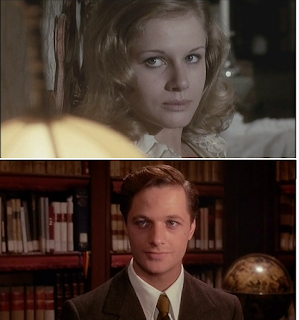
Dominque Sanda and Lino Capolicchio, stars of the film version of The Garden of the Finzi-Continis
Dominique Sanda and Lino Capolicchio, stars of the
film version of The Garden of the Finzi-Continis
The threat to the safety of Jews was not over, however.  With his new wife, Valeria, whom he married soon after his release from prison, he too fled to Florence, where they lived under assumed names with forged passports.  Bassani managed somehow to rescue his parents, and his sister Jenny, from the advancing Germans; Paolo, who eventually returned to Italy after a spell on the run in Spain, fought in the resistance and survived, settling in Rome. Sadly, most of their extended family left in Ferrara died at the Buchenwald concentration camp.

Bassani, too, drifted south to Rome, where his literary career gathered pace. As an editorial director of the publisher Feltrinelli, he was responsible for the posthumous publication of Giuseppe Tomasi di Lampedusa's novel Il Gattopardo - The Leopard. He published some poetry and short stories of his own before his Cinque storie ferraresi raised his profile following the award of the Premio Strega.

His 1958 novel, Gli occhiali d'oro - The Gold-Rimmed Spectacles, which was later also made into a film, examined the marginalisation of Jews and homosexuals and ultimately became the first in a series of books known as Il romanzo di Ferrara - the Ferrara Stories.  

The Garden of the Finzi-Continis, which was one of the series, is narrated by a young middle-class Jew in the Italian city of Ferrara, who is fascinated with the Finzi-Continis, a wealthy Jewish family, and especially by their beautiful daughter MicĂ²l, with whom he becomes infatuated.

The Finzi-Continis live in a lavish walled estate, which becomes a meeting place for other wealthy Jews, who find sanctuary there. The narrator - himself called Giorgio - finds his love for MicĂ²l ultimately unrequited in a poignant portrait of a family and friends enjoying their final days of freedom before the horrors of the world outside the walls close in on them. 

After Dietro la porta - Behind the Door (1964), L'airone - The Heron (1968) and L'odore del fieno - The Smell of May (1972) completed his series of Ferrara stories, Bassani wrote very little more in the way of fiction.

Estranged from his wife, he spent the final years of his life with his companion, Portia Prebys, an American-born professor of literature, whom he met in 1977. Suffering from Parkinson’s, Alzheimer’s and a heart complaint, he died in 2000 at the age of 84. 

De Sica’s film of The Garden of the Finzi-Continis, which starred Lino Capolicchio as Giorgio and Dominique Sanda as MicĂ²l, won the Academy Award for Best Foreign Language Film in 1972.

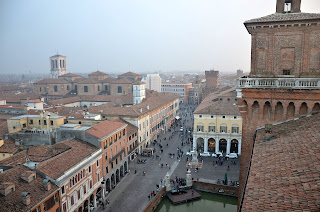
The centre of the city of Ferrara, looking down from the Castello Estense
The centre of the city of Ferrara, looking
down from the Castello Estense
Travel tip:

Ferrara is a city in Emilia-Romagna, about 50 km (31 miles) to the north-east of Bologna. It was ruled by the Este family between 1240 and 1598. Building work on the magnificent Este Castle in the centre of the city began in 1385 and it was added to and improved by successive rulers of Ferrara until the end of the Este line.  The castle was purchased for 70,000 lire by the province of Ferrara in 1874 to be used as the headquarters of the Prefecture.   Ferrara is also notable for Palazzo dei Diamanti, a palace in Corso Ercole I d’Este, that takes its name from the 8500 pointed diamond shaped stones that stud the façade, diamonds being an emblem of the Este family. It was designed by Biagio Rossetti and completed in 1503. The palace now houses the Pinacoteca Nazionale di Ferrara on its first floor.

Hotels in Ferrara by Booking.com


The bustling Via Giuseppe Mazzini is part of what used to be Ferrara's Ghetto
The bustling Via Giuseppe Mazzini is part of
what used to be Ferrara's Ghetto
Travel tip:

Via Vignatagliata in Ferrara, where Giorgio Bassani found work as a teacher at the Jewish School - formerly at No 79 - is part of what used to be the city’s Jewish Ghetto, established in 1624, when about 1,500 Jews lived in Ferrara. Centrally situated, only about 500km (546 yards) from the Castello Estense, it remained open, on and off, until 1859, when it was permanently closed, although it remained the heart of the city’s Jewish community for many years afterwards. Criss-crossed by cobbled streets, the area maintains much of its structure and character. Its main street, Via Giuseppe Mazzini, which begins at Piazza della Cattedrale, is largely pedestrianised and has evolved into one of Ferrara’s main shopping streets.

Also on this day:

1678: The birth of composer Antonio Vivaldi

1848: The approval of the Albertine Statute, which became the basis for the Italian Constitution

1943: The birth of singer-songwriter Lucio Dalla


Home