Showing posts with label Kingdom of Naples. Show all posts

11 December 2025

Giovanni Antonio Medrano - architect and engineer

Designed Teatro di San Carlo and Palace of Capodimonte in Naples

Medrano revolutionised theatre design with his horseshoe-shaped auditorium at Teatro di San Carlo
Medrano revolutionised theatre design with his
horseshoe-shaped auditorium at Teatro di San Carlo
The architect and engineer Giovanni Antonio Medrano, who left a lasting mark on Naples by designing the Teatro di San Carlo and the Royal Palace at Capodimonte while in the service of the Bourbon king Charles VII - later Charles III of Spain - was born on this day in 1703 in Sciacca, a town on the southwestern coast of Sicily.

Teatro di San Carlo, which is recognised as the oldest continuously active opera house in the world, set new standards for European theatre design with Medrano’s horseshoe-shaped layout and attention to acoustics.

His design became known as the Italian-style theatre model and was taken up by architects around the world as the gold standard for new projects. The San Carlo became a symbol of Bourbon prestige and remains one of his most enduring legacies.

Medrano, born into a noble Sicilian-Spanish family, was stationed in Naples as a military engineer and brigadier having taken part in the Spanish military campaign to conquer Naples in 1734. This campaign was part of the War of the Polish Succession, which had broadened into a wider conflict after the Bourbons used it as a pretext to attack Austrian territories in southern Italy and Sicily.

When the Spanish prince Don Carlos de Borbón became Charles VII of Naples in 1735, he appointed Medrano - his former tutor in the court of his father, Philip V of Spain - as his court architect, with a brief to design and oversee major royal projects that symbolised Bourbon authority and magnificence.


One of his first projects was to renovate the Royal Palace that adjoins the Piazza del Plebiscito, designed by Domenico Fontana and built between 1600 and 1614 on behalf of the Bourbon king Philip III. Medrano’s work was mainly focussed on readying the royal apartments ahead of the new king’s marriage to Maria Amalia of Saxony.

Medrano's Teatro di San Carlo, as it appeared in a painting of the centre of Naples in around 1830
Medrano's Teatro di San Carlo, as it appeared in
a painting of the centre of Naples in around 1830
The project to construct a theatre connected to the palace essentially followed on from that after Charles VII decided he wanted to replace the Teatro San Bartolomeo, which had been the city’s main theatre since 1621, with something much bigger and which would reflect the growing status of Naples as a centre for opera. 

The Real Teatro di San Carlo was built in just eight months, partially helped by Medrano’s use of wood rather than stone in the internal construction. This choice was initially controversial, as traditionalists favoured stone or marble, symbols of permanence and royal prestige, but Medrano argued that wood reflects and diffuses sound more evenly than stone, giving rise to a clearer, warmer tone.

What set the Teatro di San Carlo apart, though, was Medrano’s horseshoe-shaped layout with its six tiers of boxes. Unlike previous theatre designs, which were either based on the semi-circular footprint of Roman auditoriums, or rectangular layouts similar to medieval banqueting halls, Medrano’s design wrapped the audience around the stage, enhancing the acoustics and allowing almost all spectators a view of the performers.

After the Teatro di San Carlo was inaugurated in November 1737, with a performance of Domenico Sarro's opera Achille in Sciro, the horseshoe design became the standard for new theatres in Europe and around the world.

Medrano’s wide architectural legacy includes the Royal Palace of Portici, built between 1737 and 1738 as a summer residence for the royal family, with views over the Bay of Naples. 

Medrano also designed and built the Royal Palace of Portici, a summer residence overlooking the sea
Medrano also designed and built the Royal Palace
of Portici, a summer residence overlooking the sea
The palace later became central to the excavations of Herculaneum, the Roman city that had been buried by the same volcanic eruption that destroyed Pompeii in 79AD. The existence of ruins beneath the planned site of the palace was already known, marble having been discovered during the sinking of a well in 1709, but after more remains were revealed as the foundations were dug for the palace, Charles VII ordered more organised excavations, which Medrano oversaw.

The vast Reggia di Capodimonte, which Charles commissioned in 1738 after deciding the Portici palace was too small, was also designed by Medrano. Work began under Medrano’s direction but took over a century to complete, finishing in 1840.

Other projects attributed to Medrano include the Di Torcini bridge, which crossed the Volturno river at Venafro, north of Naples, and the Obelisk of Bitonto, which commemorates the decisive Bourbon victory over the Habsburg army at the town of the same name, near Bari in Puglia. 

Despite his successes, Medrano’s career was marred by controversy. In 1741, he and his associate Angelo Carasale were accused of fraud in tax dealings related to Capodimonte’s construction. The long trail was a contributing factor in delaying the work at Capodimonte.

The charges led to an 18-month jail sentence, after which Medrano was dismissed from his position at the court and exiled. Though he eventually returned to Naples, in 1746, and carried out renovations at the Santissima Trinità dei Pellegrini, a church on via Portamedina in the centre of Naples, his reputation never fully recovered.

After the inauguration of the choir in the church in 1754, there is no record of Medrano being active professionally again. He died in 1760, at the age of 56. 

The Reggia di Capodimonte, another Bourbon palace, now houses a major museum of Italian art
The Reggia di Capodimonte, another Bourbon palace,
now houses a major museum of Italian art

Travel tip:

The Reggia di Capodimonte, which Charles VII commissioned to house both his expanding court and the vast Farnese art collection, which he had inherited from his mother, Elisabetta Farnese, is a grand Bourbon royal palace a few kilometres from the centre of Naples.  Adjoining an area of woodland now known as the Real Bosco di Capodimonte, it was originally intended to be a hunting lodge but evolved as a replacement for the Reggia di Portici.  Its location was chosen because its elevated position - capo di monte literally means ‘top of the hill’ - promised an escape from the heat of the city. Although it has subsequently become part of greater Naples, at the time of its construction it was surrounded by parkland. Nowadays, the main building is home to the National Museum of Capodimonte, which showcases major works by Caravaggio, Raphael, Titian, El Greco, Giovanni Bellini, Masaccio, Lorenzo Lotto and many others, as well as the best collection of paintings from the distinct tradition of Neapolitan art, and many works of monumental sculpture from the Farnese Collection.

Search Hotels.com for Naples hotels

Some parts of Herculaneum are extraordinarily well preserved
Some parts of Herculaneum are
extraordinarily well preserved
Travel tip:

Until 1969, the town now called Ercolano was known as Resina, the name given to the medieval settlement that was built on top of the volcanic material left by the eruption of Vesuvius that also destroyed nearby Pompeii.  The existence of Ercolano - the Roman city of Herculaneum - was not known until the early 18th century, when a farmer sinking a well came across ancient marble columns which, it transpired, were part of an ancient theatre.  Systematic exploration followed under the patronage of Charles VII, the Bourbon king of Naples, from the 1730s to the 1760s.  Charles was more concerned with treasure-hunting than archaeology, but under Giovanni Antonio Medrano’s supervision statues and frescoes were uncovered as well as the famous Villa of the Papyri, with its extraordinary library of carbonized papyrus scrolls. Ercolano was smaller and less prestigious than Pompeii but is better preserved due to the different volcanic materials that covered the town, although its more famous neighbour was a bigger city and its destruction was particularly well documented.  The ruins at Pompeii and Ercolano can both be reached by using the Circumvesuviana railway, which runs from Naples along the southern stretch of the Bay of Naples, terminating at Sorrento.

Find accommodation near Ercolano with Expedia

More reading

The Vesuvius eruption that buried Pompeii

The emperor who came to the aid of the victims

The 19th century archaeologist who saved the relics

Also on this day:

1475: The birth of Pope Leo X

1912: The birth of film producer Carlo Ponti

1944: The birth of veteran pop star Gianni Morandi

1968: The birth of footballer Fabrizio Ravanelli


Home


30 March 2025

Joseph Bonaparte becomes King of Naples

Programme of reform launched to improve lives of citizens

Joseph Bonaparte was the older brother of the French emperor Napoleon
Joseph Bonaparte was the older brother
of the French emperor Napoleon
People took to the streets to celebrate in Naples on this day in 1806 after Napoleon’s older brother, Joseph Bonaparte, was declared to be their new king.

Joseph had been welcomed when he first arrived in Naples and was eager to be a popular monarch with his subjects. He kept most of the people who had held office under the Bourbons in their posts because he was anxious not to appear as a foreign oppressor.

Once he had established a provisional government in the capital of his new kingdom, he set off on a tour of inspection of his territory.

His immediate objective was to assess the feasibility of an invasion of Sicily to expel King Ferdinand and Queen Maria Carolina, who had fled to Palermo from Naples. But once he arrived at the Strait of Messina, he realized this was going to be impossible as the Bourbon monarchs had taken away all the boats and transport with them and their forces were grouped, alongside British troops, on the opposite side of the water ready to repel any invaders.

Therefore, he continued his progress through Calabria, Lucania, and Puglia, visiting the main villages in the regions and meeting the people so that they could get used to their new king.

Joseph embarked on an ambitious programme of reform in Naples and the south of Italy to raise his new kingdom to the level of a modern state in the style of Napoleonic France. He improved the economy, introduced more education for girls and took measures to make life better for ordinary people.


Joseph was the older brother of Napoleon Bonaparte and had trained as a lawyer. He helped his younger brother to overthrow the Directory, the committee who were governing the French First Republic, and, as a Minister in Napoleon’s Government, had signed a treaty of friendship and commerce between France and the United States.

Julie, Joseph's wife, was sent to support her husband
Julie, Joseph's wife, was
sent to support her husband
When war broke out between France and Austria, Ferdinand IV of Naples had agreed to a treaty of neutrality with Napoleon, but a few days later he declared his support for Austria.

In December 1805, Napoleon declared Ferdinand to be ‘faithless’, and to have forfeited his position, and said that an invasion of Naples would follow.

He sent his brother, Joseph, to Rome to command an army to dispossess Ferdinand of his throne. 

On February 8, 1806, a French army of 40,000 men advanced on Naples, meeting little resistance. The British and Russian forces in the area retreated and King Ferdinand and Queen Maria Carolina went to Sicily.

Gaeta and Capua put up a token resistance, but by February 14 the French had taken Naples,  and Joseph Bonaparte was able to enter the city in triumph the following day.

The French seized control of the Strait of Messina and defeated the Neapolitan Royal Army at the Battle of Campo Tenese, securing the mainland for the French.

On March 30, Napoleon issued a decree, installing his brother, Joseph, as King of Naples and Sicily.

Joseph’s wife, Julie, who had remained in Paris, became Queen Consort of Naples and Napoleon sent her to support her husband in 1808 when he was facing a rebellion.

While she was there, she supported educational projects for girls such as a college for the daughters of public functionaries in Aversa.

After the French invaded Spain, the couple became King and Queen of Spain, and Joseph was replaced as ruler of Naples by his sister’s husband, Joachim Murat.

After they left Naples, they were reputed to have taken valuables with them. The comment made by local people at the time was:  "The King arrived like a sovereign, and left like a brigand. The Queen arrived in rags and left like a sovereign.”

How the Bay of Naples looked in the early 19th century, according to a contemporary lithograph
How the Bay of Naples looked in the early 19th
century, according to a contemporary lithograph
Travel tip:

Naples and Sicily were part of an independent and prosperous kingdom from the beginning of the 18th century until the start of the French Revolution. In 1799, Napoleon's army reached Naples, creating the short-lived Parthenopean Republic, ruled by Joseph Bonaparte for part of the time. Joseph Bonaparte and his successor, Joachim Murat both took up residence in the Royal Palace in Piazza del Plebiscito in Naples. Building work had started on the palace after 1600 and it became the main residence of the Bourbons from the 1730s,  after Charles III of Spain became King of Naples. Joseph Bonaparte and Joachim Murat both carried out extensive redecoration work on the palace while they were living there. They had to substantially refurnish the palace because Ferdinand IV had emptied it before escaping to Palermo.

The Strait of Messina: Reggio Calabria is in the foreground; Mount Etna on the Sicily side
The Strait of Messina: Reggio Calabria is in
the foreground; Mount Etna on the Sicily side
Travel tip:

The Strait of Messina is a narrow stretch of water between Sicily’s most eastern tip and Calabria’s most western tip. It connects the Tyrrhenian sea to the north with the Ionian sea to the south. At its narrowest point it is just 3.1 km wide. A ferry service connects Messina on Sicily with the mainland of Italy at Villa San Giovanni, a port city a few kilometres north of Reggio Calabria. The possibility of building a bridge across the Strait of Messina to link Sicily with the mainland has been discussed for many years. Silvio Berlusconi’s Government announced plans for a bridge in 2009 but these were cancelled in 2013. Prime Minister Giorgia Meloni revived the plans with a decree in 2022.

Also on this day:

1282: The Sicilian Vespers uprising

1697: The birth of mezzo-soprano Faustina Bordoni

1815: Joachim Murat’s Rimini Proclamation

1892: The birth of Futurist painter and graphic designer Fortunato Depero

1905: The birth of architect Ignazio Gardella


Home


4 November 2023

Alfonso II - King of Naples

Ruler forced to abdicate after one year

Alfonso II became King on the  death of his father in 1494
Alfonso II became King on the 
death of his father in 1494
Alfonso II, who became King of Naples in 1494 but was forced to abdicate after just one year, was born on this day in 1448 in Naples.

Also known as Alfonso II of Aragon, as heir to Ferdinand I he had the title Duke of Calabria from the age of 10. Blessed with a natural flair for leadership and military strategy, he spent much of his life as a condottiero, leading the army of Naples in a number of conflicts.

He contributed to the Renaissance culture of his father’s court, building the splendid palaces of La Duchesca and Poggio Reale, although neither survived to be appreciated today.

Alfonso II also introduced improvements to the urban infrastructure of Naples, building new churches, tree-lined straight roads, and a sophisticated hydraulic system to supply the city’s fountains. 

He became King of Naples with the death of his father in January 1494 but stepped down in favour of his son, Ferdinand II, in January the following year as the powerful army of Charles VIII of France, who had launched an invasion of the Italian peninsula in September, 1494, prepared to take the city.

Alfonso fled to Sicily, seeking refuge in a monastery at Mazara del Vallo on the southwestern coast, about 25km (15 miles) from Marsala in the province of Trapani.  He died there in December 1495 at the age of 47.

The eldest son of Isabella de Clermont, the first wife of King Ferdinand I, Alfonso II inherited the title of King of Jerusalem on his mother’s death. After being given a humanist education from tutors in his father’s court, he became a career soldier.

A drawing depicting the scene of Alfonso's abdication in favour of his son, Ferdinand II
A drawing depicting the scene of Alfonso's
abdication in favour of his son, Ferdinand II
His battlefield skills were praised when in 1467, still only 19 years old, he helped the Florentines against Venice. 

Other notable campaigns included the war waged by the Kingdom of Naples and Pope Sixtus IV against Florence following the attempt by the Pazzi family to assassinate Lorenzo de’ Medici in 1478, the reversal of the Ottoman invasion of Otranto in 1481, and a major intervention against Venice in the War of Ferrara, also known as the Salt War, between 1482 and 1484.

Closer to home, he advised his father to impose severe repressive measures to crush the so-called Conspiracy of the Barons in 1485, which made him many enemies. 

By the time Alfonso ascended to the throne in Naples with the death of his father, the Kingdom’s coffers were exhausted and the chances of repelling the armies of Charles VIII were much reduced.  The French king had been encouraged to attack Naples by Alfonso’s brother-in-law, Ludovico Sforza, who saw a chance to reassert his power in Milan. 

Pope Alexander VI tried to persuade Charles VIII to use his resources against the Turks instead but without success. By early 1495, Charles was approaching Naples, having defeated Florence and the Neapolitan fleet under Alfonso's brother, Frederick, at Porto Venere, at which point Alfonso took flight, handing power to his son, Ferdinand II, who offered no resistance as Charles VIII seized the crown on behalf of his father, Louis XI, who had inherited the Angevin claim to Naples.

A bust at the Victoria and Albert Museum in London, said to be of Ippolita Maria Sforza
A bust at the Victoria and Albert Museum in
London, said to be of Ippolita Maria Sforza
Notorious for a somewhat debauched lifestyle and innumerable lovers, Alfonso II had three legitimate children by his one marriage, to Ippolita Maria Sforza, and two out of wedlock by Trogia Gazzella, a noblewoman.

Of Alfonso’s two major villas in Naples - La Duchesca and Poggio Reale - the latter, a complex said to have been designed by the architect Giuliano da Maiano, was said to be so beautiful that Charles VIII described it as an “earthly paradise”. 

Located in a district now known as Poggioreale, the Poggio Reale complex fell into disrepair after Charles had left, taking many of its treasures back to France. In the 17th century, an attempt was made to restore it under King Philip III of Spain but a resurgence of bubonic plague put paid to that, and part of the grounds became a burial place for lepers. Ultimately, a cemetery was built on top of the ruins.

After his death in Sicily, Alfonso’s remains were buried at the Duomo di Messina, the Cathedral Basilica of Santa Maria Assunta.

The Norman church of San Nicolò Regale in Mazaro del Vallo, built in 1124
The Norman church of San Nicolò Regale in
Mazaro del Vallo, built in 1124
Travel tip:

Mazara del Vallo, where Alfonso II sheltered after fleeing Naples, is a port and resort at the mouth of the Mazara river on the southwest coast of Sicily, 25km (15 miles) from Marsala and just over 130km (80 miles) from the island’s capital, Palermo. Founded by the Phoenicians in the ninth century BC, it has passed under the control of the Greeks, Carthaginians, Romans, Vandals, Ostrogoths, Byzantines, Arabs, Normans, Angevins, Catalans, Savoys, Habsburgs and Bourbons before being conquered by Giuseppe Garibaldi in 1860 and joining the newly-formed Kingdom of Italy. Attractions include the remains of a Norman Castle built in 1073 and demolished in 1880, the church of San Nicolò Regale, which is a rare example of Norman architecture, built in 1124, and the simple church of San Vito a Mare, built in 1776 on the site of old Norman remains on the edge of the water. Arab influences can be enjoyed in the historic Kasbah Mazara del Vallo district, while the Museo del Satiro Danzante houses a bronze statue of a dancing satyr believed to have been sculpted by Greek artist Praxiteles, which was found at a depth of 500m (1,600 ft) in the Strait of Sicily by a fishing boat in 1998. 

The triumphal arch that forms the gate of the Castel Nuovo in Naples, home of the Aragonese court
The triumphal arch that forms the gate of the Castel
Nuovo in Naples, home of the Aragonese court
Travel tip:

The Aragonese court in Naples was based at Castel Nuovo, often known as the Maschio Angioino, the imposing castle that stands on the water’s edge in Naples, overlooking the Piazza Municipio. Alfonso of Aragon, who had conquered the throne of Naples in 1443, had the fortress completely rebuilt in its present form, entrusting the renovation of the old Angevin palace-fortress to an Aragonese architect, Guillem Sagrera. The five round towers, four of which were part of the square Angevin structure, reaffirmed the defensive role of the castle, while the castle’s status as a centre of royal power was underlined by the construction at the entrance, between the two western towers, of a triumphal arch, a masterpiece of Neapolitan Renaissance architecture which was the work of Francesco Laurana and others. It was built in 1470 and commemorates Alfonso of Aragon's entry into Naples in 1443.

Also on this day:

1333 and 1966: Devastating floods in Florence

1575: The birth of Bolognese painter Guido Reni

1737: The inauguration of Teatro di San Carlo

1964: The birth of crime writer Sandrone Dazieri


Home


2 December 2021

Ferdinando Galiani - economist and philosopher

Leading figure in the Neapolitan Enlightenment

Ferdinando Galiani spent much of his life in government service
Ferdinando Galiani spent much of
his life in government service
The economist and philosopher Ferdinando Galiani, whose theories on market economics are considered to be years ahead of his time, was born on this day in 1728 in Chieti, now in Abruzzo but then part of the Kingdom of Naples.

Galiani spent much of his life in the service of the Naples government, spending 10 years as secretary to the Neapolitan ambassador in Paris before returning to Naples in the role of councillor of the tribunal of commerce, being appointed administrator of the royal domains in 1777.

A fine writer and wit as well as a talented economist, Galiani wrote a number of humorous works as well as two significant treatises, the first of which, Della Moneta, was written while he was still a student, at the age of 22.

Initially published anonymously, Della Moneta - On Money - was ostensibly a work about the history of money and the monetary system, but Galiani used it as an opportunity to intervene in the Neapolitan debate on economic reform, his opinions on the development of the Neapolitan economy evolving into a theory of market value based on utility and scarcity.

At the same time, he put forward what was then a revolutionary notion of the importance of freedom to the well-being of any society, one shared by many contemporary thinkers, including the French writer and philosopher Voltaire.

Advancing arguments based on the principle of personal freedom, Galiani suggested that the value of anything should be determined by the mutual agreement of buyer and seller, with prices and wages set naturally according to demand.

Galiani's seminal work, Della Moneta, which he wrote at 22
Galiani's seminal work, Della
Moneta,
which he wrote at 22
He argued that any form of control of the market would lead to injustices in society and could therefore be defined as tyranny. 

Galiani’s views on fairness could almost certainly be attributed to the education he received from his uncle, Monsignor Celestino Galiani, a prominent archbishop, whose intention was to prepare his nephew for a life as a clergyman.

In the event, Galiani revealed a talent not only for economics but as a witty writer, whose clever parodies of the Neapolitan literary style established his reputation as a humorist. In all his writing, however, he was faithful to the fundamental principles of truth and justice imbued in him by his uncle. 

During his time in Paris, Galiani wrote his second important treatise, Dialogues sur le commerce des blés - Dialogues on the Grain Trade - in which he argued in favour of regulation of the corn market on the basis that free international trade in grain, not so much a commodity as a necessity, risked the wellbeing of the population if foreign markets were more attractive to producers than domestic ones.

Galiani wrote fluently in both French and Italian, and his letters are seen as valuable for their depiction of economic, social, and political life in 18th-century Europe. He died in Naples in 1787 at the age of 58.

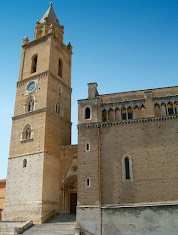
Chieti's Baroque Cathedral of San Giustino
Chieti's Baroque Cathedral
of San Giustino
Travel tip:

Chieti, the capital of the Abruzzi region, is among the most historic Italian cities, reputedly founded in 1181BC by the Homeric Greek hero Achilles and named Theate in honour of his mother, Thetis. The city is notable for the Gothic Cathedral of San Giustino, which has a Romanesque crypt dated at 1069 but is mainly of later construction, having been rebuilt a number of times, usually because of earthquake damage.  The main part of the cathedral is in early 18th century Baroque style.  Situated about 20km (12 miles) inland from the Adriatic city of Pescara, the city consists of Chieti Alta, the higher part and the historic centre, and the more modern Chieti Scalo.

Pescara, with the snow-capped mountains of the Gran Sasso range in the background
Pescara, with the snow-capped mountains of the
Gran Sasso range in the background
Travel tip:

Pescara, a city of almost 120,000 people on the Adriatic in the Abruzzo region, is known for its 10 miles of clean, sandy beaches, yet is only 50km (31 miles) from the Gran Sasso mountain range, the snow-capped peaks of which are visible even from the coast on a clear winter’s day. The city is the birthplace of the poet, patriot and military leader, Gabriele D’Annunzio. His childhood home, the Casa Natale di Gabriele D’Annunzio, which can be found in the historic centre of the city on the south side of the Fiume Pescara, which bisects the city, houses a museum about his life and works. The Museo delle Genti d'Abruzzo has exhibitions on regional industries like ceramics and olive oil. Pieces by Miró and Picasso are on view at the Vittoria Colonna Museum of Modern Art.

Also on this day:

1684: The birth of cook and unlikely war hero Maria Bricca

1916: The death of composer Paolo Tosti

1930: The birth of fashion designer Roberto Capucci

1946: The birth of fashion designer Gianni Versace


Home