Electronics engineer who co-founded Logitech
The electronics engineer and entrepreneur Pierluigi Zappacosta, who co-founded the computer peripherals giant Logitech, was born in the historic city of Chieti in the Abruzzo region on this day in 1950.
Pierluigi Zappacosta was CEO at
Logitech for 16 years
Zappacosta studied electronic engineering at Rome’s La Sapienza University and computer science at Stanford University in California. He teamed up with fellow Stanford graduate Daniel Borel and another young Italian, Giacomo Marini, to launch Logitech as a start-up company in Switzerland in 1981.
Marini already had experience in the burgeoning computer business, having worked for Olivetti and IBM.
Logitech began as a software and consultancy business but went on to specialise in computer peripherals, in particular the computer mouse. They were the first company to manufacture the mouse on a commercial scale, refined it by replacing wheels with optical sensors and infrared tracking, and eventually became the biggest mouse producer in the world.
Although the mouse as a device had existed since the 1960s, invented by Douglas Engelbart at the Stanford Research Institute, Logitech developed the first wireless version.
Zappacosta was Logitech’s president and CEO for 16 years, later serving as vice-chairman. He took Logitech public in Switzerland (1988) and on the NASDAQ (1997), raising over $60 million. By the time he left the company in 1998, Logitech’s annual sales exceeded $400 million.
Born and brought up in the historic centre of Chieti, about 18km (11 miles) inland from the Adriatic coastal resort of Pescara, Zappacosta attended the Liceo Classico Giambattista Vico on Corso Marrucino in Chieti.
He enrolled at the University of Rome, known since the 17th century as La Sapienza - literally, The Wisdom - to study electronic engineering. At the time of his graduation, he felt he might be best suited to a career as an academic.
 |
| Logitech became the world's biggest producer of the computer mouse |
But that was only the start. The CNR was closely linked with IBM, the American technology company, who were inviting applications for scholarships to work in the United States. Enrica applied and was successful. Pierluigi was persuaded to go with her and, as she took up a position in Palo Alto, California, he enrolled for an MSc in computer science at nearby Stanford University.
Although Logitech began life in Switzerland, and still has its global headquarters in Lausanne, its client base as the business expanded was increasingly in America, winning a major contract with Hewlett Packard in 1984. The company’s operational headquarters is in San José, California.
Pierluigi and Enrica eventually settled in California. They have three children, Francesco, Marco and Maria Cristina. Marco, like his father, is a technology entrepreneur. He is co-founder and CEO of Thumbtack, an online home services marketplace.
Since leaving Logitech, Pierluigi has enjoyed continued business success in America. He and Enrica co-founded DigitalPersona, specialising in biometric identification systems. He was CEO of Sierra Sciences, a biotech company focused on anti‑aging research, and is chairman of Faro Ventures, an investment fund active in Italy and the US.
 |
| The Delverde pasta factory in Fara San Martino, which Zappacosta saved from bankruptcy |
Zappacosta installed businessman Leonardo Valenti as CEO, rehired the 120 employees who had lost their jobs and began taking on young graduates. Within a year, the factory was back on track.
Founded in 1967, the Delverde factory uses water from the Verde river, a stream of pure spring water from the Majella massif which flows through the factory itself, providing a crucial raw material for pasta production. Using a low temperature drying process, the company has gained a reputation for high quality pasta products.
Zappacosta is secretary and treasurer of Issnaf (Italian Scientists and Scholars in North America Foundation), an association of Italian scientists and researchers in North America that was founded in 2007 by 36 scientists including four Nobel Prize winners - Renato Dulbecco, Riccardo Giacconi, Louis Ignarro and Mario Capecchi.
In 2015, he was appointed a Knight of Labour by the President of the Italian Republic, Sergio Mattarella.
Travel tip:
Chieti occupies an elevated position on a hillside, about
18km (11 miles) inland from the coast of Abruzzo
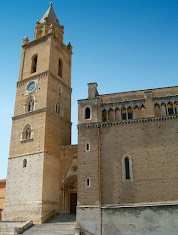
Chieti is among the most ancient Italian cities, reputedly founded in 1181BC by the Homeric Greek hero Achilles and named Theate in honour of his mother, Thetis. There is evidence, however, of prehistoric settlement, with Lower Paleolithic hand axes found in the area. Its elevated position, around 330m (1068ft) above sea level, offers panoramic views of both the Adriatic Sea and the Majella mountains, earning it the nickname “the Terrace of Abruzzo.” The city is notable for the Gothic Cathedral of San Giustino, which has a Romanesque crypt dated at 1069 but is mainly of later construction, having been rebuilt a number of times, usually because of earthquake damage. The main part of the cathedral is in early 18th century Baroque style. There are also some Roman remains, including those of a theatre, an amphitheatre, baths and temples. The city consists of Chieti Alta, the higher part and the historic centre, where Zappacosta was brought up, and the more modern Chieti Scalo.
Find a hotel in Chieti with Hotels.com
Travel tip:
Monte Amaro, the highest point of the Majella
massif, makes for a dramatic backdrop
Majella National Park is one of Italy’s most dramatic landscapes, a vast limestone massif rising abruptly between the Adriatic coast and the Abruzzo interior. Its character is shaped by deep gorges, high plateaus, and broad, wind‑scoured summits. The Majella massif itself reaches its peak at Monte Amaro (2,793 m; 9,173ft), a mountain long associated with hermits, shepherds, and pilgrims who sought solitude and silence in its uplands. The park’s biodiversity is exceptional. Beech forests cloak the lower slopes, while chamois, wolves, and golden eagles inhabit the higher, harsher terrain. Yet Majella is as much a cultural landscape as a natural one. The mountains are threaded with hermitages carved into cliffs, medieval shepherd routes, and abandoned stone villages. It is popular with hikers, who can explore the Vallone di Santo Spirito, the panoramic Blockhaus ridge, or the high Fondo di Femmina Morta plateau. Towns such as Caramanico Terme and Pacentro provide gateways to the park, blending mountain traditions with Abruzzese hospitality.
Stay in the Majella National Park with Expedia
More reading:
The Olivetti engineer who built the first personal computer
The 19th century inventor behind the forerunner of the fax machine
The inventor who used recycled piano keys to make typewriter
Also on this day:
1857: The death of socialist revolutionary Carlo Pisacane
1922: The birth of fashion designer Pierre Cardin
First running of Palio di Siena