Showing posts with label Livorno. Show all posts

15 January 2026

Delia Scala - ballerina, actress and TV presenter

Much-loved star was pioneer of Italy’s musical comedy genre 

Delia Scala's versatility as an entertainer gained her big roles in musical comedy
Delia Scala's versatility as an entertainer
gained her big roles in musical comedy
Delia Scala, a ballerina who became a stage and screen actress, helped popularise musical comedy in Italy in the 1950s and ‘60s and presented light entertainment shows on television, died on this day in 2004 in Livorno, in Tuscany.

Born Odette Bedogni in Bracciano, Lazio in 1929, she had suffered a recurrence of the breast cancer for which she had been successfully treated in the 1970s, passing away at the age of 74.

Her personal life was marred by tragedy. Her father and one of her three husbands died in road accidents, while the racing driver to whom she was engaged after her first marriage was annulled was killed on the track. Her third husband died from cancer.

Yet in her career she enjoyed considerable success and became hugely popular with Italian audiences.  After her death, the President of Italy at the time, Carlo Azeglio Ciampi, described her as a "model of enthusiasm and rigorous professionalism" and said he rated her among "the most beloved and popular artists in the history of Italian entertainment".

As a child, Scala inherited a love of music and dance from her mother, Iolanda, who chose Odette as her name after the title of one her favourite songs. When her father, Aldo, a test pilot with the Italian air force, was transferred from Bracciano to Malpensa, near Milan, the family settled in Gallarate, near Varese and Lake Maggiore. 

Already showing talent, the eight-year-old Odette was given a place at the Ballet School of Teatro alla Scala, Milan’s prestigious opera house, where she would remain for seven years.  Her family moved again, when her father left the air force, relocating to Campagnola Emilia, some 168km (100 miles) away from Milan, but Odette was able to continue her nascent dance career by staying in Milan, at first with an aunt and later in lodgings.


She performed on stage at La Scala many times, her ballet credits including Ottorino Respighi's La bottega fantastica and Tchaikovsky's The Sleeping Beauty. Another highlight was appearing as a dancer in Ruggero Leoncavallo’s opera Zazà, starring the celebrated tenor, Beniamino Gigli.  

Her move into films came after she was chosen to play a leading role in a documentary about La Scala’s ballet school. Other opportunities to appear on screen soon followed, in which she first performed under her own name before adopting Lia Della Scala as a professional name. The change to Delia Scala was at the suggestion of Italo Calvino - later to become famous as a novelist - who was at the time head of the press office at Lux Films.

Scala had embarked on a career as a ballet dancer before the big screen beckoned
Scala had embarked on a career as a ballet
dancer before the big screen beckoned
From the late 1940s, having been spotted initially by the director Luigi Zampa, who gave her a part in his 1948 film, Anni difficili (Difficult Years), Scala was seldom not working. 

Important roles followed in Eduardo De Filippo’s Napoli milionaria (1950); Roma ore 11 (1952), a neorealist film by Giuseppe De Santis; Jacques Becker’s Grisbì (1954); and Beauties on a bicycle (1951) by Carlo Campogalliani, where she appeared alongside Silvana Pampanini.

The breadth of her acting skills was shown off further in Gran Varietà (1953), alongside Vittorio de Sica and Lea Padovani, where she impressively danced a Charleston, and in Signori si nasce (1960) by Mario Mattoli, alongside the comedy great, Totò.

It was in part as a consequence of those performances that she was chosen to make her theatre debut with Giove in doppiopetto (Double-breasted Jupiter) at the Teatro Lirico in Milan in 1954. The production is considered to be the first example of commedia musicale, an italian musical genre created by playwrights Pietro Garinei and Sandro Giovannini, with the collaboration of the musician and songwriter Gorni Kramer. 

As Scala’s stature in the genre grew, she found herself in demand and had roles alongside renowned performers such as Walter Chiari, Nino Manfredi, Paolo Panelli, Domenico Modugno, Gianrico Tedeschi, Mario Carotenuto and Renato Rascel.

Her popularity led also to Scala becoming one of the earliest of Italy’s television stars as the small screen began to play a part in the lives of Italians in the 1950s, co-hosting the TV show Lui e Lei with Nino Taranto, and Canzonissima with Manfredi and Paolo Panelli.

Scala shone in the world of television, becoming a popular presenter
Scala shone in the world of television,
becoming a popular presenter
Away from her successful career, Scala’s quest for contentment in her personal life was repeatedly upended by tragedy. Her father was killed in 1947 at the age of 41, struck by a car near their home. A year later her first marriage, with a Greek soldier attached to a local partisan unit who was given shelter by her family, ended with separation. She was only 19.

The marriage was annulled, after which she became engaged to racing driver, Eugenio Castellotti. He died in 1957, losing control of his Ferrari while attempting a speed record at the Modena race track.

In 1967 she married Piero Giannotti, who died in 1982 when hit by a car while riding his motor scooter. Her third husband, the industrialist Arturo Fremura, died in 2001, from liver cancer.

Scala’s own health problems began in 1974 when she was diagnosed with breast cancer at the age of 44. Happily, under the care of the distinguished oncologist Pietro Bucalossi and his assistant Umberto Veronesi, she underwent experimental radio and chemotherapy and recovered to live another 30 years.

Societal attitudes to cancer were much different then compared with today. When news of the diagnosis was leaked to the media - she had tried to keep it private - she lost some advertising contracts on the basis that being affected by cancer was perceived as “bad for her image.” 

Once she had recovered enough, she joined the tennis player Lea Pericoli, who had suffered a similar experience after being diagnosed with cancer while still competing, in campaigning to change attitudes. 

Scala herself presented a series of annual live shows entitled A Rose for Life at Lido di Camaiore on the Tuscan coast north of Pisa, together with Raimondo Vianello and Sandra Mondaini, a showbiz couple who had also faced cancer, in order to raise funds for cancer research and prevention.

Such was her commitment that, in 1982, she insisted on presenting the show on its planned date even though she had lost Piero, her second husband, only a few days earlier. 

Scala effectively retired from acting in the 1980s, her only subsequent part in a sitcom aired between 1996 and 1998. After marrying Fremura - a widower with four children - she spent the last two decades of her life in Livorno.

The monumental Orsini-Odescalchi Castle seems to loom around every corner in Bracciano
The monumental Orsini-Odescalchi Castle seems
to loom around every corner in Bracciano
Travel tip:

The town of Bracciano is situated about 40km (24 miles) northwest of Rome, rising above Lake Bracciano, a nearly circular volcanic lake. Bracciano’s centre retains a medieval feel, with narrow lanes, stone houses, and a skyline dominated by the great Orsini–Odescalchi Castle. The surrounding area is protected as the Bracciano-Martignano Natural Park, which keeps the lake pristine by limiting motorised boats and preserving the quiet, rural atmosphere. The earliest known structure was a 10th‑century watchtower, built to defend against Saracen raids, which became the heart of a fortified settlement of which the powerful Orsini family took control in 1234. They transformed Bracciano into a strategic stronghold, culminating in the late 15th century with the construction of the huge fortress today known as the Castello Orsini-Odescalchi, one of the best-preserved Renaissance fortresses in Italy. The Odescalchi family, who bought the castle from the Orsinis in 1696, still own it. With its towers, courtyards, frescoed halls, armouries, and sweeping views over the lake, it is easily Bracciano’s star attraction and a popular location for films and television dramas, as well as the backdrop for several high-profile celebrity weddings, including that of the Hollywood stars Tom Cruise and Katie Holmes. The Vigna di Valle airbase, where Delia Scala’s father was based at the time of her birth, now houses one of Italy’s most important aviation museums, housed in historic seaplane hangars.

Stay in Bracciano with Hotels.com

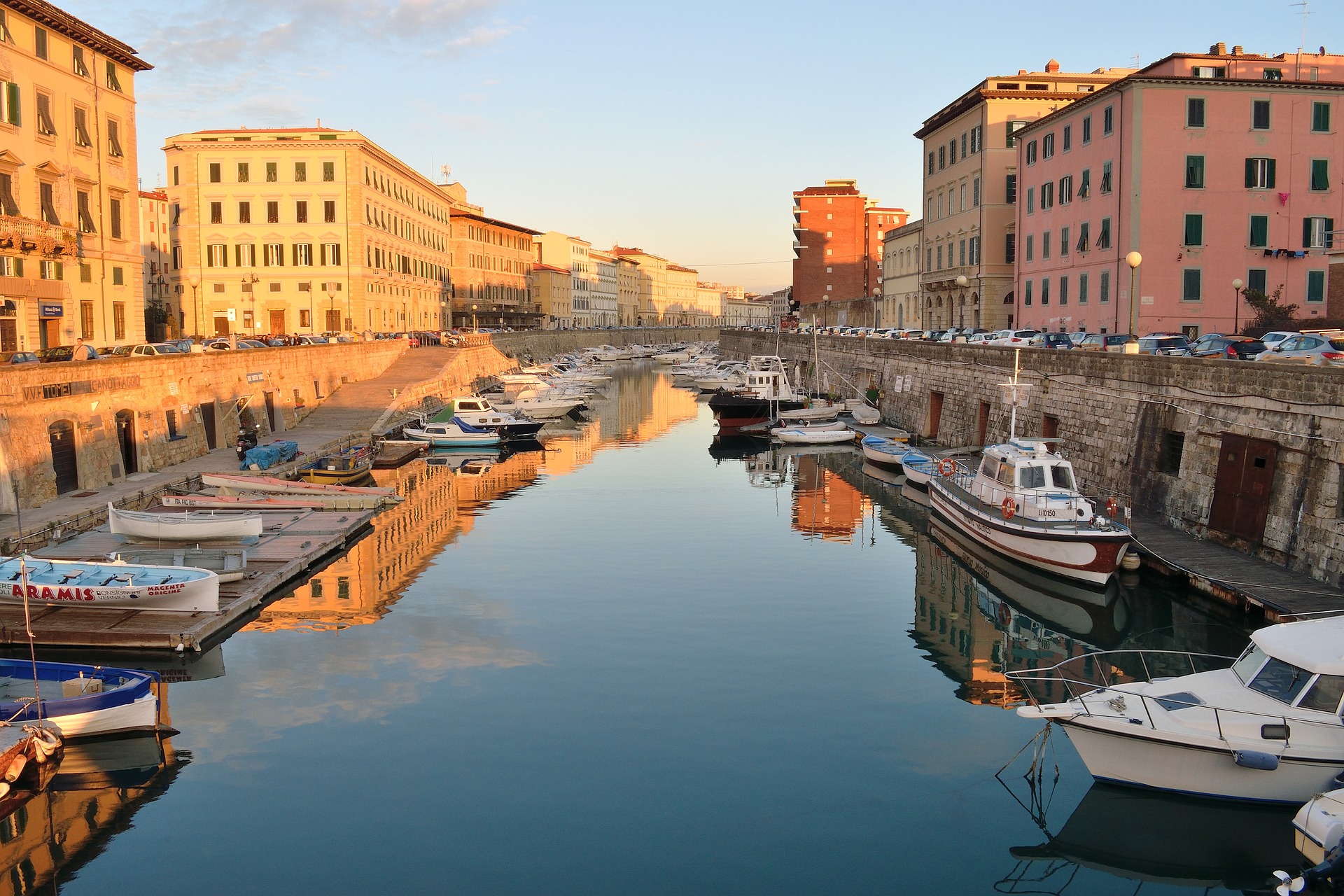
The canals of Livorno's popular Venezia Nuova district come alive after dark
The canals of Livorno's popular Venezia Nuova
district come alive after dark
Travel tip:

Livorno, where Delia Scala spent the later years of her life, is the second largest city in Tuscany after Florence, with a population of almost 160,000, and the region’s great sea port. Ferries, cargo ships, cruise liners, fishing boats, and naval vessels all move through the harbour. Yet just beyond the cranes and docks you find a city shaped by centuries of immigration, free‑trade policies, and Medici ambition. Livorno, which began as a small coastal settlement, was for centuries overshadowed by nearby Pisa, whose republic controlled the area throughout the Middle Ages.  As it grew, the port was sold to Milan in 1399 and to Genoa in 1407 before it was purchased by Florence in 1421, bringing it under Medici rule for the next three centuries.  The Medici recognised Livorno’s strategic potential and rebuilt the harbour, fortified the town, and declared it a free port, attracting merchants from across Europe and the Mediterranean. As well as becoming a major commercial hub it became one of Italy’s most cosmopolitan cities, with significant Jewish, Greek, Armenian and Dutch Protestant minorities. The Medici legacy is visible in the 16th century red brick Fortezza Vecchia, that stands guard over the harbour. Other attractions include the Fortezza Nuova, also built by the Medici, which anchors Livorno’s popular Venezia Nuova district, with its network of canals, and the elegant Terrazza Mascagni, the seafront promenade, paved in a sweeping black‑and‑white checkerboard pattern, which carries the name of one of Livorno’s most famous sons, the opera composer Pietro Mascagni.

Find Livorno accommodation with Expedia

More reading:

Raimondo Vianello, a big-screen star who conquered television

Why comic actor Totò is still seen as one of Italy’s funniest performers

How Umberto Veronesi pioneered new treatments for breast cancer

Also on this day:

1623: The death of Venetian writer and statesman Paolo Sarpi

1926: The death of songwriter Giambattista De Curtis

1935: The birth of football coach Gigi Radice

1971: The birth of rugby star Paolo Vaccari

1977: The birth of Giorgia Meloni, Italy’s first female PM


Home

30 October 2025

Giuseppe Ravizza - inventor

His writing machine was forerunner of typewriter

Ravizza used piano keys in his prototype design for his Cembalo Scrivano
Ravizza used piano keys in his prototype
design for his Cembalo Scrivano
The 19th century inventor Giuseppe Ravizza, whose Cembalo Scrivano machine could be seen as the world’s first typewriter, died on this day in 1885 in Livorno, on the Tuscan coast, about 25km (16 miles) south of Pisa.

Ravizza created the first working prototype for his writing machine in 1846 and was granted patent in 1855. Yet, although he hailed from a wealthy Piedmontese family in Novara, he did not have the opportunity in pre-unification Italy to manufacture the device on a commercial scale.

As a result, the invention of the typewriter is most commonly credited to Christopher Latham Sholes, an American inventor whose design was not patented until 1868, yet had many of the characteristics of Ravizza’s Cembalo Scrivano.

Produced with the help of Sholes's fellow designers Carlos Glidden and Samuel Souley, the American machine was eventually manufactured at scale by E Remington and Sons in 1873, marking the beginning of the typewriter's widespread use.

Born in Novara in 1811, Ravizza’s education was aimed at him becoming a lawyer and though he graduated he rarely practised. He was much more interested in engineering, specifically in producing a machine that could replicate the art of writing.


He was not the first to have envisaged such a machine. In the early 19th century, an Italian nobleman, Pellegrino Turri, designed a device he hoped would help a blind friend be able to write letters. It did not progress beyond a prototype, although it was Turri who is credited with inventing carbon paper as a means to make an imprint on the page. Another machine is said to have been designed by an American, William Austin Burt, in around 1829.

Ravizza came from a wealthy background in Novara
Ravizza came from a wealthy
background in Novara
Ravizza’s Cembalo Scrivano - literally ‘writing harpsichord’ - was so-called because the typing keys resembled those of a harpsichord. They were, in fact, recycled piano keys. Although it was not a qwerty keyboard, which is definitively thought to be a Sholes invention, the letters were arranged in what Ravizza felt was a logical order, with the aim that the user would be able to employ all 10 fingers in the writing process.

The upstroke mechanism that would be characteristic of the later American-produced version was also present in Ravizza’s machine, which also allowed the user to type both upper and lower case letters, an advancement not seen in the first Remington models.

His keyboard layout was almost certainly inspired by musical instruments, reflecting his belief that writing should be fluid and expressive. His ultimate vision was of a mechanised device that could put words on paper almost at the speed of thought.

Historians have noted the striking similarities between the Sholes typewriter and Ravizza’s design, and while no direct evidence of plagiarism has been uncovered it is possible that American designers will have been aware of Ravizza’s work. 

The Cembalo Scrivano was shown to the public at the Industrial Exhibition in Turin in 1856, where Ravizza sold a small number at 200 lire each, and at a similar exhibition in Novara, where it was awarded a gold medal.  The Cembalo Scrivano was also exhibited in London. 

Ravizza spent almost 40 years refining his typewriter but it was never produced on a commercial scale
Ravizza spent almost 40 years refining his typewriter
but it was never produced on a commercial scale
In total, Ravizza spent nearly 40 years refining his machine. Despite producing at least 16 models of his Cembalo Scrivano between 1847 and the early 1880s, his inventions never reached mass production or commercial viability. 

Italy in the mid-19th century lacked the industrial infrastructure to support such innovation, and Ravizza himself was more an inventor than a businessman, with no particular motivation to make financial gains.

Having been born into a moneyed background, in 1886 he married Alessandrina Massini, an Italian philanthropist sometimes described as a forerunner of the feminist movement. Their home became a popular bourgeois salon.

Today, he is remembered as a visionary precursor to the typewriter revolution, if not the inventor. His machines are preserved in museums and private collections, including the Civic Museum of the Broletto in Novara, which has a Cembalo Scrivano donated in 1940 by the Mayor of Ivrea on behalf of the Olivetti Society.

The towering dome of the Basilica of San Gaudenzio dominates the landscape of Novara in Piedmont
The towering dome of the Basilica of San Gaudenzio
dominates the landscape of Novara in Piedmont
Travel tip:

Novara, where Ravizza was born, is around 65km (40 miles) west of Milan and 100km (62 miles) northeast of Turin. With a population of just over 100,000, it is the second largest city in the Piedmont region, after Turin. Founded by the Romans, it was later ruled by the Visconti and Sforza families. In the 18th century it was ruled by the House of Savoy. In the 1849 Battle of Novara, the Sardinian army was defeated by the Austrian army, who occupied the city. This led to the abdication of Charles Albert of Sardinia and is seen as the beginning of the Italian unification movement.  Among the fine, historic buildings in Novara, which include the Basilica of San Gaudenzio - notable for its towering campanile, topped by Alessandro Antonelli's 75m cupola - and the Broletto, a complex that was at the civic heart of many medieval Italian cities, is the Novara Pyramid, which is also called the Ossuary of Bicocca. It was built to hold the ashes of fallen soldiers after the 19th century Battle of Novara.

Stay in Novara with Expedia

The busy port of Livorno on Italy's west coast is the second largest city in Tuscany
The busy port of Livorno on Italy's west coast
is the second largest city in Tuscany
Travel tip:

The port of Livorno is the second largest city in Tuscany after Florence, with a population of almost 160,000. It is the region’s principal seaport, a dynamic gateway to the Tyrrhenian Sea and a vital hub for both cargo and cruise traffic. The port spans over 2.5 million square meters, with 21 km of docks and around 90 berths. It handles over 35 million tonnes of goods and more than 3.5 million passengers, including 800,000 cruise passengers, each year. Positioned on Italy’s west coast, it is about 90km (56 miles) from Florence. Although it is a large commercial port with much related industry, it has many attractions, including an elegant sea front – the Terrazza Mascagni - an historic centre – the Venetian quarter – with canals, and a tradition of serving excellent seafood.  The Terrazza Mascagni is named after the composer Pietro Mascagni, who was born in Livorno. 

Find a hotel in Livorno with Hotels.com

More reading:

Camillo Olivetti - the founder of Italy’s first typewriter factory

The Italian engineer behind the world’s first personal computer

The priest and physicist who created the first ‘fax machine’

Also on this day:

1459: The death of humanist scholar Poggio Bracciolini

1877: The birth of businesswoman Luisa Spagnoli

1893: The birth of bodybuilder Charles Atlas

1896: The birth of conductor Antonino Votto


Home


3 December 2022

Matilde Malenchini – painter

The tempestuous life of a talented Tuscan artist

Vincenzo Camuccini's portrait of Malenchini, from about 1815
Vincenzo Camuccini's portrait of
Malenchini, from about 1815
The painter Matilde Malenchini was born on this day in 1779 in Livorno in Tuscany. She was well-known for her paintings of church interiors but turned to portrait painting later in life to make money to help her survive after her long relationship with Belgian writer Louis de Potter ended.

Matilde was born into the Meoni family and married the painter and musician Vincenzo Francesco Malenchini at the age of 16. Although they soon separated, she kept his name for the rest of her life.

In 1807 she went to study at the Accademia di Belle Arte in Florence under the guidance of Pietro Benvenuti. To earn money and practise her art, she copied the works of old Italian and Dutch masters in the Uffizi Gallery in Florence.

After being given a four-year annual stipend by Elisa Bonaparte, the Grand Duchess of Tuscany, in 1811, Matilde went to Rome to study at the Pontificia Accademia romana delle belle arti di San Luca. There she met the French Governor of the Papal States, General Francois de Mollis, who was an art collector. He bought 18 of her paintings and helped her establish a studio in the convent of Trinità dei Monti. 

While painting church and convent interiors, she worked with students from the Academie Francaise who were living in the Villa Medici, as well as the up-and-coming Italian artists Antonio Canova and Vincenzo Camuccini. In 1815, Matilde was named a Professor of Merit at the Accademia di San Luca and in the same year Camuccini painted her portrait. The years she spent in Rome proved to be the most productive of her career.

Malenchini's own portrait of the writer Louis de Potter, her long-time partner
Malenchini's own portrait of the writer
Louis de Potter, her long-time partner
She embarked on a long and intense relationship with Louis de Potter and between 1817 and 1819 they shared a home with the painter Francois-Joseph Navez. The couple attempted to obtain an annulment of Matilde’s previous marriage by appealing to the Roman Curia, but their requests coincided with some scandalous trials involving monks and nuns, which caused the Curia to be more cautious than usual with their decisions. At around the same time, Matilde’s former husband, who was supporting the request, was having problems with the police to further complicate the issue.

In 1820, Matilde had to leave Rome and she returned to Florence where she was named an honorary professor at the Accademia.

De Potter returned to Bruges in 1823 to be with his ailing father, but the following year, after his father’s death, he moved to Brussels and invited Matilde to join him. Their home in the Belgian capital became a meeting place for expatriate Italians and political refugees. With their friend Navez, they organised painting classes. Navez also became a prominent advocate for Belgian independence.

Matilde became restless and travelled for a while before returning to live in Florence. De Potter, who was frustrated at not being able to marry her, ended the relationship in 1826. He later married Sophie van Weydeveldt, 20 years his junior, with whom he had four children.

Although De Potter agreed to give Matilde an annual pension of 1200 francs, the money was spasmodic because of his political problems. He served 18 months in prison after writing a pamphlet denouncing King William I of Belgium and then went into exile in Germany. Matilde turned to portrait painting to make money to keep herself. There was no contact between her and De Potter until 1854, when he wrote her an affectionate letter following the death of his son, and afterwards they maintained contact with each other through letters.

The following year, by which time Matilde was 76, she was accused of pushing one of her maids out of a window after she caught her stealing. She was sentenced to three and a half years detention but the ruling was overturned. However, it was reinstated in 1857 and sadly, one of Matilde’s last paintings was of the interior of the prison in Florence. She died in 1858 in Fiesole in Tuscany at the age of 78.

Livorno, the Tuscan port city where Malenchini was born, has a network of canals
Livorno, the Tuscan port city where Malenchini
was born, has a network of canals
Travel tip:

Livorno, Malenchini’s birthplace, is the second largest city in Tuscany, with a population of almost 160,000. It has a large commercial port and in many respects is the most modern city in the region, yet there are also many remnants of its history.  Designed by the architect Bernardo Buontalenti at the behest of the House of Medici at the end of the 16th century, Livorno was conceived as an "ideal city" of the Italian Renaissance. Notable are the huge Fortezza Vecchia - the Old Fortress - which was built to protect the port, the fortified walls around the city’s pentagonal plan and the dense network of canals, a kind of “Little Venice”, which were originally created to connect the merchants’ residences with their warehouses.  The city has produced many notable painters, including the 19th century landscape and battlefield painter Giovanni Fattori, and the celebrated modernist painter of portraits and nudes, Amedeo Modigliani.  It was also home to the opera composer, Pietro Mascagni.

The remains of a Roman theatre on a hillside near the town of Fiesole in Tuscany
The remains of a Roman theatre on a hillside
near the town of Fiesole in Tuscany
Travel tip:

Fiesole, where Malenchini died, is a town of about 14,000 inhabitants occupying an elevated position about 8km (5 miles) northeast of Florence. Since the 14th century, it has been a popular place to live for wealthy Florentines and even to this day remains the richest municipality in the city. Once an important Etruscan settlement, it was also a Roman town of note, of which the remains of a theatre and baths are still visible.  Fiesole's Romanesque cathedral, built in the 11th century, is supposedly built over the site of the martyrdom of St. Romulus. In the middle ages, Fiesole was as powerful as Florence until it was conquered by the latter in 1125 after a series of wars.

Also on this day:

1596: The birth of violin maker Nicolò Amati

1911: The birth of composer Nino Rota

1917: The death in World War One of cycling champion Carlo Oriani

1937: The birth of actress Angela Luce

1947: The birth of politician Mario Borghezio


Home


24 March 2019

Guido Menasci - poet, librettist and biographer

Respected writer and historian who found fame from an opera


Guido Menasci (right) with fellow librettist Giovanni  Targioni-Tozzetti, flanking composer Pietro Mascagni
Guido Menasci (right) with fellow librettist Giovanni
Targioni-Tozzetti, flanking composer Pietro Mascagni
The writer Guido Menasci, who is best known as a co-author of the libretto for composer Pietro Mascagni’s successful opera Cavalleria rusticana but was also a respected historian, was born on this day in 1867 in the Tuscan port of Livorno.

Menasci, a law graduate from the University of Pisa and briefly a prosecutor at the Court of Appeal in Lucca, wrote for a number of literary magazines in Italy and beyond and produced a biography of the German poet and playwright Johann Wolfgang Goethe that is considered a definitive work.

Fluent in French as well as Italian, he published books and gave lectures in Paris, often on the subject of art history, which was another of his fascinations.

Yet he was most famous for his work with Mascagni and his fellow librettist, Giovanni Targioni-Tozzetti, whom he met through his involvement with literary and cultural societies in Livorno, where all three grew up.

They collaborated on a number of operas, the most famous of which by some way was Cavalleria rusticana, which was performed for the first time in 1890, at the Teatro Costanzi in Rome.

The tenor Roberto Stagno and soprano Gemma Bellincioni in the premiere of Cavalleria rusticana in Rome
The tenor Roberto Stagno and soprano
Gemma Bellincioni in the premiere
of Cavalleria rusticana in Rome
Based on a novella of the same name by Giovanni Verga, Cavalleria Rusticana is a simple story of betrayal and revenge involving two men and two women in a Sicilian village. Its success turned Mascagni, a modest music teacher, into a composer of international fame, not least for the beautiful intermezzo that has become a popular piece standing alone from the opera.

Menasci inherited his gift for writing from his father, who was a shopkeeper but also a published author of a number of books of verse and was a councillor in Livorno involved with education.

He began to write poetry at the same time as he was studying law, amusing his fellow students by composing summaries of lectures in verse.

Soon, his poetry was appearing regularly in the pages of publications such as Lettere e arti, a well-known Bolognese magazine founded by Enrico Panzacchi, others in Italy and in foreign periodicals such as the French daily Le Siècle , the Austrians Neue Freie Presse and Neue Wiener Tagblatt, and the English monthly The English Illustrated Magazine.

His collaboration with Targioni-Tozzetti, whose father, Ottaviano, had taught him literary studies at high school, began in 1899 and included the libretti for several other operas in addition to Cavalleria rusticana, including I Rantzau and Zanetto, also by Mascagni, and Umberto Giordano’s Regina Diaz. He and Targioni-Tozzetti also edited an Italian version of Werther by Jules Massenet.

At the same time, Menasci was working independently for other composers, such as the Germans August Scharrer and Ignaz Brüll. During a lengthy stay in Germany he compiled his biographical study of Goethe (1899), which was considered remarkable even among the many works dedicated to the German poet.

Menasci devoted much time to the study of other German writers and to figures in French literary and civil history. He wrote elegantly in French and was able to address conferences and deliver lectures in Paris with full confidence in his command of the language.

His versatility extended to writing stories for children and numerous studies devoted to the history of art.

In his later years, he returned to Livorno and became a professor at the prestigious Naval Academy. He died in Livorno in 1925 after a period of declining health.

Livorno's elegant promenade Terrazza Mascagni was named after the composer Pietro Mascagni
Livorno's elegant promenade Terrazza Mascagni was
named after the composer Pietro Mascagni
Travel tip:

The port of Livorno is the second largest city in Tuscany after Florence, with a population of almost 160,000. Although it is a large commercial port with much related industry, it has many attractions, including an elegant sea front – the Terrazza Mascagni - an historic centre – the Venetian quarter – with canals, and a tradition of serving excellent seafood.  The Terrazza Mascagni is named after the composer Pietro Mascagni, who was born in Livorno. Menasci is commemorated rather less grandly in the name of a fairly nondescript street in a residential area close to the city’s main railway station.

Find a Livorno hotel with Booking.com

The Teatro Costanzi, in Via del Viminale, a short distance from Piazza della Repubblica, is now known as Teatro dell'Opera
The Teatro Costanzi, in Via del Viminale, a short distance from
Piazza della Repubblica, is now known as Teatro dell'Opera
Travel tip:

Known today as the Teatro dell'Opera di Roma - Rome’s main opera house - the Teatro Costanzi was built in 1879-80. Financed by Domenico Costanzi, a contractor, it was designed by the Milanese architect Achille Sfondrini, a specialist in the building and renovation of theatres. Built on the site of the house of the Roman emperor Elagabalus, the theatre was inaugurated in November 1880 with a performance of Semiramide by Gioachino Rossini.  Sfondrini paid particular attention to the acoustics of the theatre, the dome of which was adorned with frescoes by Annibale Brugnoli. As well as the world premiere of Cavalleria rusticana, the theatre staged the first production of Tosca by Giacomo Puccini in January 1900 and introduced Roman audiences to Puccini’s La fanciulla del West, Turandot and Il trittico, Richard Wagner’s Parsifal and Modest Mussorgsky’s Boris Godunov among other compositions that would become famous.

8 February 2019

Italo Santelli - fencer

Olympic medallist famous for real ‘duel’


Italo Santelli set new standards for sabre fencing with his own technique
Italo Santelli set new standards for
sabre fencing with his own technique
The Olympic fencer Italo Santelli, who famously fought a duel with his former team captain over a matter of honour, died on this day in 1945 in Livorno, Tuscany.

Santelli won a silver medal at the 1900 Olympics in Paris with a new style of sabre fencing of his own invention. Originally from Carrodano in Liguria, he fought for Italy but spent a large part of his career coaching Hungary, who he helped become a formidable power in fencing.

It was this conflict of interests that sparked an incident at the 1924 Olympics, also in Paris, that led to Santelli and Adolfo Cotronei, who was Italy’s team captain, engaging in the infamous duel.

It happened during a match between the Italians and the host nation France in the team foil event when Italy’s Aldo Boni was facing off against Lucien Gaudin. With the match tied at four touches each, the Hungarian judge György Kovacs awarded the winning fifth touch to Gaudin, a decision that sparked immediate consternation in the Italian ranks.

Boni rounded on Kovacs, delivering a verbal tirade. But it was in Italian - beyond the official’s comprehension. It just happened that Santelli, in his capacity as Hungary’s coach, witnessed the whole dispute and was asked to step in as interpreter.

Santelli’s translation did not reflect well on Boni, who was asked to apologise for insulting Kovacs. When he refused, Italy were disqualified and the event ended with France winning the gold, with Belgium taking silver and Hungary the bronze.

Italo Santelli, left, in action at the Paris Olympics of 1900, in which he won a silver medal in the sabre event
Italo Santelli, left, in action at the Paris Olympics of 1900,
in which he won a silver medal in the sabre event
That seemed to be the end of the matter until, on the team’s return to Italy, the captain Cotronei, who was also a journalist, wrote an article in which he alleged that Santelli had deliberately portrayed Boni as the villain on the basis that if the Italians were eliminated, his own Hungary team would have a better chance of finishing in a medal position.

Santelli was outraged but the bullish Cotronei stood by his article and, although accounts vary as to who challenged whom, it was somehow agreed that the two would engage in a duel, a dispute-settling method that had been outlawed in many other parts of the western world but was still part of Italian culture even in the early part of the 20th century. Legislation was being drawn up to ban the practice in Italy - driven by Benito Mussolini, then still Prime Minister rather than dictator - but special dispensation was obtained to allow this one to go ahead.

Thus the the stage was set for a date in August for the two to face each other with sabres in the town of Abbazia, a town about 70km (43 miles) southeast of Trieste that later became Opatija in Croatia but was then on Italian soil.

In the event, Cotronei had to take on not Italo Santelli but his son, Giorgio, another fencer, who had invoked a rule under the 18th century Code Duello that allowed him to substitute for his father, who was keen to defend his honour but was by then in his 61st year.

It was at the 1924 Olympics, again in Paris, that Santelli became embroiled in a dispute between the Italian team and an official
It was at the 1924 Olympics, again in Paris, that Santelli became
embroiled in a dispute between the Italian team and an official
It was not a fight to the death, thankfully, but blood needed to be drawn for a winner to be declared.  Within only a couple of minutes, the nimbler and more agile Santelli junior had inflicted a cut to Cotronei’s face and the duel was over.

Italo Santelli had been educated at the Scuola Magistrale Militare, a military school in Rome, but in 1896 decided to move to Budapest together with brother Otello, also a fencer, and his wife. Their son, Giorgio, was born in Hungary in 1897, although he kept his Italian citizenship and ultimately emigrated to the United States,

It was while working in Hungary that he developed the new style of sabre fencing, involving a much quicker defence than the classical style. It became known as the "modern style" or the “Santelli style” and historians of the sport sometimes refer to Santelli as “the father of modern sabre fencing.”

Although Cotronei was known for his temper - he fought at least six duels in his lifetime - he and Santelli were said to have been reconciled when they met again at the 1932 Olympics in Los Angeles and subsequently became friends.

The Abbey Church of Santa Maria Assunta, built from Carrara marble, is one of La Spezia's attractions
The Abbey Church of Santa Maria Assunta, built from
Carrara marble, is one of La Spezia's attractions
Travel tip:

Santelli’s home village of Carrodano is in the province of La Spezia, a port city of 94,000 inhabitants and Liguria’s second city after Genoa. The home of Italy’s largest naval base and a major commercial port, tucked away in a sheltered gulf, La Spezia is so close to the ruggedly beautiful stretch of coastline known as the Cinque Terre, not to mention the picturesque fishing village of Portovenere, that it tends not to be regarded as a tourist attraction. Yet La Spezia has an atmospheric historic centre of narrow streets, not to mention the recently restored 17th century castle and the impressive black and white Carrara marble of the Abbey Church of Santa Maria Assunta.


One of the canals in Livorno's Venetian quarter
Travel tip:

Santelli spent his final days in another of Italy’s northern Mediterranean port cities, Livorno. The second population area in Tuscany after Florence, Livorno has a population of almost 160,000. Although it is a large commercial port with much related industry, it has many attractions, including an elegant sea front – the Terrazza Mascagni - and an historic centre – the Venetian quarter – with canals, and a tradition of serving excellent seafood.  The Terrazza Mascagni is named after the composer Pietro Mascagni, famous for the opera Cavalleria Rusticana, who was born in Livorno.


More reading:

Valentina Vezzali, the fencer who is Italy's most successful athlete

How Luigi Baccali brought home Italy's first Olympic track gold

Ottavio Missoni: From Olympic hurdler to fashion designer

Also on this day:

1591: The birth of Baroque master Guercino

1751: The death of Trevi Fountain architect Nicola Salvi

1848: Padua revolts against the Austrians

(Picture credits: La Spezia church by Davide Papalini; Livorno canal by Daniel Ventura; via Wikimedia Commons)


Home


24 October 2018

Sir Moses Montefiore - businessman

Italian-born philanthropist who made his fortune in London


A late 18th century photograph of the Jewish philanthropist Moses Montefiore
A late 18th century photograph of the
Jewish philanthropist Moses Montefiore
The businessman and philanthropist Sir Moses Montefiore, who made his fortune in England and became a prominent supporter of Jewish rights, was born in Livorno on this day in 1784.

Born into a Sephardic Jewish family, his grandfather, Moses Vita (Haim) Montefiore, had emigrated from Livorno to London in the 1740s, but regularly returned to Italy, as did other members of the family.

Moses Montefiore was born while his parents, Joseph Elias and Rachel - whose father, Abraham Mocatta, was a powerful bullion broker in London - were in Livorno on business.

Their son was to amass considerable wealth in his working life, accumulating such a fortune on the London stock exchange he was able to retire at 40, but in his youth his family’s situation was so perilous he had to abandon his education without qualifications in order to find a job.

First apprenticed to a firm of grocers and tea merchants, he left to become one of 12 so-called ‘Jew brokers’ in the City of London.  His early days in the city were not without setbacks, notably when a major fraud in 1806 caused him to lose most of his clients’ money and cost him his broker’s licence.

A drawing from a magazine shows Moses Montefiore as a young man
A drawing from a magazine shows
Moses Montefiore as a young man 
He bought a new licence in 1815 and his big break came after Henriette, the sister of his wife Judith Cohen, married Nathan Rothschild, who engaged Montefiore's firm acted as stockbrokers.

Nathan Rothschild headed the family's banking business in Britain, and Montefiore became his business partner.

In that capacity, Montefiore helped found the Alliance Assurance Company, the Imperial Continental Gas Association (which pioneered gas lighting for homes), and the Provincial Bank of Ireland.

Montefiore retired from his business in 1824, deciding to use his time and fortune for communal and civic responsibilities. He became known as a philanthropist and a zealous fighter for the rights of oppressed Jews all over the world.

Besides visiting such countries as Italy, Russia, and Romania on behalf of the Jewish people, he also made seven journeys to Palestine.

In 1827, he helped secure the release of a number of Damascan Jews who had been falsely accused of using Christian blood for religious rites and persuaded the Turkish sultan to extend to Jews the same privileges enjoyed by aliens.

In Russia he convinced Tsar Nicholas I to rescind a decree of 1844 that had ordered all Jews to withdraw from the western frontier areas of Russia.

Montefiore's London home was at 99 Park Lane in the Mayfair district
Montefiore's London home was at 99 Park
Lane in the Mayfair district
Back in London, he became a governor of Christ's Hospital, an independent educational establishment also known as the Bluecoat School, and in 1837 was elected Sheriff of London. 

He was knighted in the same year by Queen Victoria and received a baronetcy in 1846 in recognition of his services to humanitarian causes on behalf of the Jewish people.

He was president of the British Board of Deputies from 1835-1874, with one brief interruption. Despite his position, he did not play a prominent role in the Jewish emancipation struggle at home, preferring to help oppressed Jewish communities abroad.

In 1831, while keeping his home in Park Lane in London, Montefiore bought a country estate with 24 acres of land on the East Cliff of the then-fashionable seaside town of Ramsgate, previously the home of Queen Caroline, when she was still Princess of Wales.  He purchased some adjoining land and commissioned his cousin, architect David Mocatta, to design a private synagogue, known as the Montefiore Synagogue.

Montefiore died at East Cliff in 1885, at the age of 100. He had no known children and his principal heir in both name and property was a nephew, Joseph Sebag Montefiore.  His great, great nephew is the historian, author and TV presenter Simon Sebag Montefiore.

The beautiful Terrazza Mascagni is a feature of the  waterfront in modern Livorno
The beautiful Terrazza Mascagni is a feature of the
waterfront in modern Livorno
Travel tip:

The port of Livorno is the second largest city in Tuscany after Florence, with a population of almost 160,000. Although it is a large commercial port with much related industry, it has many attractions, including an elegant sea front – the Terrazza Mascagni - an historic centre – the Venetian quarter – with canals, and a tradition of serving excellent seafood.  The Terrazza Mascagni is named after the composer Pietro Mascagni, famous for the opera Cavalleria rusticana, who was born in Livorno.

The plaque commemorating the life of Sir Moses Montefiore is near the Jewish synagogue in Liverno
The plaque commemorating the life of Sir Moses Montefiore
is near the Jewish synagogue in Liverno 
Travel tip:

A plaque commemorating the life of Sir Moses Montefiore can be found in Piazza Elia Benamozegh in Livorno, the location of the city’s synagogue. Livorno was once home to one of the largest Sephardic communities in Western Europe, second only to Amsterdam. The 16th century Florentine leader Ferdinando I Medici, who governed Livorno, allowed the city’s Jews to govern themselves, without being confined to a ghetto. Although the Jewish settlement in the city had clear parameters, there were few limits imposed on the community, which by the 18th century numbered more than 4,000, almost 15 per cent of the the city’s population.

More reading:

The story of Auschwitz survivor Primo Levi

Salomone Rossi, the leading Jewish musician of the late Renaissance

The good samaritan of Rimini Alberto Marvelli

Also on this day:

1913: The birth of the acclaimed baritone Tito Gobbi

1925: The birth of composer Luciano Berio


Home

14 August 2018

Giorgio Chiellini - footballer

Juventus star renowned for defensive excellence


Giorgio Chiellini won 97 caps for the Italian national team but missed out on trophies
Giorgio Chiellini won 97 caps for the Italian
national team but missed out on trophies
The footballer Giorgio Chiellini, renowned as one of the world’s best defenders, was born on this day in 1984 in Pisa.

Chiellini has played for much of his career at Juventus, winning an incredible seven consecutive Serie A titles from 2012 to 2018, as well as numerous other trophies.  He was Serie A Defender of the Year in 2008, 2009 and 2010 and in 2017 was named in Juventus’s Greatest XI of All Time.

He also earned 97 caps for the Italy national team before announcing his retirement from international football in 2017, establishing himself as an automatic choice in a back three or four under five different coaches.

All of Chiellini’s successes so far have been in domestic football.  He was considered too young and inexperienced to be part of Marcello Lippi’s 2006 World Cup squad and hung up his boots with the azzurri without winning a trophy.

He has also missed out so far on success in European club competitions. He missed the 2015 Champions League final, which Juventus lost to Barcelona in Berlin, and finished on the losing side in the 2017 Champions League final, when the Italian champions were thumped 4-0 by Read Madrid in Cardiff.

Chiellini has won seven consecutive Serie A titles during a 13-year career with Juventus
Chiellini has won seven consecutive Serie A titles during
a 13-year career with Juventus
But he still has hopes of winning a Champions League medal now that Cristiano Ronaldo, who scored two of Real Madrid’s four goals in that match, has joined Juventus for the 2018-19 season.

Chiellini is regarded as a character of contradictions. As a player, he has broken his nose four times and been sent off five times. When he scores a goal he pounds his chest with closed fists. He is the archetypal Italian defender - rugged, ruthless and uncompromising.

Yet away from football he is softly spoken and a lover of literature, a calm and reflective personality not given to excess or displays of temper.

He was brought up in Livorno, a dockyard city on the coast of Tuscany with a seamy side, yet was always a conscientious student and would have left high school for university had he not been occupied with becoming a footballer. In the event, after becoming an established player, he enrolled at the University of Turin, where he completed a laurea - a bachelor’s degree - in economics and commerce and a master's in business administration.

The son of an orthopaedic surgeon, he would have studied medicine but found the work involved incompatible with being a footballer.

Chiellini in action against Cesc Fabregas of Spain
Growing up, being an enthusiastic follower of the Los Angeles Lakers, he dreamed of playing basketball, before his talent for football won out.

One of twin boys, he joined his local Livorno team at the age of 13. He played as a central midfielder and a winger before settling into the role of left-back, making his senior debut at the age of 17 in 2000.

Livorno then sold him to Roma but he was immediately loaned back to the Tuscan club, before being sold to Juventus, who loaned him to Fiorentina. He finally made his Juventus debut in the 2005-06 season and was part of a title-winning team, although the prize was later taken from them because of the so-called Calciopoli corruption scandal.

Many players left the club after the scandal, which also led to the team’s demotion to Serie B, but Chiellini remained as part of the squad that won promotion under Didier Deschamps in 2006-07 and became a key element in the rebuilding of bianconeri fortunes under a succession of coaches, culminating in three consecutive Serie A titles under Antonio Conte and four more under current coach Massimiliano Allegri.

Chiellini retired from international football in 2017 but is continuing his domestic career
Chiellini retired from international football
in 2017 but is continuing his domestic career
Chiellini made his debut for the Italian national team in November 2004 against Finland under Lippi, at the age of 20. He scored his first of his eight goals for the azzurri three years later.

Roberto Donadoni made him a regular member of the national team, although his first call-up for a major tournament did not get off to the best start. Preparing for the Euro 2008 finals, he collided with the national captain, Fabio Cannavaro, during a training session, with the result that Cannavaro missed the whole tournament.

He made up for that with some impressive performances, particularly against the eventual winners Spain in the quarter-final, which ended in a 0-0 draw before Italy were eliminated in a penalty shoot-out.

Subsequently, Chiellini was one of the first names on the teamsheet for Lippi in his second spell in charge of the national team, and for Cesare Prandelli, Conte and Gian Piero Ventura, even though his international career did not bring him the trophies he probably deserved.

His two World Cups were disappointing, ending in early elimination for Italy in 2010 and 2014, and though Prandelli’s team reached the final of Euro 2012 they were beaten 4-0 by Spain, with Chiellini substituted due to injury.

He announced his retirement from international football after Italy failed to qualify for the 2018 World Cup finals in Russia, beaten in a play-off by Sweden.

In July 2014, Chiellini married his long-time girlfriend Carolina Bonistalli at the Sanctuary of Montenero in Livorno. The couple have a daughter, Nina, born in 2015.

Livorno's elegant Terrazza Mascagni promenade
Travel tip:

Livorno is the second largest city in Tuscany after Florence, with a population of almost 160,000. Although it is a large commercial port with much related industry, and also suffered extensive damage as a prime target for Allied bombing raids in the Second World War, it retains many attractions, including an elegant sea front – the Terrazza Mascagni - an historic centre – the Venetian quarter – with canals, and a tradition of serving excellent seafood.

The Sanctuary of Montenero in the Livorno Hills
Travel tip:

The Sanctuary of Montenero, where Chiellini was married, can be found in the village of the same name, part of the area south of the city known as the Livorno Hills. The complex, now elevated to the rank of basilica and maintained by Vallumbrosan monks, originated in the early 17th century and was expanded in the 18th century before a suppression of religious orders in the later part of the century led it to fall into disrepair.  It was fully restored in the last century.  A series of grottos exist behind the church, once a hide-out for robbers and a shelter during the Second World War, but these are now closed over safety concerns.

More reading:

The story of record-breaking coach Massimiliano Allegri

Marcello Lippi and Italy's fourth World Cup

Franco Baresi - Italy's greatest defender?

Also on this day:

1742: The birth of Pope Pius VII

1988: The death of car maker Enzo Ferrari


Home

6 August 2018

Battle of Meloria

Naval loss that sparked decline of Pisa as trading power


An artist's visualisation of the Battle of Meloria
The decline of the Republic of Pisa as one of Italy’s major naval and commercial powers began with a catastrophic defeat at the Battle of Meloria on this day in 1284.

A fleet of 72 galleys was routed by the forces of the rival Ligurian Sea port of Genoa in a confrontation fought close to the islet of Meloria, about 10km (6 miles) off the coast, near what is now Livorno.

More than 5,000 Pisan crew were killed with 10 galleys sunk and at least 25 captured before other vessels fled the scene and the Genovese claimed victory.

Pisa and Genoa had once been allies, joining forces to drive the Saracens out of Sardinia in the 11th century, but subsequently became fierce rivals for trade, particularly from the eastern Mediterranean and the Byzantine Empire.

The city’s participation in the Crusades secured valuable commercial positions for Pisan traders in Syria, and thereafter Pisa grew in strength to rival Genoa and Venice.

A scene from the battle displayed in a commemorative plaque in Diano Castello, Liguria
A scene from the battle displayed in a commemorative
plaque in Diano Castello, Liguria
However, in the 13th century, Genoa conquered numerous settlements in Crimea, establishing a colony at Caffa. The Byzantine Empire granted free trading rights to Genoa, increasing their wealth and simultaneously reducing commercial opportunities for Venice and Pisa.

Matters came to a head in the tense relationship between Pisa and Genoa in 1282 when Pisa tried to seize control of the commerce and administration a part of Corsica then held by Genoa, on the pretext of responding to a call for help after an uprising.

The Genovese retailiated by blockading Pisan commerce near the River Arno and both sides began preparing for war. Pisa recruited soldiers from Tuscany and appointed captains from its noble families. The Genovese leader Oberto Doria massively expanded his fleet, hiring between 15,000 to 17,000 rowers and seamen.

In early 1284, the Genovese fleet acted to provoke a conflict by attempting to conquer Porto Torres and Sassari in Pisan-controlled Sardinia. Pisa responded but the force they sent to engage the Genovese was defeated.

he drawing on which a lunette fresco by Giovanni David in the Sala del Maggior Consiglio of the Palazzo Ducale, Genoa
The drawing on which a lunette fresco by Giovanni David
in the Sala del Maggior Consiglio of the Palazzo Ducale, Genoa 
The Genovese fleet then blocked Porto Pisano, the city’s naval base and commercial harbour, and attacked Pisan ships travelling in the Mediterranean Sea. Meanwhile a Genovese force of thirty ships led by Benedetto Zaccaria travelled to Porto Torres to support Genovese forces besieging Sassari.

Eventually the entire Genovese fleet massed near Meloria, where tactics were employed to draw the Pisan fleet out of the mouth of the River Arno, where they had assembled, and into conflict on the open sea.

This was achieved by the Genovese splitting into two lines of galleys, the first, under the command of Admiral Doria, comprising around 66 ships. The second, commanded by Admiral Zaccaria, was positioned so far behind Doria’s force that the Pisans would not be able to determine whether they were warships or merely support vessels.

The Pisan fleet, under the command of the city’s ruler - the Podestà Alberto Morosini - advanced on Doria’s ships with the intention of ramming and boarding them in accordance with the customary tactics of the time but were taken by surprise when Zaccaria’s fleet arrived and attacked them from the flanks, with the result that the Pisan force was almost annihilated.

Two years later, Genoa captured Porto Pisano, the city's access to the sea, and filled in the harbour. Pisa thus lost its role as a major Mediterranean naval power and its power in Tuscany diminished accordingly. In 1406 it was conquered in 1406 by Florence.

The Basilica of San Piero a Grado occupies the site where Porto Pisano once stood as the port of Pisa
The Basilica of San Piero a Grado occupies the site
where Porto Pisano once stood as the port of Pisa
Travel tip:

After the Battle of Meloria, Porto Pisano, also known as Triturrita, was rebuilt as a port and sold by Genoa to Florence. But it suffered from increasing alluvial deposits, which meant that the Tuscan coastline grew steadily further away. Florence subsequently began to use Livorno as its port and after the 16th century Porto Pisano ceased entirely to be used and disappeared. The site it formerly occupied, now some 9km (4.5 miles) inland from the Marina di Pisa, is occupied by the Romanesque Basilica of San Piero a Grado and a small village of the same name.

Marina di Pisa has become a stylish holiday destination
Travel tip:

Marina di Pisa is a seaside town located 12km (7 miles) from Pisa that began to develop in the early 17th century when Ferdinando I de’ Medici, Grand Duke of Tuscany, decided to move the mouth of the Arno river in a bid to reduce the effect of silting up, which he believed caused flooding in Pisa. On the left bank, a new customs building was erected and fishermen began to build houses around this structure. The official foundation of the town was in 1872. In June 1892 a steam railway line from Pisa to the Marina was opened, contributing to its rapid growth as a tourist destination, which saw the construction of many beautiful Art Nouveau and neo-medieval villas.

More reading:

How the Battle of Solferino led to the founding of the Red Cross

Galileo Galilei - Pisa's most famous son

The kidnapping of Pope Boniface VIII

Also on this day:

1519: The birth of the singer and composer Barbara Strozzi

1994: The death of singer and songwriter Domenico Modugno

Home